Shop
 Grade workbooks


Classroom · Math · CCSS K.CC.A.1-3, K.CC.B.4-5, 1.NBT.A.1
worksheets for kindergarten and 1st grade
Count pictures to 5, 10 and 20, use ten frames, find the number before and after, and fill in number charts to 100 and 120. Big friendly pictures and boxes make every page easy for small hands, and the ink saver keeps the pictures in light gray.
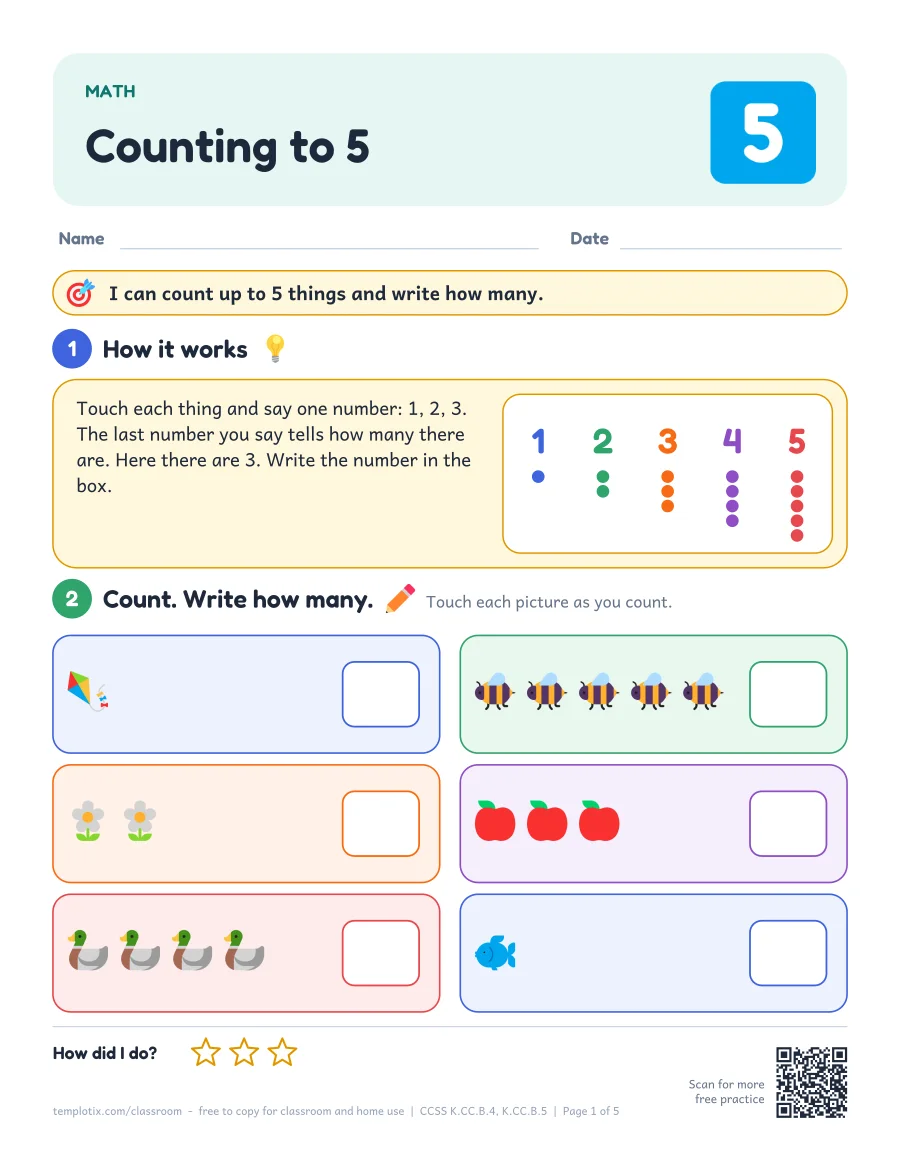
- Counting to 5Kindergarten
Touch each thing and say one number: 1, 2, 3. The last number you say tells how many there are. Here there are 3. Write the number in the box.
- Counting to 10Kindergarten
Count each picture once. A ten frame has 10 boxes in two rows of 5. Put one dot in each box, top row first. A full top row is 5, and a full ten frame is 10.
- Counting to 20Kindergarten
When there are more than 10, make a group of 10 first. Then count on: 10, 11, 12, 13, 14. Two ten frames show numbers to 20. One full frame and 4 more is 14.
- Number before and afterKindergarten and 1st grade
The number after is one more: after 7 comes 8. The number before is one less: before 7 comes 6. The number between 6 and 8 is 7. A number line helps you see it.
- Counting to 100Kindergarten
In a hundred chart, each row has 10 numbers. Moving right, numbers go up by 1. At the end of a row a new ten starts: after 39 comes 40. Moving down a column, numbers go up by 10.
- Counting to 1201st grade
After 100 we keep counting: 101, 102, 103, all the way to 120. The numbers after 100 follow the same pattern as 1 to 20, with a 1 in front. After 109 comes 110.






Numbers 0 to 20 poster
 Numbers 0 to 20 poster
Every number from 0 to 20 with its word and a ten frame.
Whole unit in one PDF Plus
 Whole unit in one PDF
All counting packs, the unit chart and a contents page: 32 pages, ready to print. For Templotix Plus members.
What is in each pack
- 1. Learn itThe idea with a picture, then first counting practice.
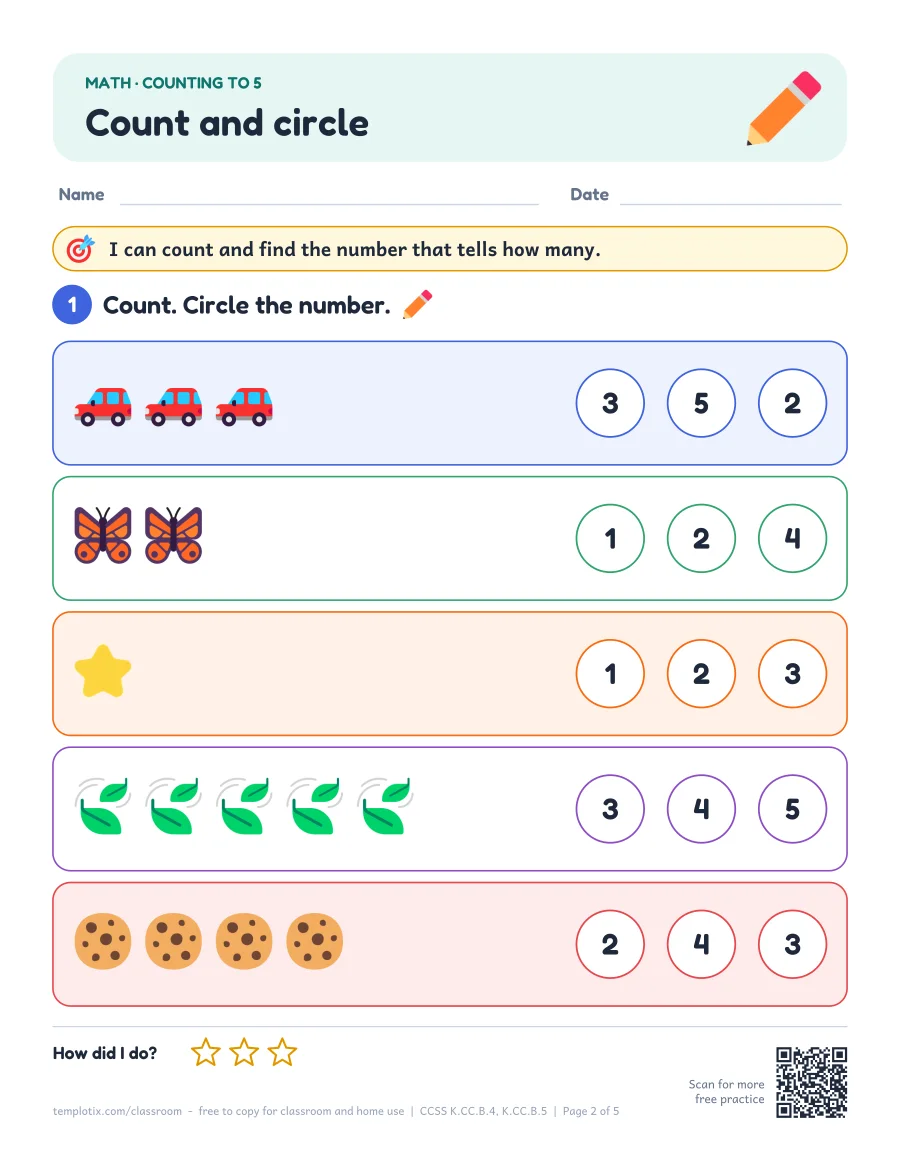
- 2. PracticeCount and circle the number, or count on along a row.
- 3. Think deeperTen frames, coloring, between numbers and counting back.
- 4. Word problemsFour short stories a grown-up can read aloud.
- 5. Answer key and tipEvery answer on one page, plus a teaching tip for grown-ups.


How to teach counting
- Count real things first. Count spoons, blocks or steps together before the worksheet, touching each one as you say the number.
- Touch and cross. On the page, children touch each picture as they count and make a small mark on it so nothing is counted twice.
- Say it out loud. Counting aloud, even in a whisper, helps children keep their place in long rows.
- Keep the poster up. Put the numbers 0 to 20 poster where children can see it when they write numbers.
More math
- Telling time
- Money
- Fractions
- Division
- Multi-digit multiplication
- Decimals
- Greater than and less than
- Skip counting
- Shapes
- Number bonds
- Graphs and data
- Measurement
- Area and Perimeter
- Rounding and Estimating
- 3-Digit Addition and Subtraction
- Factors and Multiples
- Fraction Operations
- Decimal Operations
- Math Word Problems
- Geometry
- Order of Operations
- Measurement Conversions
- Patterns
- Multiplication Strategies
- Multi-Digit Place Value
Common questions
How do you teach a kindergartner to count objects?
Line the objects up and touch each one as you say one number. The last number you say tells how many. Moving each object to a "counted" pile helps children who skip or count twice.
How high should a kindergartner count?
By the end of kindergarten, children count to 100 by ones and by tens (CCSS K.CC.A.1) and count up to 20 objects (K.CC.B.5). In 1st grade they count to 120, starting from any number (1.NBT.A.1).
What is a ten frame?
A ten frame is a box of 2 rows with 5 spaces each. Children fill it with dots or counters, top row first. It shows at a glance how many there are and how many more make 10, which builds strong number sense.
Can I copy these worksheets for my class?
Yes. The PDFs are free to print and photocopy for classroom and home use, in color or in the black-and-white ink saver. Please link to this page rather than re-uploading the files.