Shop
 Grade workbooks


Classroom · Science · NGSS K-PS3, 1-ESS1, 1-PS4, 5-ESS1
worksheets for kindergarten to 3rd grade
Children look up at the sky every day, so space is a natural place for big questions. Each free pack teaches one big idea, from the sun and shadows to moon phases and the planets, with a clear picture, practice pages, a Think like a scientist page and a hands-on experiment, then ends with an answer key.
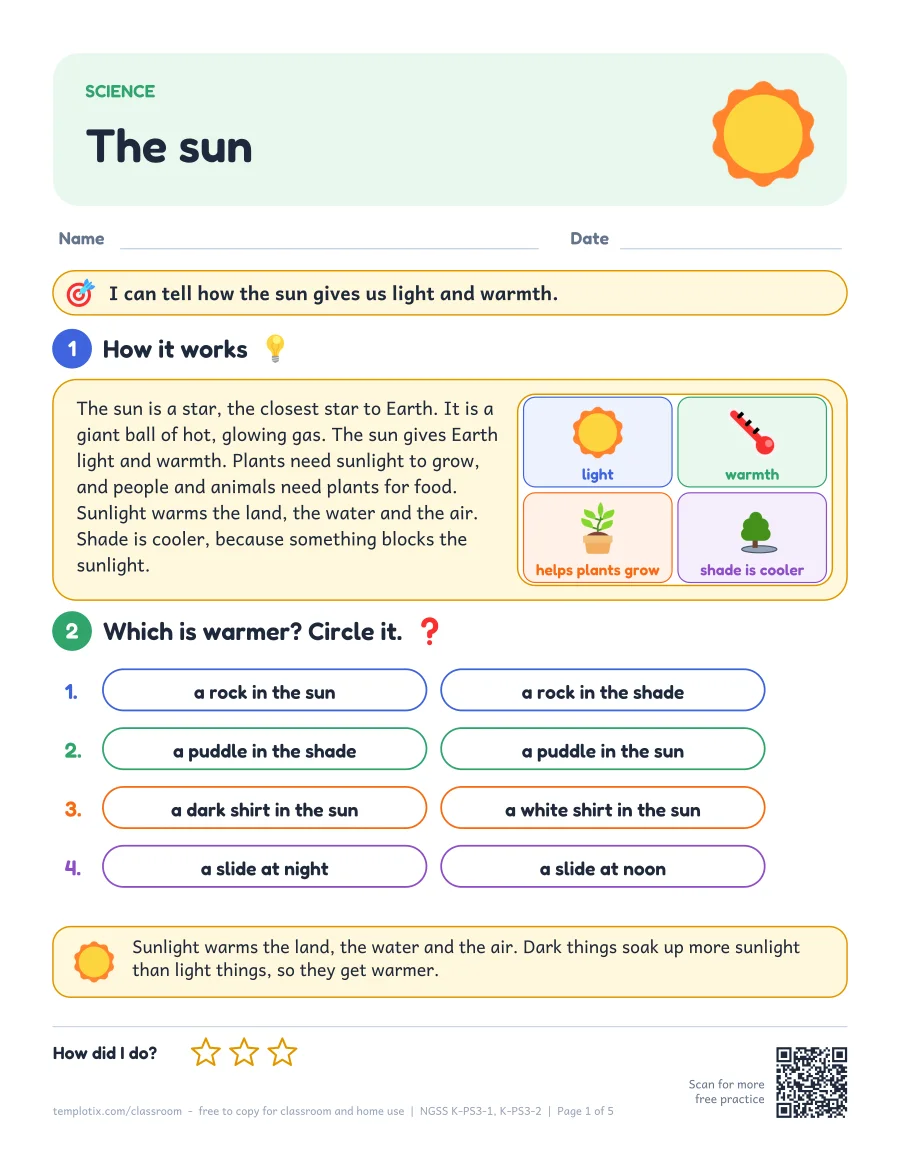
- The sunKindergarten and 1st grade · NGSS K-PS3-1, K-PS3-2
The sun is a star, the closest star to Earth. It is a giant ball of hot, glowing gas. The sun gives Earth light and warmth. Plants need sunlight to grow, and people and animals need plants for food. Sunlight warms the land, the water and the air. Shade is cooler, because something blocks the sunlight.
- Day and night1st grade · NGSS 1-ESS1-1
Earth is always spinning, like a top. It turns all the way around once every day. When our side of Earth faces the sun, it is day. When our side turns away from the sun, it is night. The sun does not really move across the sky; it only looks that way because Earth turns. The sun seems to rise in the east and set in the west.
- Light and shadowsKindergarten and 1st grade · NGSS 1-PS4-3
A shadow is a dark shape made when something blocks light. Light travels in straight lines, so it cannot bend around you. Your shadow is always on the side away from the light. In the morning and evening, when the sun is low, shadows are long. At noon, when the sun is high, they are short. Clear glass makes almost no shadow.
- Phases of the moon1st to 3rd grade · NGSS 1-ESS1-1
The moon does not make its own light. It shines because sunlight bounces off it. As the moon travels around Earth, we see different amounts of its lit side. These shapes are called phases: new moon, crescent, half moon, gibbous and full moon. One whole cycle takes about a month, 29 and a half days.
- Stars and constellations1st and 2nd grade · NGSS 1-ESS1-1
Stars are huge balls of hot, glowing gas, like our sun. They look tiny because they are very far away. We see stars at night because the sun is not lighting up our sky, but they are still there in the day. Long ago, people joined stars into pictures called constellations. The Big Dipper looks like a big spoon.
- The solar system2nd and 3rd grade · NGSS 1-ESS1-1, 5-ESS1-1
Our solar system is the sun and everything that travels around it. Eight planets orbit the sun: Mercury, Venus, Earth, Mars, Jupiter, Saturn, Uranus and Neptune. The first four are small and rocky. The last four are giant planets made mostly of gas and ice. Earth is the only planet we know of with life.





Solar system poster
 Solar system poster
One colorful page with the sun and the eight planets in order, a fact for each, which are rocky and which are gas giants, and a sentence to remember the order.
What is in each pack
- 1. Learn itA short explanation with a clear, labeled picture, then a first activity.
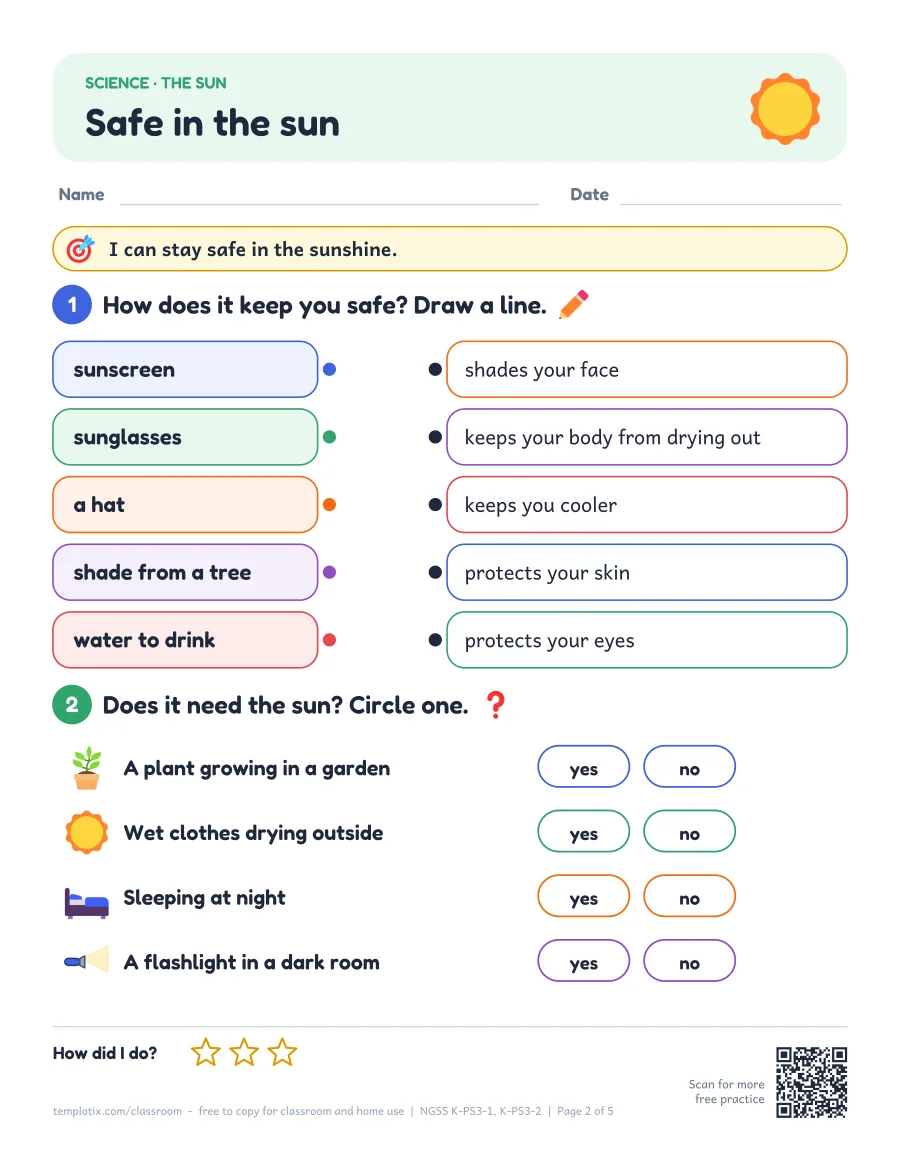
- 2. PracticeLabeling, matching, sorting and fill in the blanks.
- 3. Think like a scientistWhy questions, true or false and a drawing that explains an idea.
- 4. Try it!A hands-on experiment with a materials list, a prediction and an observation chart.
- 5. Answer keyEvery answer, what to expect from the experiment, a teaching tip and a safety note.


How to teach space
- Look up together. A two-minute look at the sky, morning or night, gives children something real to talk about.
- Model it in the room. A lamp, a ball and a child turning slowly explain day and night and the moon better than any picture.
- Track patterns. Shadows, moon shapes and sunrise times change in patterns, so keep a simple chart over days and weeks.
- Keep it safe. Never look straight at the sun, and do night sky watching with a grown-up.
- Use memory tricks. A silly sentence like My Very Eager Mother Just Served Us Nachos makes the planet order stick.
More science
Common questions
Are these space worksheets free?
Yes. Every space pack and the poster are free to download, print and copy for your class or home, in color or in a black-and-white ink saver.
What grade are these space worksheets for?
Kindergarten to 3rd grade. The sun and shadows start in kindergarten, day and night, the moon and stars fit 1st and 2nd grade, and the solar system suits 2nd and 3rd grade.
Do I need special supplies for the experiments?
No. The Try it! pages use everyday things, such as a flashlight, a ball, a paper cup, sidewalk chalk and paper signs. Some activities happen outside or at night with a grown-up.
Do the worksheets follow the NGSS?
Yes. Each pack names the NGSS performance expectation it supports, for example 1-ESS1-1 for patterns of the sun, moon and stars, and K-PS3-1 for how sunlight warms Earth.