Shop
 Grade workbooks


Classroom · Science · NGSS K-PS2, 3-PS2
worksheets for kindergarten to 3rd grade
Pushes, pulls, ramps and races: forces and motion is the most hands-on science there is. Each free pack teaches one big idea, from pushes and pulls to friction, gravity and simple machines, with a clear picture, practice pages, a Think like a scientist page and a hands-on experiment, then ends with an answer key.
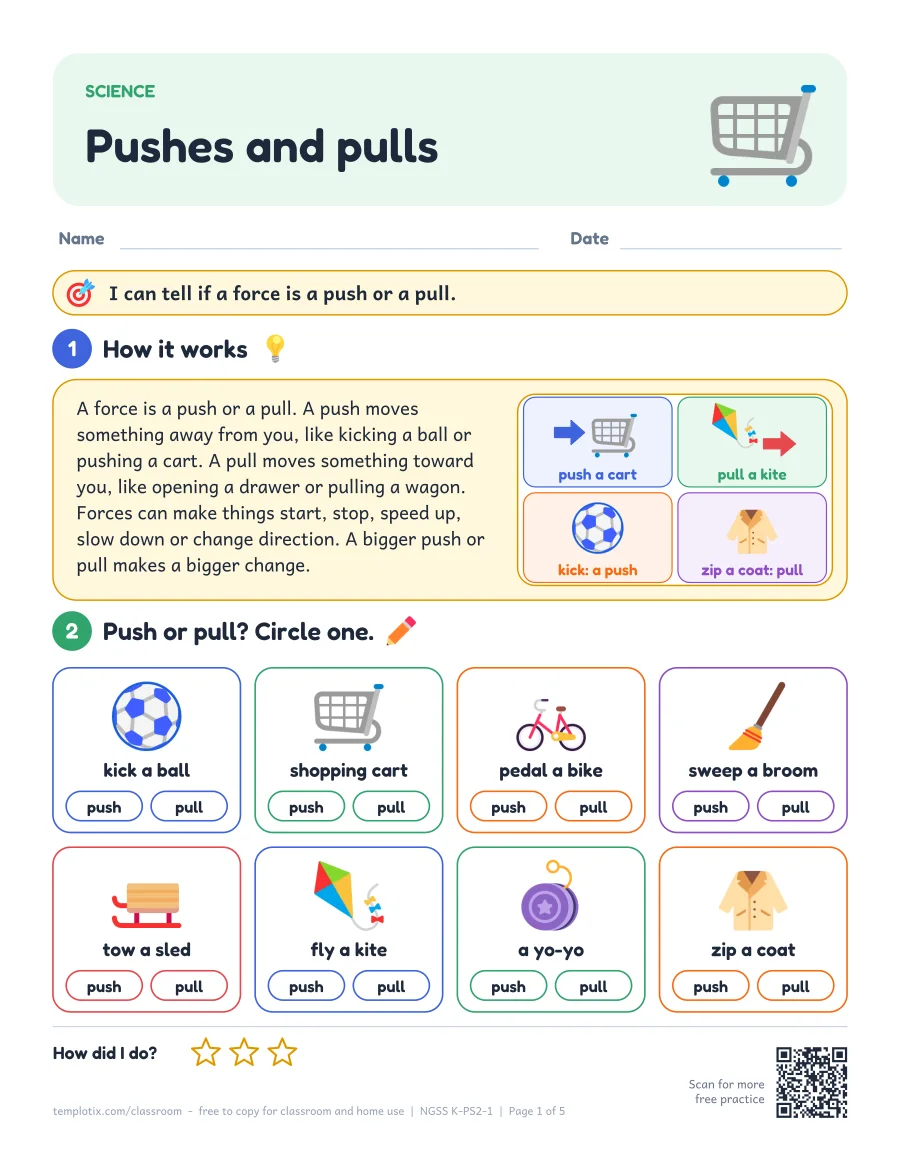
- Pushes and pullsKindergarten and 1st grade · NGSS K-PS2-1
A force is a push or a pull. A push moves something away from you, like kicking a ball or pushing a cart. A pull moves something toward you, like opening a drawer or pulling a wagon. Forces can make things start, stop, speed up, slow down or change direction. A bigger push or pull makes a bigger change.
- Motion and speedKindergarten and 1st grade · NGSS K-PS2-2
Things move in many ways: in a straight line, round and round, zigzag, back and forth, or up and down. They can move fast or slow. A rocket zooms; a snail creeps. To change how something moves, you need a push or a pull. A ramp can make a ball roll faster: the steeper the ramp, the faster it goes.
- Friction2nd and 3rd grade · NGSS 3-PS2-1
Friction is a force that happens when two surfaces rub together. It slows moving things down and helps them stop. Rough surfaces, like carpet, grass and sandpaper, make lots of friction. Smooth surfaces, like ice and glass, make little friction. Friction helps us too: it stops our shoes from slipping and lets brakes stop a bike.
- Gravity2nd and 3rd grade · NGSS 3-PS2-1, 5-PS2-1
Gravity is a pull that brings things down toward Earth. When you drop a ball, gravity pulls it to the ground. When you jump, gravity pulls you back down. Gravity keeps us on the ground and keeps the moon going around Earth. Air can slow falling things: a feather floats down slowly, but a ball drops fast.
- Simple machines1st to 3rd grade · NGSS K-PS2-2
Simple machines help us push and pull with less effort. A ramp lets you roll a heavy load up instead of lifting it. A lever is a bar that tips on a point, like a seesaw. A wheel and axle roll things along, like a wagon. A pulley is a wheel with a rope that lets you pull down to lift something up, like a flag.
- Balanced and unbalanced forces3rd grade · NGSS 3-PS2-1
Often more than one force acts on an object. In a tug of war, both teams pull the rope. If they pull with equal strength, the forces are balanced and the rope does not move. If one team pulls harder, the forces are unbalanced and the rope moves toward the stronger team. Unbalanced forces change motion.


Forces all around poster
 Forces all around poster
One colorful page with push, pull, gravity, friction, simple machines and balanced forces, each with a picture and a one-line meaning. Made for a science wall.
What is in each pack
- 1. Learn itA short explanation with a clear, labeled picture, then a first activity.
- 2. PracticeLabeling, matching, sorting and fill in the blanks.
- 3. Think like a scientistWhy questions, true or false and a drawing that explains an idea.
- 4. Try it!A hands-on experiment with a materials list, a prediction and an observation chart.
- 5. Answer keyEvery answer, what to expect from the experiment, a teaching tip and a safety note.


How to teach forces and motion
- Let them push and pull. A toy car, a ball and a wagon make the words push and pull real in seconds.
- Change one thing at a time. In ramp and slide tests, change only the height or the surface, so children see what made the difference.
- Measure with steps. Counting steps or floor tiles is a perfect first measuring tool for young scientists.
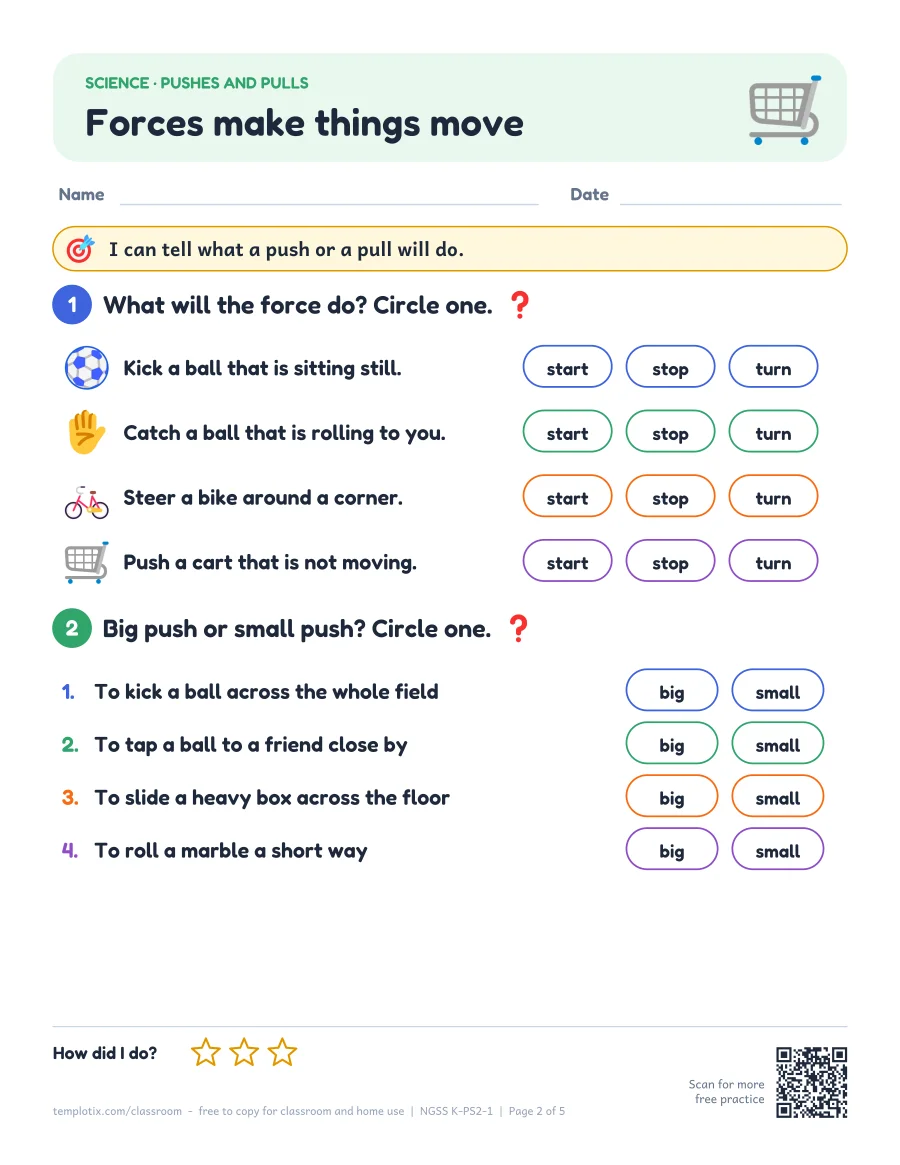
- Name the force. Whenever something starts, stops or turns, ask: what was the push or the pull?
- Hunt for machines. Ramps, levers, wheels and pulleys are all around school; a short hunt makes them memorable.
More science
Common questions
Are these forces and motion worksheets free?
Yes. Every forces and motion pack and the poster are free to download, print and copy for your class or home, in color or in a black-and-white ink saver.
What grade are these forces worksheets for?
Kindergarten to 3rd grade. Pushes and pulls and motion start in kindergarten, simple machines suit 1st to 3rd grade, and friction, gravity and balanced forces are 2nd and 3rd grade topics.
Do I need special supplies for the experiments?
No. The Try it! pages use everyday things, such as a ball, a toy car, a board for a ramp, paper, a rubber band and an empty box.
Do the worksheets follow the NGSS?
Yes. Each pack names the NGSS performance expectation it supports, for example K-PS2-1 for pushes and pulls and 3-PS2-1 for balanced and unbalanced forces.