Shop
 Grade workbooks


Classroom · Math · CCSS 1.OA.A.1, 2.OA.A.1, 2.MD.C.8, 3.OA.A.3, 4.OA.A.3, 4.MD.A.2, 5.NF.A.2, 5.NF.B.6
worksheets for 1st to 5th grade
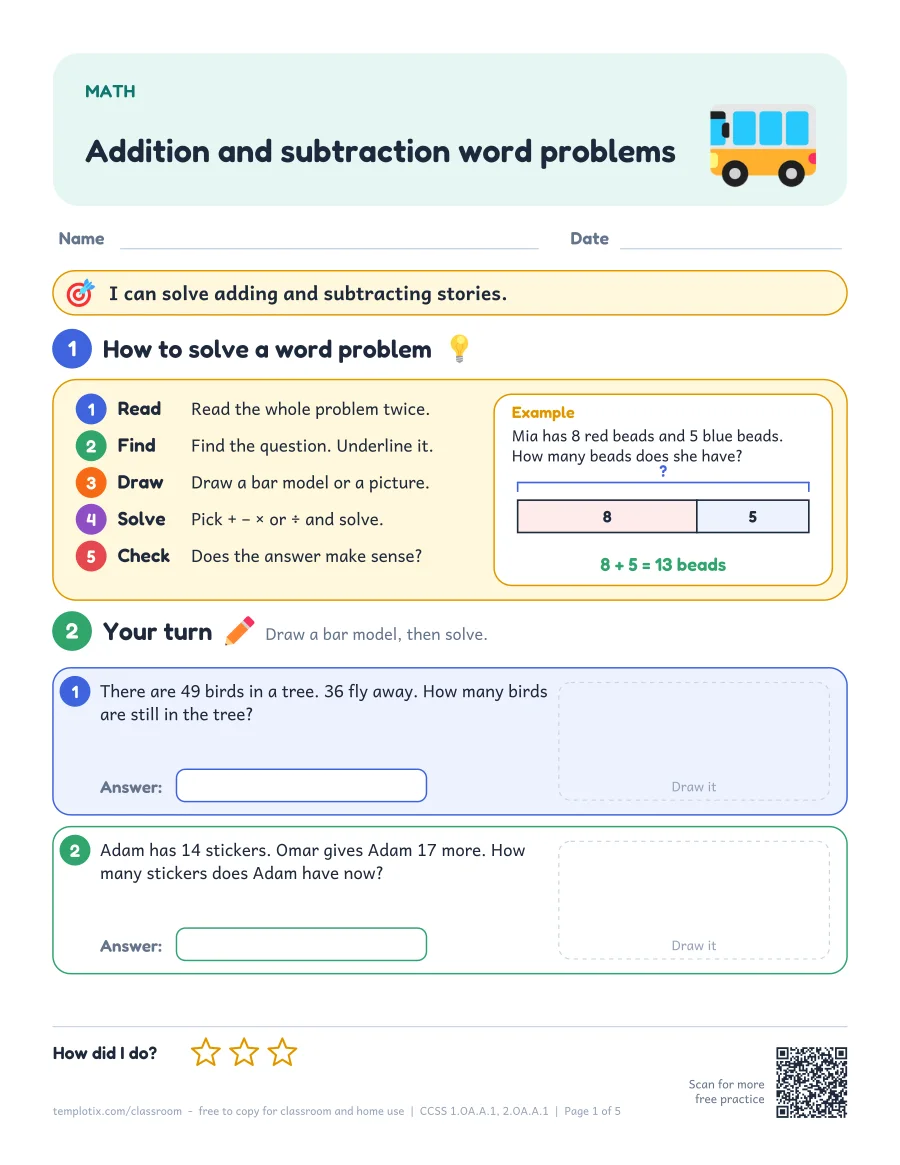
Real stories to solve: adding and subtracting, money, multiplying, dividing, multi-step problems and fractions. Each pack teaches a five-step plan with a worked bar model, then moves from one-step problems to picking the operation and two-step problems.
- Addition and subtraction word problems1st and 2nd grade
Read the story and ask what is happening. Are things being put together? Add. Are some taken away, or are you finding how many more? Subtract. Draw a bar: two parts side by side make the whole. If you know both parts, add. If you know the whole and one part, subtract.
- Money word problems2nd to 4th grade
Money problems use the same four operations. Count coins by value: quarters are 25¢, dimes 10¢, nickels 5¢ and pennies 1¢. To find change, subtract the cost from the money paid. Line up the decimal points when you add or subtract dollars and cents, and write the $ sign in your answer.
- Multiplication word problems3rd grade
Look for equal groups: bags with the same number in each, rows of the same length, or "times as many". Draw one box for each group and write how many are in each box. The number of groups times the number in each group gives the total: 4 bags of 6 apples is 4 × 6 = 24 apples.
- Division word problems3rd grade
Division stories split a total into equal groups. Sometimes you know how many groups and need how many in each (sharing). Sometimes you know how many in each group and need how many groups. Either way, total ÷ one number = the other: 24 cookies on 4 plates is 24 ÷ 4 = 6 cookies on each plate.
- Multi-step word problems4th grade
Some problems hide a question you have to answer first. Find what you need to know, solve that, then use the answer for the next step. 3 packs of 12 pens with 5 sold: first 3 × 12 = 36 pens, then 36 – 5 = 31 pens left. Estimate first so you know about how big the answer should be.
- Fraction word problems4th and 5th grade
Draw a bar for the whole and split it into equal parts. To find 3/4 of 20, split 20 into 4 equal parts of 5, then take 3 parts: 15. To add or subtract fractions of the same thing, make the denominators match first. Check that the answer is a sensible size: a fraction of a number is smaller than the number.






Word problem clue words chart
 Word problem clue words chart
Clue words for adding, subtracting, multiplying and dividing, with an example of each.
Whole unit in one PDF Plus
All math word problems packs, the unit chart and a contents page: 32 pages, ready to print. For Templotix Plus members.
What is in each pack
- 1. Learn itA five-step plan and a worked bar model, then two problems to try.
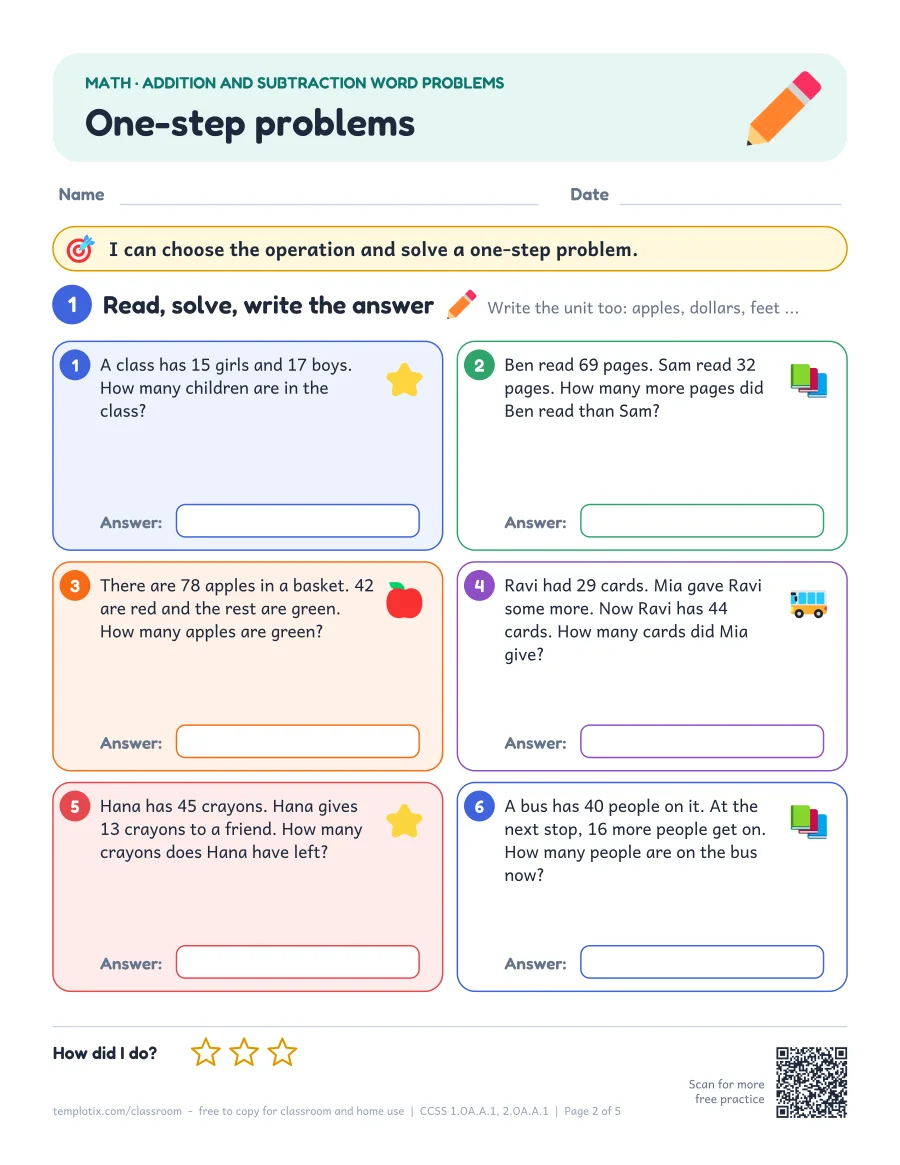
- 2. One-step problemsSix short stories to solve, with room to work and write the answer.
- 3. Pick the operationCircle the operation each story needs, then write number sentences.
- 4. Two-step problemsFour longer stories that take two steps to solve.
- 5. Answer key and tipEvery number sentence and answer, plus a teaching tip for grown-ups.


How to teach math word problems
- Use one plan. Read, find the question, draw, solve, check. The same five steps work for every grade.
- Draw the story. A bar model makes the operation easy to see. Ask for a drawing before any numbers.
- Say it back. Ask children to retell the story in their own words. If they can tell it, they can usually solve it.
- Check the units. An answer is "14 apples" or "$3.25", not just 14. Writing the unit catches many mistakes.
More math
- Telling time
- Money
- Fractions
- Division
- Multi-digit multiplication
- Decimals
- Greater than and less than
- Skip counting
- Shapes
- Number bonds
- Graphs and data
- Measurement
- Area and Perimeter
- Rounding and Estimating
- 3-Digit Addition and Subtraction
- Factors and Multiples
- Fraction Operations
- Decimal Operations
- Geometry
- Order of Operations
- Measurement Conversions
- Counting
- Patterns
- Multiplication Strategies
- Multi-Digit Place Value
Common questions
How do you teach children to solve word problems?
Use the same short plan every time: read the problem twice, find and underline the question, draw a bar model or a picture, choose the operation and solve, then check that the answer makes sense. Drawing the story is the step children skip most and need most.
What is a bar model?
A bar model is a rectangle drawn to show the numbers in a story. Parts that join sit side by side, and a bracket shows the whole. It turns the words into a picture, so children can see whether to add, subtract, multiply or divide.
Should children learn clue words for word problems?
Clue words like "in all" and "left" are a useful start, but they can mislead. "How many more" can mean add or subtract. Teach clue words alongside drawing the story, and always ask what is happening in the problem.
Can I copy these worksheets for my class?
Yes. The PDFs are free to print and photocopy for classroom and home use, in color or in the black-and-white ink saver. Please link to this page rather than re-uploading the files.