Shop
 Grade workbooks


Classroom · Science · Ecosystems and food chains · 3rd to 5th grade

Changes in ecosystems worksheets
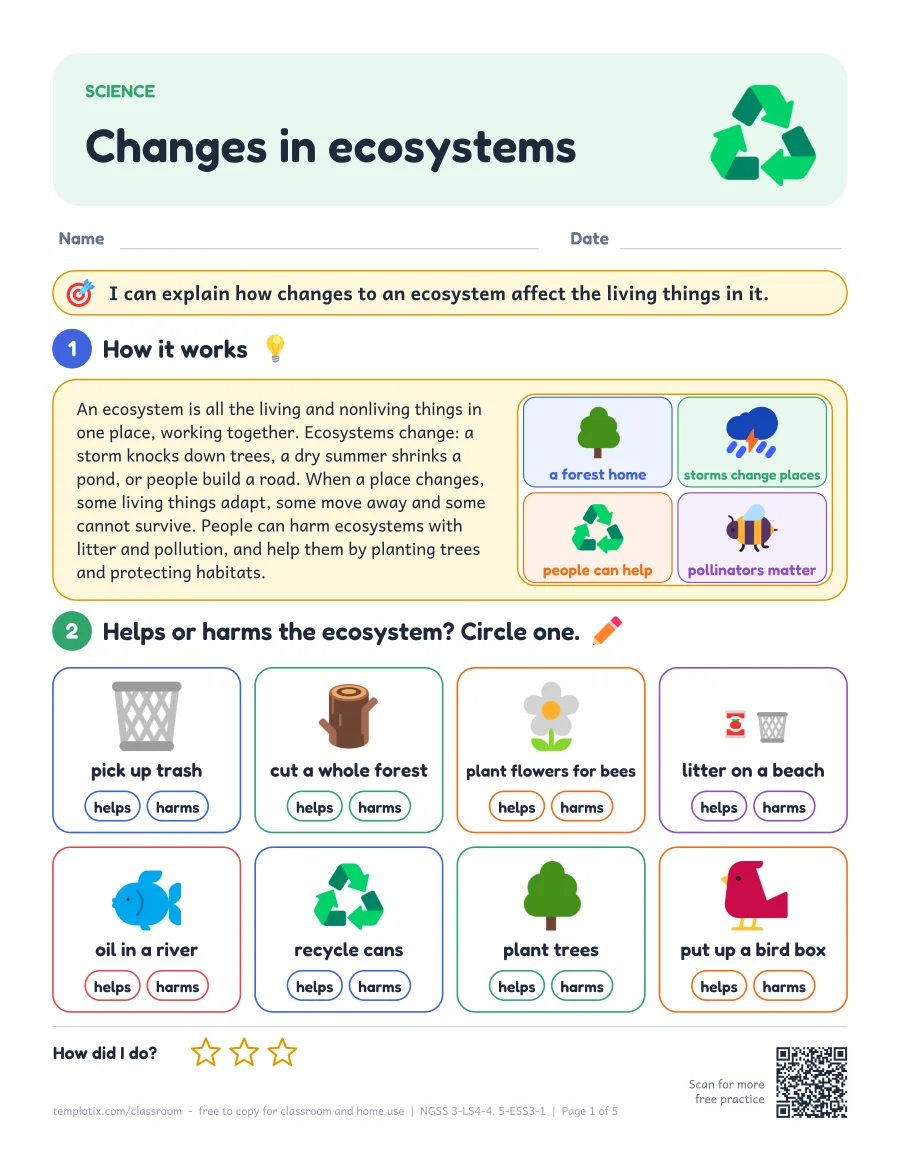
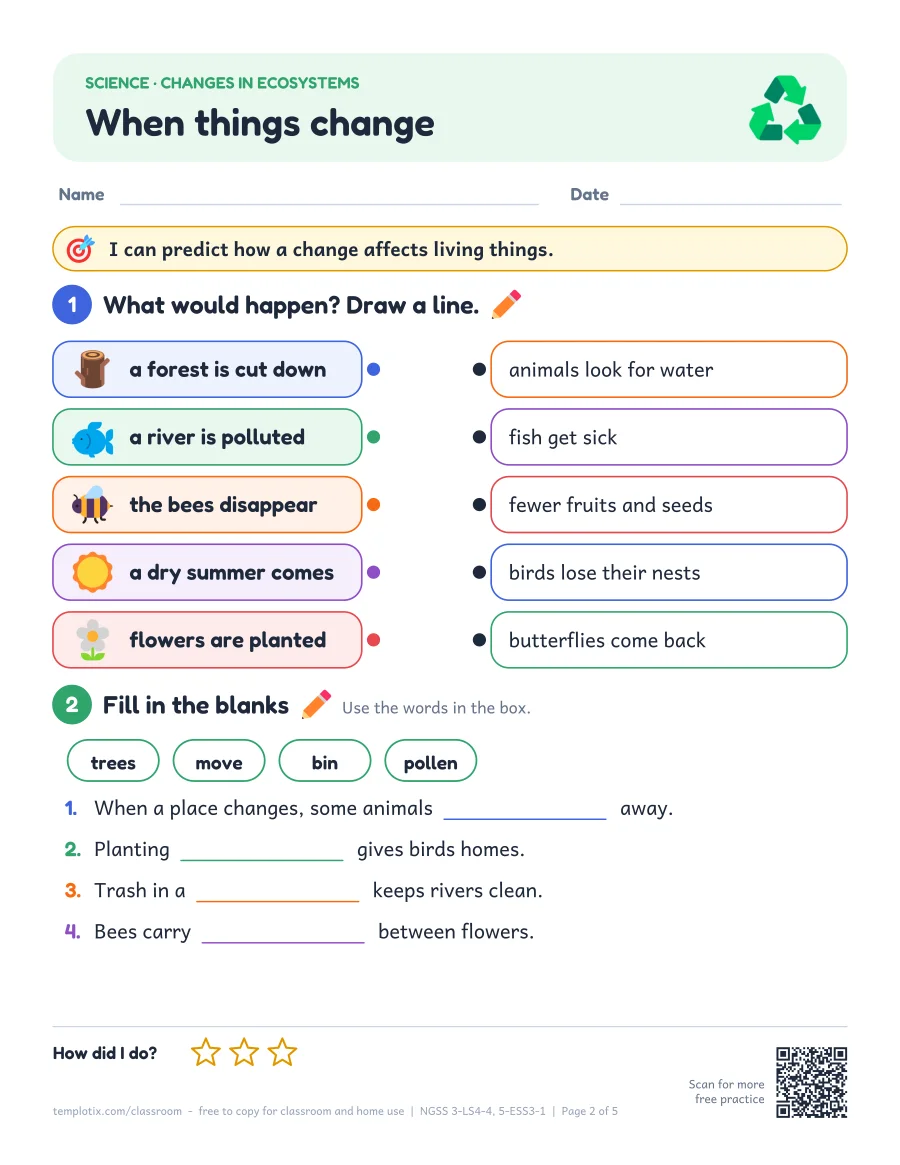
A free five-page science pack for 3rd to 5th grade: learn to explain how changes to an ecosystem affect the living things in it, with a labeled picture, practice pages, a hands-on experiment and an answer key.
The big idea
 The big idea
An ecosystem is all the living and nonliving things in one place, working together. Ecosystems change: a storm knocks down trees, a dry summer shrinks a pond, or people build a road. When a place changes, some living things adapt, some move away and some cannot survive. People can harm ecosystems with litter and pollution, and help them by planting trees and protecting habitats.
Teaching tip
 Teaching tip
Take a short walk around the school grounds and look for one change people made, like a path or a garden. Ask: which living things does this help, and which does it harm?
Try it: the litter survey
 Try it: the litter survey
I can find out what kind of litter is in one place and how to stop it.
You need
- Gloves
- A trash bag
- A clipboard and a pencil
- An adult helper
- A recycling bin
What to do
- 1With an adult, choose a small area, like one side of the playground.
- 2Wear gloves. Pick up the litter you find, but leave anything sharp for the adult.
- 3Sort the litter: plastic, paper, metal and other.
- 4Count each kind, then recycle what you can.
Predict first: Which kind of litter will you find the most?What happens?
Most surveys find more plastic than anything else: wrappers, bottle caps and bags. Plastic lasts a very long time and can harm animals that eat it or get tangled in it. Children can suggest real fixes, such as more bins, a sign, or reusable lunch boxes.
Safety: always wear gloves, work with an adult and never pick up glass or sharp things.
Quick check
What is an ecosystem?Tap to checkAll the living and nonliving things in one place
Name a natural change to an ecosystem.Tap to checkA flood, a fire, a storm or a dry summer
Name a change people make.Tap to checkCutting forests, building roads or polluting rivers
How can you help an ecosystem?Tap to checkPick up litter, recycle, save water or plant trees
Why do bees matter?Tap to checkThey carry pollen so plants make fruit and seeds
What happens to animals when their home is lost?Tap to checkThey move, adapt or cannot survive
What the worksheets look like
Who eats what? poster
 Who eats what? poster
One colorful page with a food chain, producers, consumers, decomposers, predators, prey and food webs, each with a picture and a one-line meaning. Made for a science wall.
Common questions
What are examples of changes in an ecosystem?
Floods, droughts, fires and storms are natural changes. Cutting forests, building roads, polluting rivers and bringing in new animals or plants are changes people make.
How can kids help protect ecosystems?
Pick up litter, recycle, save water, plant native flowers for bees and butterflies, and leave wild animals and their homes undisturbed.
What grade learns changes in ecosystems?
Usually 3rd to 5th grade. In the Next Generation Science Standards (NGSS) it supports 3-LS4-4 and 5-ESS3-1.
Is there a hands-on experiment?
Yes. Page 4 is a Try it! experiment, the litter survey, with a materials list, a prediction and an observation chart. Safety: always wear gloves, work with an adult and never pick up glass or sharp things.
Is there an answer key?
Yes. Page 5 has every answer from the pack, what to expect from the experiment and a short teaching tip.