Shop
 Grade workbooks


Classroom · Science · Human body · 3rd and 4th grade
Heart and lungs worksheets
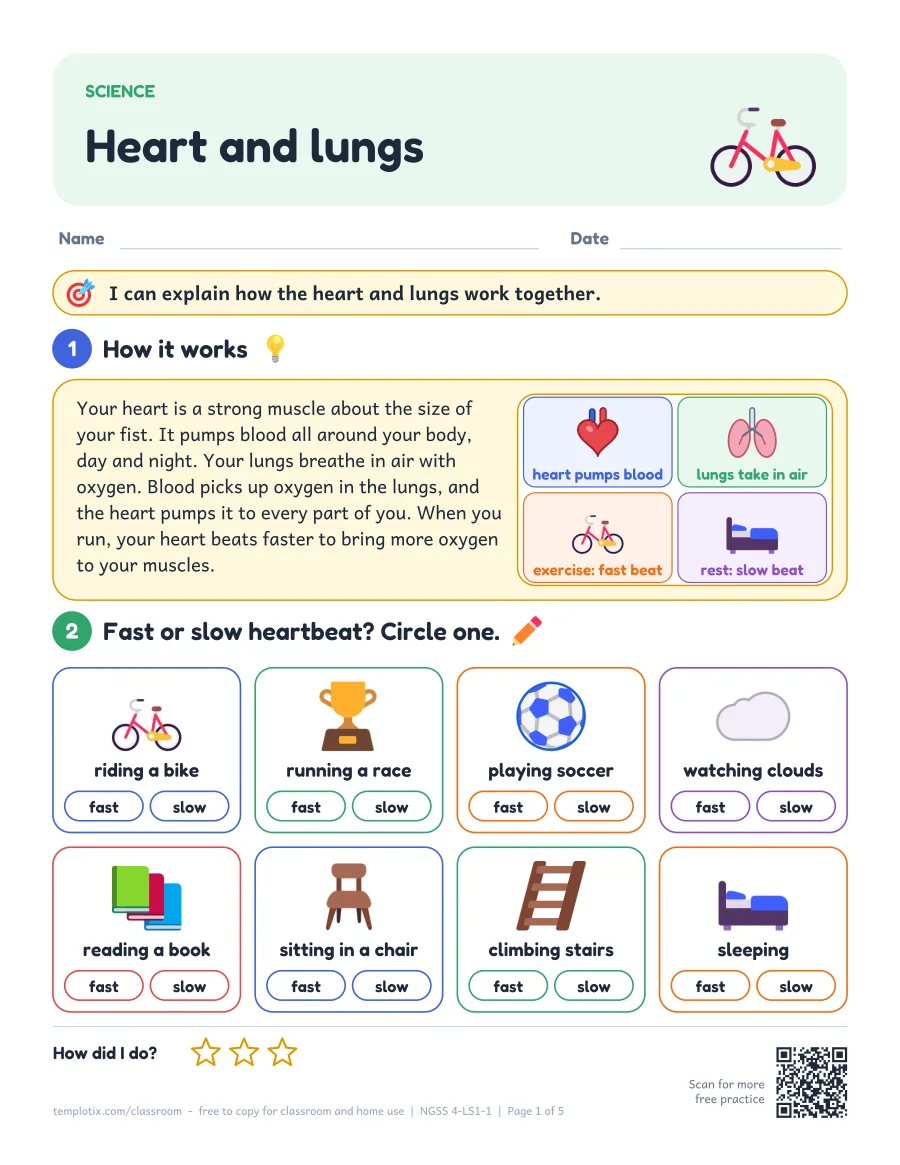
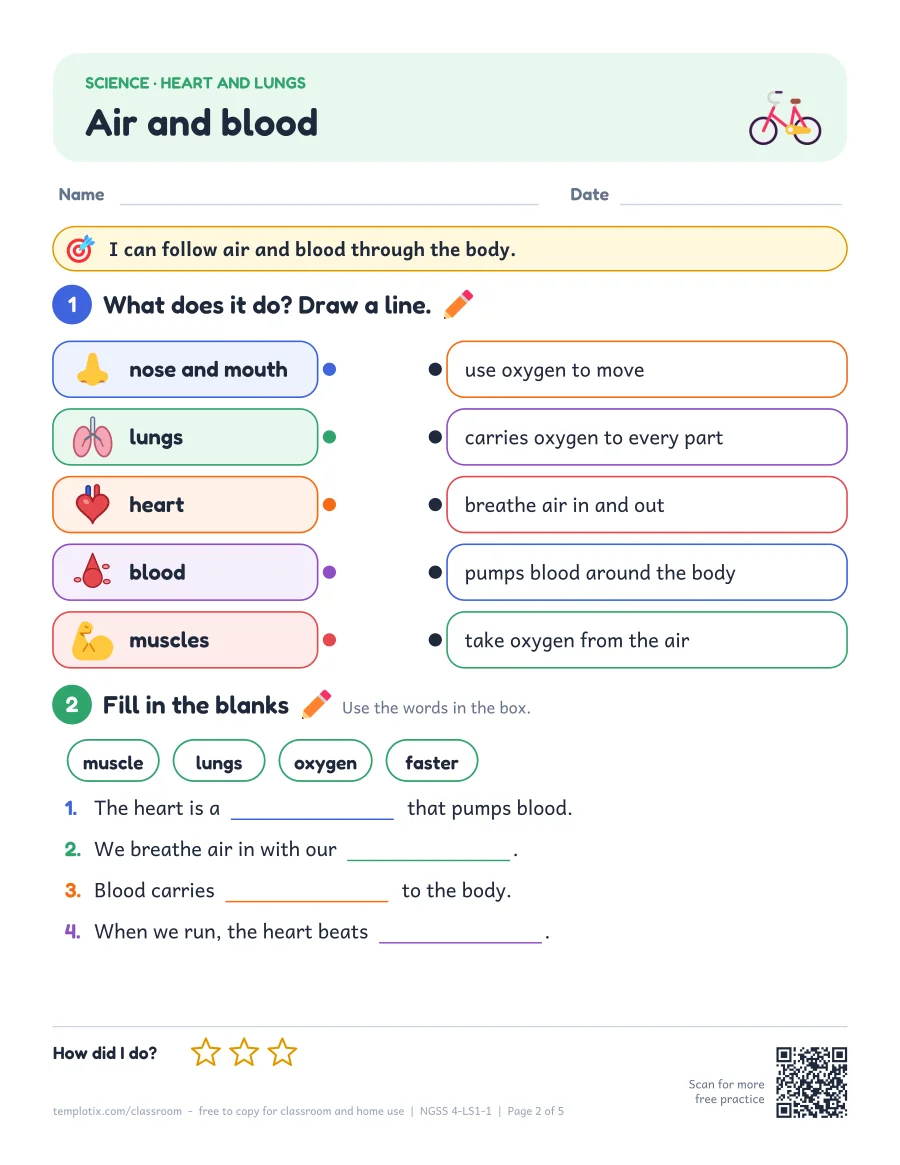
A free five-page science pack for 3rd and 4th grade: learn to explain how the heart and lungs work together, with a labeled picture, practice pages, a hands-on experiment and an answer key.
The big idea
 The big idea
Your heart is a strong muscle about the size of your fist. It pumps blood all around your body, day and night. Your lungs breathe in air with oxygen. Blood picks up oxygen in the lungs, and the heart pumps it to every part of you. When you run, your heart beats faster to bring more oxygen to your muscles.
Teaching tip
 Teaching tip
Let children make a fist and squeeze it about once a second for a minute. It shows how hard the heart muscle works without ever taking a break.
Try it: count your heartbeat
 Try it: count your heartbeat
I can measure how exercise changes my heartbeat.
You need
- A clock or timer
- Two fingers
- A clear space to jump
- A pencil
What to do
- 1Sit still for one minute. Put two fingers on the side of your neck or inside your wrist to feel your pulse.
- 2Count the beats for 15 seconds while a partner times you.
- 3Jump in place for one minute, then count again.
- 4Rest for 2 minutes and count one more time.
Predict first: Will your heart beat faster after jumping?What happens?
The numbers are different for every child. The count after jumping is higher than the resting count, because working muscles need more oxygen, so the heart pumps faster. After a short rest the count goes back down toward the resting number.
Safety: jump on a flat, clear floor and stop if you feel dizzy. A child who should not jump can be the timer.
Quick check
What does the heart do?Tap to checkIt pumps blood around the body
What do the lungs do?Tap to checkThey breathe in air and take oxygen from it
What does blood carry?Tap to checkOxygen
When does the heart beat faster?Tap to checkWhen we exercise
Where can you feel your pulse?Tap to checkAt your wrist or neck
How big is your heart?Tap to checkAbout the size of your fist
What the worksheets look like
Five senses poster
 Five senses poster
One colorful page with the five senses (sight, hearing, smell, taste and touch), the body part for each and how the brain puts the messages together. Made for a science wall.
Common questions
How fast does a child's heart beat?
At rest, a school-age child's heart usually beats about 70 to 100 times a minute. Running and jumping make it beat faster to send more oxygen to the muscles.
How can kids keep their heart and lungs healthy?
Play actively every day, eat fruits and vegetables, get enough sleep and stay away from smoke. Running, biking and swimming make the heart and lungs stronger.
What grade learns heart and lungs?
Usually 3rd and 4th grade. In the Next Generation Science Standards (NGSS) it supports 4-LS1-1.
Is there a hands-on experiment?
Yes. Page 4 is a Try it! experiment, count your heartbeat, with a materials list, a prediction and an observation chart. Safety: jump on a flat, clear floor and stop if you feel dizzy. A child who should not jump can be the timer.
Is there an answer key?
Yes. Page 5 has every answer from the pack, what to expect from the experiment and a short teaching tip.