Shop
 Grade workbooks


Classroom · Science · Energy · 4th grade

Energy and collisions worksheets
A free five-page science pack for 4th grade: learn to explain how speed and collisions change energy, with a labeled picture, practice pages, a hands-on experiment and an answer key.
The big idea
 The big idea
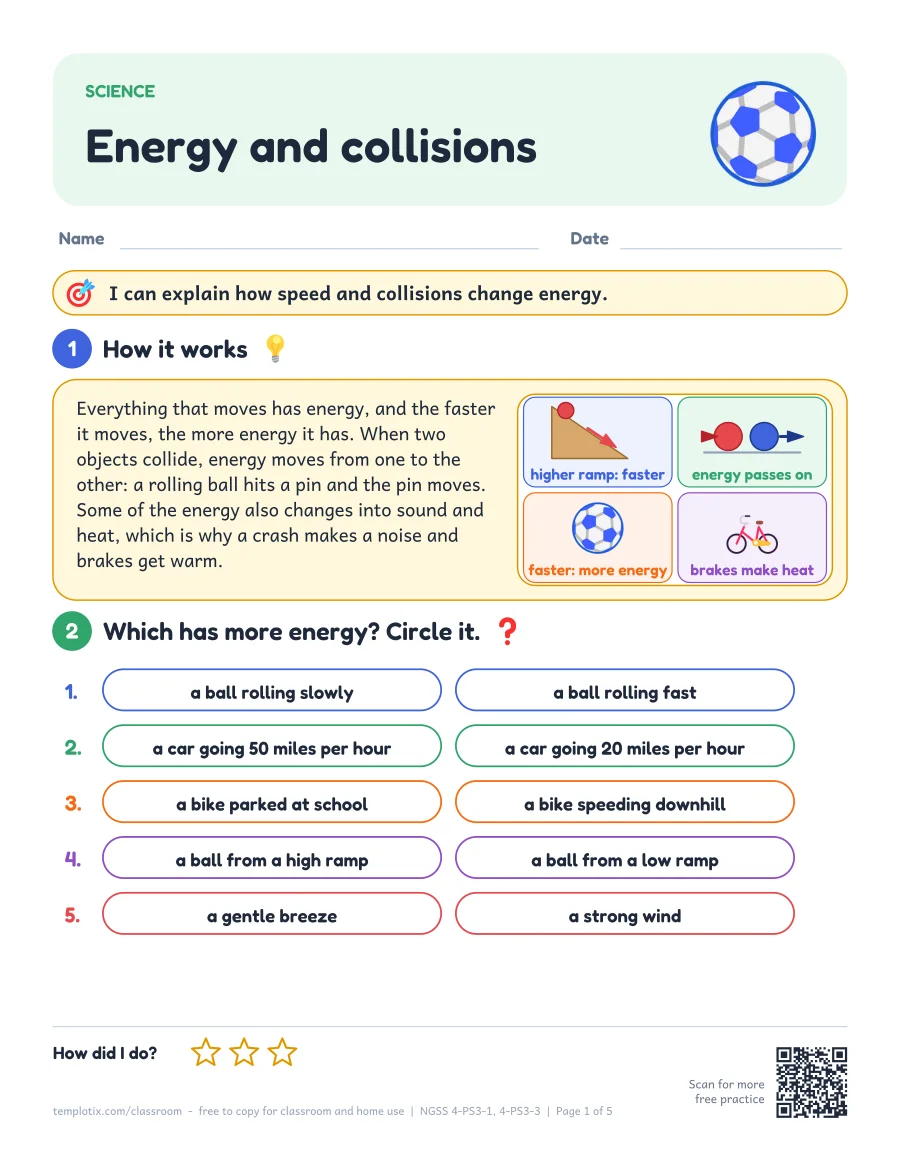
Everything that moves has energy, and the faster it moves, the more energy it has. When two objects collide, energy moves from one to the other: a rolling ball hits a pin and the pin moves. Some of the energy also changes into sound and heat, which is why a crash makes a noise and brakes get warm.
Teaching tip
 Teaching tip
Roll the same ball slowly, then fast, into a stack of paper cups. Children see at once that the faster ball knocks down more, which is the heart of 4-PS3-1.
Try it: the marble crash
 Try it: the marble crash
I can test how speed changes the energy in a collision.
You need
- A ruler or a cardboard tube
- A marble
- A paper cup with a door cut
- Books to stack
- Tape
What to do
- 1Make a ramp: lean the ruler on 1 book. Put the cup at the bottom, opening facing the ramp.
- 2Let the marble roll down. Do not push it. Measure how far the cup moves.
- 3Do it again with 2 books, then 3 books.
- 4Compare how far the cup moved each time.
Predict first: Which ramp will push the cup the farthest?What happens?
The cup moves farthest with the highest ramp. A higher ramp lets the marble speed up more, and a faster marble has more energy, so it passes more energy to the cup in the collision. Children may also hear a louder click with the fast marble: some energy turns into sound.
Safety: keep marbles away from young children, who could swallow them, and pick them up so no one slips.
Quick check
Which has more energy, a slow ball or a fast ball?Tap to checkA fast ball
What happens to energy in a collision?Tap to checkIt moves from one object to another
What can energy turn into in a crash?Tap to checkSound, heat and motion
How do you make a marble go faster on a ramp?Tap to checkMake the ramp higher
Why do bike brakes get warm?Tap to checkMotion energy turns into heat
Name a collision you heard today.Tap to checkAnswers will vary, for example a door closing
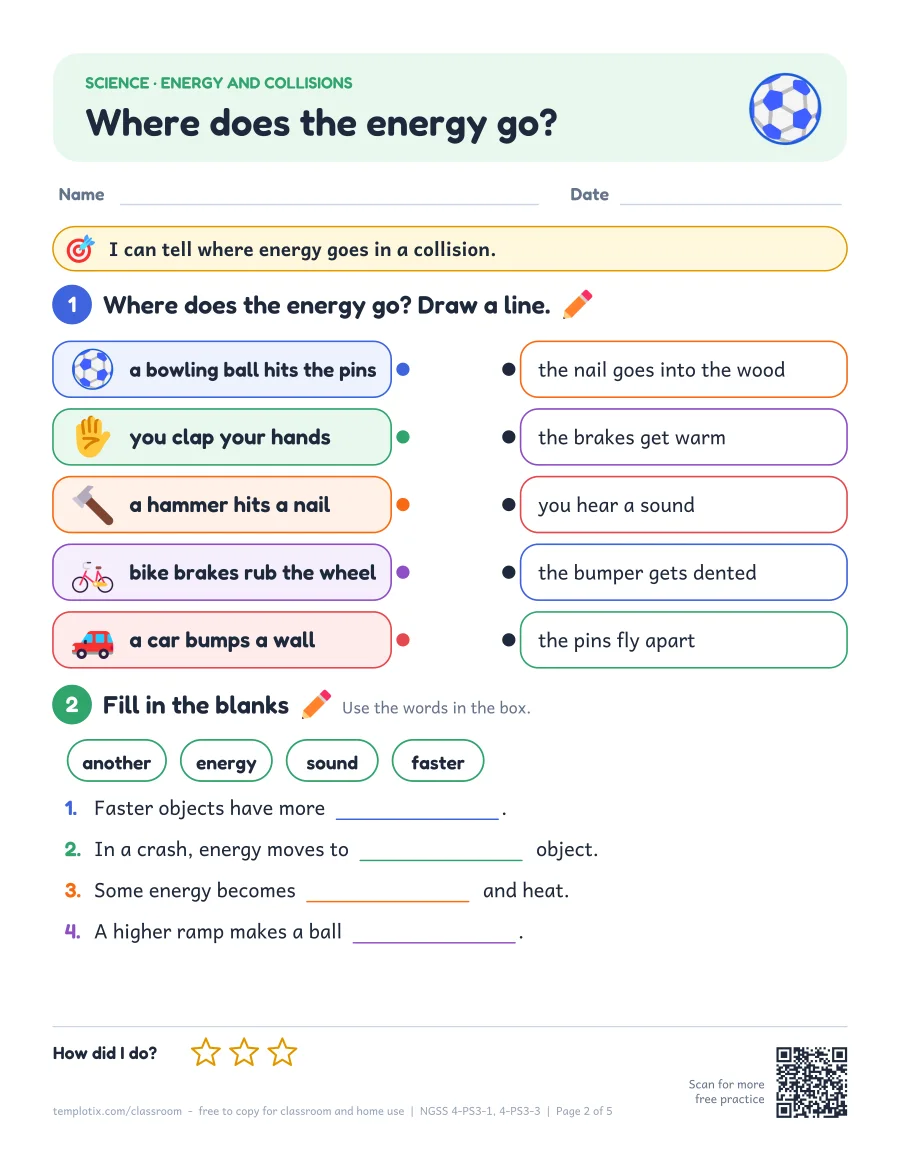
What the worksheets look like
Energy all around poster
One colorful page with light, heat, sound, motion, electricity and renewable energy, each with a picture and a one-line meaning. Made for a science wall.
Common questions
Does a faster object have more energy?
Yes. The faster something moves, the more motion energy it has, so it can push harder on whatever it hits.
Where does the energy go in a collision?
Some moves to the other object and makes it move. Some changes into sound and heat, like the bang of a crash or warm bike brakes.
What grade learns energy and collisions?
Usually 4th grade. In the Next Generation Science Standards (NGSS) it supports 4-PS3-1 and 4-PS3-3.
Is there a hands-on experiment?
Yes. Page 4 is a Try it! experiment, the marble crash, with a materials list, a prediction and an observation chart. Safety: keep marbles away from young children, who could swallow them, and pick them up so no one slips.
Is there an answer key?
Yes. Page 5 has every answer from the pack, what to expect from the experiment and a short teaching tip.