Shop
 Grade workbooks


Classroom · Math · CCSS 3.MD.C.5, 3.MD.C.6, 3.MD.C.7, 3.MD.D.8, 4.MD.A.3
worksheets for 3rd and 4th grade
Find the space inside and the distance around. Children count unit squares, multiply length by width, add the sides for perimeter, split tricky shapes into rectangles, and see how shapes with the same perimeter can have different areas.
- Area by counting squares3rd grade
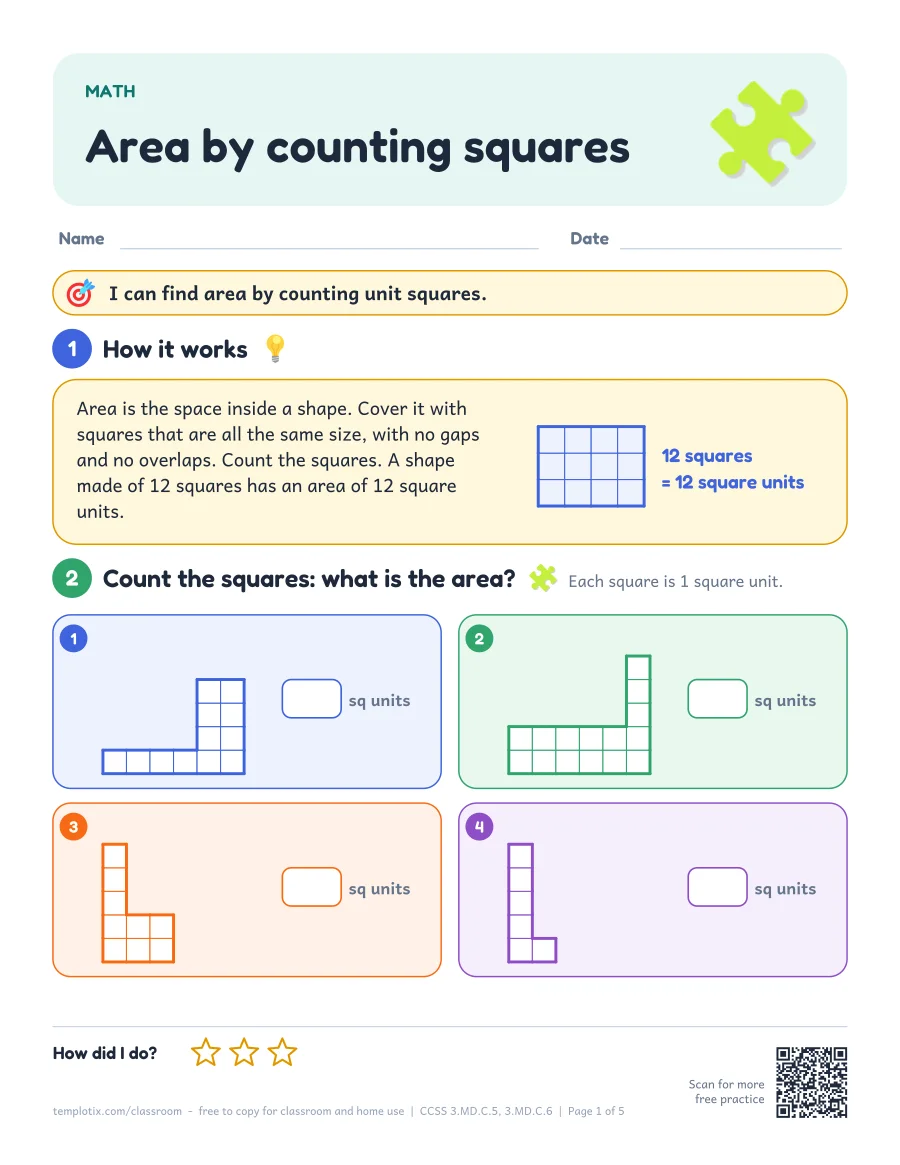
Area is the space inside a shape. Cover it with squares that are all the same size, with no gaps and no overlaps. Count the squares. A shape made of 12 squares has an area of 12 square units.
- Area of rectangles3rd grade
A rectangle is rows of squares. Multiply the number of rows by the squares in each row: length × width. A rectangle 4 long and 3 wide has an area of 4 × 3 = 12 square units. Split tricky shapes into rectangles and add.
- Perimeter3rd grade
Perimeter is the distance all the way around a shape. Start at one corner and add every side until you are back where you started. A 5 by 3 rectangle has a perimeter of 5 + 3 + 5 + 3 = 16 units.
- Area and perimeter of rectangles4th grade
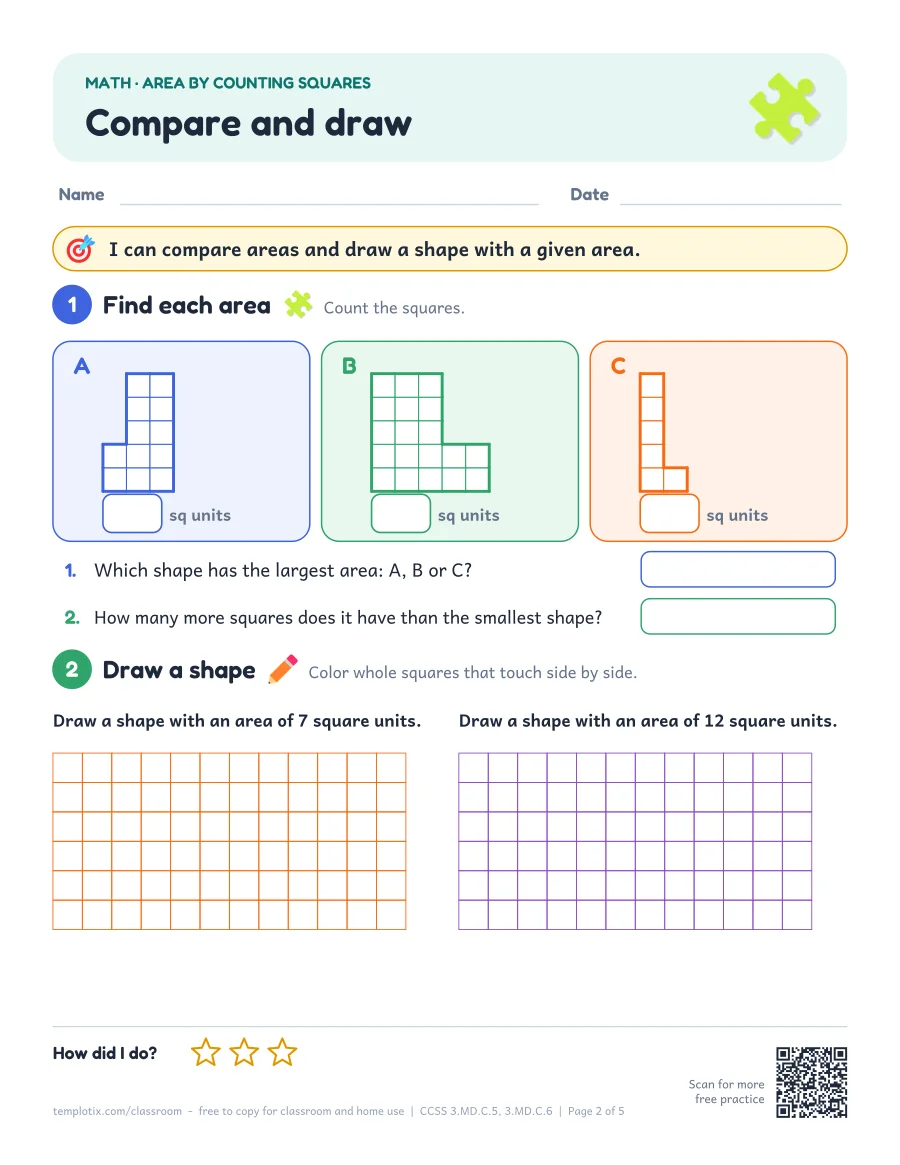
Area = length × width, in square units. Perimeter = 2 × (length + width), in units. Shapes with the same perimeter can have different areas, and shapes with the same area can have different perimeters.




Area and perimeter poster
A one-page anchor chart with both rules, examples and tips.
Whole unit in one PDF Plus
 Whole unit in one PDF
All area and perimeter packs, the unit chart and a contents page: 22 pages, ready to print. For Templotix Plus members.
What is in each pack
- 1. Learn itA picture that shows the rule, then first practice.
- 2. PracticeCount squares, multiply sides or add them up, with real units.
- 3. Think deeperMissing sides, split shapes, tables and drawing on a grid.
- 4. Word problemsFour short stories about rooms, gardens, fences and posters.
- 5. Answer key and tipEvery answer on one page, plus a teaching tip for grown-ups.


How to teach area and perimeter
- Start with squares. Cover a book with sticky notes or count squares on grid paper before using a rule.
- Link it to multiplying. Rows of squares are a multiplication: 4 rows of 6 is 4 × 6 = 24.
- Walk the edge. For perimeter, trace around the shape with a finger and add each side as you go.
- Keep the units straight. Area is in square units and perimeter is in units. Say the unit with every answer.
More math
- Telling time
- Money
- Fractions
- Division
- Multi-digit multiplication
- Decimals
- Greater than and less than
- Skip counting
- Shapes
- Number bonds
- Graphs and data
- Measurement
- Rounding and Estimating
- 3-Digit Addition and Subtraction
- Factors and Multiples
- Fraction Operations
- Decimal Operations
- Math Word Problems
- Geometry
- Order of Operations
- Measurement Conversions
- Counting
- Patterns
- Multiplication Strategies
- Multi-Digit Place Value
Common questions
What is the difference between area and perimeter?
Area is the space inside a flat shape, counted in square units. Perimeter is the distance all the way around it, counted in units of length. A 5 by 3 rectangle has an area of 15 square units and a perimeter of 16 units.
What grade learns area and perimeter?
Area and perimeter are taught in 3rd grade, starting with counting unit squares, then multiplying length by width and adding the sides. In 4th grade, children use the area and perimeter formulas for rectangles to solve real-world problems.
How do you find the area of a rectangle?
Multiply the length by the width. A rectangle 6 cm long and 4 cm wide has an area of 6 × 4 = 24 square centimeters. You can check by counting rows of squares.
Can I copy these worksheets for my class?
Yes. The PDFs are free to print and photocopy for classroom and home use, in color or in the black-and-white ink saver. Please link to this page rather than re-uploading the files.