Shop
 Grade workbooks


Classroom · Science · Human body · 1st grade

How we hear worksheets
A free five-page science pack for 1st grade: learn to explain that sounds are made by vibrations, with a labeled picture, practice pages, a hands-on experiment and an answer key.
The big idea
 The big idea
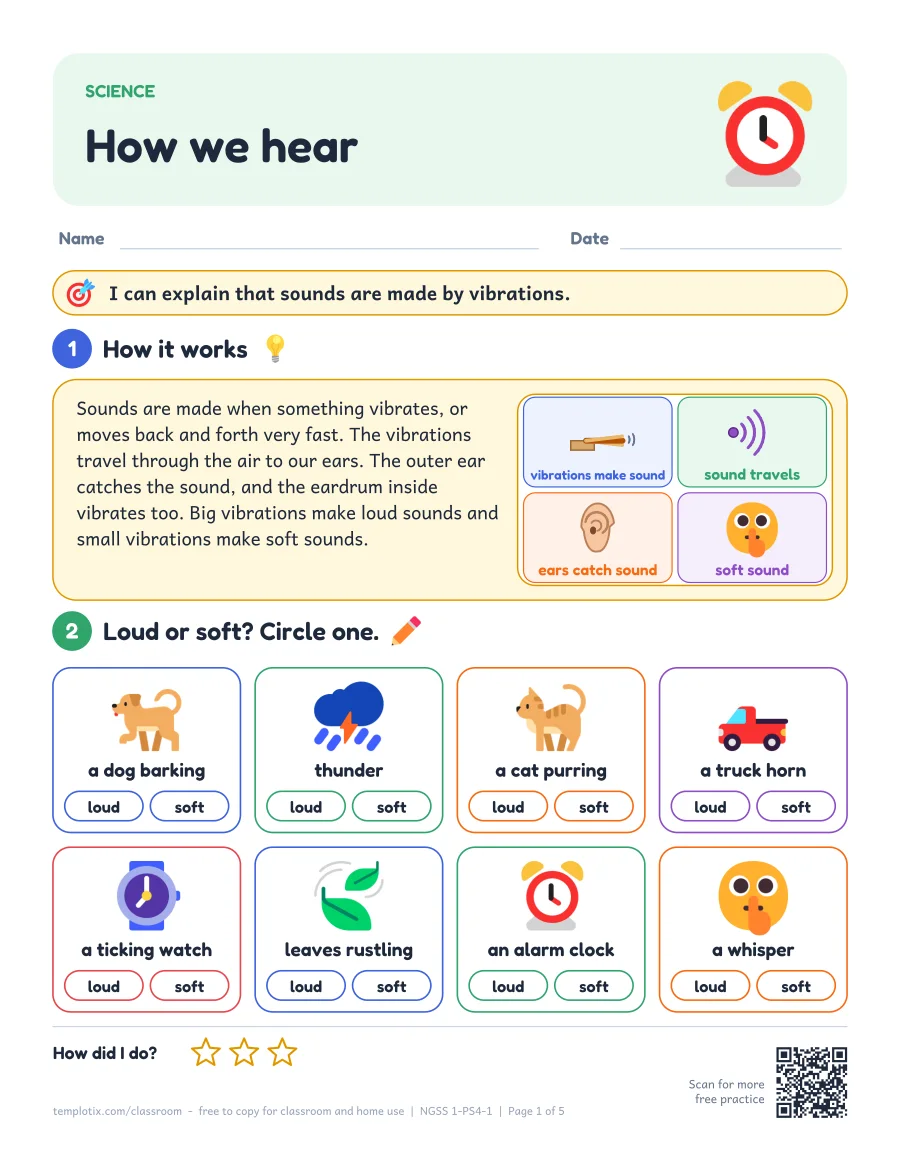
Sounds are made when something vibrates, or moves back and forth very fast. The vibrations travel through the air to our ears. The outer ear catches the sound, and the eardrum inside vibrates too. Big vibrations make loud sounds and small vibrations make soft sounds.
Teaching tip
 Teaching tip
Ask children to hum with a hand on their throat. They can feel the vibration that makes the sound, then feel it stop when they stop humming.
Try it: jumping rice
 Try it: jumping rice
I can see sound vibrations move things.
You need
- A bowl
- Plastic wrap, rubber band
- A few grains of rice
- A metal pot
- A spoon
What to do
- 1Stretch plastic wrap tight over the bowl. Hold it with the rubber band.
- 2Sprinkle a few grains of rice on top.
- 3Hold the pot near the bowl and tap it softly with the spoon. Watch the rice.
- 4Now tap the pot hard. Watch the rice again.
Predict first: What will the rice do when you tap the pot?What happens?
The tapped pot vibrates and sends vibrations through the air. They make the plastic wrap vibrate, so the rice jiggles or jumps. A hard tap makes a louder sound with bigger vibrations, so the rice jumps more. With no tap, the rice stays still. The eardrum works the same way.
Safety: tap gently near people's ears, and keep the rice away from mouths, noses and ears.
Quick check
How is sound made?Tap to checkSomething vibrates
How does sound reach our ears?Tap to checkIt travels through the air
What part of the ear vibrates?Tap to checkThe eardrum
Is thunder loud or soft?Tap to checkLoud
Do big vibrations make loud or soft sounds?Tap to checkLoud sounds
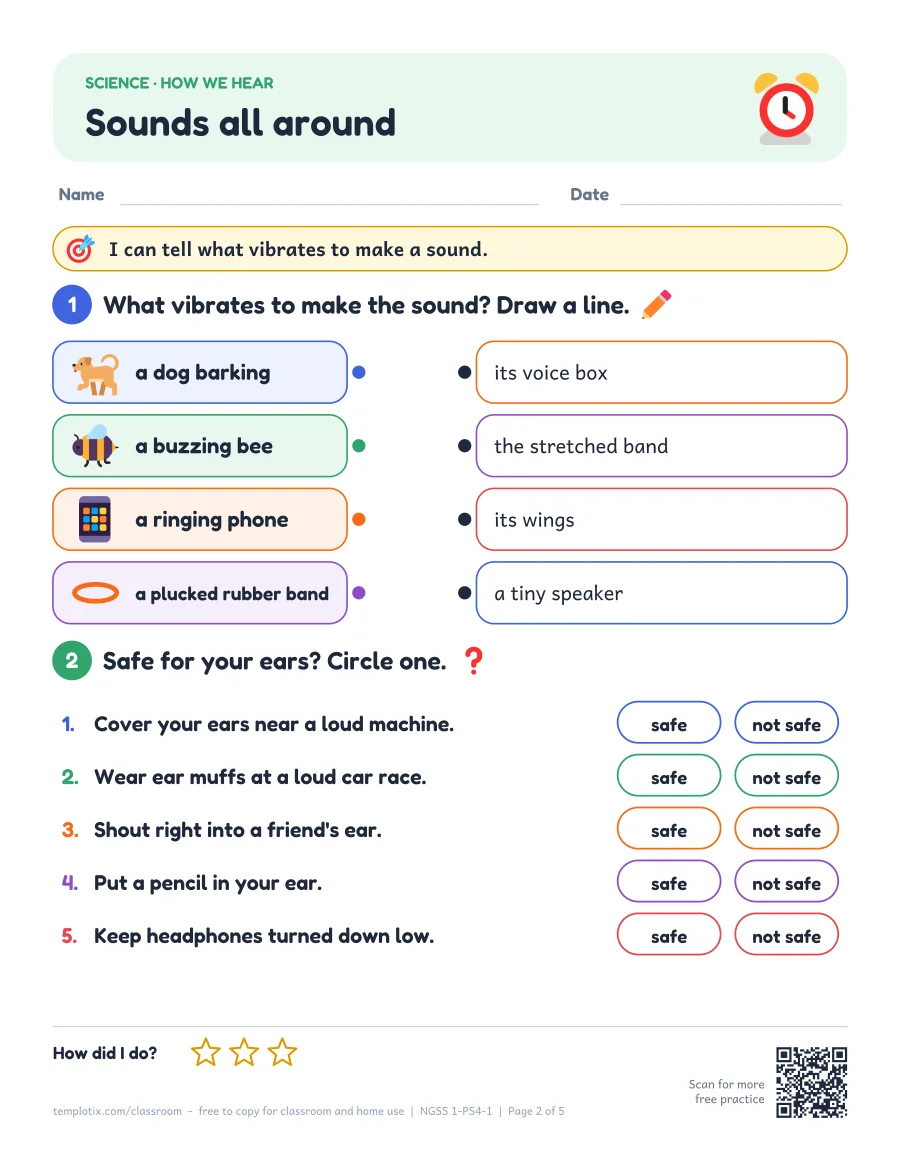
How can we protect our ears?Tap to checkCover them or wear ear muffs near loud sounds
What the worksheets look like
Five senses poster
 Five senses poster
One colorful page with the five senses (sight, hearing, smell, taste and touch), the body part for each and how the brain puts the messages together. Made for a science wall.
Common questions
How does sound travel?
Sound travels as vibrations through air, water and solids, and it moves even better through solids. Press an ear to a table while someone taps gently at the other end to hear it.
How loud is too loud for kids' ears?
Sounds that make you shout to be heard, such as power tools, fireworks or loud music in headphones, can hurt hearing over time. Turn the volume down, move away, or wear ear muffs.
What grade learns how we hear?
Usually 1st grade. In the Next Generation Science Standards (NGSS) it supports 1-PS4-1.
Is there a hands-on experiment?
Yes. Page 4 is a Try it! experiment, jumping rice, with a materials list, a prediction and an observation chart. Safety: tap gently near people's ears, and keep the rice away from mouths, noses and ears.
Is there an answer key?
Yes. Page 5 has every answer from the pack, what to expect from the experiment and a short teaching tip.