Shop
 Grade workbooks


Classroom · Science · Space · 1st and 2nd grade

Stars and constellations worksheets
A free five-page science pack for 1st and 2nd grade: learn to describe stars and find a constellation, with a labeled picture, practice pages, a hands-on experiment and an answer key.
The big idea
 The big idea
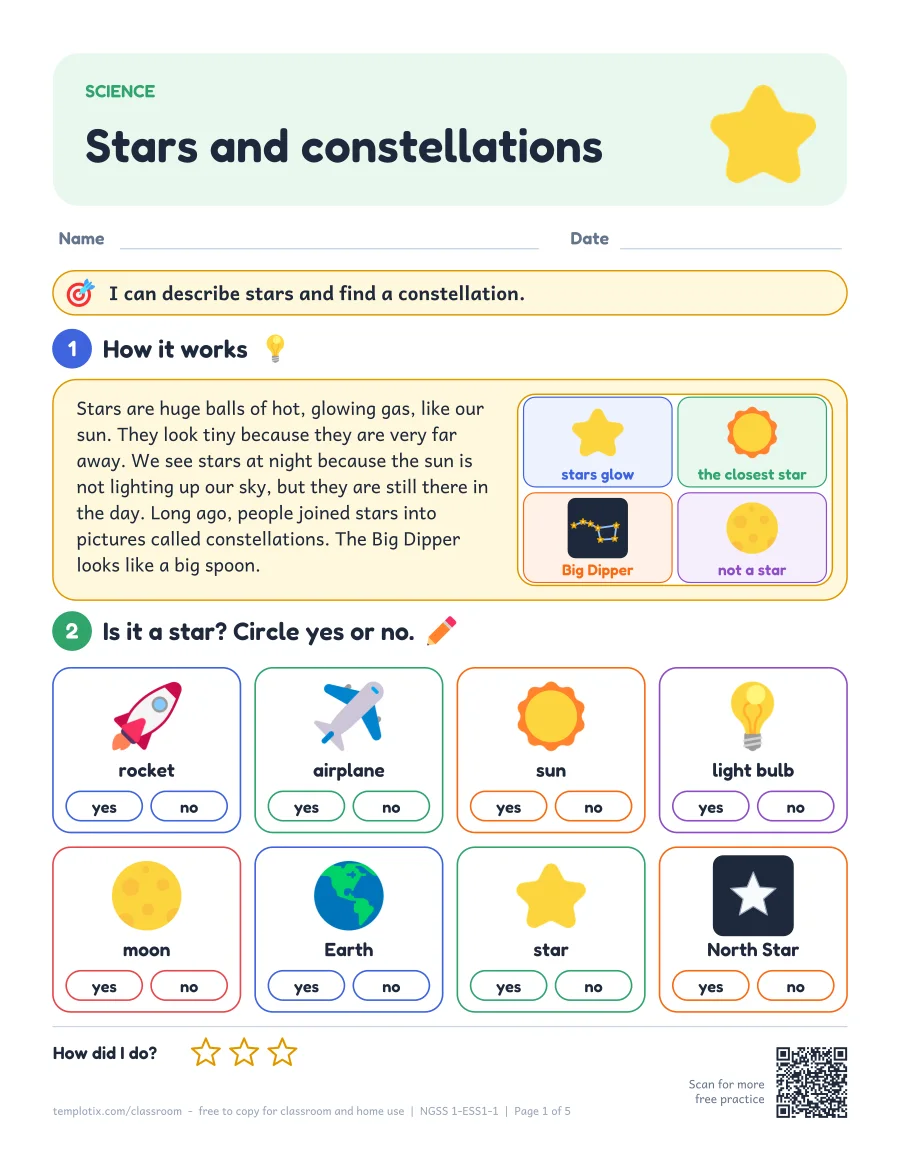
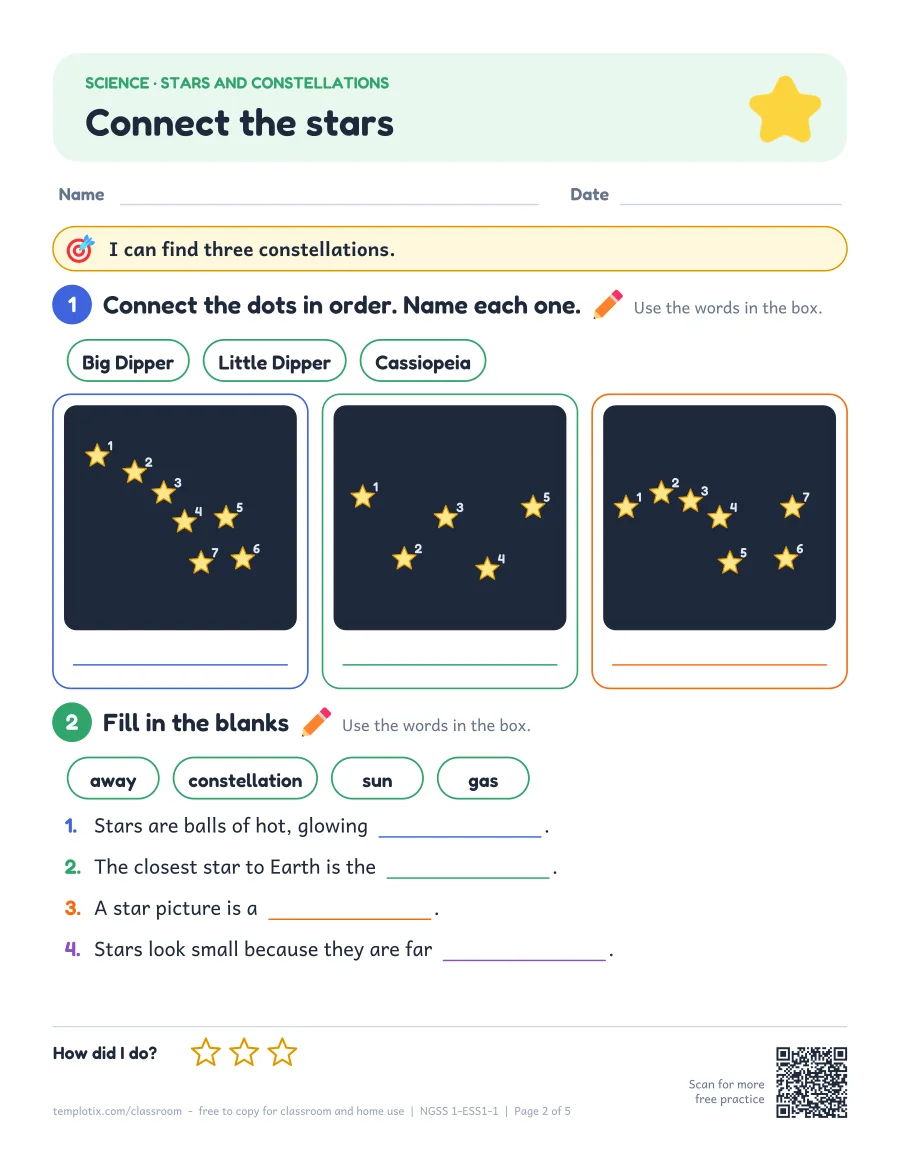
Stars are huge balls of hot, glowing gas, like our sun. They look tiny because they are very far away. We see stars at night because the sun is not lighting up our sky, but they are still there in the day. Long ago, people joined stars into pictures called constellations. The Big Dipper looks like a big spoon.
Teaching tip
 Teaching tip
On a clear night, ask families to find the Big Dipper together. In class, let children press foil star stickers onto dark paper to copy the pattern they saw.
Try it: a constellation viewer
 Try it: a constellation viewer
I can make a model of a constellation.
You need
- A paper cup
- A pencil
- A flashlight
- A dark room
- A grown-up
What to do
- 1Draw the Big Dipper dots on the bottom of the cup.
- 2A grown-up pokes a small hole at each dot with the pencil.
- 3In a dark room, shine the flashlight into the cup and point the bottom at a wall.
- 4Move closer to the wall, then farther away. What happens?
Predict first: What will you see on the wall?What happens?
Small dots of light appear on the wall in the shape of the Big Dipper. Close to the wall the pattern is small and bright; farther away it gets bigger and dimmer. Real constellations keep the same shapes, which is why people have used them to find their way at night.
Safety: a grown-up pokes the holes. Never shine the flashlight into anyone's eyes.
Quick check
What are stars?Tap to checkHuge balls of hot, glowing gas
What is the closest star to Earth?Tap to checkThe sun
Are stars still there in the daytime?Tap to checkYes, the sun is just too bright
What is a constellation?Tap to checkA group of stars that makes a picture
Which constellation looks like a big spoon?Tap to checkThe Big Dipper
Is the moon a star?Tap to checkNo
What the worksheets look like
Solar system poster
 Solar system poster
One colorful page with the sun and the eight planets in order, a fact for each, which are rocky and which are gas giants, and a sentence to remember the order.
Common questions
Why do stars twinkle?
Starlight passes through moving layers of air above us, which bend the light a little this way and that, so stars seem to twinkle. Seen from space, stars do not twinkle at all.
What is an easy constellation for kids to find?
The Big Dipper is easy to spot in the northern sky most of the year. Orion the Hunter, with three bright stars in a row for his belt, is easy to see on winter evenings.
What grade learns stars and constellations?
Usually 1st and 2nd grade. In the Next Generation Science Standards (NGSS) it supports 1-ESS1-1.
Is there a hands-on experiment?
Yes. Page 4 is a Try it! experiment, a constellation viewer, with a materials list, a prediction and an observation chart. Safety: a grown-up pokes the holes. Never shine the flashlight into anyone's eyes.
Is there an answer key?
Yes. Page 5 has every answer from the pack, what to expect from the experiment and a short teaching tip.