Shop
 Grade workbooks


Classroom · Science · Space · Kindergarten and 1st grade

The sun worksheets
A free five-page science pack for Kindergarten and 1st grade: learn to tell how the sun gives us light and warmth, with a labeled picture, practice pages, a hands-on experiment and an answer key.
The big idea
 The big idea
The sun is a star, the closest star to Earth. It is a giant ball of hot, glowing gas. The sun gives Earth light and warmth. Plants need sunlight to grow, and people and animals need plants for food. Sunlight warms the land, the water and the air. Shade is cooler, because something blocks the sunlight.
Teaching tip
 Teaching tip
On a sunny day, let children carefully touch a dark mat, a light mat, a sunny wall and a shady wall. Ask which is warmest and why, then try the water test on page 4.
Try it: sun or shade?
 Try it: sun or shade?
I can test how sunlight warms water.
You need
- 2 cups of cold water
- A thermometer, or your finger
- A sunny spot
- A shady spot
- A clock
What to do
- 1Fill both cups with the same cold water.
- 2Put one cup in the sun and one in the shade.
- 3Wait one hour.
- 4Feel the water or measure it with the thermometer. Which cup is warmer?
Predict first: Which cup will be warmer?What happens?
The water in the sun gets warmer than the water in the shade, because sunlight warms the water. The shade blocks the sunlight, so that water stays cooler. This is why we look for shade on hot days, and why people build roofs and umbrellas.
Safety: never look straight at the sun. Wear a hat and sunscreen when you work outside.
Quick check
What is the sun?Tap to checkA star, the closest star to Earth
What two things does the sun give Earth?Tap to checkLight and warmth
Why is shade cooler?Tap to checkSomething blocks the sunlight
Is it safe to look at the sun?Tap to checkNo, never
Why do plants need the sun?Tap to checkTo make food and grow
Which gets hotter in the sun, a dark or a white shirt?Tap to checkA dark shirt
What the worksheets look like
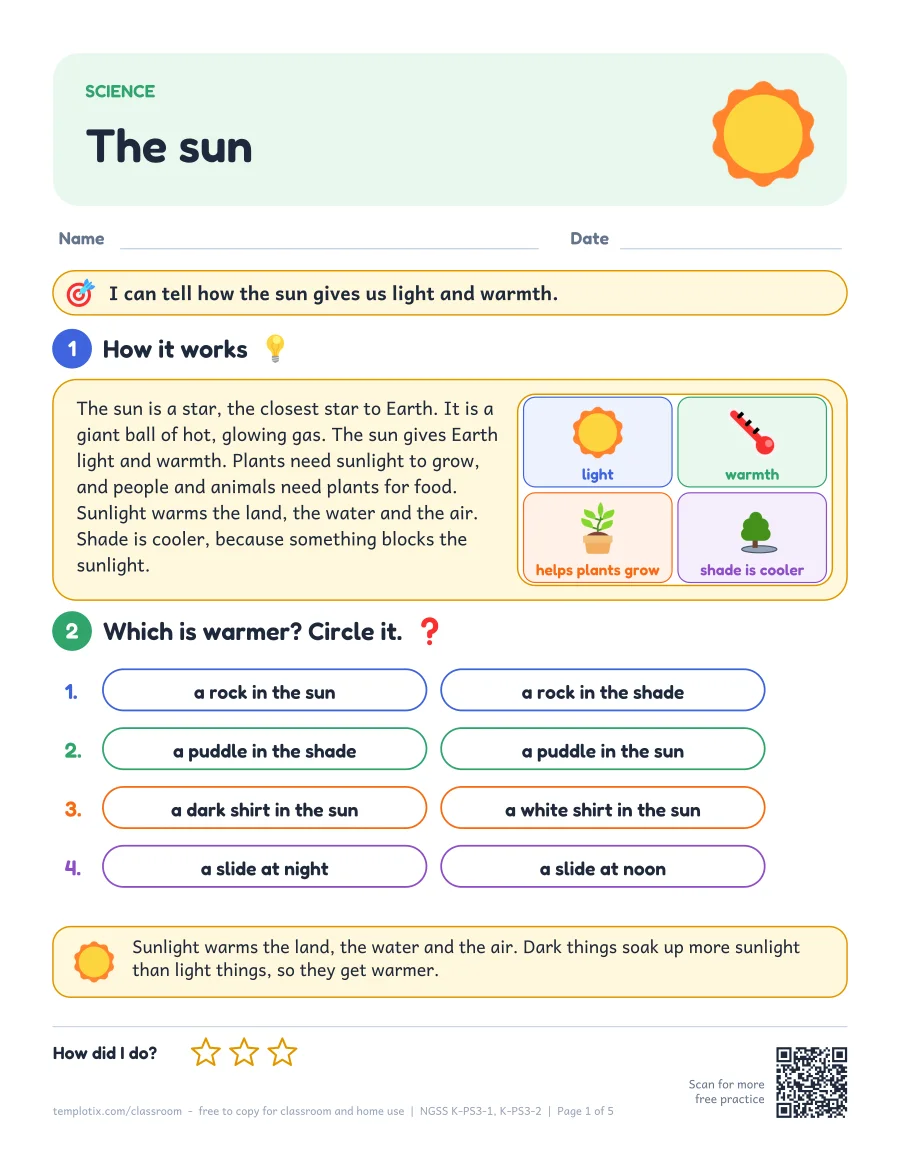
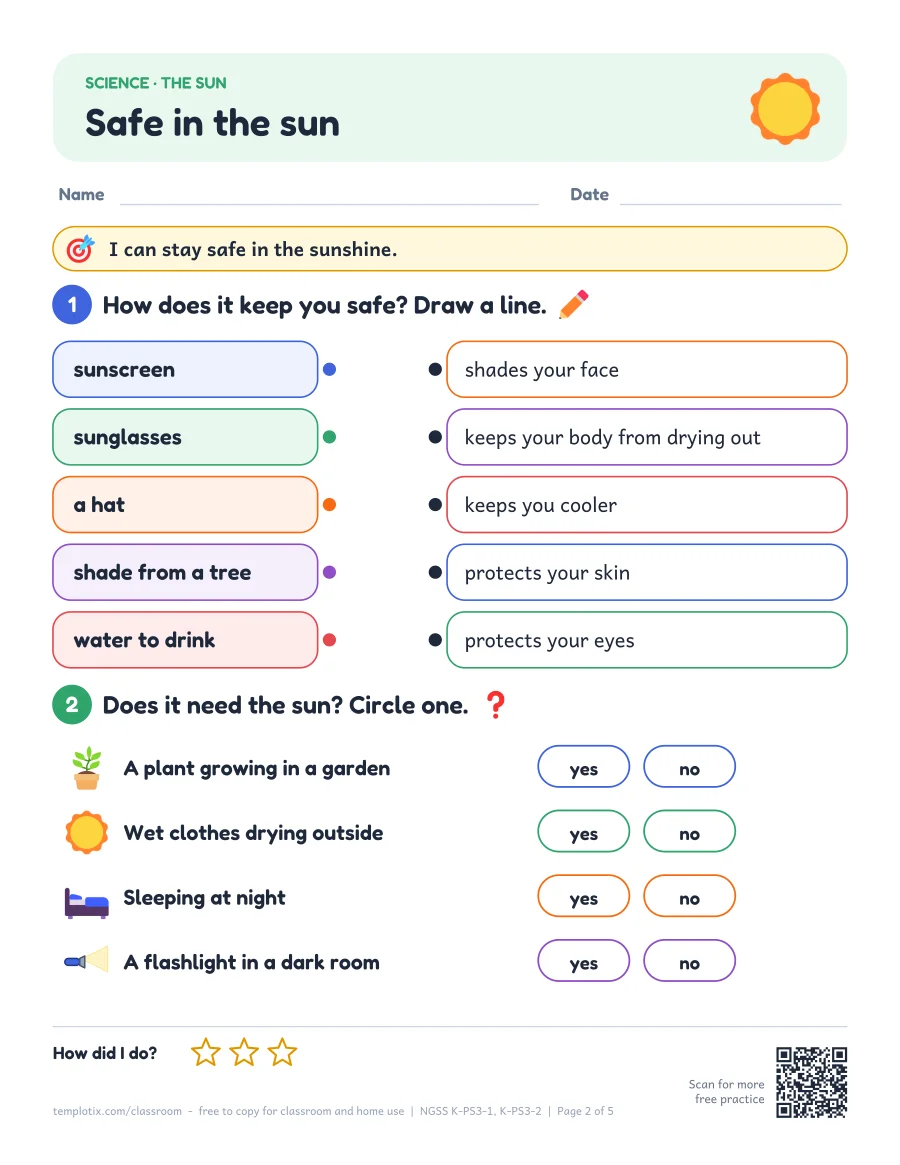
Solar system poster
 Solar system poster
One colorful page with the sun and the eight planets in order, a fact for each, which are rocky and which are gas giants, and a sentence to remember the order.
Common questions
How big is the sun?
The sun is so big that about one million Earths could fit inside it. It looks small because it is about 93 million miles away.
Is it safe to look at the sun?
No. Never look straight at the sun, even with sunglasses, because its light can hurt your eyes. Scientists use special filters to study it.
What grade learns the sun?
Usually Kindergarten and 1st grade. In the Next Generation Science Standards (NGSS) it supports K-PS3-1 and K-PS3-2.
Is there a hands-on experiment?
Yes. Page 4 is a Try it! experiment, sun or shade?, with a materials list, a prediction and an observation chart. Safety: never look straight at the sun. Wear a hat and sunscreen when you work outside.
Is there an answer key?
Yes. Page 5 has every answer from the pack, what to expect from the experiment and a short teaching tip.