Shop
 Grade workbooks


Classroom · Science · Forces and motion · Kindergarten and 1st grade

Pushes and pulls worksheets
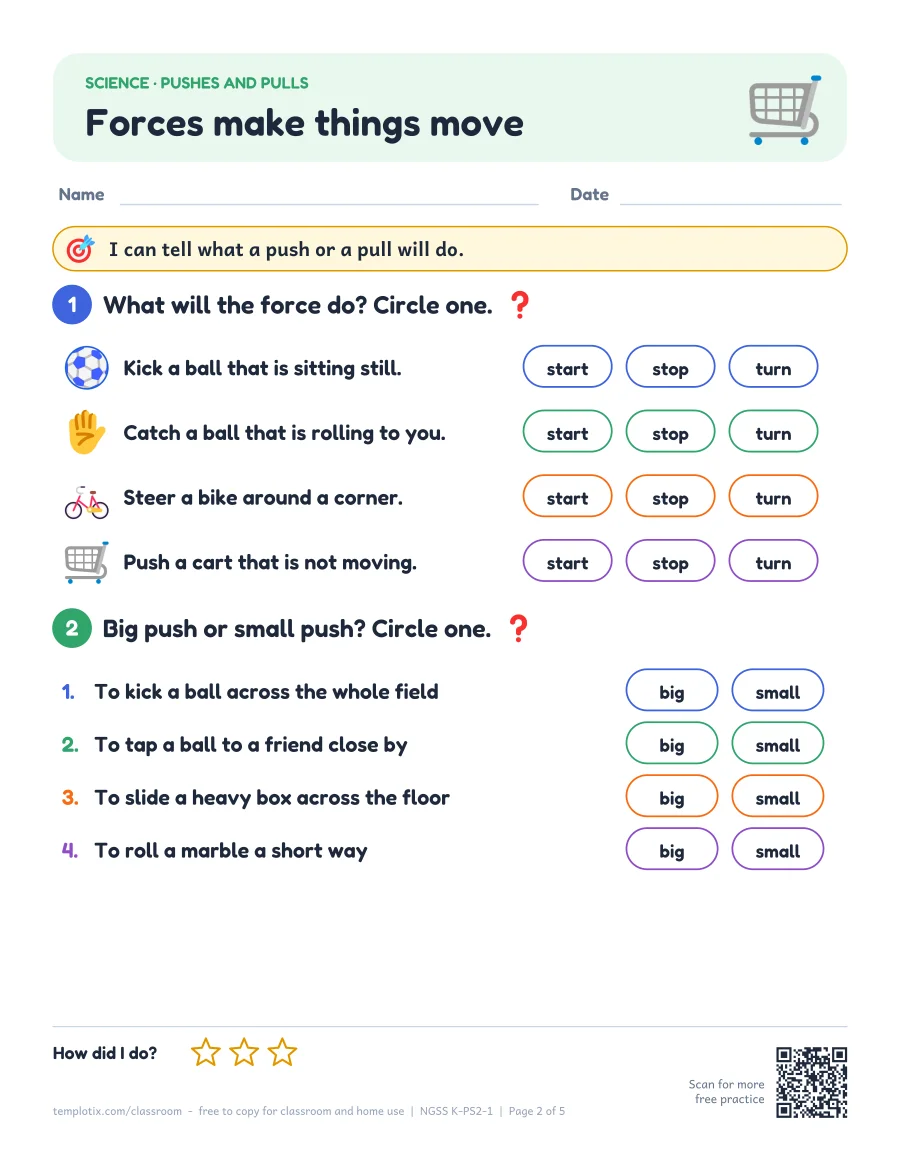
A free five-page science pack for Kindergarten and 1st grade: learn to tell if a force is a push or a pull, with a labeled picture, practice pages, a hands-on experiment and an answer key.
The big idea
 The big idea
A force is a push or a pull. A push moves something away from you, like kicking a ball or pushing a cart. A pull moves something toward you, like opening a drawer or pulling a wagon. Forces can make things start, stop, speed up, slow down or change direction. A bigger push or pull makes a bigger change.
Teaching tip
 Teaching tip
Hold up a toy car and ask children to make it start, stop, speed up and turn using only pushes and pulls. Name the force each time.
Try it: the ball push test
 Try it: the ball push test
I can test how the size of a push changes motion.
You need
- A ball
- Tape
- A hallway or a yard
- Big steps to measure
- A partner
What to do
- 1Mark a start line with tape.
- 2Roll the ball with a small push. Mark where it stops.
- 3Roll it again with a medium push, then a big push. Mark each stop.
- 4Count your steps from the start line to each mark.
Predict first: Which push will send the ball the farthest?What happens?
The big push sends the ball the farthest and the fastest, and the small push sends it the shortest way. A bigger force makes a bigger change in motion. Children may also notice that the ball slows down and stops because the floor rubs against it.
Safety: roll the ball where no one can trip, and away from windows.
Quick check
What is a force?Tap to checkA push or a pull
Is kicking a ball a push or a pull?Tap to checkA push
Is opening a drawer a push or a pull?Tap to checkA pull
What can a force do?Tap to checkStart, stop, speed up, slow down or turn something
Which goes farther, a big push or a small push?Tap to checkA big push
Is flying a kite a push or a pull?Tap to checkA pull
What the worksheets look like
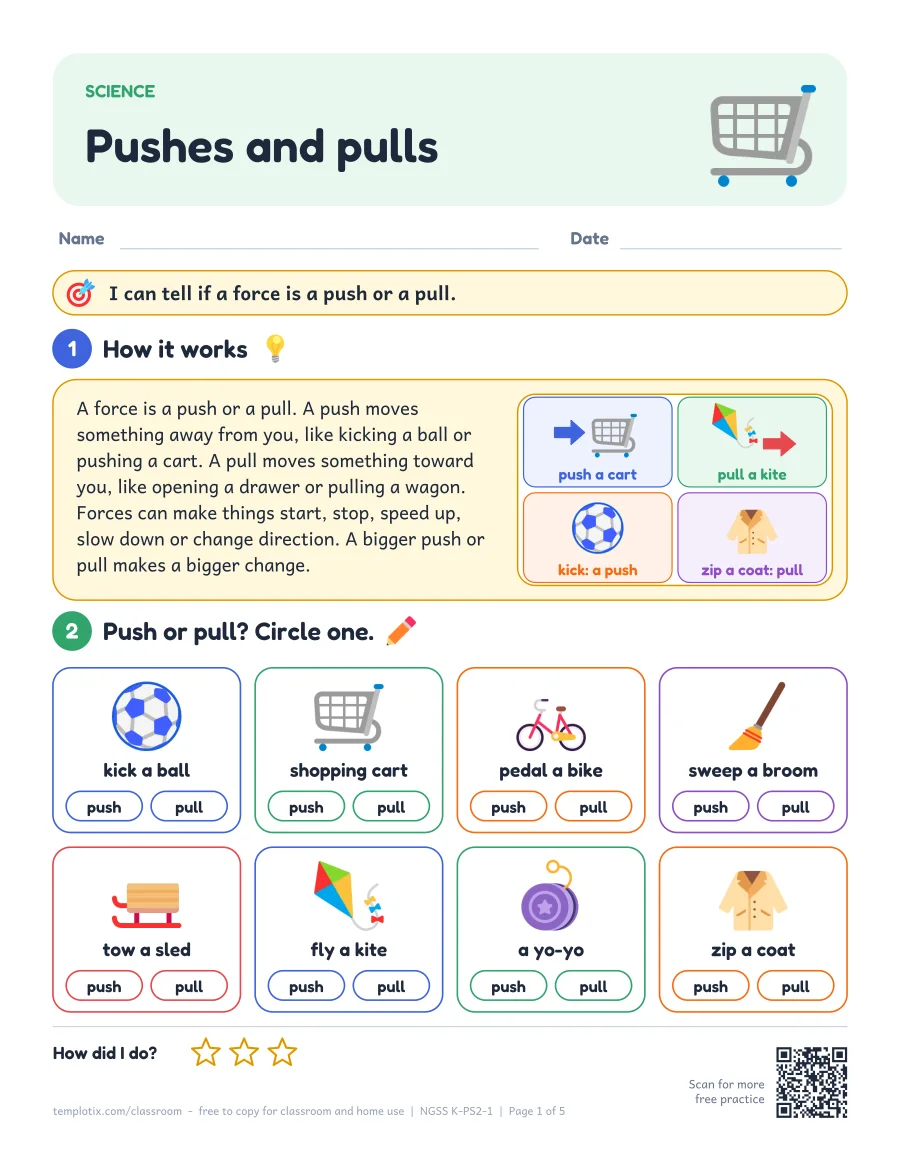
Forces all around poster
 Forces all around poster
One colorful page with push, pull, gravity, friction, simple machines and balanced forces, each with a picture and a one-line meaning. Made for a science wall.
Common questions
What are examples of pushes and pulls for kids?
Pushes: kicking a ball, closing a door, pressing a button. Pulls: opening a drawer, tugging a wagon, picking up a backpack. Some actions use both, like pumping a swing.
What can a push or pull do?
A push or pull can start something moving, stop it, speed it up, slow it down or change its direction. Hitting a ball with a bat sends it back the other way.
What grade learns pushes and pulls?
Usually Kindergarten and 1st grade. In the Next Generation Science Standards (NGSS) it supports K-PS2-1.
Is there a hands-on experiment?
Yes. Page 4 is a Try it! experiment, the ball push test, with a materials list, a prediction and an observation chart. Safety: roll the ball where no one can trip, and away from windows.
Is there an answer key?
Yes. Page 5 has every answer from the pack, what to expect from the experiment and a short teaching tip.