 Shop
 Grade workbooks


Classroom · Reading comprehension · 3rd grade
reading comprehension worksheets
8 original passages, half stories and half nonfiction, each 139 to 167 words long. Every passage comes with four pages: the text, comprehension questions, word work and writing, and an answer key.
All 8 passages in one PDF
With a reading log and a Super Reader certificate.
The passages
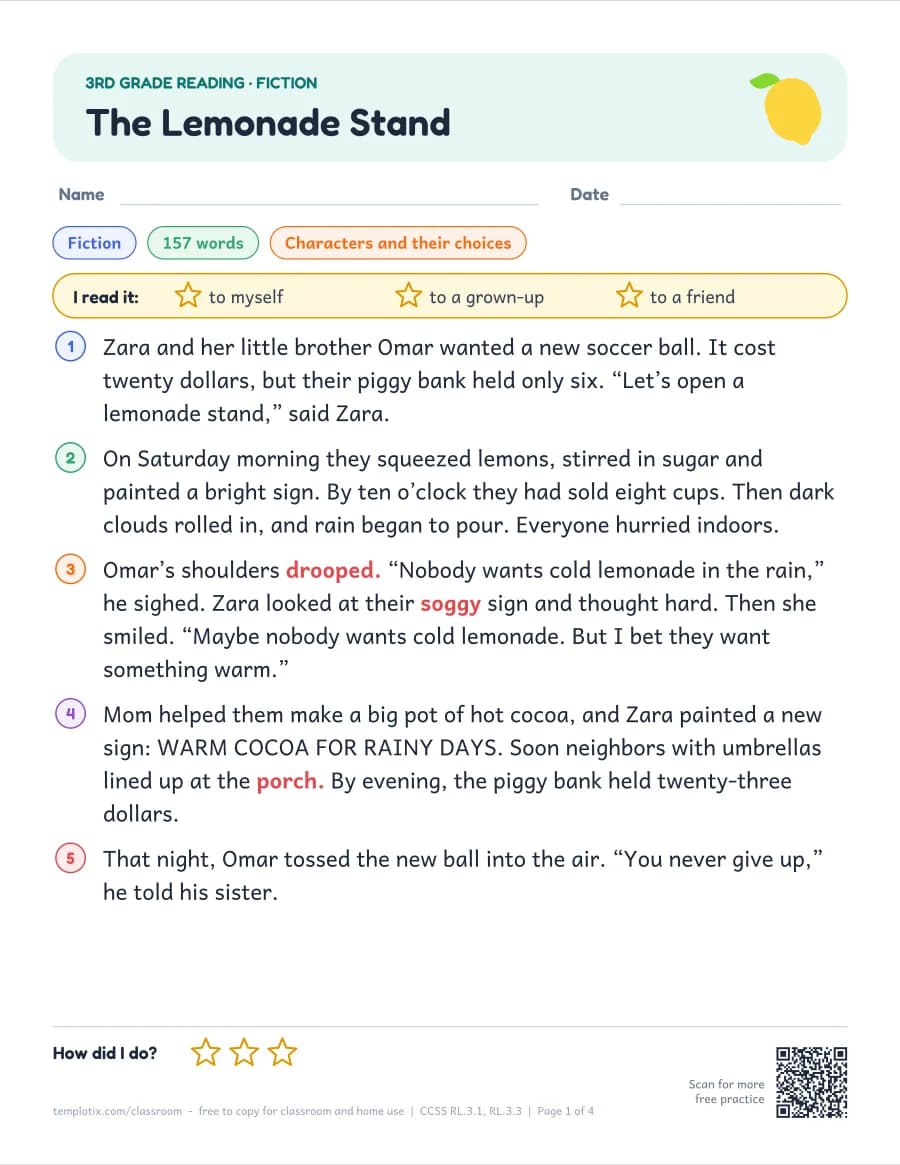
1. The Lemonade Stand
Fiction157 wordsCharacters and their choicesCCSS RL.3.1, RL.3.3
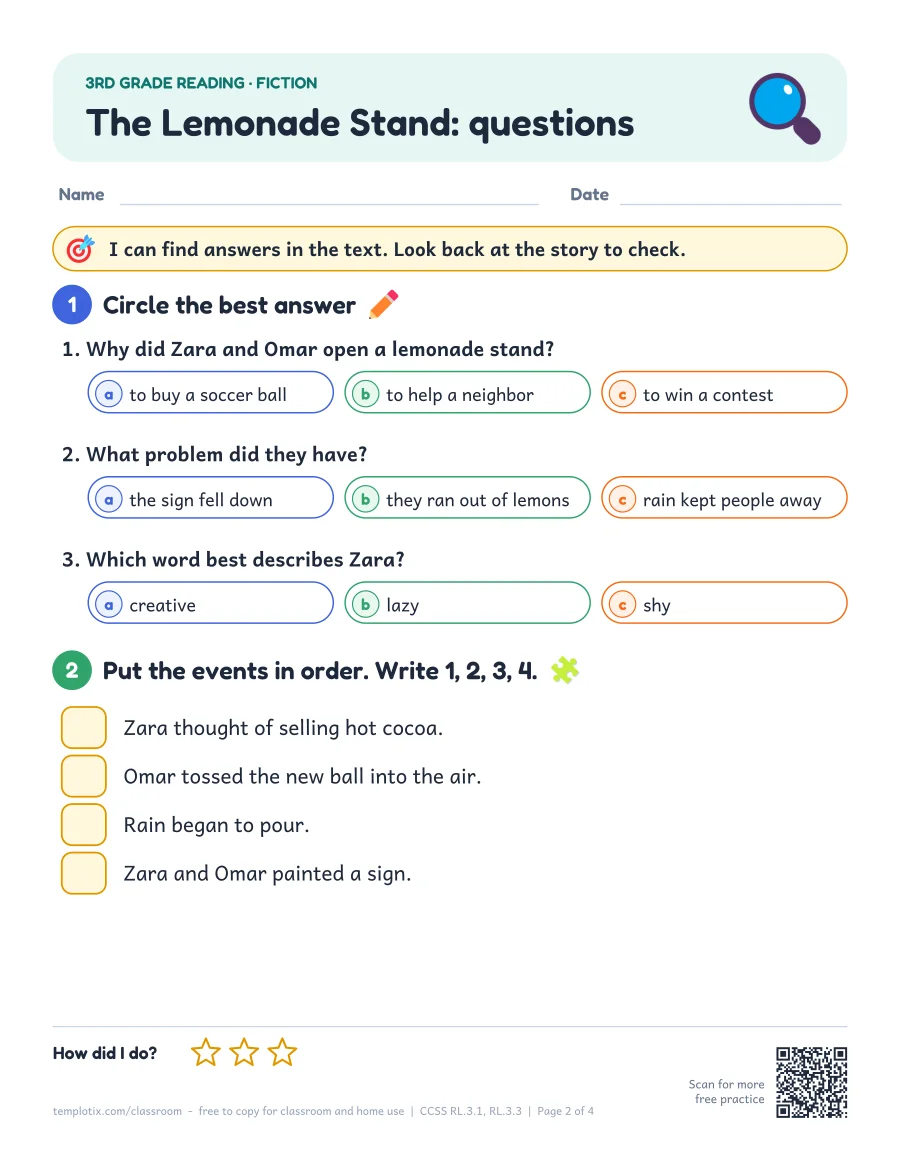
Zara and her little brother Omar wanted a new soccer ball. It cost twenty dollars, but their piggy bank held only six. “Let’s open a lemonade stand,” said Zara.
Read the whole passage
On Saturday morning they squeezed lemons, stirred in sugar and painted a bright sign. By ten o’clock they had sold eight cups. Then dark clouds rolled in, and rain began to pour. Everyone hurried indoors.
Omar’s shoulders drooped. “Nobody wants cold lemonade in the rain,” he sighed. Zara looked at their soggy sign and thought hard. Then she smiled. “Maybe nobody wants cold lemonade. But I bet they want something warm.”
Mom helped them make a big pot of hot cocoa, and Zara painted a new sign: WARM COCOA FOR RAINY DAYS. Soon neighbors with umbrellas lined up at the porch. By evening, the piggy bank held twenty-three dollars.
That night, Omar tossed the new ball into the air. “You never give up,” he told his sister.
Words taught: drooped, soggy, porch.
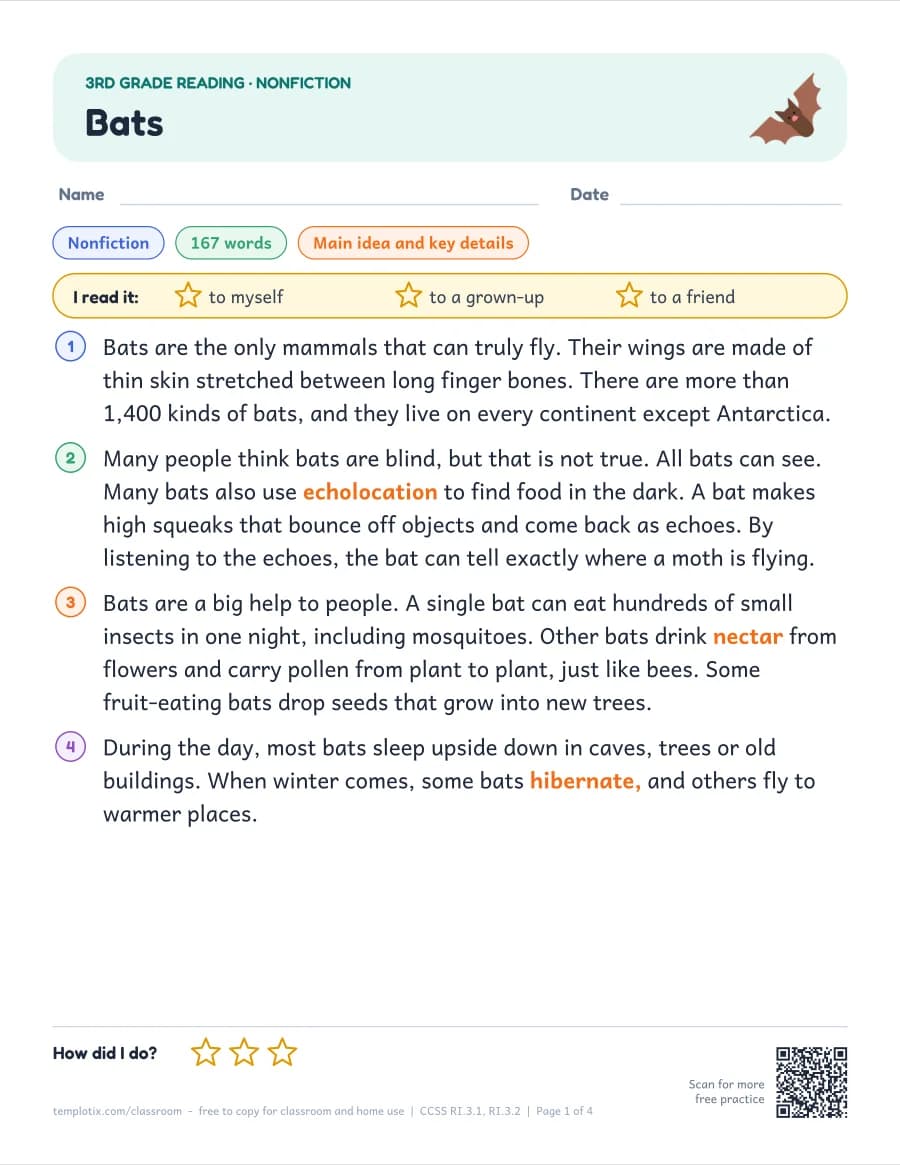
2. Bats
Nonfiction167 wordsMain idea and key detailsCCSS RI.3.1, RI.3.2
Bats are the only mammals that can truly fly. Their wings are made of thin skin stretched between long finger bones. There are more than 1,400 kinds of bats, and they live on every continent except Antarctica.
Read the whole passage
Many people think bats are blind, but that is not true. All bats can see. Many bats also use echolocation to find food in the dark. A bat makes high squeaks that bounce off objects and come back as echoes. By listening to the echoes, the bat can tell exactly where a moth is flying.
Bats are a big help to people. A single bat can eat hundreds of small insects in one night, including mosquitoes. Other bats drink nectar from flowers and carry pollen from plant to plant, just like bees. Some fruit-eating bats drop seeds that grow into new trees.
During the day, most bats sleep upside down in caves, trees or old buildings. When winter comes, some bats hibernate, and others fly to warmer places.
Words taught: echolocation, nectar, hibernate.
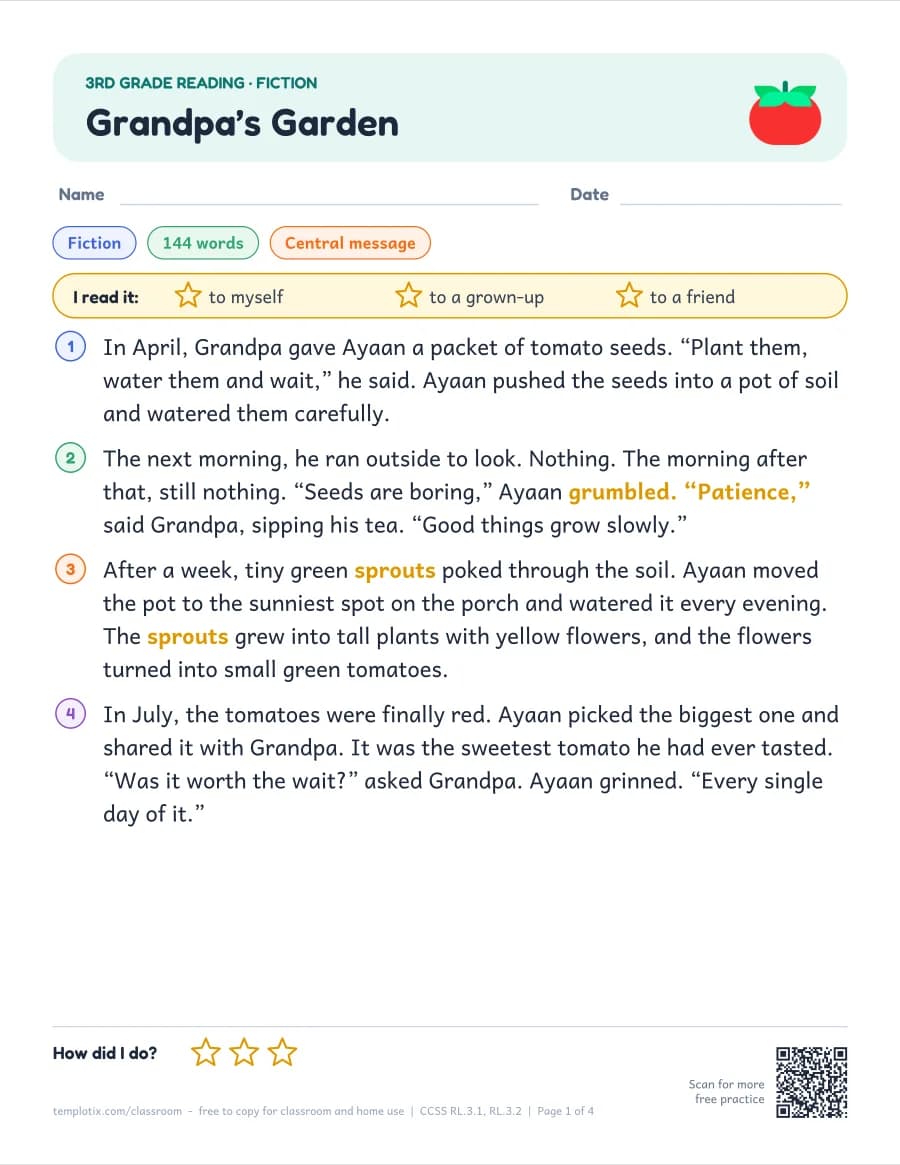
3. Grandpa’s Garden
Fiction144 wordsCentral messageCCSS RL.3.1, RL.3.2
In April, Grandpa gave Ayaan a packet of tomato seeds. “Plant them, water them and wait,” he said. Ayaan pushed the seeds into a pot of soil and watered them carefully.
Read the whole passage
The next morning, he ran outside to look. Nothing. The morning after that, still nothing. “Seeds are boring,” Ayaan grumbled. “Patience,” said Grandpa, sipping his tea. “Good things grow slowly.”
After a week, tiny green sprouts poked through the soil. Ayaan moved the pot to the sunniest spot on the porch and watered it every evening. The sprouts grew into tall plants with yellow flowers, and the flowers turned into small green tomatoes.
In July, the tomatoes were finally red. Ayaan picked the biggest one and shared it with Grandpa. It was the sweetest tomato he had ever tasted. “Was it worth the wait?” asked Grandpa. Ayaan grinned. “Every single day of it.”
Words taught: grumbled, patience, sprouts.
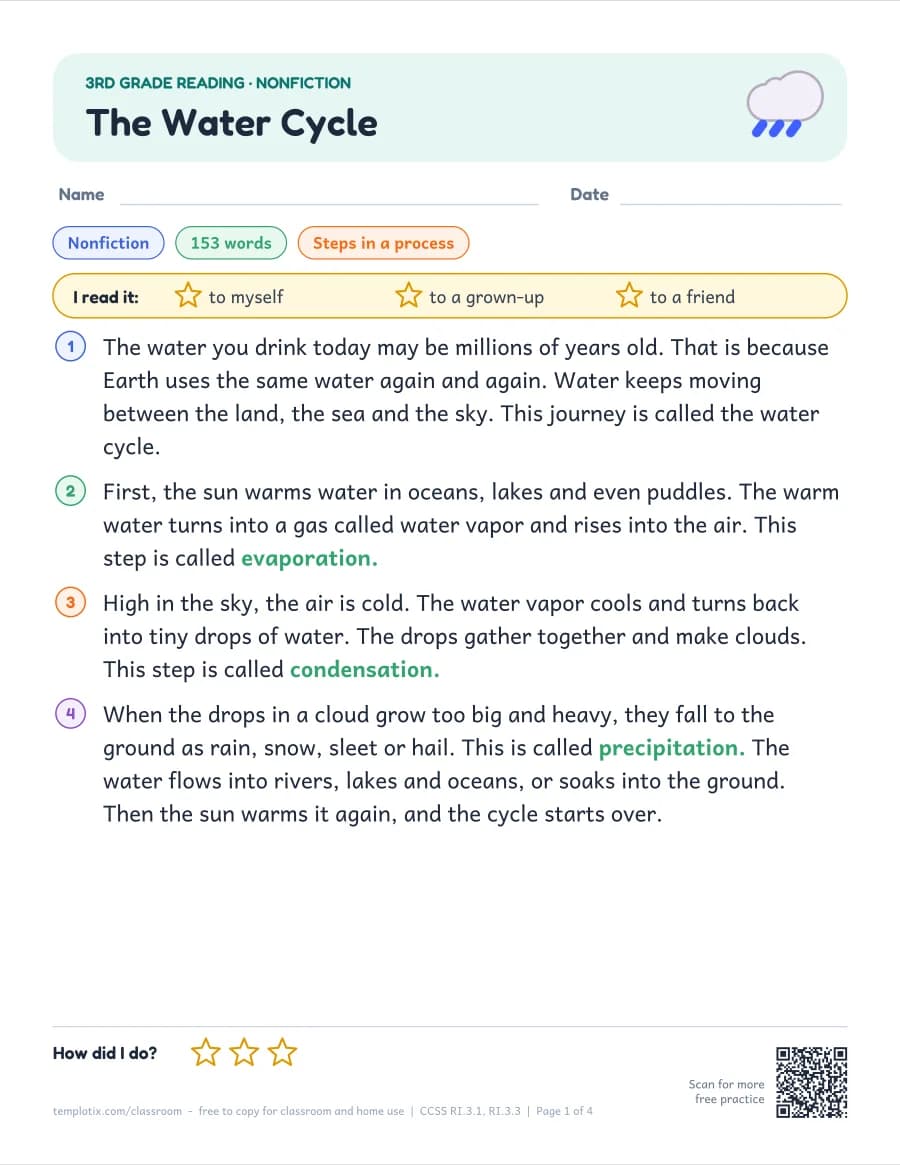
4. The Water Cycle
Nonfiction153 wordsSteps in a processCCSS RI.3.1, RI.3.3
The water you drink today may be millions of years old. That is because Earth uses the same water again and again. Water keeps moving between the land, the sea and the sky. This journey is called the water cycle.
Read the whole passage
First, the sun warms water in oceans, lakes and even puddles. The warm water turns into a gas called water vapor and rises into the air. This step is called evaporation.
High in the sky, the air is cold. The water vapor cools and turns back into tiny drops of water. The drops gather together and make clouds. This step is called condensation.
When the drops in a cloud grow too big and heavy, they fall to the ground as rain, snow, sleet or hail. This is called precipitation. The water flows into rivers, lakes and oceans, or soaks into the ground. Then the sun warms it again, and the cycle starts over.
Words taught: evaporation, condensation, precipitation.
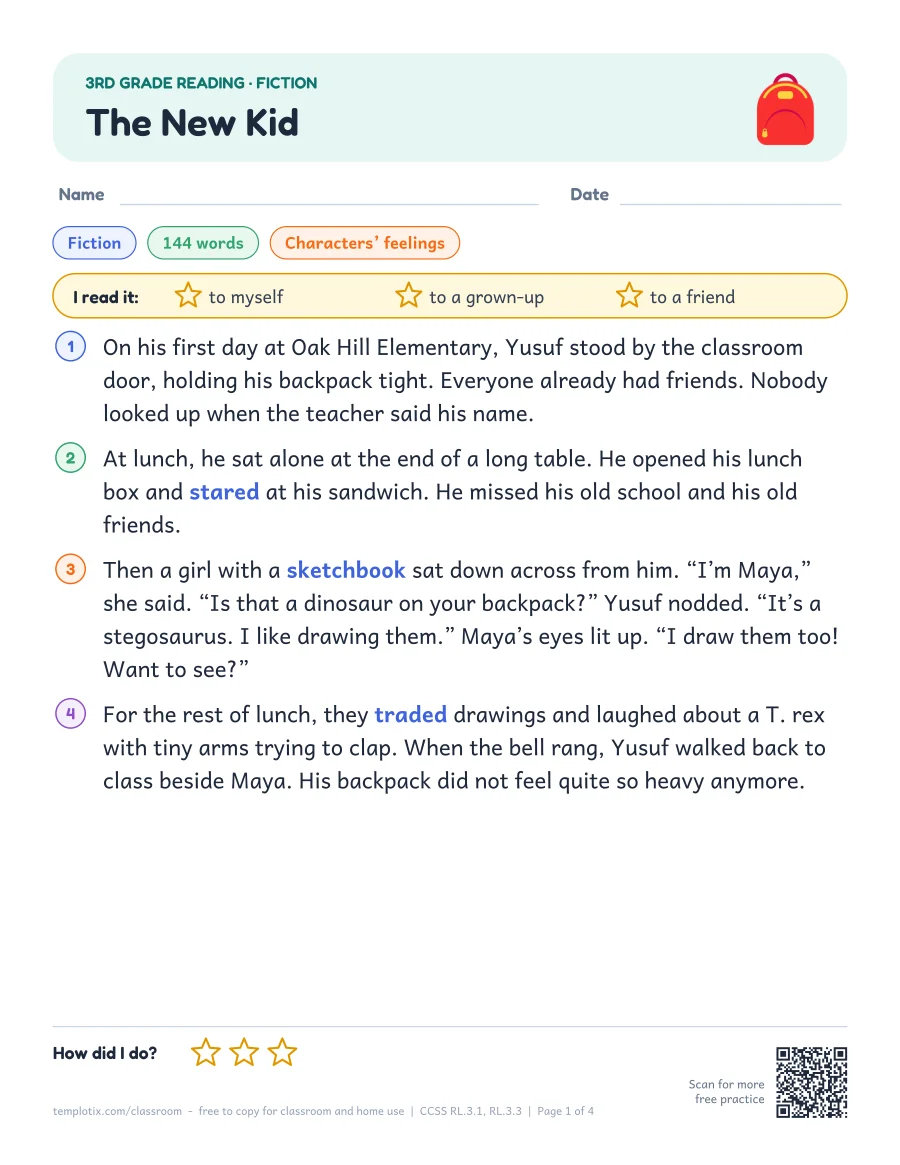
5. The New Kid
Fiction144 wordsCharacters’ feelingsCCSS RL.3.1, RL.3.3
On his first day at Oak Hill Elementary, Yusuf stood by the classroom door, holding his backpack tight. Everyone already had friends. Nobody looked up when the teacher said his name.
Read the whole passage
At lunch, he sat alone at the end of a long table. He opened his lunch box and stared at his sandwich. He missed his old school and his old friends.
Then a girl with a sketchbook sat down across from him. “I’m Maya,” she said. “Is that a dinosaur on your backpack?” Yusuf nodded. “It’s a stegosaurus. I like drawing them.” Maya’s eyes lit up. “I draw them too! Want to see?”
For the rest of lunch, they traded drawings and laughed about a T. rex with tiny arms trying to clap. When the bell rang, Yusuf walked back to class beside Maya. His backpack did not feel quite so heavy anymore.
Words taught: stared, sketchbook, traded.
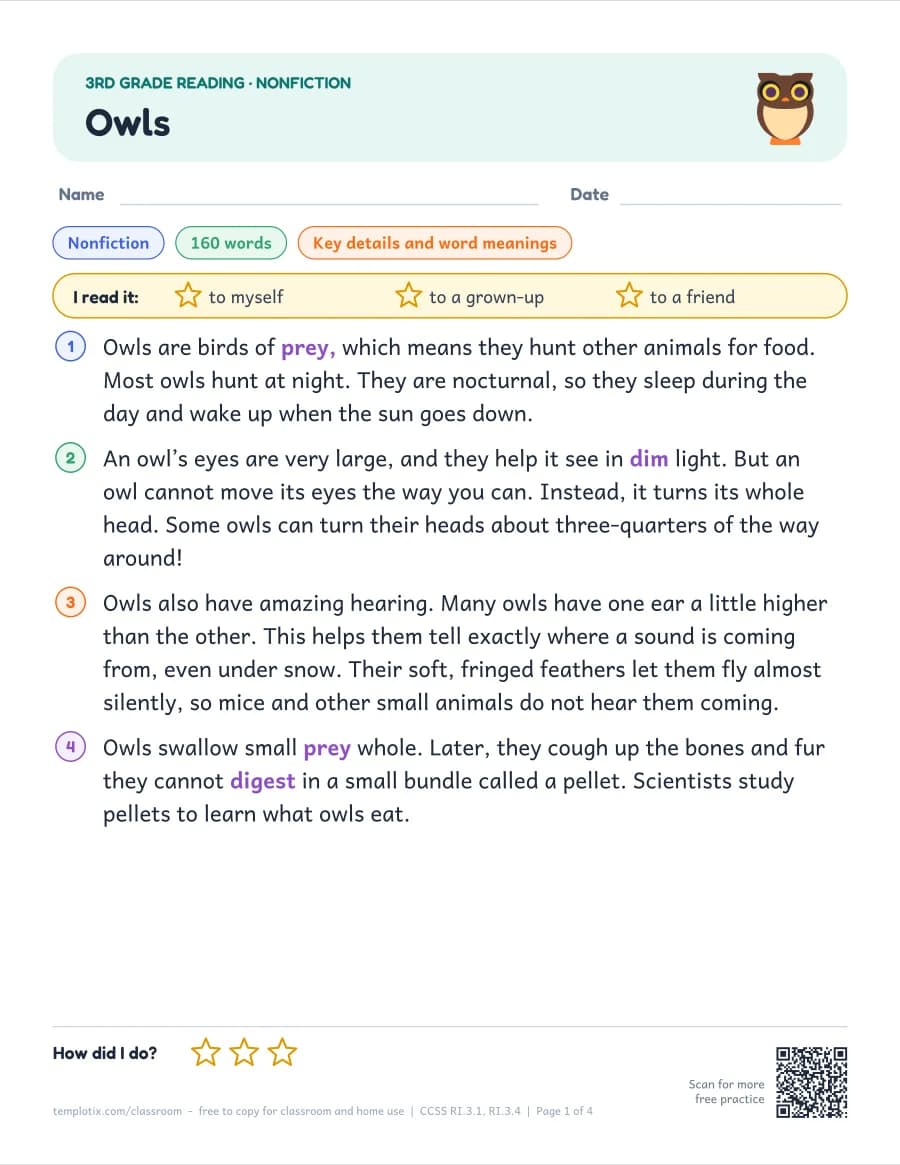
6. Owls
Nonfiction160 wordsKey details and word meaningsCCSS RI.3.1, RI.3.4
Owls are birds of prey, which means they hunt other animals for food. Most owls hunt at night. They are nocturnal, so they sleep during the day and wake up when the sun goes down.
Read the whole passage
An owl’s eyes are very large, and they help it see in dim light. But an owl cannot move its eyes the way you can. Instead, it turns its whole head. Some owls can turn their heads about three-quarters of the way around!
Owls also have amazing hearing. Many owls have one ear a little higher than the other. This helps them tell exactly where a sound is coming from, even under snow. Their soft, fringed feathers let them fly almost silently, so mice and other small animals do not hear them coming.
Owls swallow small prey whole. Later, they cough up the bones and fur they cannot digest in a small bundle called a pellet. Scientists study pellets to learn what owls eat.
Words taught: prey, dim, digest.
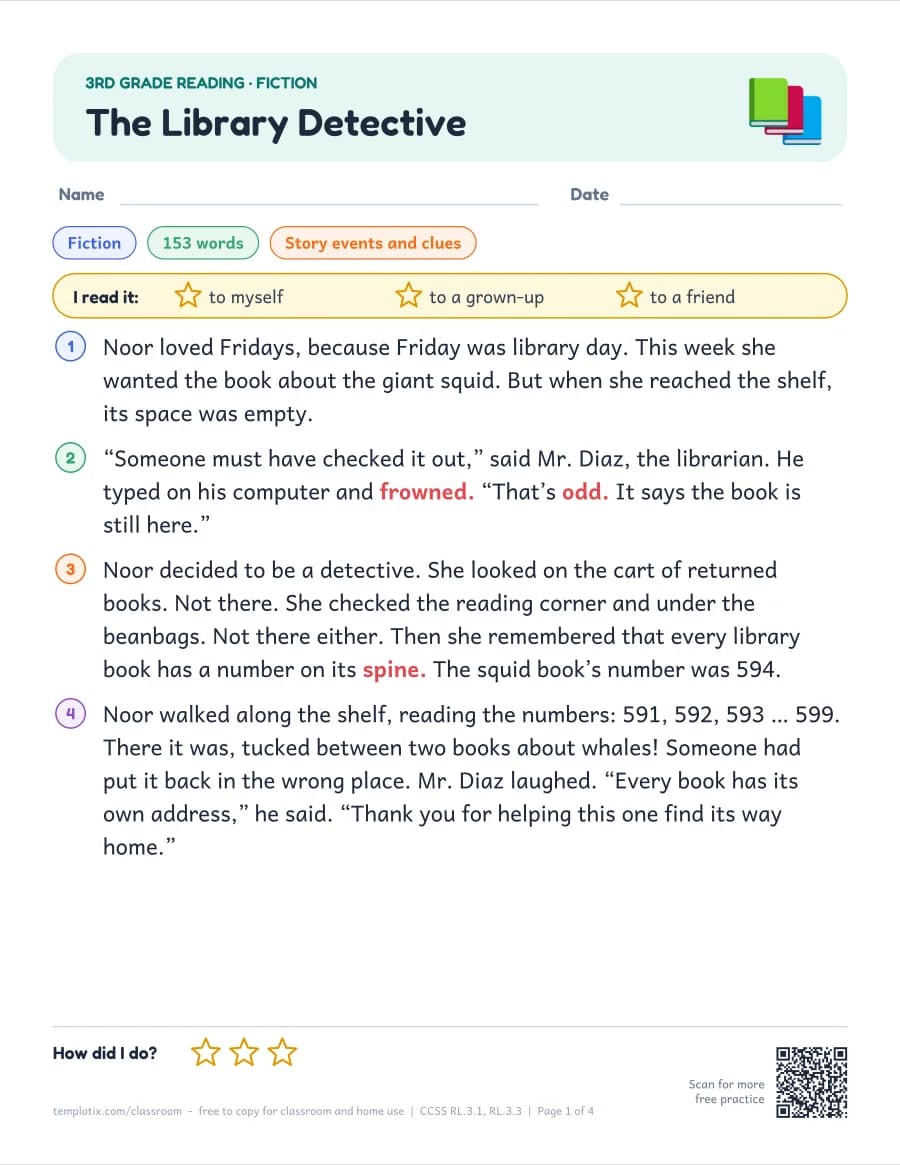
7. The Library Detective
Fiction153 wordsStory events and cluesCCSS RL.3.1, RL.3.3
Noor loved Fridays, because Friday was library day. This week she wanted the book about the giant squid. But when she reached the shelf, its space was empty.
Read the whole passage
“Someone must have checked it out,” said Mr. Diaz, the librarian. He typed on his computer and frowned. “That’s odd. It says the book is still here.”
Noor decided to be a detective. She looked on the cart of returned books. Not there. She checked the reading corner and under the beanbags. Not there either. Then she remembered that every library book has a number on its spine. The squid book’s number was 594.
Noor walked along the shelf, reading the numbers: 591, 592, 593 … 599. There it was, tucked between two books about whales! Someone had put it back in the wrong place. Mr. Diaz laughed. “Every book has its own address,” he said. “Thank you for helping this one find its way home.”
Words taught: frowned, odd, spine.
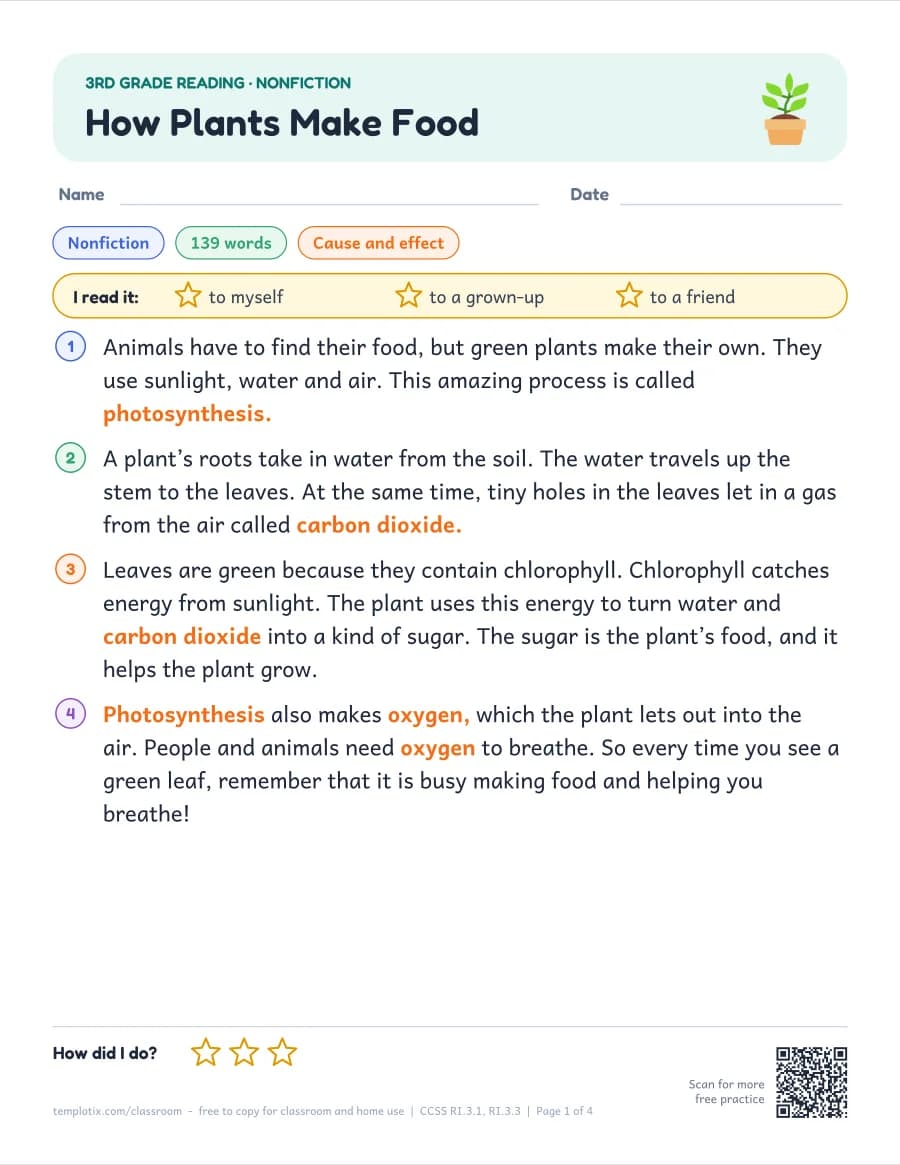
8. How Plants Make Food
Nonfiction139 wordsCause and effectCCSS RI.3.1, RI.3.3
Animals have to find their food, but green plants make their own. They use sunlight, water and air. This amazing process is called photosynthesis.
Read the whole passage
A plant’s roots take in water from the soil. The water travels up the stem to the leaves. At the same time, tiny holes in the leaves let in a gas from the air called carbon dioxide.
Leaves are green because they contain chlorophyll. Chlorophyll catches energy from sunlight. The plant uses this energy to turn water and carbon dioxide into a kind of sugar. The sugar is the plant’s food, and it helps the plant grow.
Photosynthesis also makes oxygen, which the plant lets out into the air. People and animals need oxygen to breathe. So every time you see a green leaf, remember that it is busy making food and helping you breathe!
Words taught: photosynthesis, carbon dioxide, oxygen.
 1. The Lemonade Stand
 2. Bats
 3. Grandpa’s Garden
 4. The Water Cycle
 5. The New Kid
 6. Owls
 7. The Library Detective
 8. How Plants Make Food
Inside a worksheet
Common questions
What reading level are these 3rd grade passages?
They are written for 3rd grade: 139 to 167 words, with short sentences and everyday vocabulary, plus three new words in each passage that are taught on the worksheet. Use them for children reading at or near a 3rd grade level.
What is in each worksheet?
Four pages: the passage with a "read it three times" tracker, multiple-choice questions with either an order-of-events or a true-or-false task, a word-meaning match with a written answer and a drawing box, and an answer key with a sample written answer.
How should I use a passage?
Read it together first, then let the child read it alone and to someone else (the stars on page 1 track this). Do the questions the next day, and ask the child to point to the sentence in the text that proves each answer.
Can I copy these worksheets for my class?
Yes. The PDFs are free to print and photocopy for classroom and home use, in color or in the black-and-white ink saver. Please link to this page rather than re-uploading the files.