Shop
 Grade workbooks


Classroom · Grammar · CCSS L.K.1 to L.5.5
worksheets for K-5
Naming words, action words, describing words, one and more than one, how to start and end a sentence, then pronouns, past tense, contractions and compound words, for 3rd grade adverbs, comparing adjectives, possessive nouns and conjunctions, and for 4th grade relative pronouns, progressive and modal verbs, prepositional phrases, sound-alike words and prefixes, and for 5th grade interjections, perfect tenses, correlative conjunctions, suffixes, roots, similes and metaphors. Each free five-page pack teaches one rule with pictures, then practices it four ways, with an answer key.
- NounsKindergarten and 1st grade
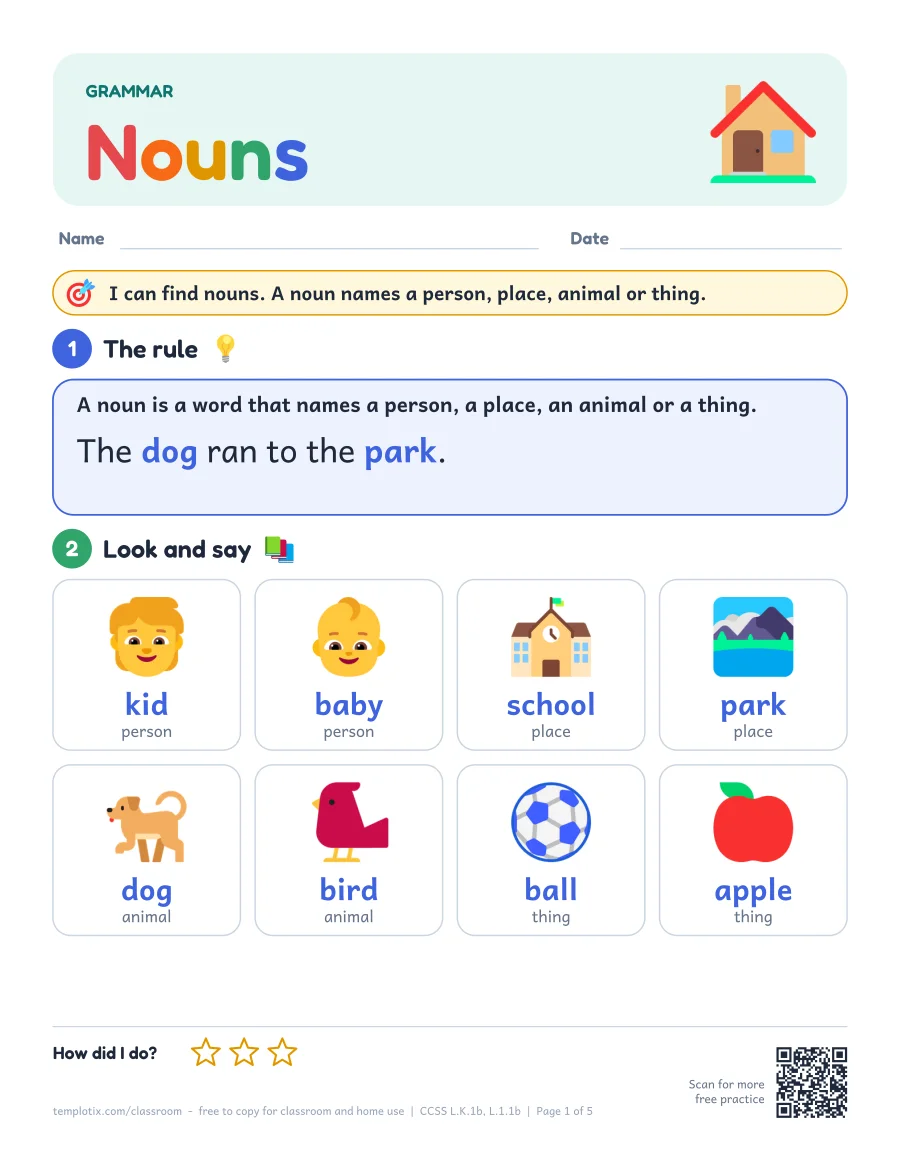
A noun is a word that names a person, a place, an animal or a thing.
The dog ran to the park.
- VerbsKindergarten and 1st grade
A verb is an action word. It tells what someone or something does.
The frog jumps and the bird flies.
- Adjectives1st and 2nd grade
An adjective describes a noun. It tells its color, size or shape, or how it looks, feels or tastes.
The big elephant has a small friend.
- Singular and plural nounsKindergarten and 1st grade
Singular means one. Plural means more than one. Add -s to most nouns (cat, cats). Add -es to nouns that end in s, x, ch or sh (box, boxes).
One cat, two cats. One box, two boxes.
- Capital letters and end marksKindergarten and 1st grade
Every sentence starts with a capital letter and ends with an end mark.
- Pronouns1st and 2nd grade
A pronoun takes the place of a noun, so we do not have to say the noun again and again.
Sam has a dog. He loves it.
- Past tense verbs1st and 2nd grade
A past tense verb tells about something that already happened. Add -ed to most verbs (jump, jumped). Some verbs change (run, ran).
Yesterday I jumped and ran in the park.
- Contractions2nd grade
A contraction is two words made into one. An apostrophe (') takes the place of the letters that are left out.
do not = don't, it is = it's
- Compound words2nd grade
A compound word is two small words joined together to make a new word.
sun + flower = sunflower
- Irregular plural nouns3rd grade
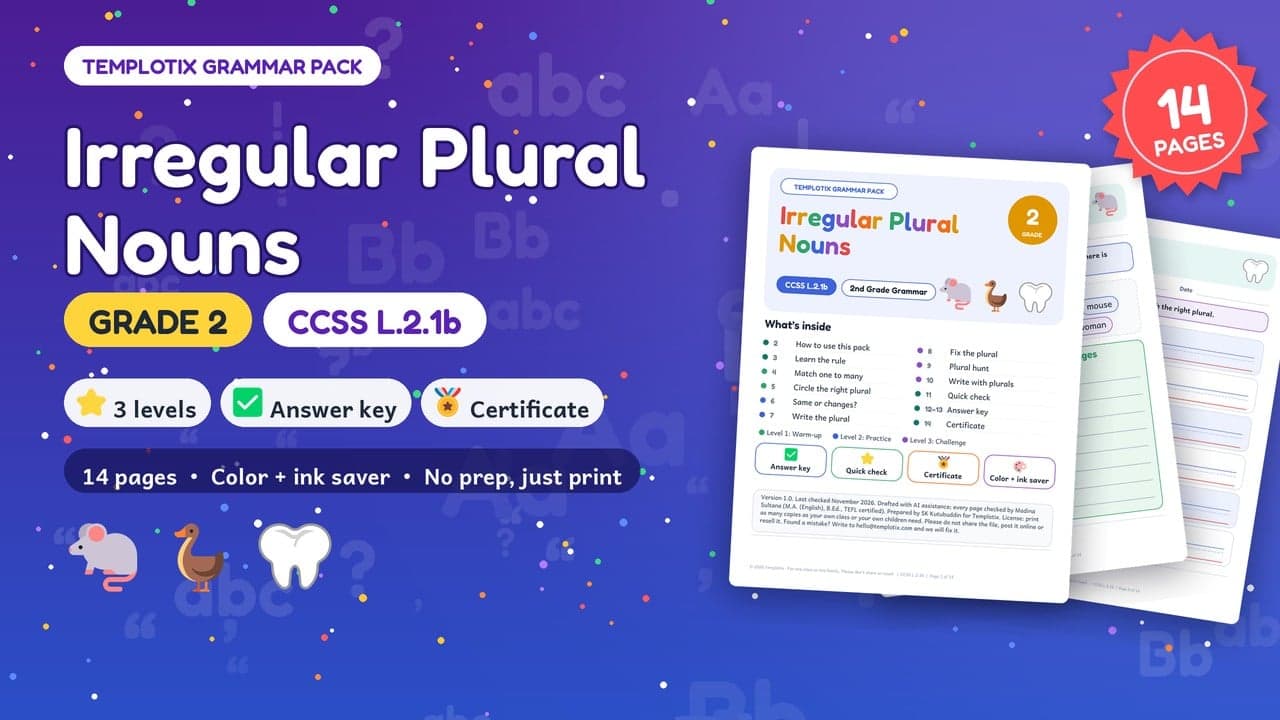
Most nouns add -s or -es. Irregular plural nouns change their spelling (mouse, mice), and a few stay the same (sheep, sheep).
Two mice and three geese walked past the sheep.
- Irregular past tense verbs3rd grade
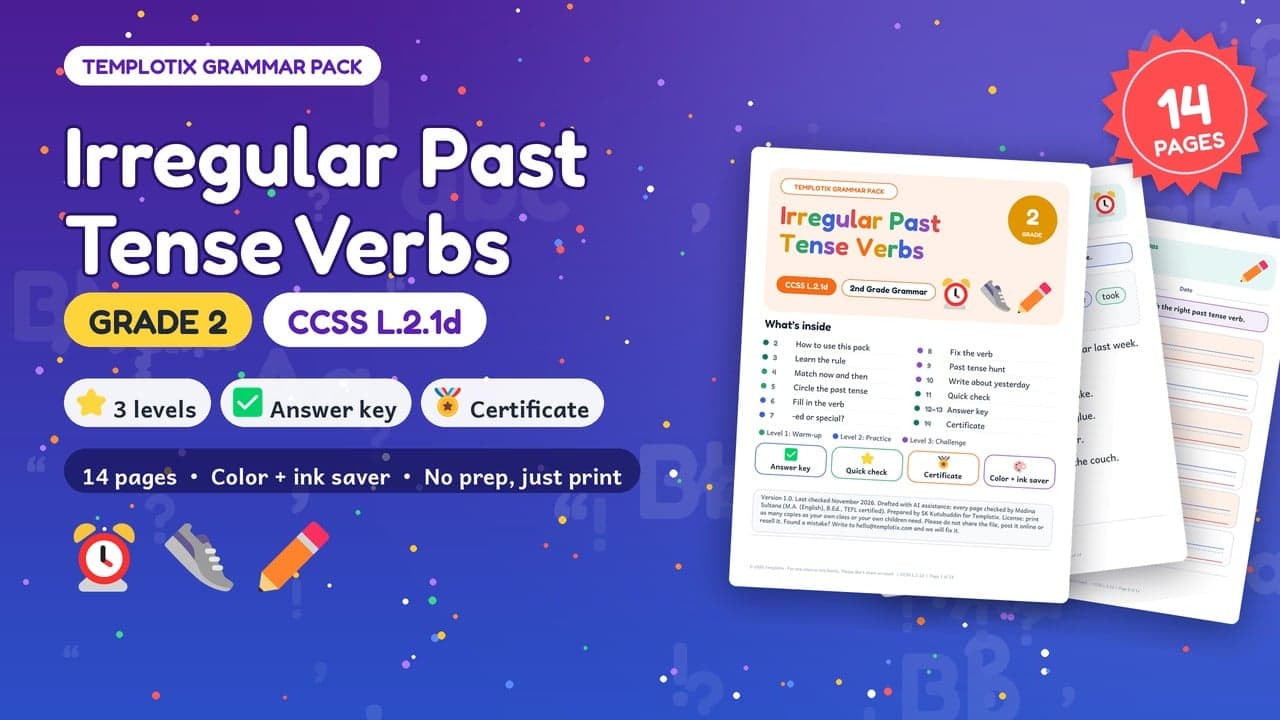
Most verbs add -ed to tell about the past (walk, walked). Irregular verbs change in a special way (eat, ate; go, went).
Yesterday we went to the park and ate lunch.
- Adverbs3rd grade
An adverb tells more about a verb. It tells how, when or where something happens. Many adverbs that tell how end in -ly.
The turtle walked slowly outside today.
- Comparing adjectives3rd grade
Add -er to an adjective to compare two things (tall, taller). Add -est to compare three or more things (tall, tallest).
A dog is bigger than a cat. A whale is the biggest of all.
- Possessive nouns3rd grade
A possessive noun shows who owns something. Add 's for one owner (the dog's bone). Add just ' to a plural that ends in s (the kids' ball).
The dog's bone is next to the cats' bowl.
- Conjunctions3rd grade
A conjunction joins words or ideas. And adds, but shows a difference, or gives a choice, so tells a result, because tells why.
I wanted to play, but it rained, so we read inside.
- Relative pronouns4th grade
A relative pronoun (who, whose, which, that) adds information about a noun. Use who for people, and which or that for things.
The girl who lives next door has a dog that loves snow.
- Progressive verb tenses4th grade
A progressive verb shows an action that keeps going. It uses am, is, are, was, were or will be, plus a verb that ends in -ing.
I was reading. I am reading. I will be reading.
- Modal verbs4th grade
A modal verb is a helping verb that shows whether something is possible, allowed or needed: can, could, may, might, must, should, will and would.
It might rain, so you should take an umbrella.
- Prepositional phrases4th grade
A preposition shows where or when (in, on, under, after). A prepositional phrase starts with a preposition and ends with a noun.
After lunch, the cat slept under the table.
- Commonly confused words4th grade
Some words sound the same but have different spellings and meanings. Read the whole sentence to choose the right one.
They're taking their dog over there.
- Prefixes4th grade
A prefix goes at the start of a word and changes its meaning: un- and dis- mean not, re- means again, pre- before, mis- wrongly.
I reread the story because I misread a word.
- Interjections5th grade
An interjection is a word that shows a sudden feeling, like Wow! or Ouch! Use an exclamation point for a strong feeling and a comma for a mild one.
Wow! That rocket is huge. Oh, it is leaving already.
- Perfect verb tenses5th grade
A perfect verb tense shows an action that is finished by a certain time. Use had, has, have or will have with a verb like walked or eaten.
I had eaten. I have eaten. I will have eaten.
- Correlative conjunctions5th grade
Correlative conjunctions work in pairs to join two equal ideas: both ... and, either ... or, neither ... nor, not only ... but also.
We can either walk or ride our bikes.
- Suffixes5th grade
A suffix is added to the end of a word and changes its meaning: -ful means full of, -less means without, -able means can be, and -ness means being.
The fearless lion was hopeful and careful.
- Greek and Latin roots5th grade
Many words come from Greek and Latin roots. Knowing a root helps you work out a word: tele means far, aqua means water, graph means write.
We used a telescope and a microscope at the science fair.
- Similes and metaphors5th grade
A simile compares two things using like or as (as busy as a bee). A metaphor says that one thing is another (the classroom was a zoo).
My brother runs like a rocket, and his room is a jungle.























What is in each pack
- 1. Learn itThe rule in one sentence, an example with the key words in color, and eight picture cards.
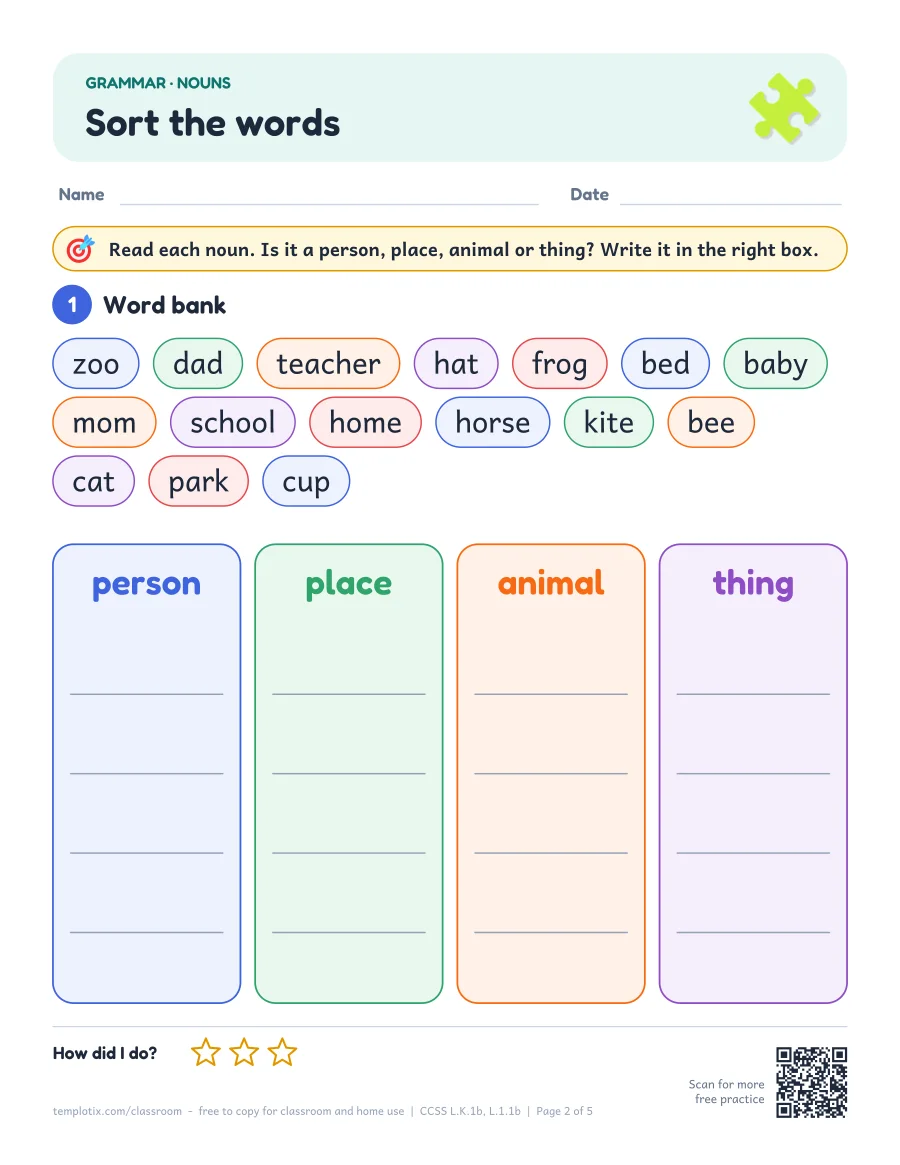
- 2. Sort itA word bank to sort into groups, such as person, place, animal and thing.
- 3. Find itEight short sentences. Children underline or circle the words that fit the rule.
- 4. Write itFinish each sentence with a word from the box, or write the plural yourself.
- 5. Answer key and tipEvery answer, a teaching tip and the most common mistake to watch for.


Common questions
What grammar should children learn in kindergarten to 5th grade?
In the Common Core, kindergarten children use common nouns and verbs, form plurals with -s and -es, and start sentences with a capital letter and end them with a period or question mark. In 1st grade they add adjectives, verb tenses and more punctuation. In 2nd grade they use adjectives and adverbs and irregular plurals. In 3rd grade they add irregular past tense verbs, comparing with -er and -est, possessive nouns with apostrophes, and conjunctions that join ideas. In 4th grade they use relative pronouns, progressive verb tenses, modal verbs and prepositional phrases, and choose between words that sound alike, such as there, their and they're. In 5th grade they add interjections, perfect verb tenses, correlative conjunctions, Greek and Latin roots, and similes and metaphors.
In what order should I teach the parts of speech?
Start with nouns (naming words), then verbs (action words), then adjectives (describing words). Children need to know what a noun is before they can describe it. Capitals and end marks can be taught alongside from the start.
How can I make grammar fun?
Keep it active: act out verbs, play "I spy a noun", and describe objects in a mystery bag with adjectives. Then use the worksheets to practice what children already said out loud.
Can I copy these worksheets for my class?
Yes. The PDFs are free to print and photocopy for classroom and home use, in color or in the black-and-white ink saver. Please link to this page rather than re-uploading the files.