Shop
 Grade workbooks


Classroom · Math · CCSS 1.MD.B.3, 2.MD.C.7, 3.MD.A.1
worksheets for 1st to 3rd grade
Read and draw clocks to the hour, the half hour, 5 minutes and the minute, then work out how much time has passed. Every pack has clocks to read, hands to draw, word problems and an answer key.
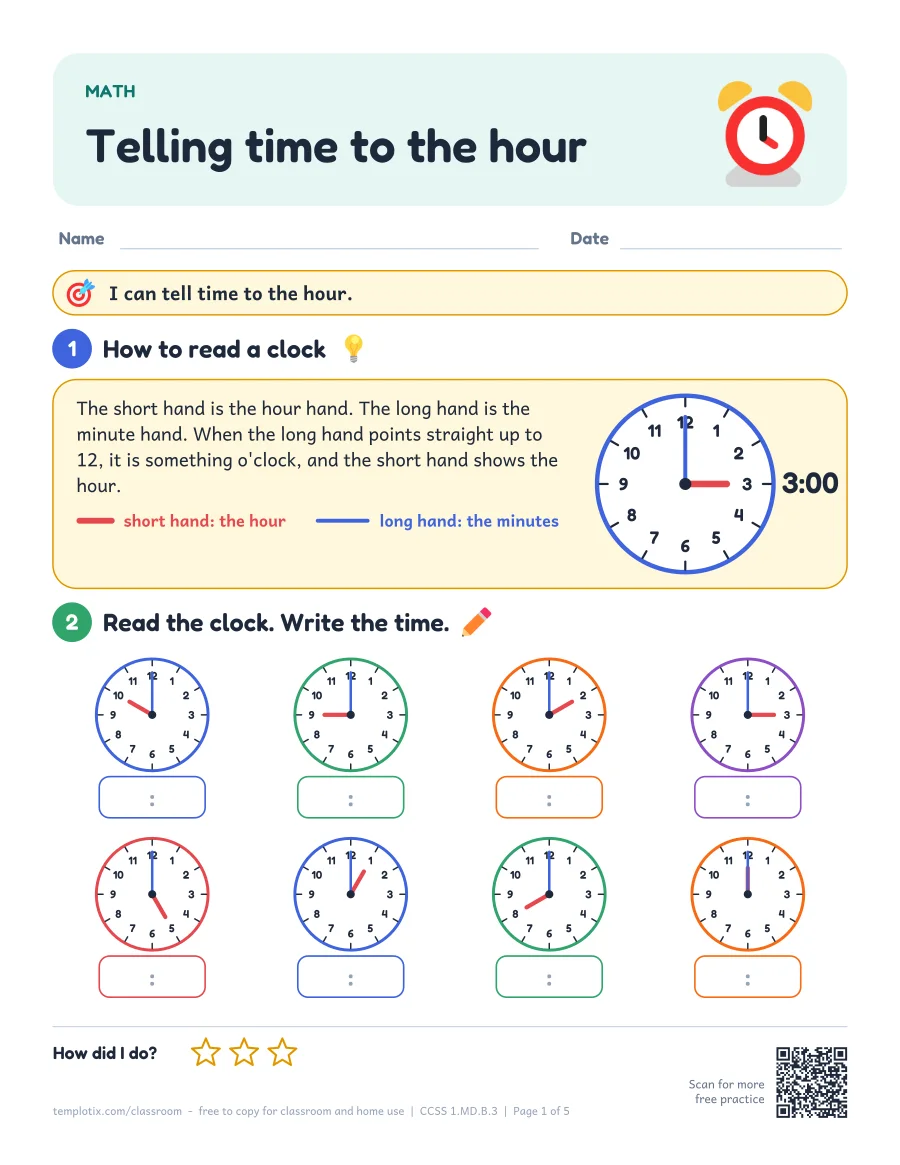
- Telling time to the hour1st grade
The short hand is the hour hand. The long hand is the minute hand. When the long hand points straight up to 12, it is something o'clock, and the short hand shows the hour.
- Telling time to the half hour1st grade
When the long hand points down to 6, half the hour has passed: it is half past. The short hand is halfway between two numbers, so read the number it has just passed.
- Telling time to 5 minutes2nd grade
Each number on the clock stands for 5 minutes. Count by fives from 12 to the long hand: at 4 it is 20 minutes past. Morning times are a.m., and afternoon and evening times are p.m.
- Telling time to the minute3rd grade
Count by fives to the last number the long hand has passed, then count the small marks by ones. Two marks past the 7 is 35 + 2 = 37 minutes.
- Elapsed time3rd grade
Elapsed time is how long something takes. Count on from the start time: jump to the next hour, then add whole hours, then the minutes that are left.

Blank clock faces
 Blank clock faces
Nine clocks with no hands, to make your own practice.
What is in each pack
- 1. Learn itHow to read a clock with a worked example, then eight clocks to read.
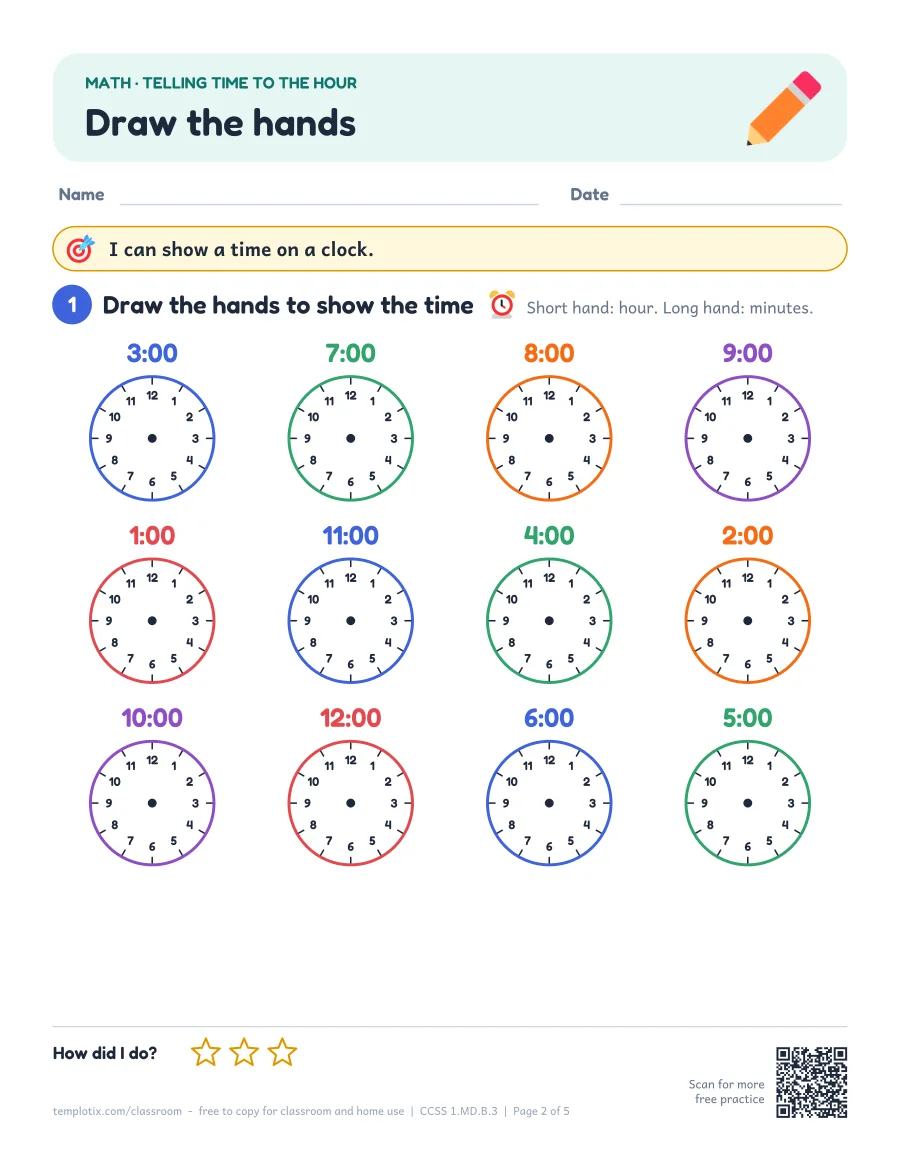
- 2. Draw itTwelve clocks with no hands to draw on. For elapsed time: start and end clocks to compare.
- 3. Skill pageMatching, a.m. and p.m., counting by fives, minutes to the hour, or number lines, depending on the level.
- 4. Word problemsFour short time stories, with a blank clock beside each one.
- 5. Answer key and tipEvery answer on one page, plus a teaching tip for grown-ups.


How to teach telling time
- Start with the hour. Point out that the short hand moves slowly and only the long hand changes quickly.
- Count by fives. Once o’clock and half past are easy, count the long hand around the clock by fives.
- Use the real day. Ask what time lunch is, or how long until recess. Children learn faster when the answer matters.
- Watch the hour hand. At 7:50 the short hand is almost at 8, but it is still 7. Ask which number it has just passed.
- Then find elapsed time. Count on from the start: to the next hour first, then whole hours, then minutes.
More math
Common questions
When do children learn to tell time?
In the Common Core, children tell time to the hour and half hour in 1st grade, to the nearest 5 minutes with a.m. and p.m. in 2nd grade, and to the nearest minute, with elapsed time, in 3rd grade.
Why is the hour hand so tricky?
It moves slowly between the numbers. At 3:30 it sits halfway between 3 and 4, so children often read it as 4. Ask: which number has the hour hand just passed?
Should I teach analog or digital time first?
Analog. A clock face shows how time moves and how the two hands work together. Digital time is easy once children understand the clock.
Can I copy these worksheets for my class?
Yes. The PDFs are free to print and photocopy for classroom and home use, in color or in the black-and-white ink saver. Please link to this page rather than re-uploading the files.