Shop
 Grade workbooks


Classroom · Math · CCSS 1.G.A.3, 2.G.A.3, 3.NF.A.1-3, 4.NF.A.1-2, 4.NF.B.3
worksheets for 1st to 4th grade
From halves and fourths in 1st grade to adding fractions in 4th grade: shaded shapes to name, parts to color, number lines, a fraction wall, comparing and adding, all with answer keys. Shading turns into hatching in the ink saver, so every page still works in black and white.
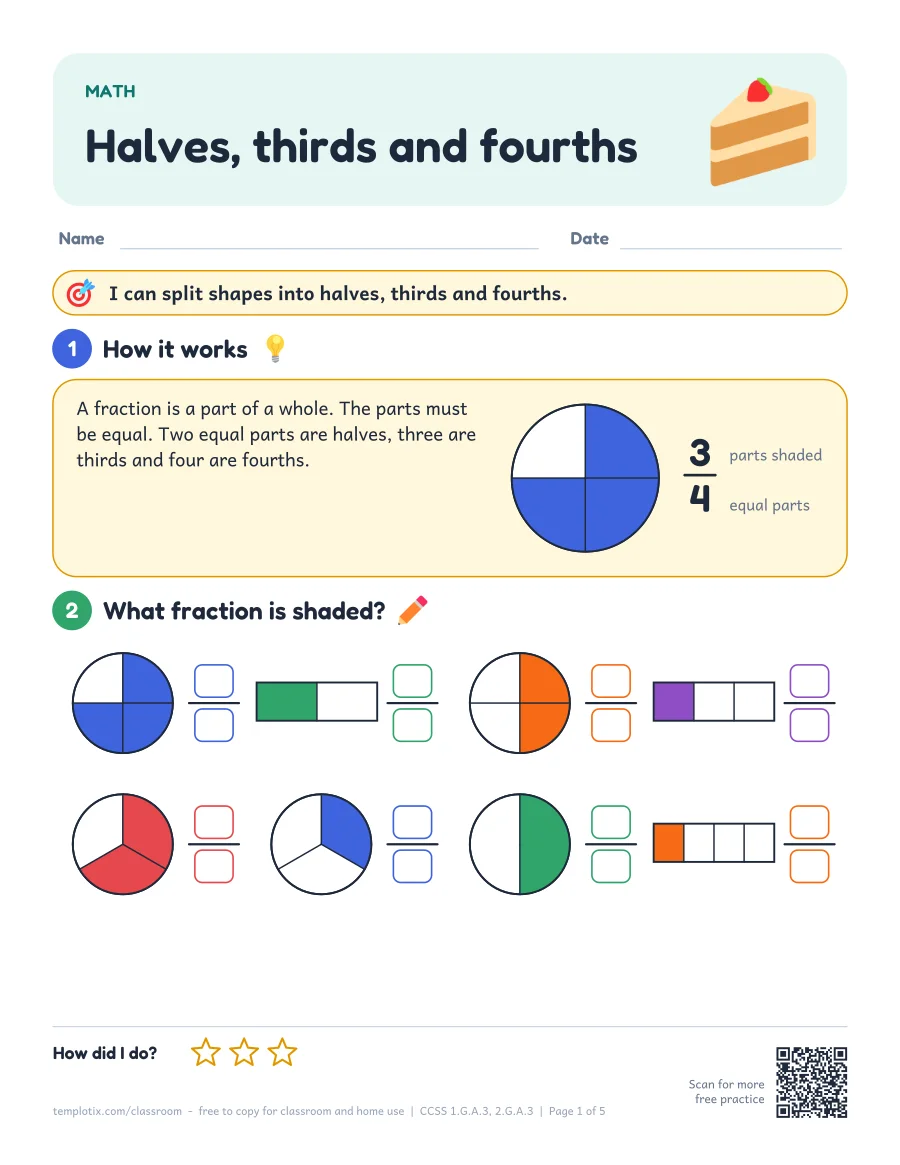
- Halves, thirds and fourths1st and 2nd grade
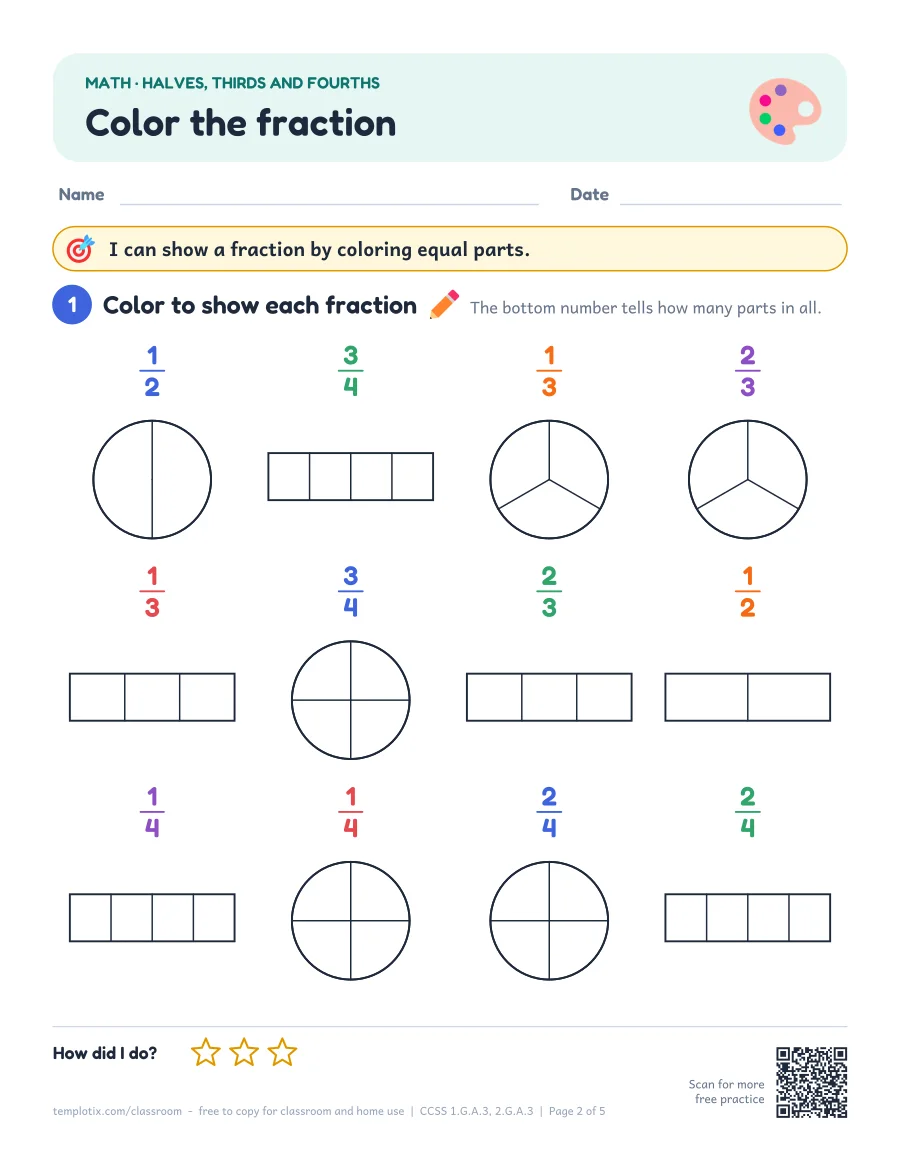
A fraction is a part of a whole. The parts must be equal. Two equal parts are halves, three are thirds and four are fourths.
- Understanding fractions3rd grade
The bottom number (denominator) tells how many equal parts the whole has. The top number (numerator) tells how many parts are shaded.
- Fractions on a number line3rd grade
Split the space from 0 to 1 into equal jumps. If there are 4 jumps, each one is 1/4. The second mark is 2/4, and 4/4 lands on 1.
- Equivalent fractions3rd and 4th grade
Equivalent fractions show the same amount with different numbers. 1/2 and 2/4 cover the same part of the whole. Multiply the top and bottom by the same number to make one.
- Comparing fractions3rd and 4th grade
With the same bottom number, the bigger top number is bigger: 3/8 < 5/8. With the same top number, the smaller bottom number is bigger, because the pieces are larger: 1/3 > 1/6.
- Adding and subtracting fractions4th grade
When the bottom numbers are the same, add or subtract the top numbers and keep the bottom: 2/8 + 3/8 = 5/8. The pieces stay the same size.

Fraction wall
 Fraction wall
Strips for one whole, halves, thirds and so on to twelfths, to compare and find equal fractions.
What is in each pack
- 1. Learn itWhat the top and bottom numbers mean, with a worked picture, then eight shapes to name.
- 2. Picture pageShapes to color, number lines to label, the fraction wall, or fraction bars, depending on the skill.
- 3. Skill pageEqual parts, fractions in words, missing fractions, equal fractions, comparing, or adding and subtracting.
- 4. Word problemsFour stories about cakes, walks, paint and watermelon.
- 5. Answer key and tipEvery answer on one page, plus a teaching tip for grown-ups.


How to teach fractions
- Start with real things. Fold paper, cut sandwiches and share crackers. The parts must be equal to be fractions.
- Name the parts. Say "one fourth" before writing 1/4, so the words and the numbers connect.
- Use one whole. When comparing, the wholes must be the same size. Fraction bars of the same length make this easy.
- Line them up. A fraction wall or number line shows that 2/4 and 1/2 land in the same place.
- Then add. With the same denominator, add the tops and keep the bottom, because the size of the pieces does not change.
More math
Common questions
When do children learn fractions?
In the Common Core, children split shapes into halves and fourths in 1st grade and add thirds in 2nd grade. In 3rd grade they learn what a fraction means, place fractions on a number line and compare them. In 4th grade they find equivalent fractions, compare fractions with different denominators and add and subtract fractions with the same denominator.
What are the numerator and denominator?
The denominator (bottom number) tells how many equal parts make the whole. The numerator (top number) tells how many of those parts you have. In 3/4, there are 4 equal parts and you have 3.
Why is 1/8 smaller than 1/4?
The whole is cut into more pieces, so each piece is smaller. Fold one paper strip into 4 and another into 8 and put them side by side.
Can I copy these worksheets for my class?
Yes. The PDFs are free to print and photocopy for classroom and home use, in color or in the black-and-white ink saver. Please link to this page rather than re-uploading the files.