 Shop
 Grade workbooks


Classroom · Math · CCSS 3.OA.A.1, 3.OA.A.3, 3.OA.A.4, 3.OA.C.7
worksheets: times tables 1 to 12
Every times table has its own five-page pack, from first facts to word problems, with an answer key. Print the chart, practice one table at a time, then make mixed drills with the free worksheet maker. Each PDF comes in color and in ink-saving black and white.
Multiplication chart
 Multiplication chart
All facts from 1 × 1 to 12 × 12, plus a blank chart to fill in.
Times tables book
The chart, a learning page for every table from 1 to 12, and a Times Tables Star certificate.
Worksheet maker
 Worksheet maker
Pick the tables, choose across, columns or missing numbers, and get a new random sheet with an answer key.
Make a worksheetChoose a times table
- 11 times table1 × 1 to 1 × 12
- 22 times table2 × 1 to 2 × 12
- 33 times table3 × 1 to 3 × 12
- 44 times table4 × 1 to 4 × 12
- 55 times table5 × 1 to 5 × 12
- 66 times table6 × 1 to 6 × 12
- 77 times table7 × 1 to 7 × 12
- 88 times table8 × 1 to 8 × 12
- 99 times table9 × 1 to 9 × 12
- 1010 times table10 × 1 to 10 × 12
- 1111 times table11 × 1 to 11 × 12
- 1212 times table12 × 1 to 12 × 12


What is in each pack
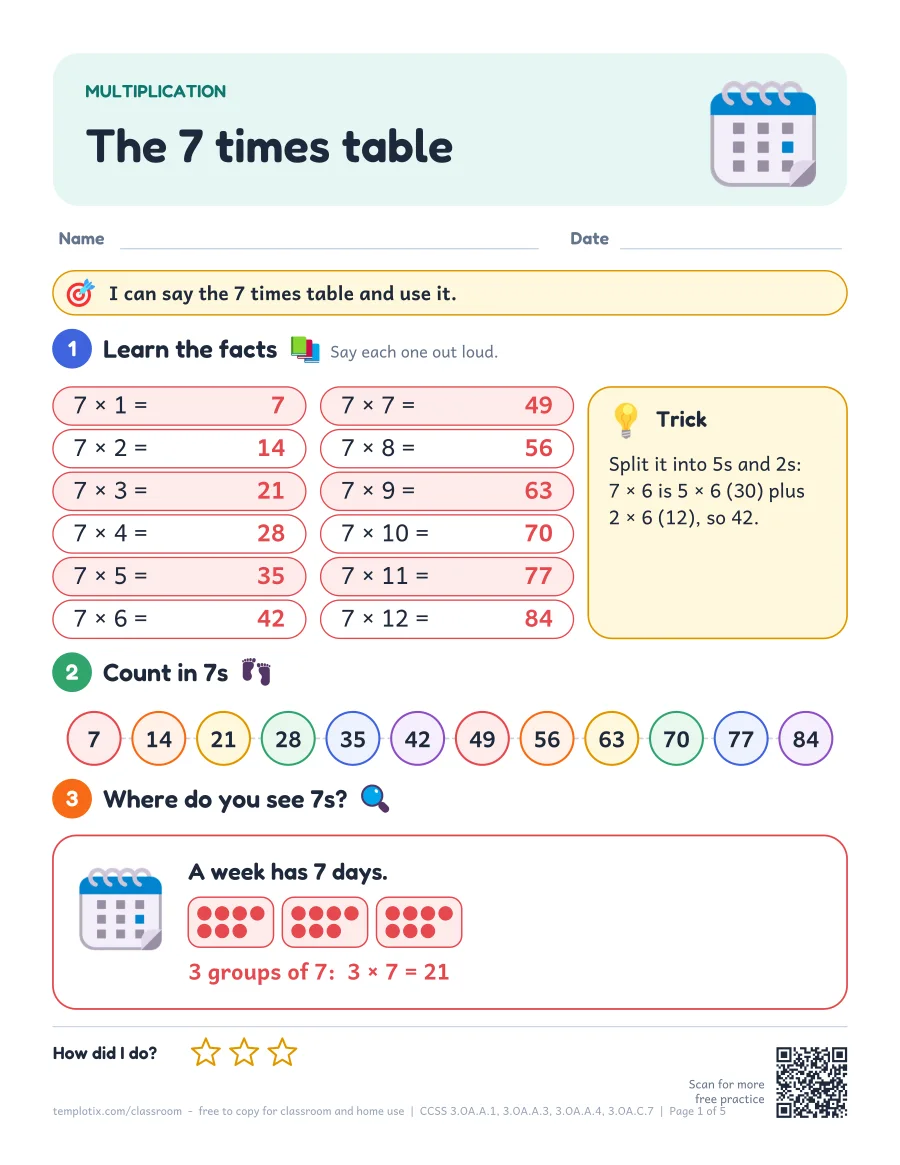
- 1. Learn the tableAll twelve facts, a trick that makes the table easier, counting in steps, and a real-life example drawn as equal groups.
- 2. Practice in orderWrite the table, fill the gaps in the counting row, and find missing numbers like 7 × __ = 56.
- 3. Mixed factsTwenty facts in both orders, six problems in columns, and a hunt for numbers that belong to the table.
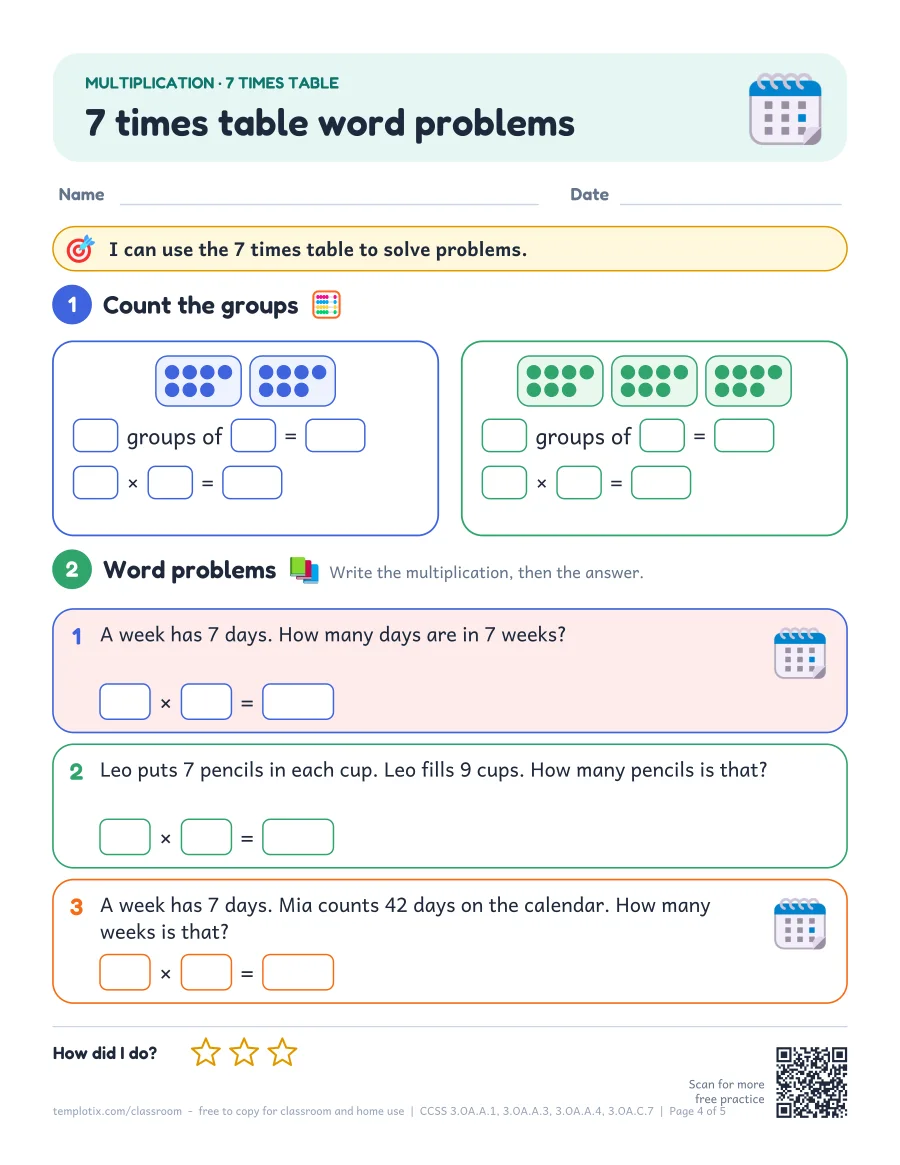
- 4. Pictures and word problemsCount equal groups and write the multiplication, then three short word problems from everyday life.
- 5. Answer key and notesEvery answer, plus short notes for grown-ups on how to practice.


How to teach the times tables
 How to teach the times tables
- Groups first. 3 × 4 means 3 groups of 4. Build it with counters or draw it before learning it by heart.
- Easy tables first. 2, 5 and 10, then 4, 3 and 6, then 8 and 9, then 7, 11 and 12.
- Turn it around. 3 × 4 = 4 × 3, so every new fact is really two facts.
- Use what you know. 6 × 7 is 5 × 7 plus one more 7. Each table page has a trick like this.
- A little every day. Five minutes of mixed facts beats one long weekly session.
Common questions
Which times tables should children learn first?
Start with 2, 5 and 10. They follow easy patterns (even numbers, numbers ending in 5 or 0, numbers ending in 0). Then 4 (double the 2s), 3 and 6, then 8 and 9, and finally 7, 11 and 12.
What grade learns multiplication?
Children meet equal groups and arrays in 2nd grade and learn multiplication properly in 3rd grade. The Common Core standard asks them to know all products of two one-digit numbers (up to 9 × 9) from memory by the end of 3rd grade. Many schools also practice the 10, 11 and 12 times tables.
What is the fastest way to learn the times tables?
A few minutes every day works better than one long session. Understand first (equal groups, counting in steps), then learn the facts with the tricks on each page, then practice mixed facts. Use the worksheet maker to make a fresh sheet of only the facts a child still finds hard.
Why do the worksheets show both 3 × 7 and 7 × 3?
Because they have the same answer. Once children see that order does not matter, they only have to learn about half of the facts, and every fact they learn counts twice.
Can I copy these worksheets for my class?
Yes. The PDFs are free to print and photocopy for classroom and home use, in color or in the black-and-white ink saver. Please link to this page rather than re-uploading the files.