Shop
 Grade workbooks


Classroom · Phonics · CCSS RF.K.3b
worksheets
Picture-rich worksheets for the first words children sound out on their own. Each short vowel has a seven-page pack: meet the words, tap and blend with sound buttons, picture match, write the word, sort the word families, read and trace, and an answer key. Every PDF comes in color and in ink-saving black and white.
short
28 words · 6 families
cat, hat, bat, rat
short
19 words · 5 families
bed, pen, hen, net
short
27 words · 6 families
pin, bin, six, kit
short
22 words · 6 families
dog, log, box, fox
short
20 words · 6 families
sun, bus, cup, bug




Mixed short vowel review
 Mixed short vowel review
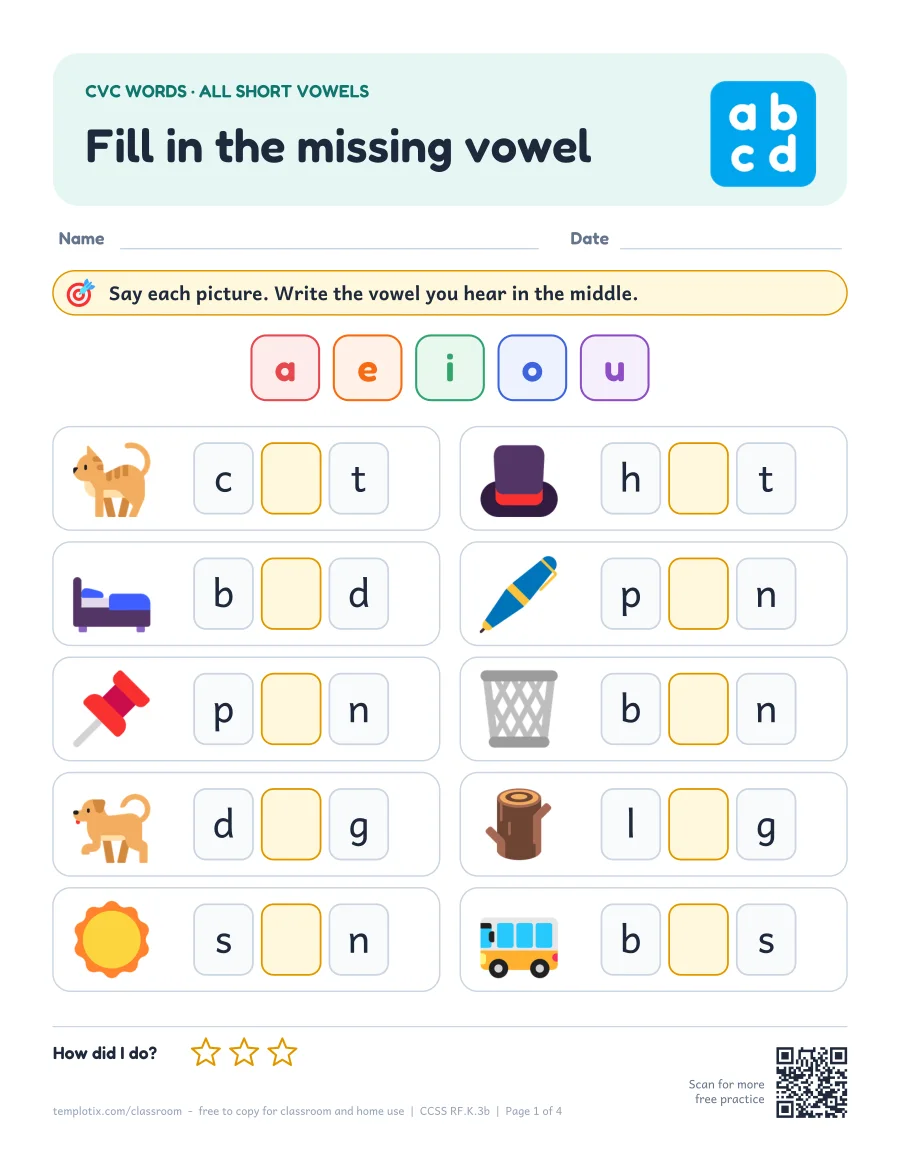
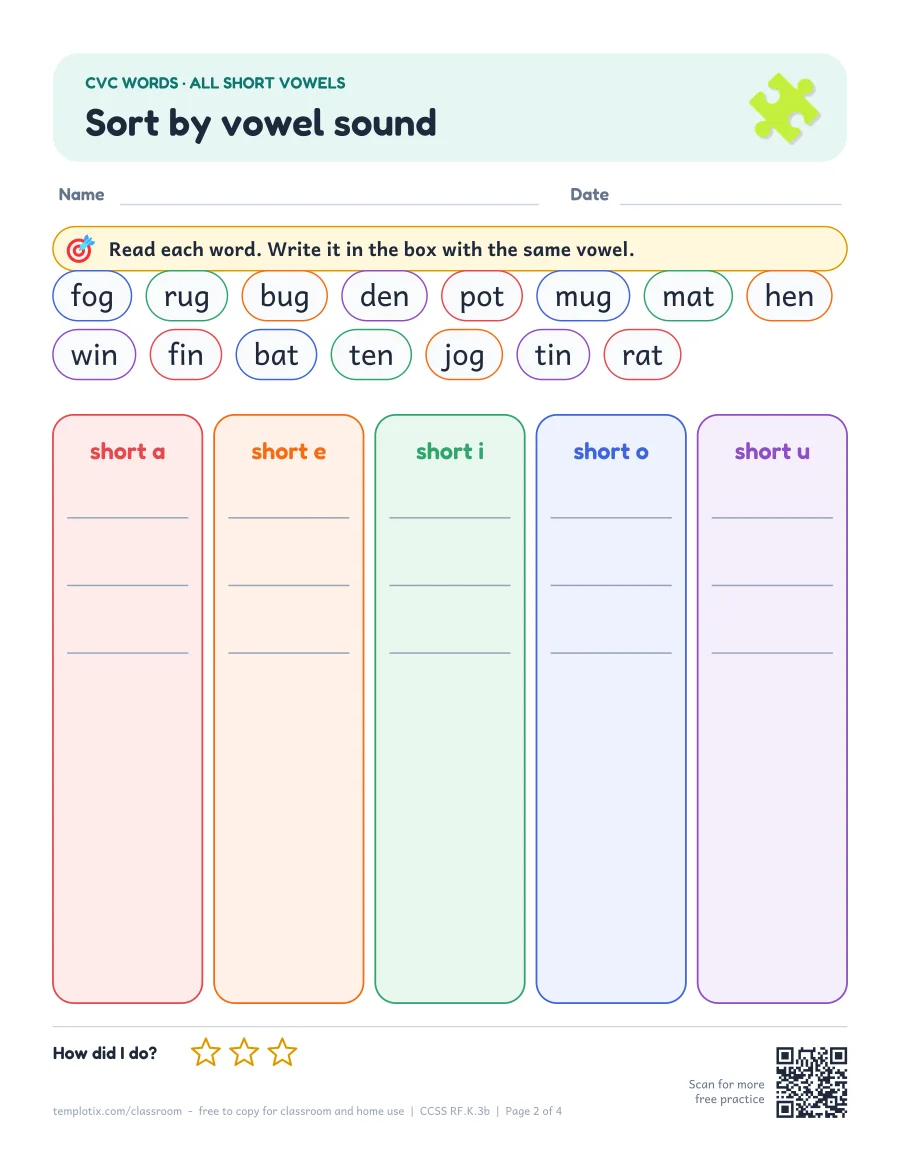
Once the vowels are taught one at a time, mix them: fill in the missing vowel from a picture, then sort words by their vowel sound. Includes an answer key and a CVC Word Champion certificate.
How to teach CVC words
 How to teach CVC words
- Hear it first. Say a word and ask for the middle sound before any letters appear.
- Tap and blend. One finger per sound, then sweep: c, a, t, cat.
- One vowel at a time. Stay with short a until blending is easy, then add the next vowel.
- Use word families. Change the first sound to read a whole family: cat, hat, bat, rat.
- Mix them up. Only then use the mixed review, where the vowel changes from word to word.
Common questions
What is a CVC word?
A CVC word has three letters in the pattern consonant, vowel, consonant, like cat, bed, pin, dog and sun. The vowel in the middle makes its short sound, so CVC words are usually the first words children learn to sound out and blend.
In what order should the short vowels be taught?
Many programs start with short a, then add short i or short o, and leave short e for later because it is easily confused with short i. There is no single correct order; what matters is mastering one vowel before mixing them, then practicing them together.
What are sound buttons?
Sound buttons are dots under each letter. The child touches each dot and says that letter’s sound (c, a, t), then sweeps a finger under the whole word to blend the sounds into "cat". Page 2 of every pack uses them.
Are CVC words the same as word families?
Word families are groups of words that share an ending, such as -at (cat, hat, bat). Most early word families are made of CVC words, so learning a family is a quick way to read many CVC words at once.