Shop
 Grade workbooks


Sight words · Dolch primer · CCSS RF.K.3c
Sight word worksheets
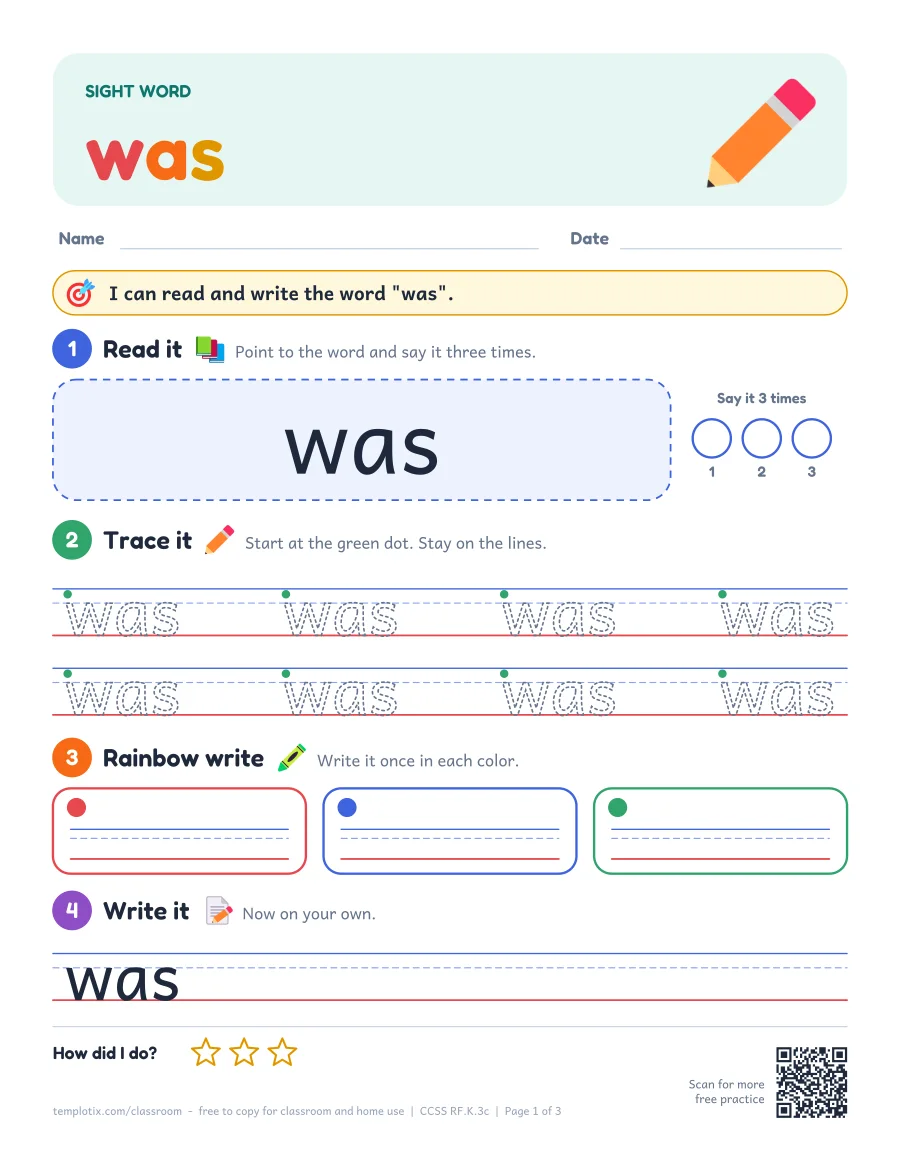
A free three-page worksheet for the sight word “was”: children read it, trace it, rainbow-write it, pick it out from look-alike words and use it in picture sentences. Page 3 is the answer key with a teaching tip. US Letter, in color or ink-saving black and white.
Watch it solved
51 sec · with voice and captionsA pencil works one example of each activity, so you can see how the worksheet goes before you print it. Tap a step to jump to it. The rest of the sheet is left for your child to finish.
Read what the video says
- 0:00 Let's do the sight word worksheet for the word "was", step by step.
- 0:04 First, read it. Point to the word, and say it three times.
- 0:10 Next, trace it. Start at the green dot, and stay on the dotted lines.
- 0:16 Now rainbow write. Write it in red first. Then use blue and green.
- 0:21 Then write it on your own, next to the example.
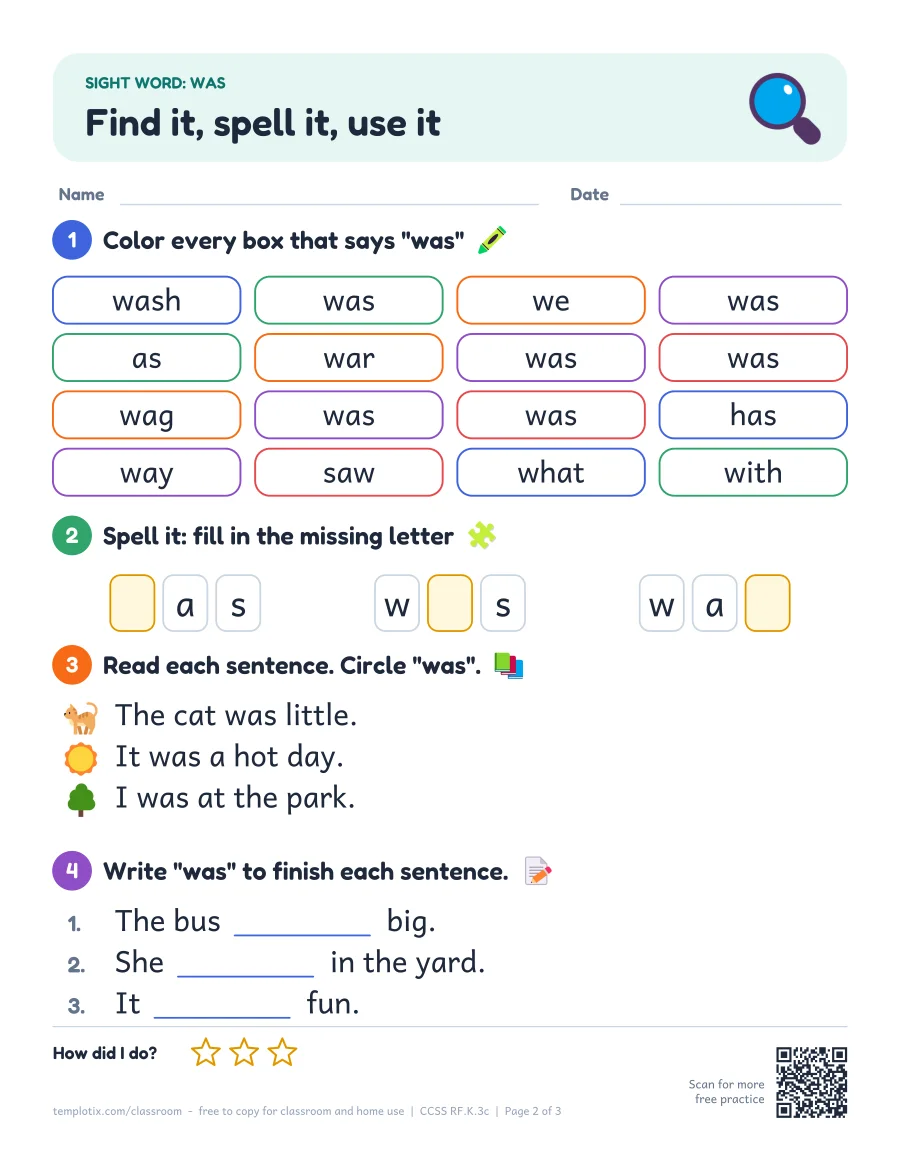
- 0:25 On page two, color every box that says "was". Here's one, and here's another. Can you find the rest?
- 0:32 Spell it. Fill in the missing letter to make "was".
- 0:36 Read each sentence, and circle "was". The cat was little.
- 0:40 Write "was" to finish each sentence. The bus was big.
- 0:44 Great job! Now print the free worksheet, and finish the rest on your own.
What is on the worksheet
- Read it. The word large, to say aloud three times and check off.
- Trace it. Dotted “was” on color-coded three-line handwriting paper, with a start dot.
- Rainbow write. Write it once each in red, blue and green.
- Write it. One model, then space to write it independently.
- Find it. A 16-box grid: color every box that says “was”, among words that look similar.
- Spell it. The word with one letter missing, three times, a different letter each time.
- Read and write it in sentences. Three picture sentences to read and circle the word, three to finish by writing it.
- Answer key. The completed grid and sentences, plus the teaching tip below.
Every page has an “I can” goal, a three-star “How did I do?” self-check and a QR code back to this page.
Teaching “was”
 Teaching “was”
"Was" is said /wuz/: neither the a nor the s makes its usual sound, so it has to be learned by sight. Keep it in short sentences about things that already happened.
Watch for: Reading it as "saw" (a reversal). Have the child put a finger under the w before reading.
Sentences on the worksheet
All six use simple words a beginning reader can decode, so the sight word is the only new thing on the line.
Read and circle
- The cat was little.
- It was a hot day.
- I was at the park.
 It was a hot day.
 I was at the park.
Write to finish
- The bus ______ big.
- She ______ in the yard.
- It ______ fun.
How to use it
- Say the word and use it in a sentence before the sheet comes out.
- Do page 1 together: read, trace, then write without the model.
- Let the child do page 2 alone, then read the sentences back to you.
- Come back to the word over the next few days: a quick look and read is enough.
Common questions
Is “was” a Dolch sight word?
Yes. “was” is on the Dolch primer list, and it is also one of the first 100 words on the Fry list, so it shows up constantly in early readers.
How do you teach the sight word “was”?
"Was" is said /wuz/: neither the a nor the s makes its usual sound, so it has to be learned by sight. Keep it in short sentences about things that already happened.
What is the most common mistake with “was”?
Reading it as "saw" (a reversal). Have the child put a finger under the w before reading.
Can I copy this worksheet for my class?
Yes. The PDF is free to print and photocopy for classroom and home use. Please link to this page rather than re-uploading the file elsewhere.
Track progress and celebrate
 Track progress and celebrate
A star chart for all 10 words, and a certificate for when every row is full.