 Shop
 Grade workbooks


Classroom · Reading comprehension · 4th grade
reading comprehension worksheets
8 original passages, half stories and half nonfiction, each 177 to 200 words long. Every passage comes with four pages: the text, comprehension questions, word work and writing, and an answer key.
All 8 passages in one PDF
With a reading log and a Super Reader certificate.
The passages
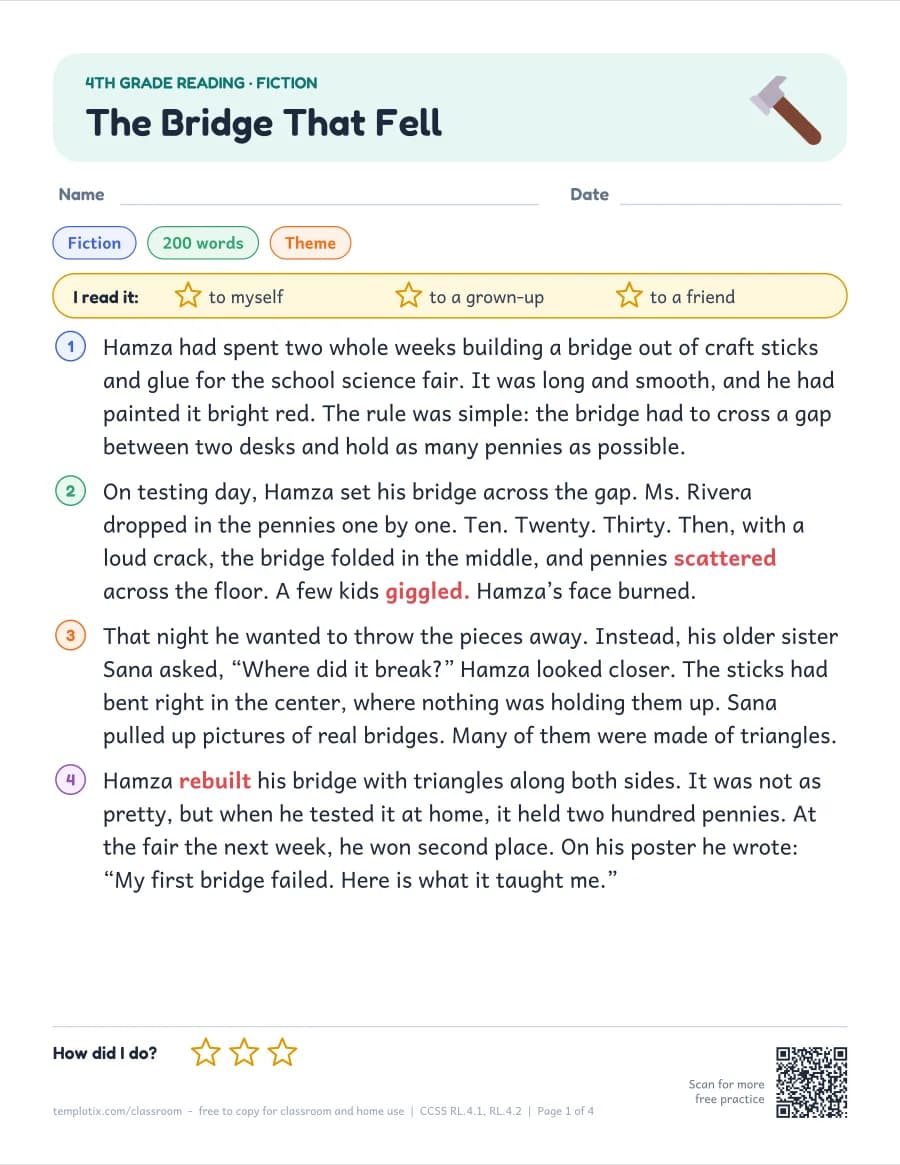
1. The Bridge That Fell
Fiction200 wordsThemeCCSS RL.4.1, RL.4.2
Hamza had spent two whole weeks building a bridge out of craft sticks and glue for the school science fair. It was long and smooth, and he had painted it bright red. The rule was simple: the bridge had to cross a gap between two desks and hold as many pennies as possible.
Read the whole passage
On testing day, Hamza set his bridge across the gap. Ms. Rivera dropped in the pennies one by one. Ten. Twenty. Thirty. Then, with a loud crack, the bridge folded in the middle, and pennies scattered across the floor. A few kids giggled. Hamza’s face burned.
That night he wanted to throw the pieces away. Instead, his older sister Sana asked, “Where did it break?” Hamza looked closer. The sticks had bent right in the center, where nothing was holding them up. Sana pulled up pictures of real bridges. Many of them were made of triangles.
Hamza rebuilt his bridge with triangles along both sides. It was not as pretty, but when he tested it at home, it held two hundred pennies. At the fair the next week, he won second place. On his poster he wrote: “My first bridge failed. Here is what it taught me.”
Words taught: scattered, giggled, rebuilt.
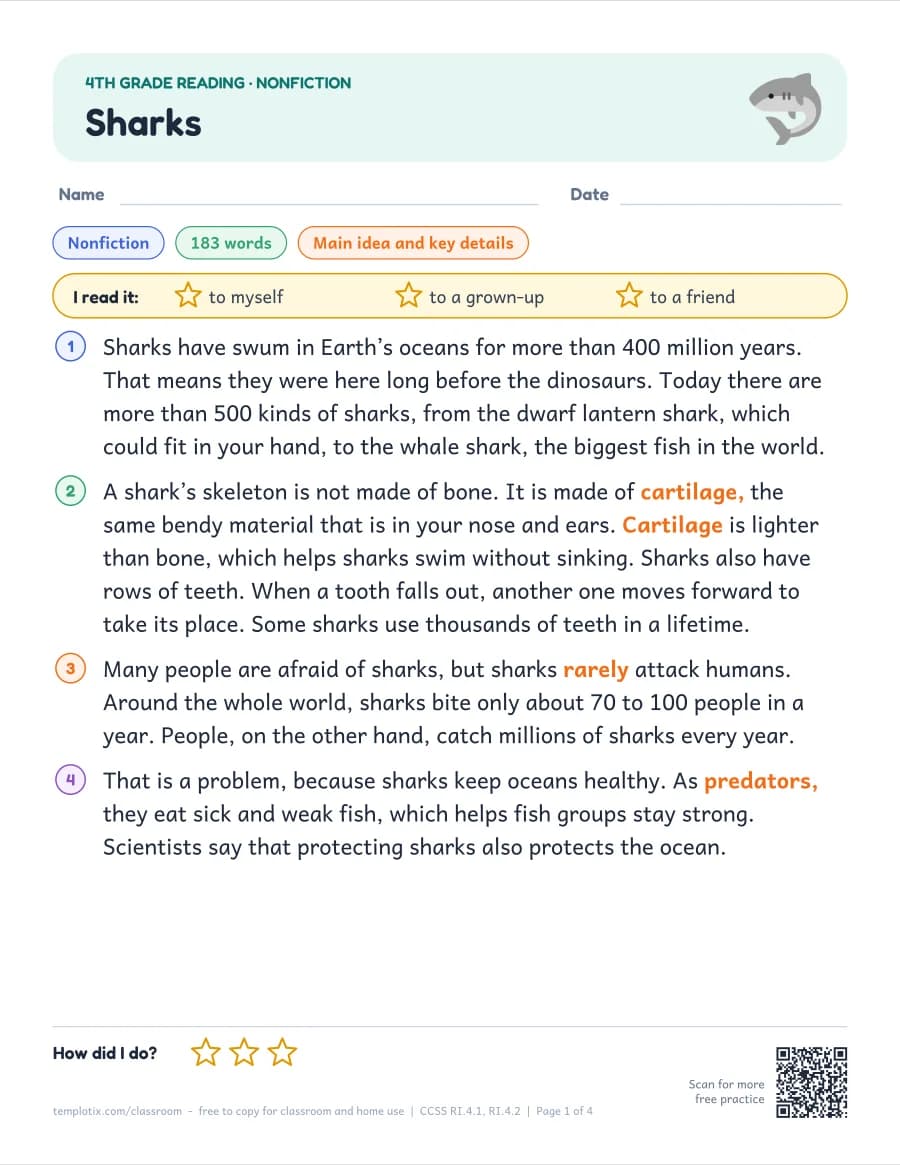
2. Sharks
Nonfiction183 wordsMain idea and key detailsCCSS RI.4.1, RI.4.2
Sharks have swum in Earth’s oceans for more than 400 million years. That means they were here long before the dinosaurs. Today there are more than 500 kinds of sharks, from the dwarf lantern shark, which could fit in your hand, to the whale shark, the biggest fish in the world.
Read the whole passage
A shark’s skeleton is not made of bone. It is made of cartilage, the same bendy material that is in your nose and ears. Cartilage is lighter than bone, which helps sharks swim without sinking. Sharks also have rows of teeth. When a tooth falls out, another one moves forward to take its place. Some sharks use thousands of teeth in a lifetime.
Many people are afraid of sharks, but sharks rarely attack humans. Around the whole world, sharks bite only about 70 to 100 people in a year. People, on the other hand, catch millions of sharks every year.
That is a problem, because sharks keep oceans healthy. As predators, they eat sick and weak fish, which helps fish groups stay strong. Scientists say that protecting sharks also protects the ocean.
Words taught: cartilage, rarely, predators.
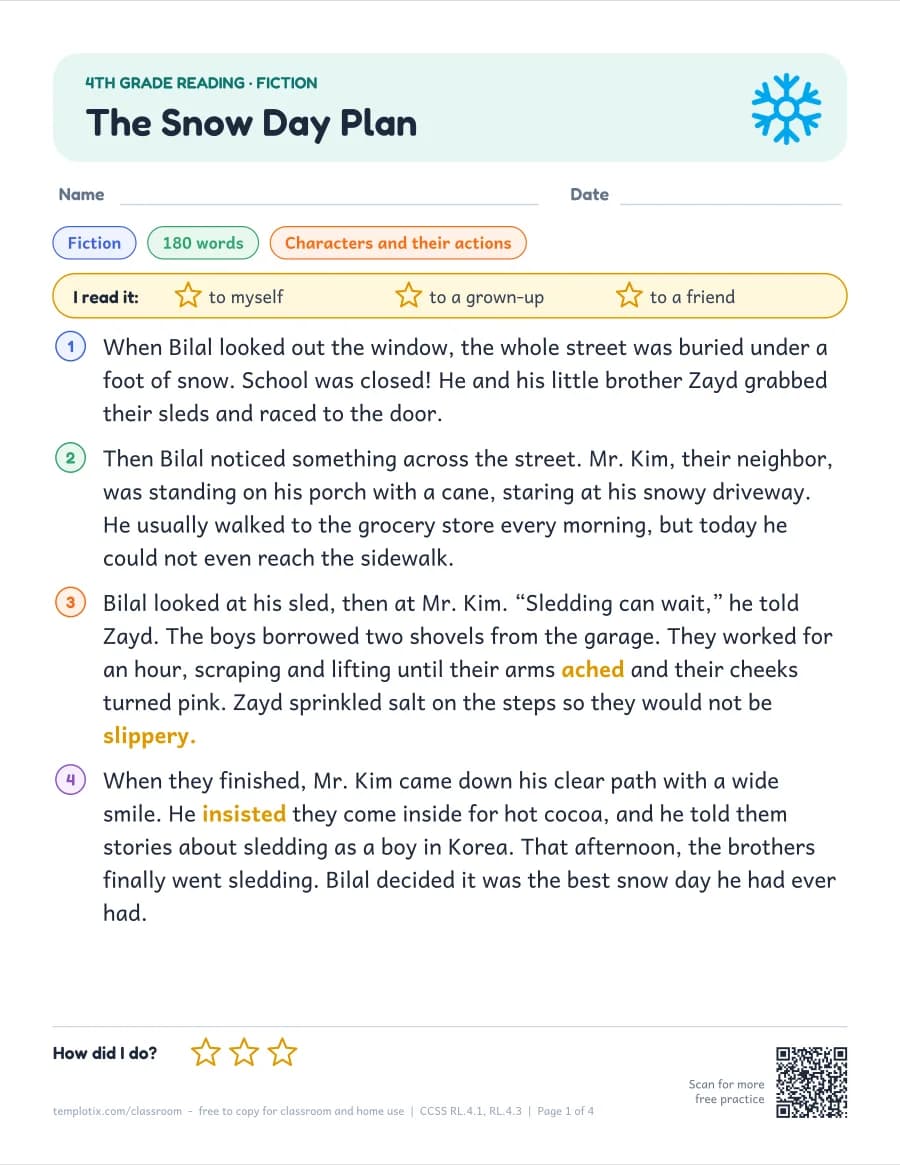
3. The Snow Day Plan
Fiction180 wordsCharacters and their actionsCCSS RL.4.1, RL.4.3
When Bilal looked out the window, the whole street was buried under a foot of snow. School was closed! He and his little brother Zayd grabbed their sleds and raced to the door.
Read the whole passage
Then Bilal noticed something across the street. Mr. Kim, their neighbor, was standing on his porch with a cane, staring at his snowy driveway. He usually walked to the grocery store every morning, but today he could not even reach the sidewalk.
Bilal looked at his sled, then at Mr. Kim. “Sledding can wait,” he told Zayd. The boys borrowed two shovels from the garage. They worked for an hour, scraping and lifting until their arms ached and their cheeks turned pink. Zayd sprinkled salt on the steps so they would not be slippery.
When they finished, Mr. Kim came down his clear path with a wide smile. He insisted they come inside for hot cocoa, and he told them stories about sledding as a boy in Korea. That afternoon, the brothers finally went sledding. Bilal decided it was the best snow day he had ever had.
Words taught: ached, slippery, insisted.
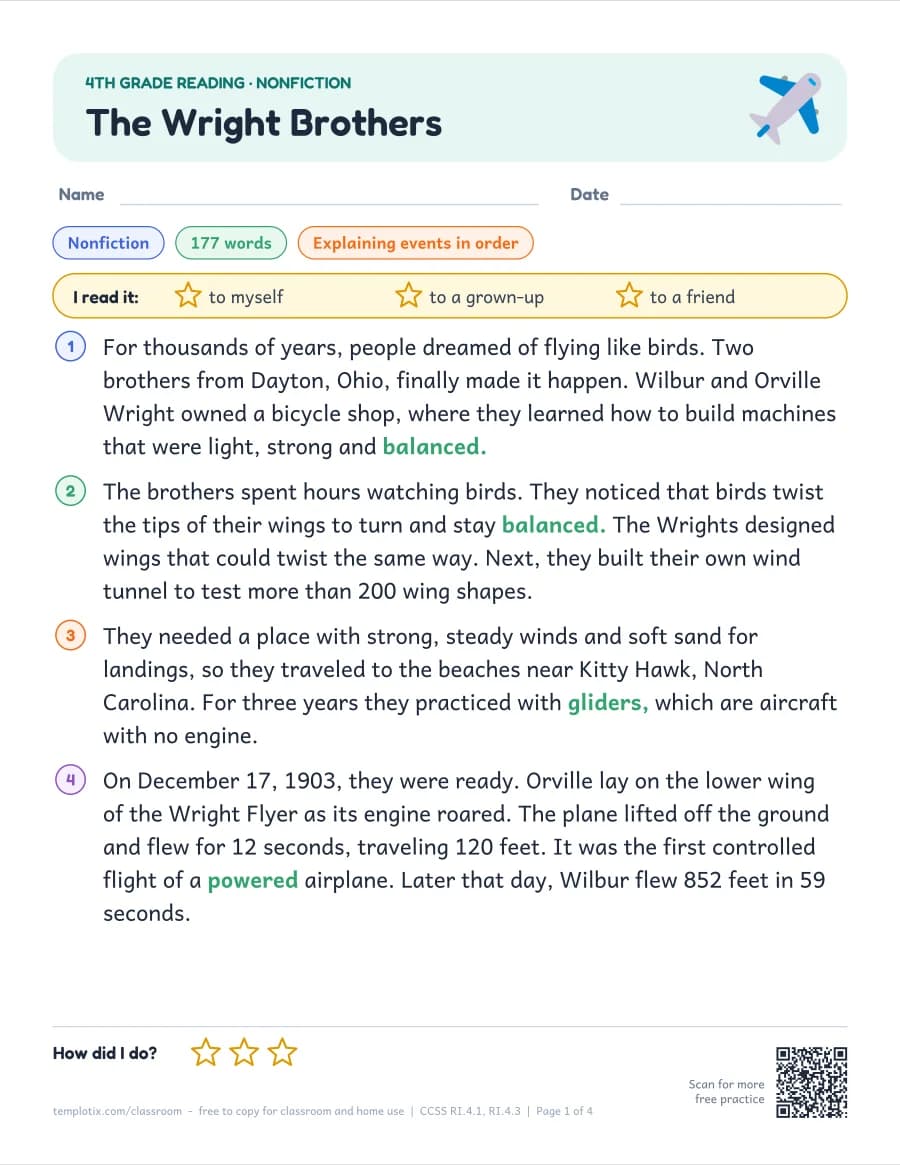
4. The Wright Brothers
Nonfiction177 wordsExplaining events in orderCCSS RI.4.1, RI.4.3
For thousands of years, people dreamed of flying like birds. Two brothers from Dayton, Ohio, finally made it happen. Wilbur and Orville Wright owned a bicycle shop, where they learned how to build machines that were light, strong and balanced.
Read the whole passage
The brothers spent hours watching birds. They noticed that birds twist the tips of their wings to turn and stay balanced. The Wrights designed wings that could twist the same way. Next, they built their own wind tunnel to test more than 200 wing shapes.
They needed a place with strong, steady winds and soft sand for landings, so they traveled to the beaches near Kitty Hawk, North Carolina. For three years they practiced with gliders, which are aircraft with no engine.
On December 17, 1903, they were ready. Orville lay on the lower wing of the Wright Flyer as its engine roared. The plane lifted off the ground and flew for 12 seconds, traveling 120 feet. It was the first controlled flight of a powered airplane. Later that day, Wilbur flew 852 feet in 59 seconds.
Words taught: balanced, gliders, powered.
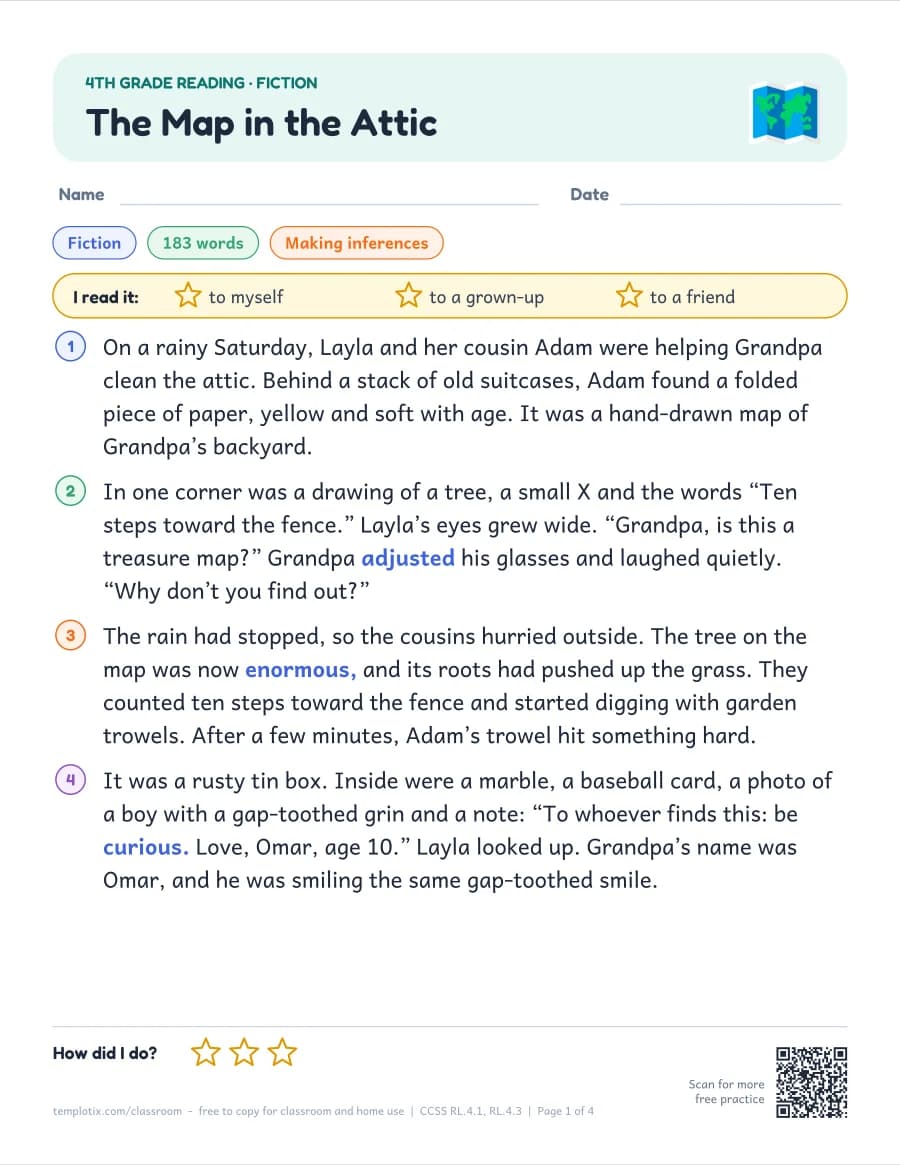
5. The Map in the Attic
Fiction183 wordsMaking inferencesCCSS RL.4.1, RL.4.3
On a rainy Saturday, Layla and her cousin Adam were helping Grandpa clean the attic. Behind a stack of old suitcases, Adam found a folded piece of paper, yellow and soft with age. It was a hand-drawn map of Grandpa’s backyard.
Read the whole passage
In one corner was a drawing of a tree, a small X and the words “Ten steps toward the fence.” Layla’s eyes grew wide. “Grandpa, is this a treasure map?” Grandpa adjusted his glasses and laughed quietly. “Why don’t you find out?”
The rain had stopped, so the cousins hurried outside. The tree on the map was now enormous, and its roots had pushed up the grass. They counted ten steps toward the fence and started digging with garden trowels. After a few minutes, Adam’s trowel hit something hard.
It was a rusty tin box. Inside were a marble, a baseball card, a photo of a boy with a gap-toothed grin and a note: “To whoever finds this: be curious. Love, Omar, age 10.” Layla looked up. Grandpa’s name was Omar, and he was smiling the same gap-toothed smile.
Words taught: adjusted, enormous, curious.
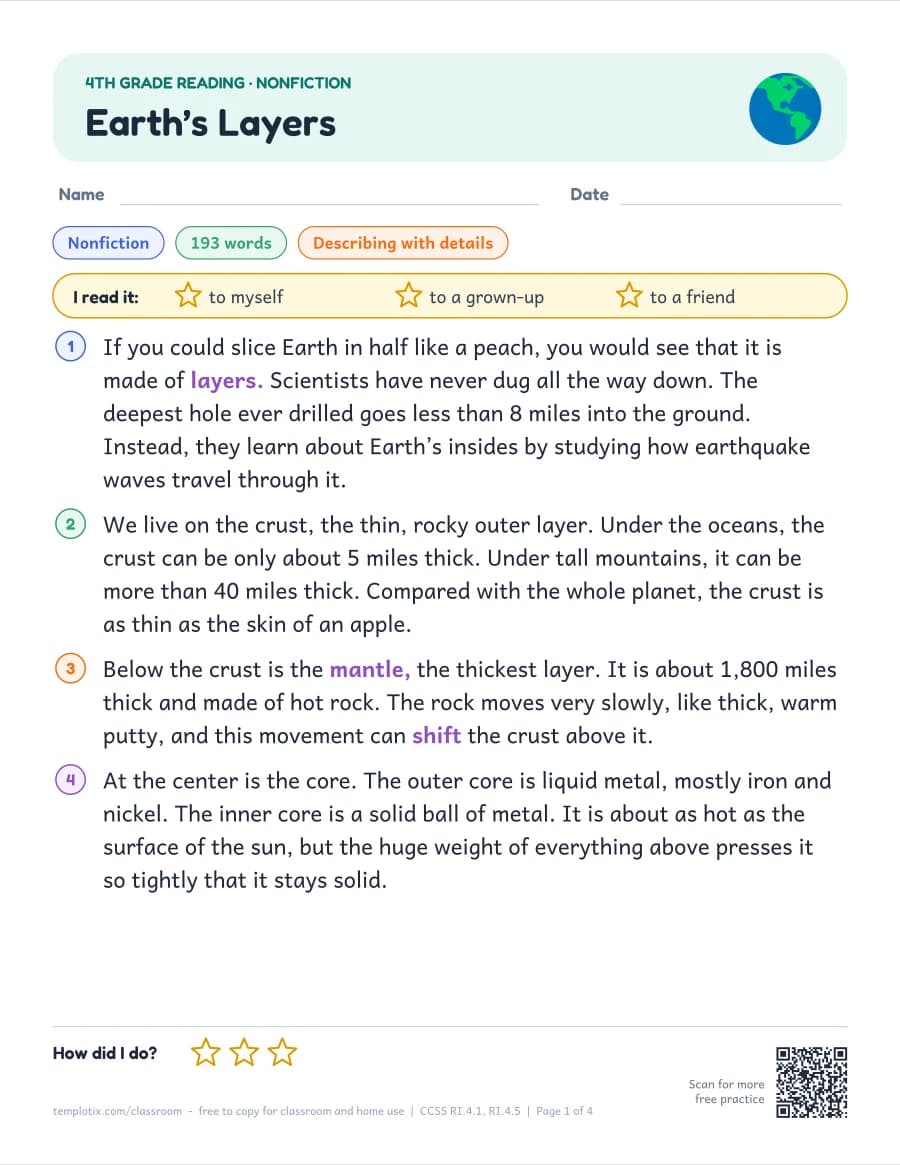
6. Earth’s Layers
Nonfiction193 wordsDescribing with detailsCCSS RI.4.1, RI.4.5
If you could slice Earth in half like a peach, you would see that it is made of layers. Scientists have never dug all the way down. The deepest hole ever drilled goes less than 8 miles into the ground. Instead, they learn about Earth’s insides by studying how earthquake waves travel through it.
Read the whole passage
We live on the crust, the thin, rocky outer layer. Under the oceans, the crust can be only about 5 miles thick. Under tall mountains, it can be more than 40 miles thick. Compared with the whole planet, the crust is as thin as the skin of an apple.
Below the crust is the mantle, the thickest layer. It is about 1,800 miles thick and made of hot rock. The rock moves very slowly, like thick, warm putty, and this movement can shift the crust above it.
At the center is the core. The outer core is liquid metal, mostly iron and nickel. The inner core is a solid ball of metal. It is about as hot as the surface of the sun, but the huge weight of everything above presses it so tightly that it stays solid.
Words taught: layers, mantle, shift.
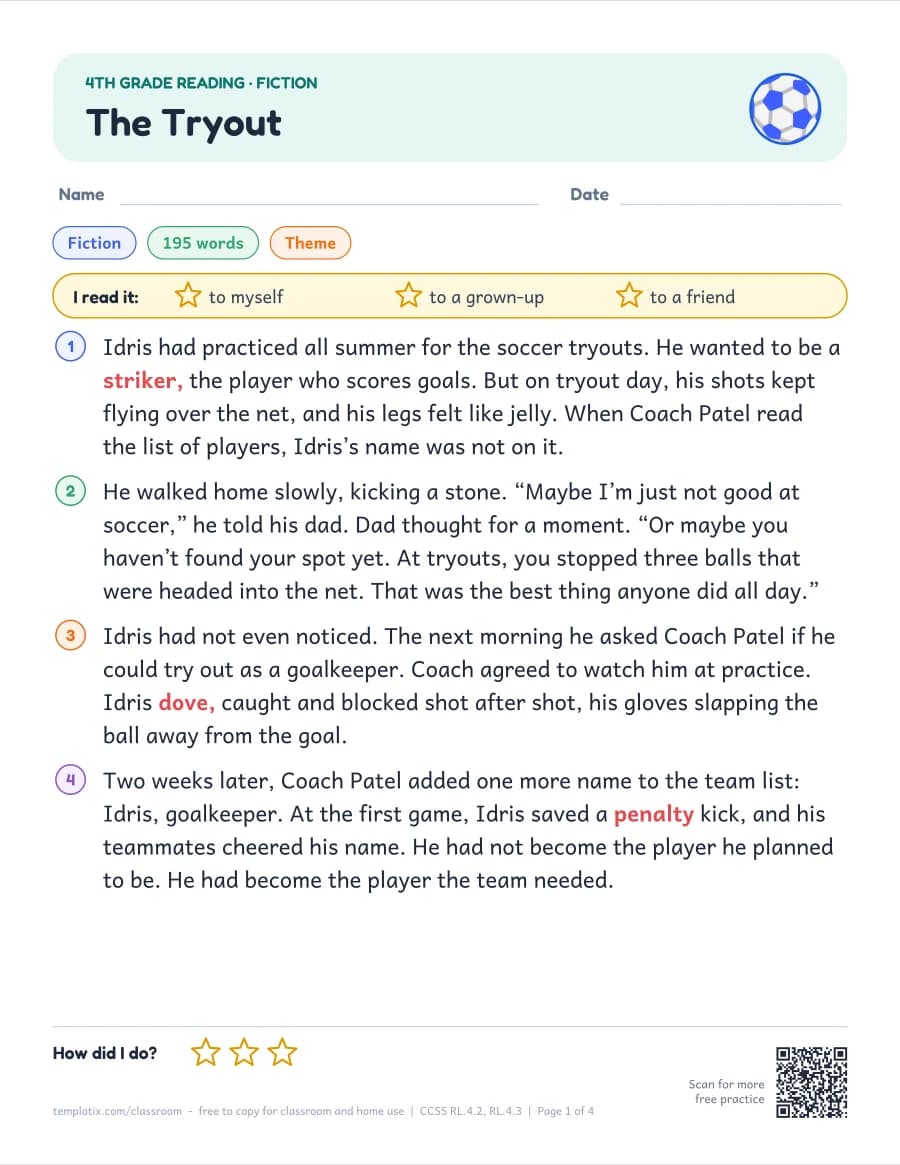
7. The Tryout
Fiction195 wordsThemeCCSS RL.4.2, RL.4.3
Idris had practiced all summer for the soccer tryouts. He wanted to be a striker, the player who scores goals. But on tryout day, his shots kept flying over the net, and his legs felt like jelly. When Coach Patel read the list of players, Idris’s name was not on it.
Read the whole passage
He walked home slowly, kicking a stone. “Maybe I’m just not good at soccer,” he told his dad. Dad thought for a moment. “Or maybe you haven’t found your spot yet. At tryouts, you stopped three balls that were headed into the net. That was the best thing anyone did all day.”
Idris had not even noticed. The next morning he asked Coach Patel if he could try out as a goalkeeper. Coach agreed to watch him at practice. Idris dove, caught and blocked shot after shot, his gloves slapping the ball away from the goal.
Two weeks later, Coach Patel added one more name to the team list: Idris, goalkeeper. At the first game, Idris saved a penalty kick, and his teammates cheered his name. He had not become the player he planned to be. He had become the player the team needed.
Words taught: striker, dove, penalty.
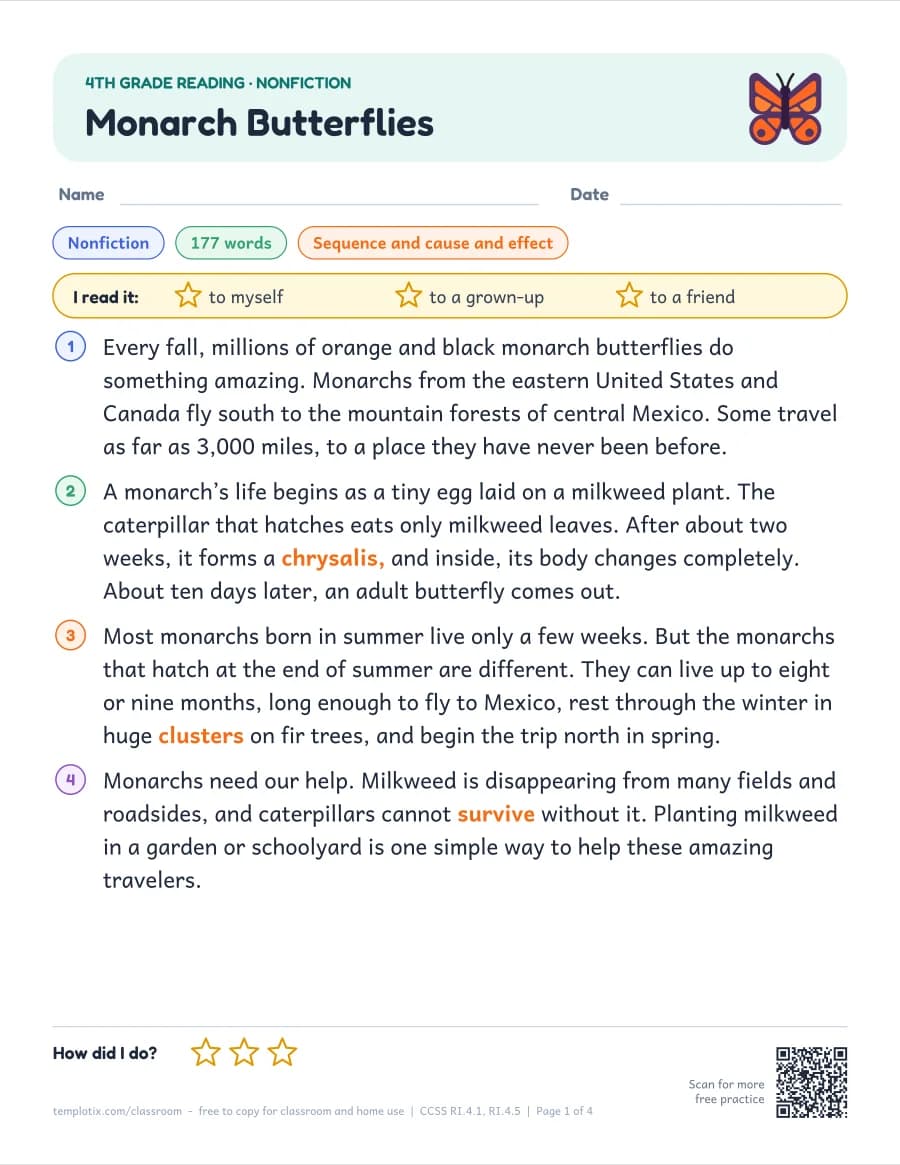
8. Monarch Butterflies
Nonfiction177 wordsSequence and cause and effectCCSS RI.4.1, RI.4.5
Every fall, millions of orange and black monarch butterflies do something amazing. Monarchs from the eastern United States and Canada fly south to the mountain forests of central Mexico. Some travel as far as 3,000 miles, to a place they have never been before.
Read the whole passage
A monarch’s life begins as a tiny egg laid on a milkweed plant. The caterpillar that hatches eats only milkweed leaves. After about two weeks, it forms a chrysalis, and inside, its body changes completely. About ten days later, an adult butterfly comes out.
Most monarchs born in summer live only a few weeks. But the monarchs that hatch at the end of summer are different. They can live up to eight or nine months, long enough to fly to Mexico, rest through the winter in huge clusters on fir trees, and begin the trip north in spring.
Monarchs need our help. Milkweed is disappearing from many fields and roadsides, and caterpillars cannot survive without it. Planting milkweed in a garden or schoolyard is one simple way to help these amazing travelers.
Words taught: chrysalis, clusters, survive.
 1. The Bridge That Fell
 2. Sharks
 3. The Snow Day Plan
 4. The Wright Brothers
 5. The Map in the Attic
 6. Earth’s Layers
 7. The Tryout
 8. Monarch Butterflies
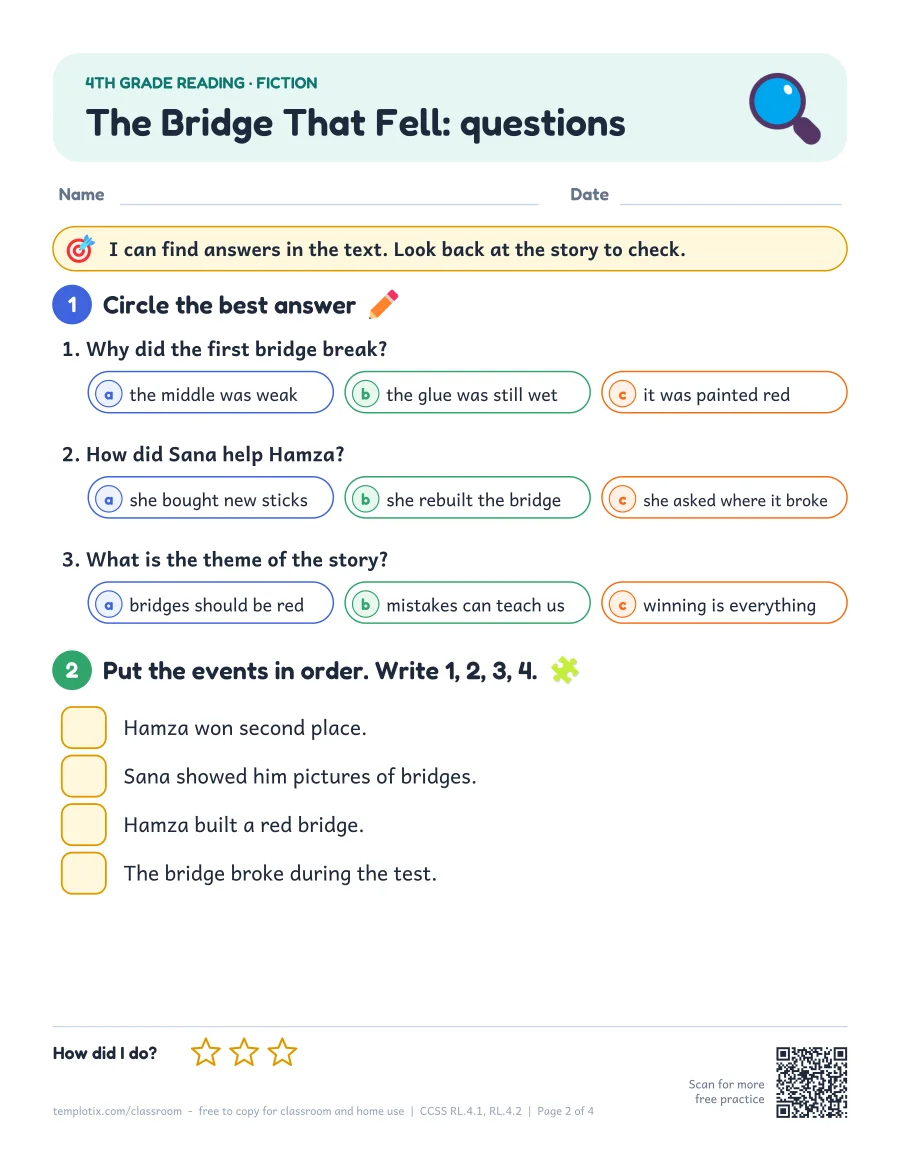
Inside a worksheet
Common questions
What reading level are these 4th grade passages?
They are written for 4th grade: 177 to 200 words, with short sentences and everyday vocabulary, plus three new words in each passage that are taught on the worksheet. Use them for children reading at or near a 4th grade level.
What is in each worksheet?
Four pages: the passage with a "read it three times" tracker, multiple-choice questions with either an order-of-events or a true-or-false task, a word-meaning match with a written answer and a drawing box, and an answer key with a sample written answer.
How should I use a passage?
Read it together first, then let the child read it alone and to someone else (the stars on page 1 track this). Do the questions the next day, and ask the child to point to the sentence in the text that proves each answer.
Can I copy these worksheets for my class?
Yes. The PDFs are free to print and photocopy for classroom and home use, in color or in the black-and-white ink saver. Please link to this page rather than re-uploading the files.