Shop
 Grade workbooks


Classroom · Reading comprehension · 2nd grade
reading comprehension worksheets
8 original passages, half stories and half nonfiction, each 129 to 158 words long. Every passage comes with four pages: the text, comprehension questions, word work and writing, and an answer key.
All 8 passages in one PDF
With a reading log and a Super Reader certificate.
The passages
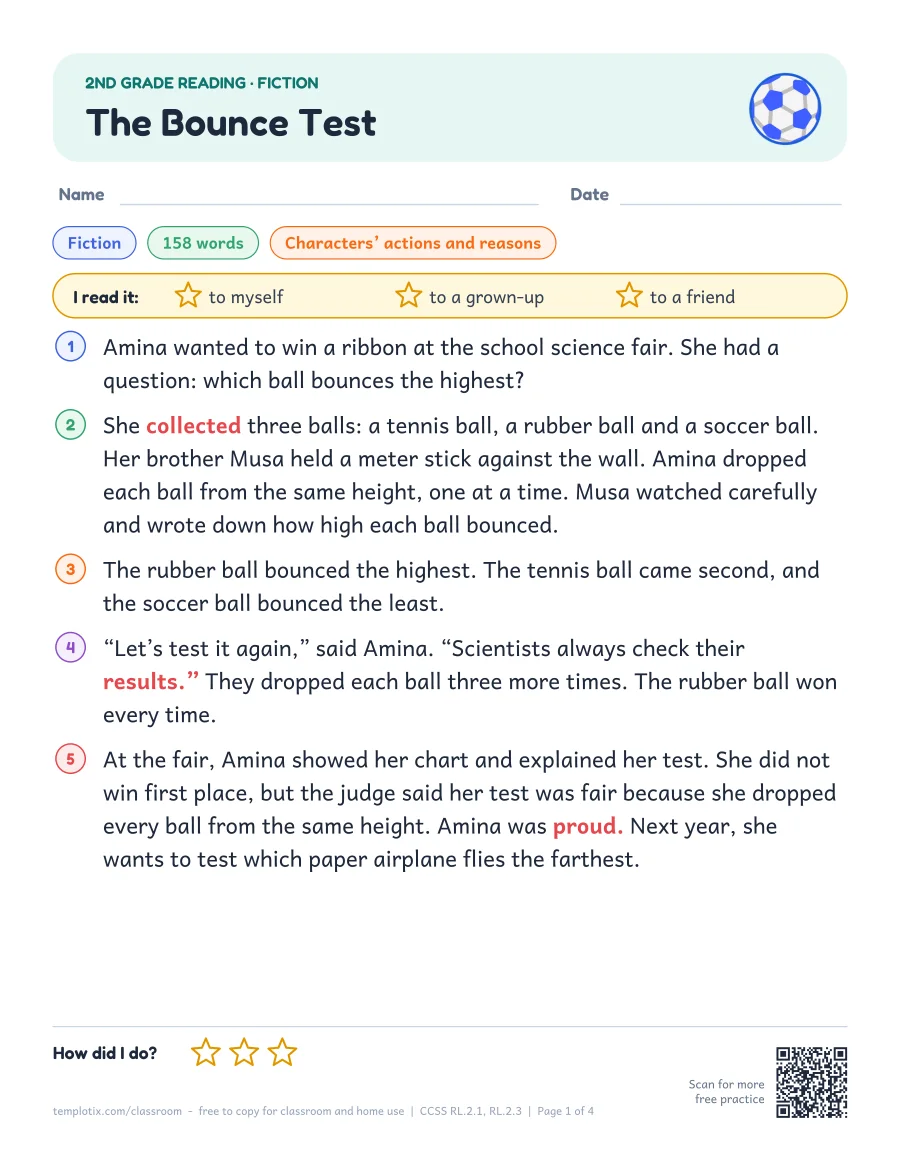
1. The Bounce Test
Fiction158 wordsCharacters’ actions and reasonsCCSS RL.2.1, RL.2.3
Amina wanted to win a ribbon at the school science fair. She had a question: which ball bounces the highest?
Read the whole passage
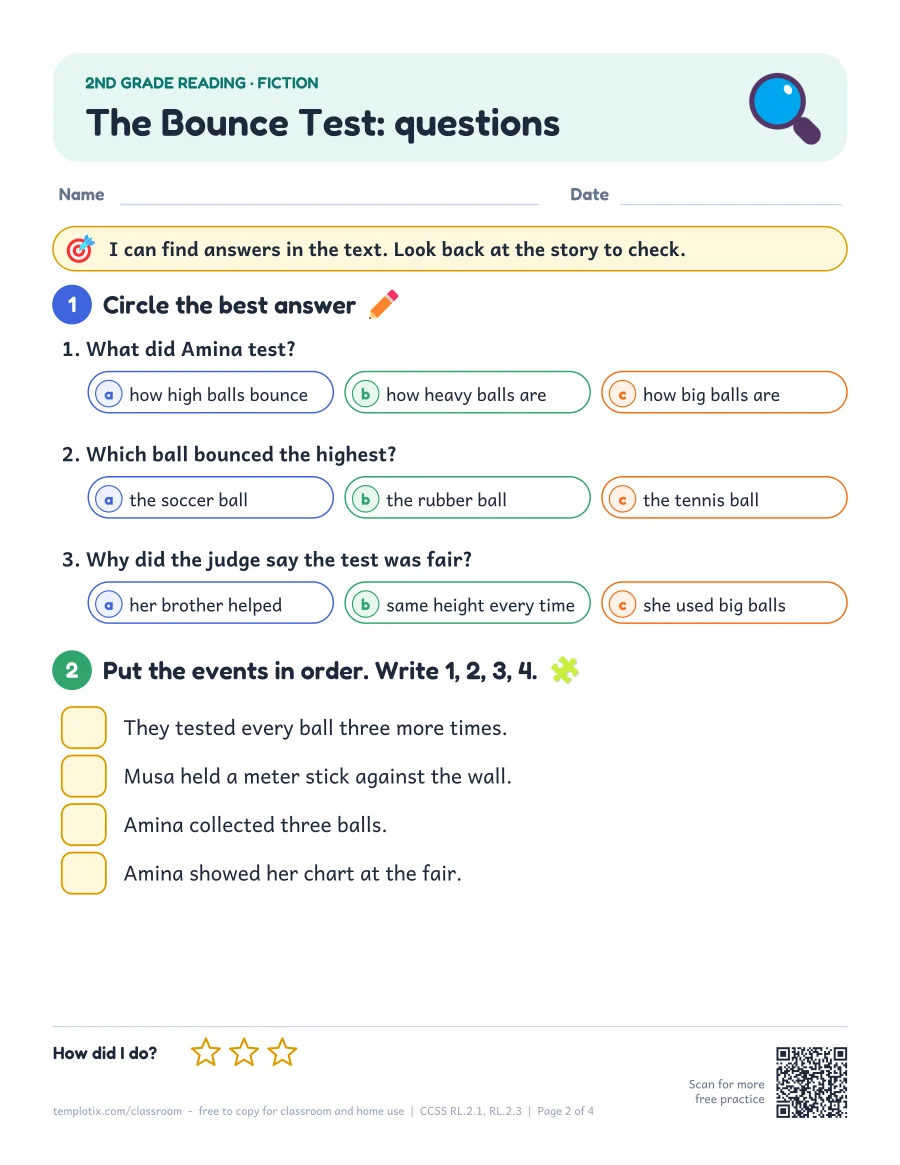
She collected three balls: a tennis ball, a rubber ball and a soccer ball. Her brother Musa held a meter stick against the wall. Amina dropped each ball from the same height, one at a time. Musa watched carefully and wrote down how high each ball bounced.
The rubber ball bounced the highest. The tennis ball came second, and the soccer ball bounced the least.
“Let’s test it again,” said Amina. “Scientists always check their results.” They dropped each ball three more times. The rubber ball won every time.
At the fair, Amina showed her chart and explained her test. She did not win first place, but the judge said her test was fair because she dropped every ball from the same height. Amina was proud. Next year, she wants to test which paper airplane flies the farthest.
Words taught: collected, results, proud.
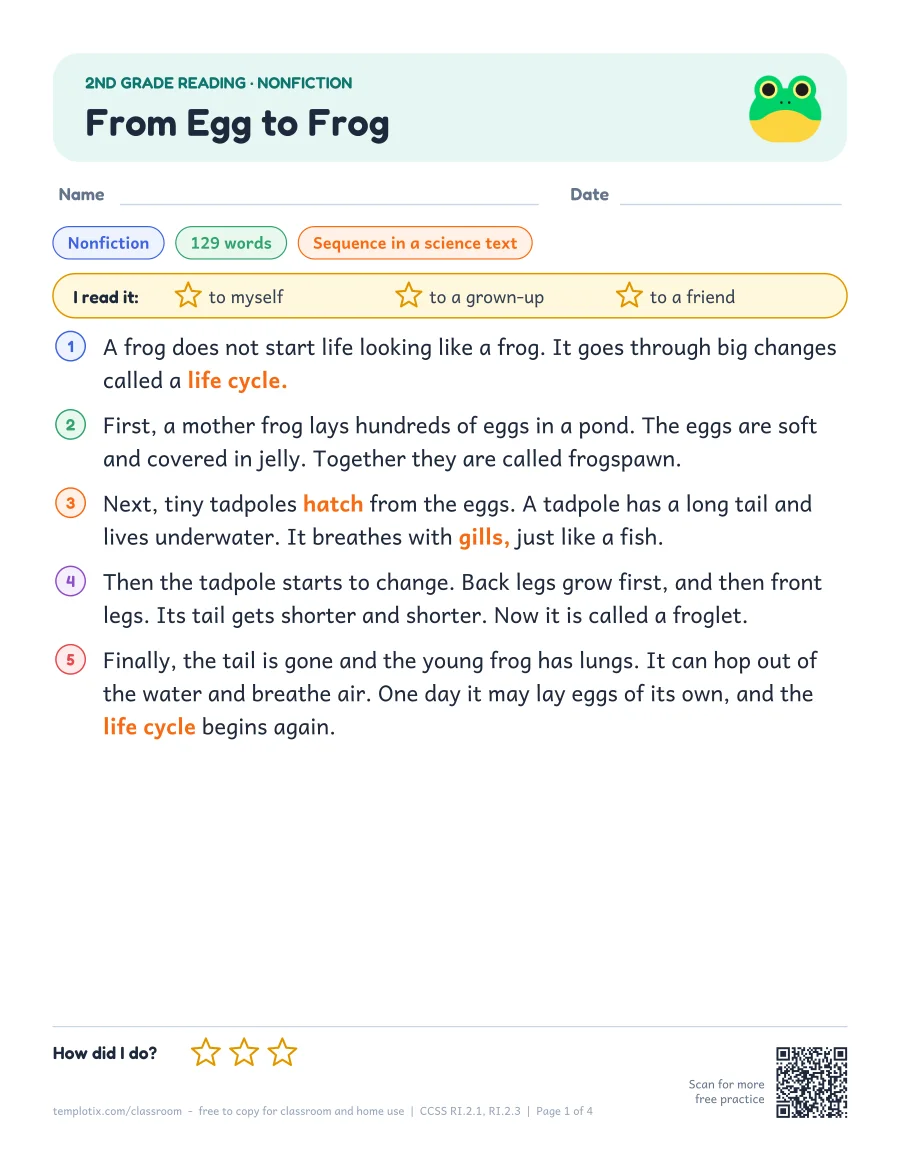
2. From Egg to Frog
Nonfiction129 wordsSequence in a science textCCSS RI.2.1, RI.2.3
A frog does not start life looking like a frog. It goes through big changes called a life cycle.
Read the whole passage
First, a mother frog lays hundreds of eggs in a pond. The eggs are soft and covered in jelly. Together they are called frogspawn.
Next, tiny tadpoles hatch from the eggs. A tadpole has a long tail and lives underwater. It breathes with gills, just like a fish.
Then the tadpole starts to change. Back legs grow first, and then front legs. Its tail gets shorter and shorter. Now it is called a froglet.
Finally, the tail is gone and the young frog has lungs. It can hop out of the water and breathe air. One day it may lay eggs of its own, and the life cycle begins again.
Words taught: life cycle, gills, hatch.
3. The Case of the Missing Lunchbox
Fiction132 wordsClues and story eventsCCSS RL.2.1, RL.2.5
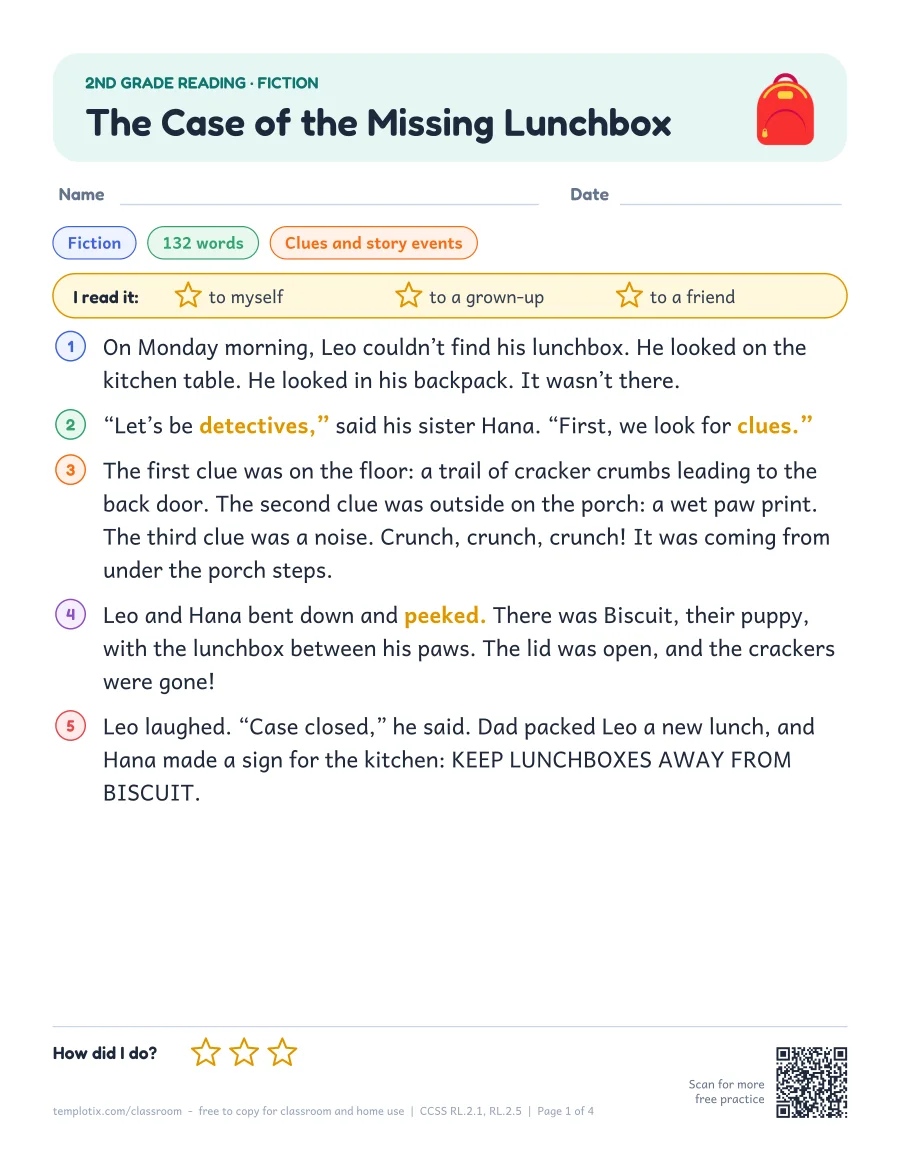
On Monday morning, Leo couldn’t find his lunchbox. He looked on the kitchen table. He looked in his backpack. It wasn’t there.
Read the whole passage
“Let’s be detectives,” said his sister Hana. “First, we look for clues.”
The first clue was on the floor: a trail of cracker crumbs leading to the back door. The second clue was outside on the porch: a wet paw print. The third clue was a noise. Crunch, crunch, crunch! It was coming from under the porch steps.
Leo and Hana bent down and peeked. There was Biscuit, their puppy, with the lunchbox between his paws. The lid was open, and the crackers were gone!
Leo laughed. “Case closed,” he said. Dad packed Leo a new lunch, and Hana made a sign for the kitchen: KEEP LUNCHBOXES AWAY FROM BISCUIT.
Words taught: detectives, clues, peeked.
4. Volcanoes
Nonfiction139 wordsMain topic and key detailsCCSS RI.2.1, RI.2.2
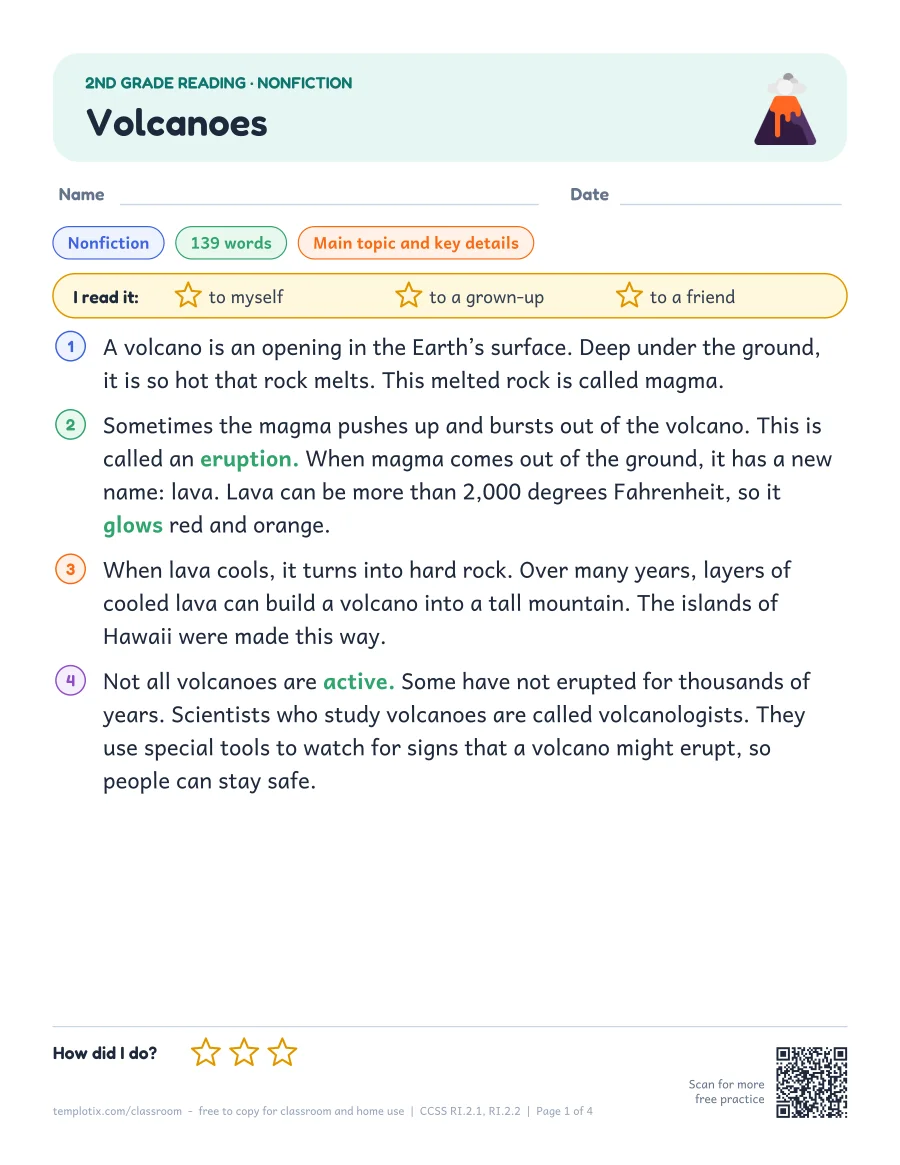
A volcano is an opening in the Earth’s surface. Deep under the ground, it is so hot that rock melts. This melted rock is called magma.
Read the whole passage
Sometimes the magma pushes up and bursts out of the volcano. This is called an eruption. When magma comes out of the ground, it has a new name: lava. Lava can be more than 2,000 degrees Fahrenheit, so it glows red and orange.
When lava cools, it turns into hard rock. Over many years, layers of cooled lava can build a volcano into a tall mountain. The islands of Hawaii were made this way.
Not all volcanoes are active. Some have not erupted for thousands of years. Scientists who study volcanoes are called volcanologists. They use special tools to watch for signs that a volcano might erupt, so people can stay safe.
Words taught: eruption, active, glows.
5. A Helping Hand
Fiction146 wordsLesson of the storyCCSS RL.2.1, RL.2.2
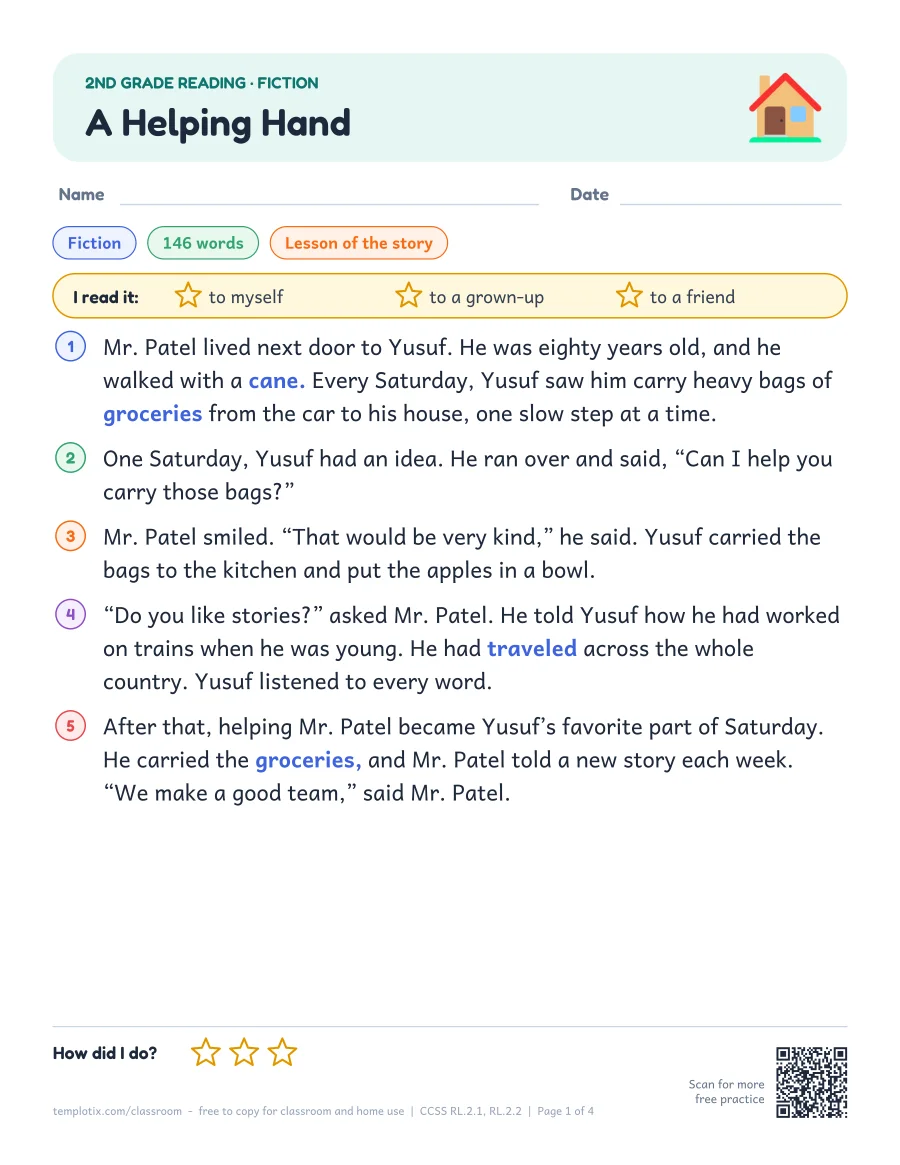
Mr. Patel lived next door to Yusuf. He was eighty years old, and he walked with a cane. Every Saturday, Yusuf saw him carry heavy bags of groceries from the car to his house, one slow step at a time.
Read the whole passage
One Saturday, Yusuf had an idea. He ran over and said, “Can I help you carry those bags?”
Mr. Patel smiled. “That would be very kind,” he said. Yusuf carried the bags to the kitchen and put the apples in a bowl.
“Do you like stories?” asked Mr. Patel. He told Yusuf how he had worked on trains when he was young. He had traveled across the whole country. Yusuf listened to every word.
After that, helping Mr. Patel became Yusuf’s favorite part of Saturday. He carried the groceries, and Mr. Patel told a new story each week. “We make a good team,” said Mr. Patel.
Words taught: cane, groceries, traveled.
6. Elephants
Nonfiction132 wordsKey details and new wordsCCSS RI.2.1, RI.2.4
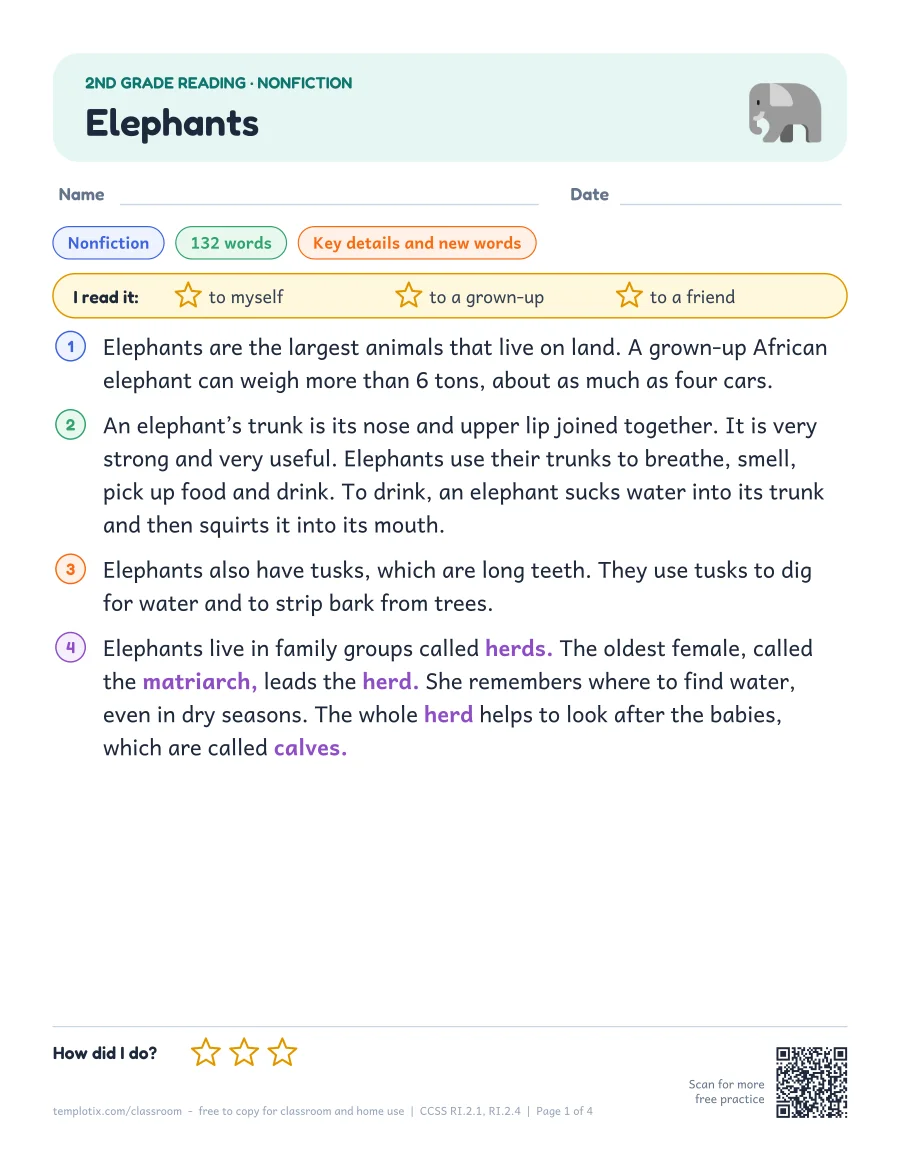
Elephants are the largest animals that live on land. A grown-up African elephant can weigh more than 6 tons, about as much as four cars.
Read the whole passage
An elephant’s trunk is its nose and upper lip joined together. It is very strong and very useful. Elephants use their trunks to breathe, smell, pick up food and drink. To drink, an elephant sucks water into its trunk and then squirts it into its mouth.
Elephants also have tusks, which are long teeth. They use tusks to dig for water and to strip bark from trees.
Elephants live in family groups called herds. The oldest female, called the matriarch, leads the herd. She remembers where to find water, even in dry seasons. The whole herd helps to look after the babies, which are called calves.
Words taught: herd, matriarch, calves.
7. The Treehouse Plan
Fiction148 wordsCharacters and problem solvingCCSS RL.2.1, RL.2.3
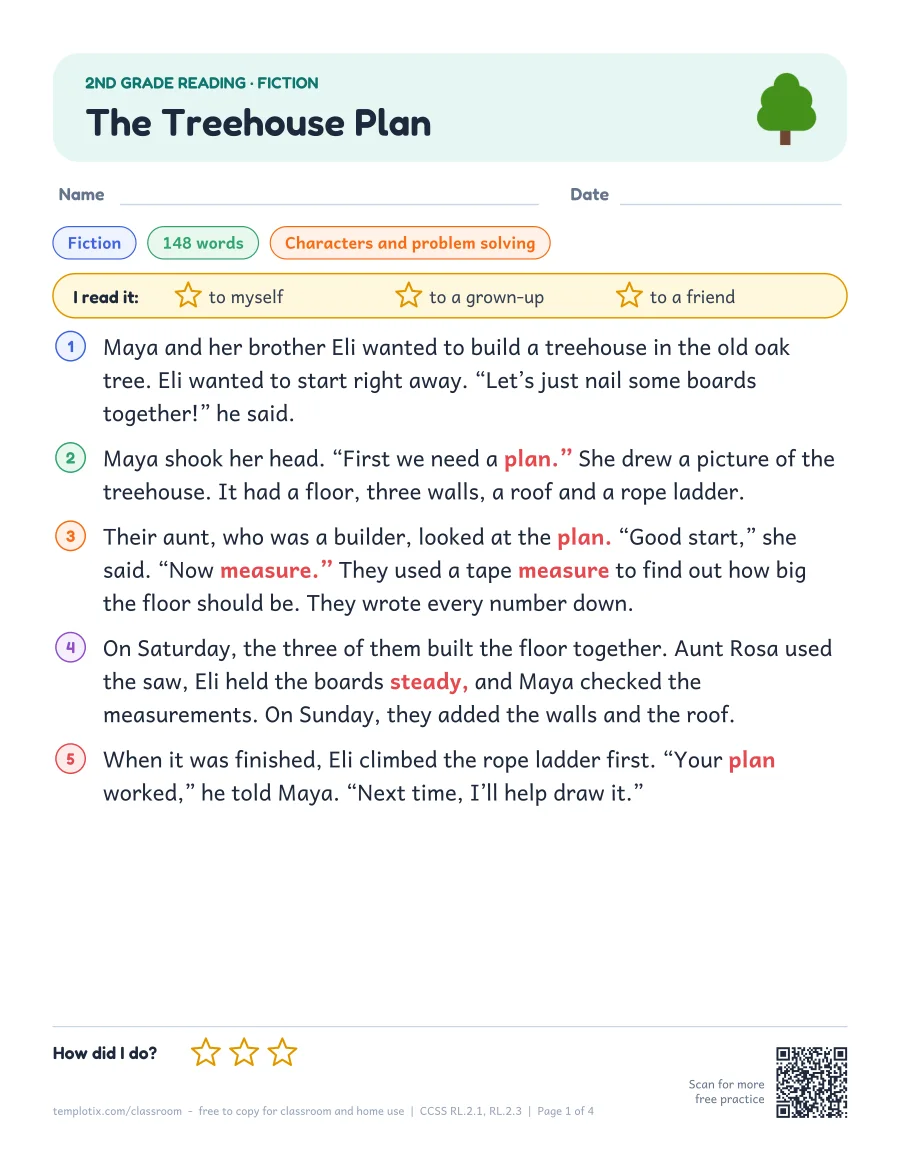
Maya and her brother Eli wanted to build a treehouse in the old oak tree. Eli wanted to start right away. “Let’s just nail some boards together!” he said.
Read the whole passage
Maya shook her head. “First we need a plan.” She drew a picture of the treehouse. It had a floor, three walls, a roof and a rope ladder.
Their aunt, who was a builder, looked at the plan. “Good start,” she said. “Now measure.” They used a tape measure to find out how big the floor should be. They wrote every number down.
On Saturday, the three of them built the floor together. Aunt Rosa used the saw, Eli held the boards steady, and Maya checked the measurements. On Sunday, they added the walls and the roof.
When it was finished, Eli climbed the rope ladder first. “Your plan worked,” he told Maya. “Next time, I’ll help draw it.”
Words taught: plan, measure, steady.
8. Where Does Our Trash Go?
Nonfiction140 wordsMain topic and key detailsCCSS RI.2.1, RI.2.2
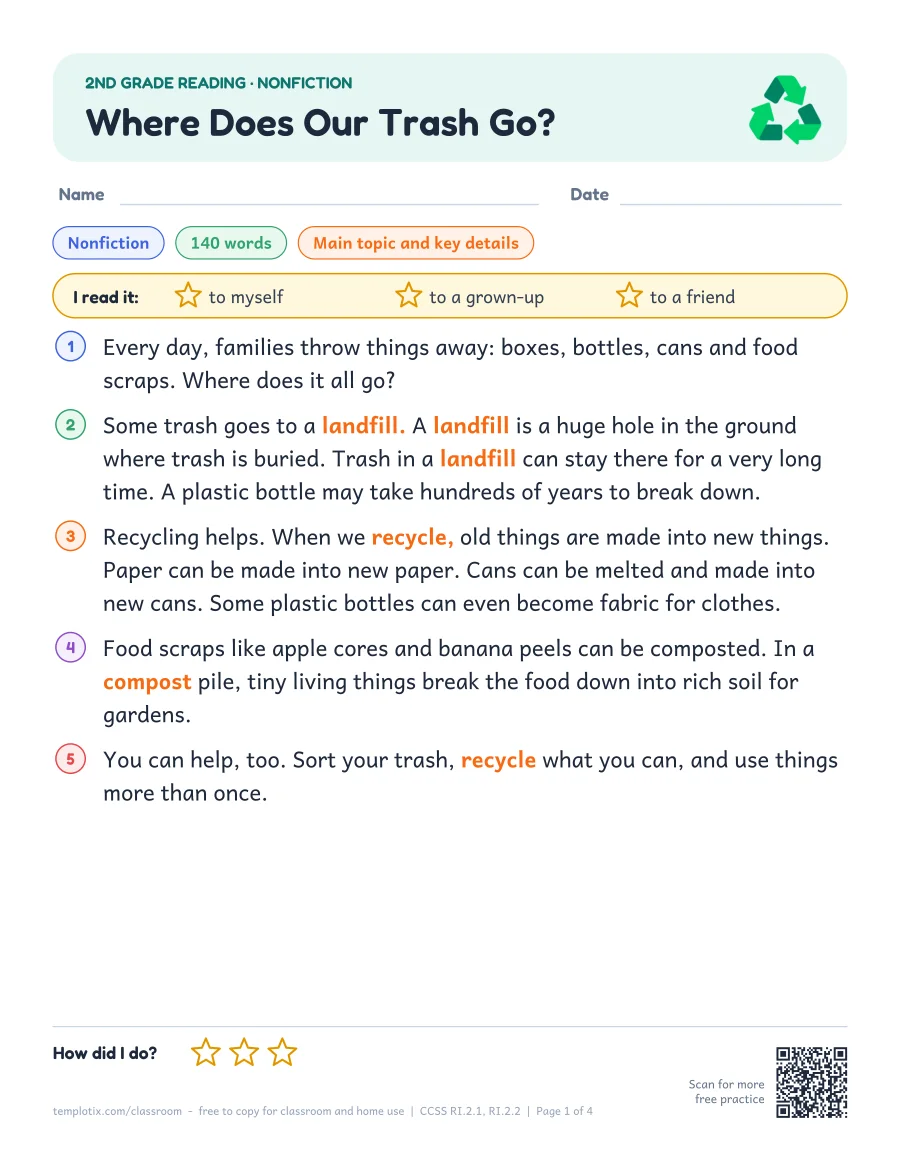
Every day, families throw things away: boxes, bottles, cans and food scraps. Where does it all go?
Read the whole passage
Some trash goes to a landfill. A landfill is a huge hole in the ground where trash is buried. Trash in a landfill can stay there for a very long time. A plastic bottle may take hundreds of years to break down.
Recycling helps. When we recycle, old things are made into new things. Paper can be made into new paper. Cans can be melted and made into new cans. Some plastic bottles can even become fabric for clothes.
Food scraps like apple cores and banana peels can be composted. In a compost pile, tiny living things break the food down into rich soil for gardens.
You can help, too. Sort your trash, recycle what you can, and use things more than once.
Words taught: landfill, recycle, compost.
 1. The Bounce Test
 2. From Egg to Frog
 3. The Case of the Missing Lunchbox
 4. Volcanoes
 5. A Helping Hand
 6. Elephants
 7. The Treehouse Plan
 8. Where Does Our Trash Go?
Inside a worksheet
Common questions
What reading level are these 2nd grade passages?
They are written for 2nd grade: 129 to 158 words, with short sentences and everyday vocabulary, plus three new words in each passage that are taught on the worksheet. Use them for children reading at or near a 2nd grade level.
What is in each worksheet?
Four pages: the passage with a "read it three times" tracker, multiple-choice questions with either an order-of-events or a true-or-false task, a word-meaning match with a written answer and a drawing box, and an answer key with a sample written answer.
How should I use a passage?
Read it together first, then let the child read it alone and to someone else (the stars on page 1 track this). Do the questions the next day, and ask the child to point to the sentence in the text that proves each answer.
Can I copy these worksheets for my class?
Yes. The PDFs are free to print and photocopy for classroom and home use, in color or in the black-and-white ink saver. Please link to this page rather than re-uploading the files.