 Shop
 Grade workbooks


Classroom · Reading comprehension · 5th grade
reading comprehension worksheets
8 original passages, half stories and half nonfiction, each 193 to 219 words long. Every passage comes with four pages: the text, comprehension questions, word work and writing, and an answer key.
All 8 passages in one PDF
With a reading log and a Super Reader certificate.
The passages
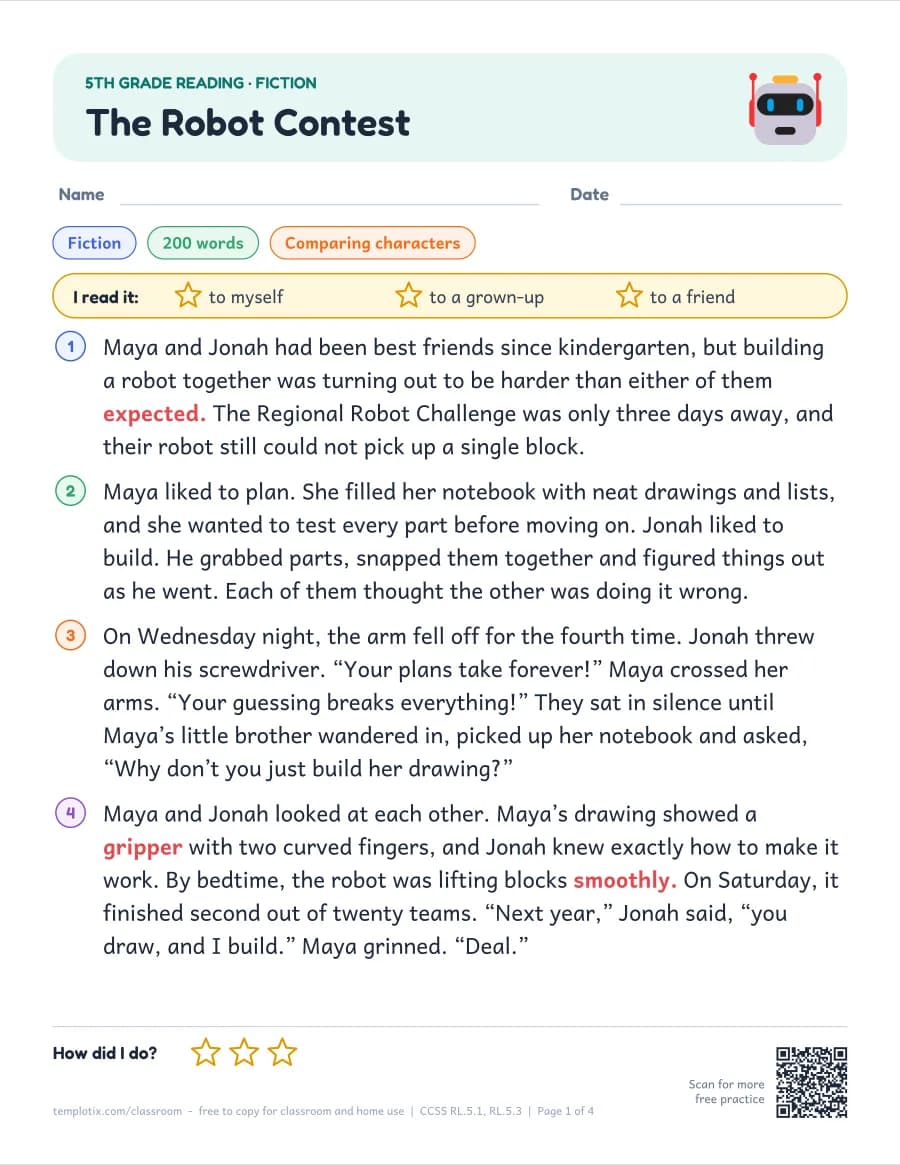
1. The Robot Contest
Fiction200 wordsComparing charactersCCSS RL.5.1, RL.5.3
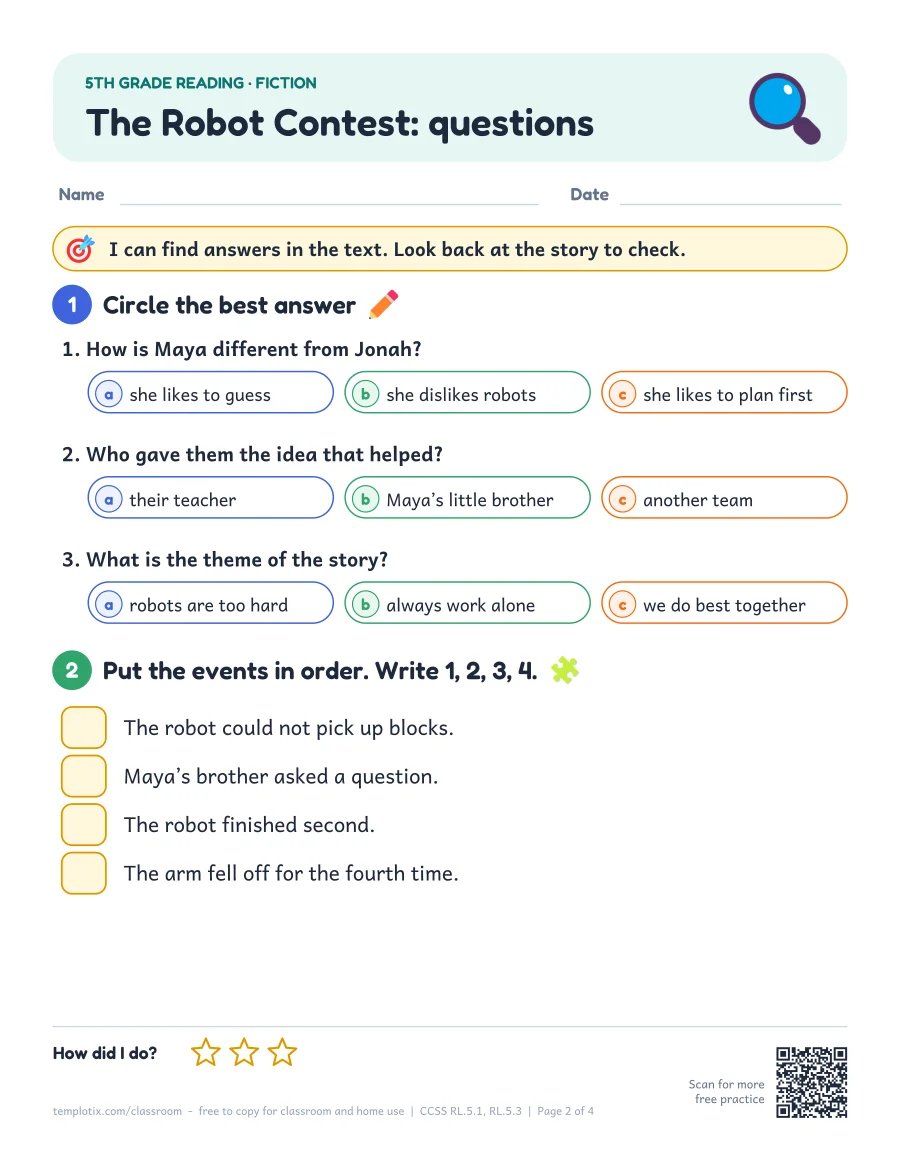
Maya and Jonah had been best friends since kindergarten, but building a robot together was turning out to be harder than either of them expected. The Regional Robot Challenge was only three days away, and their robot still could not pick up a single block.
Read the whole passage
Maya liked to plan. She filled her notebook with neat drawings and lists, and she wanted to test every part before moving on. Jonah liked to build. He grabbed parts, snapped them together and figured things out as he went. Each of them thought the other was doing it wrong.
On Wednesday night, the arm fell off for the fourth time. Jonah threw down his screwdriver. “Your plans take forever!” Maya crossed her arms. “Your guessing breaks everything!” They sat in silence until Maya’s little brother wandered in, picked up her notebook and asked, “Why don’t you just build her drawing?”
Maya and Jonah looked at each other. Maya’s drawing showed a gripper with two curved fingers, and Jonah knew exactly how to make it work. By bedtime, the robot was lifting blocks smoothly. On Saturday, it finished second out of twenty teams. “Next year,” Jonah said, “you draw, and I build.” Maya grinned. “Deal.”
Words taught: expected, gripper, smoothly.
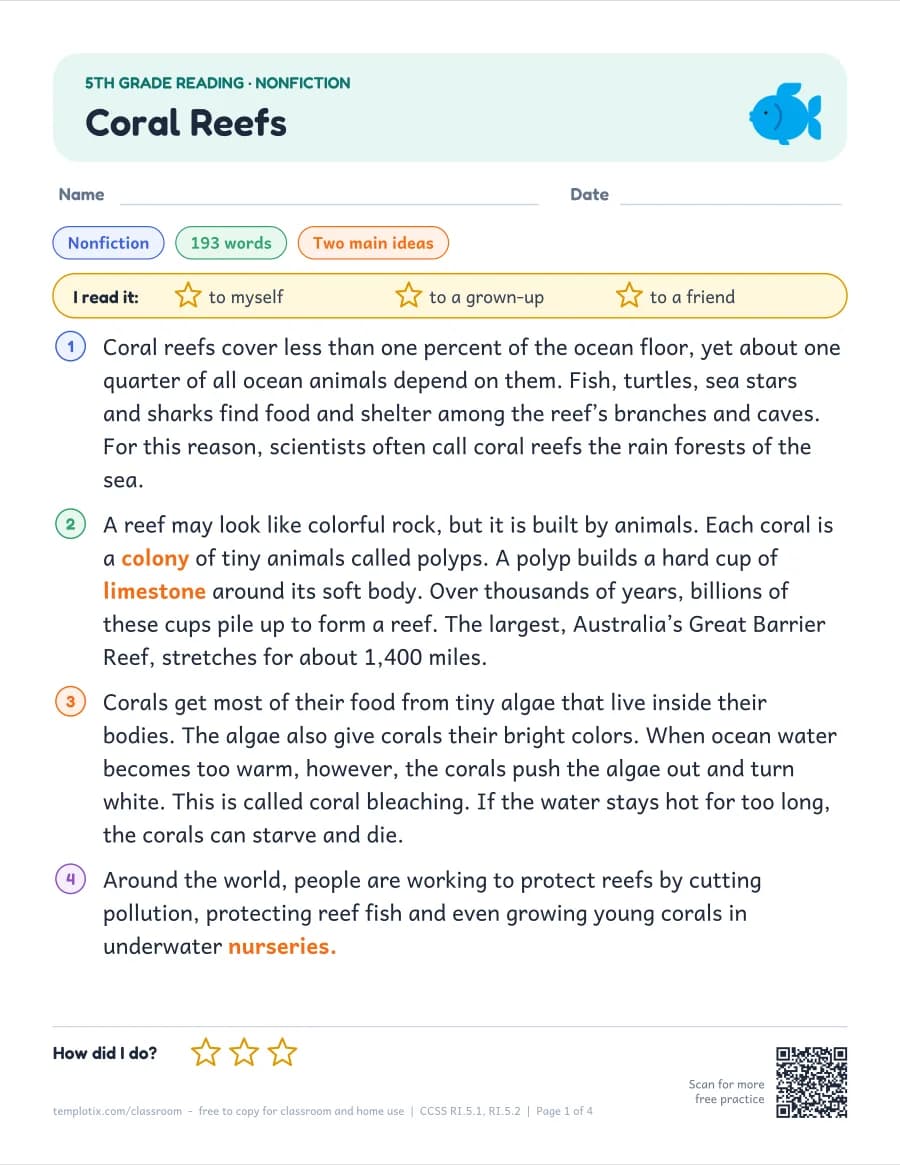
2. Coral Reefs
Nonfiction193 wordsTwo main ideasCCSS RI.5.1, RI.5.2
Coral reefs cover less than one percent of the ocean floor, yet about one quarter of all ocean animals depend on them. Fish, turtles, sea stars and sharks find food and shelter among the reef’s branches and caves. For this reason, scientists often call coral reefs the rain forests of the sea.
Read the whole passage
A reef may look like colorful rock, but it is built by animals. Each coral is a colony of tiny animals called polyps. A polyp builds a hard cup of limestone around its soft body. Over thousands of years, billions of these cups pile up to form a reef. The largest, Australia’s Great Barrier Reef, stretches for about 1,400 miles.
Corals get most of their food from tiny algae that live inside their bodies. The algae also give corals their bright colors. When ocean water becomes too warm, however, the corals push the algae out and turn white. This is called coral bleaching. If the water stays hot for too long, the corals can starve and die.
Around the world, people are working to protect reefs by cutting pollution, protecting reef fish and even growing young corals in underwater nurseries.
Words taught: colony, limestone, nurseries.
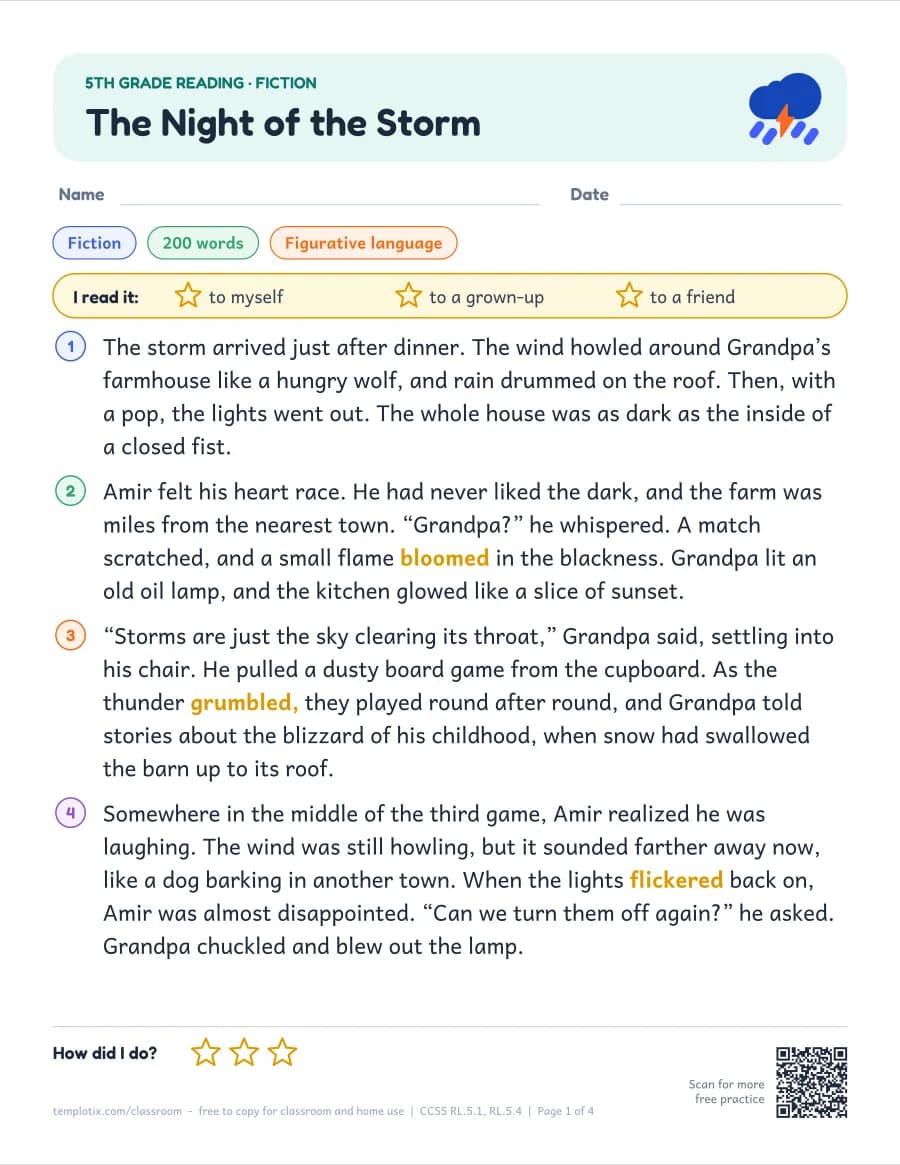
3. The Night of the Storm
Fiction200 wordsFigurative languageCCSS RL.5.1, RL.5.4
The storm arrived just after dinner. The wind howled around Grandpa’s farmhouse like a hungry wolf, and rain drummed on the roof. Then, with a pop, the lights went out. The whole house was as dark as the inside of a closed fist.
Read the whole passage
Amir felt his heart race. He had never liked the dark, and the farm was miles from the nearest town. “Grandpa?” he whispered. A match scratched, and a small flame bloomed in the blackness. Grandpa lit an old oil lamp, and the kitchen glowed like a slice of sunset.
“Storms are just the sky clearing its throat,” Grandpa said, settling into his chair. He pulled a dusty board game from the cupboard. As the thunder grumbled, they played round after round, and Grandpa told stories about the blizzard of his childhood, when snow had swallowed the barn up to its roof.
Somewhere in the middle of the third game, Amir realized he was laughing. The wind was still howling, but it sounded farther away now, like a dog barking in another town. When the lights flickered back on, Amir was almost disappointed. “Can we turn them off again?” he asked. Grandpa chuckled and blew out the lamp.
Words taught: bloomed, grumbled, flickered.
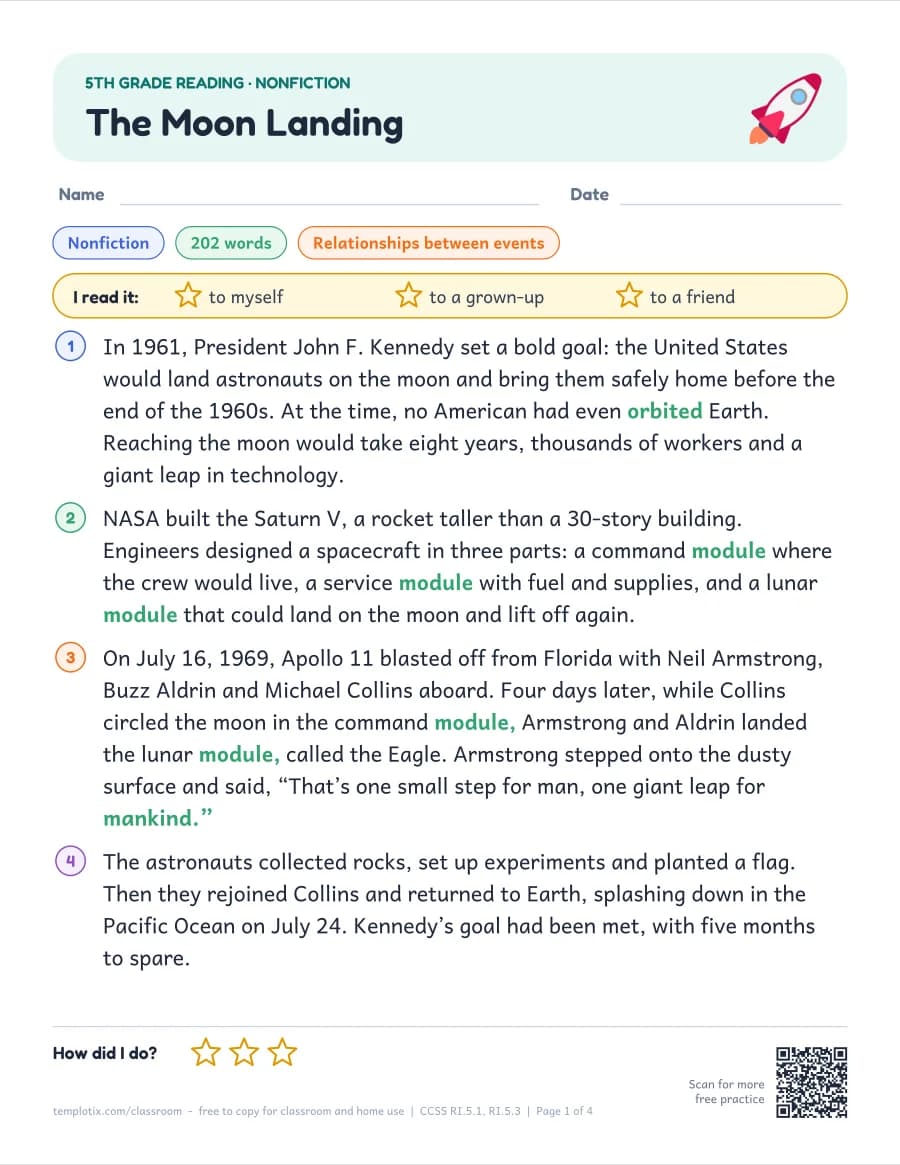
4. The Moon Landing
Nonfiction202 wordsRelationships between eventsCCSS RI.5.1, RI.5.3
In 1961, President John F. Kennedy set a bold goal: the United States would land astronauts on the moon and bring them safely home before the end of the 1960s. At the time, no American had even orbited Earth. Reaching the moon would take eight years, thousands of workers and a giant leap in technology.
Read the whole passage
NASA built the Saturn V, a rocket taller than a 30-story building. Engineers designed a spacecraft in three parts: a command module where the crew would live, a service module with fuel and supplies, and a lunar module that could land on the moon and lift off again.
On July 16, 1969, Apollo 11 blasted off from Florida with Neil Armstrong, Buzz Aldrin and Michael Collins aboard. Four days later, while Collins circled the moon in the command module, Armstrong and Aldrin landed the lunar module, called the Eagle. Armstrong stepped onto the dusty surface and said, “That’s one small step for man, one giant leap for mankind.”
The astronauts collected rocks, set up experiments and planted a flag. Then they rejoined Collins and returned to Earth, splashing down in the Pacific Ocean on July 24. Kennedy’s goal had been met, with five months to spare.
Words taught: orbited, module, mankind.
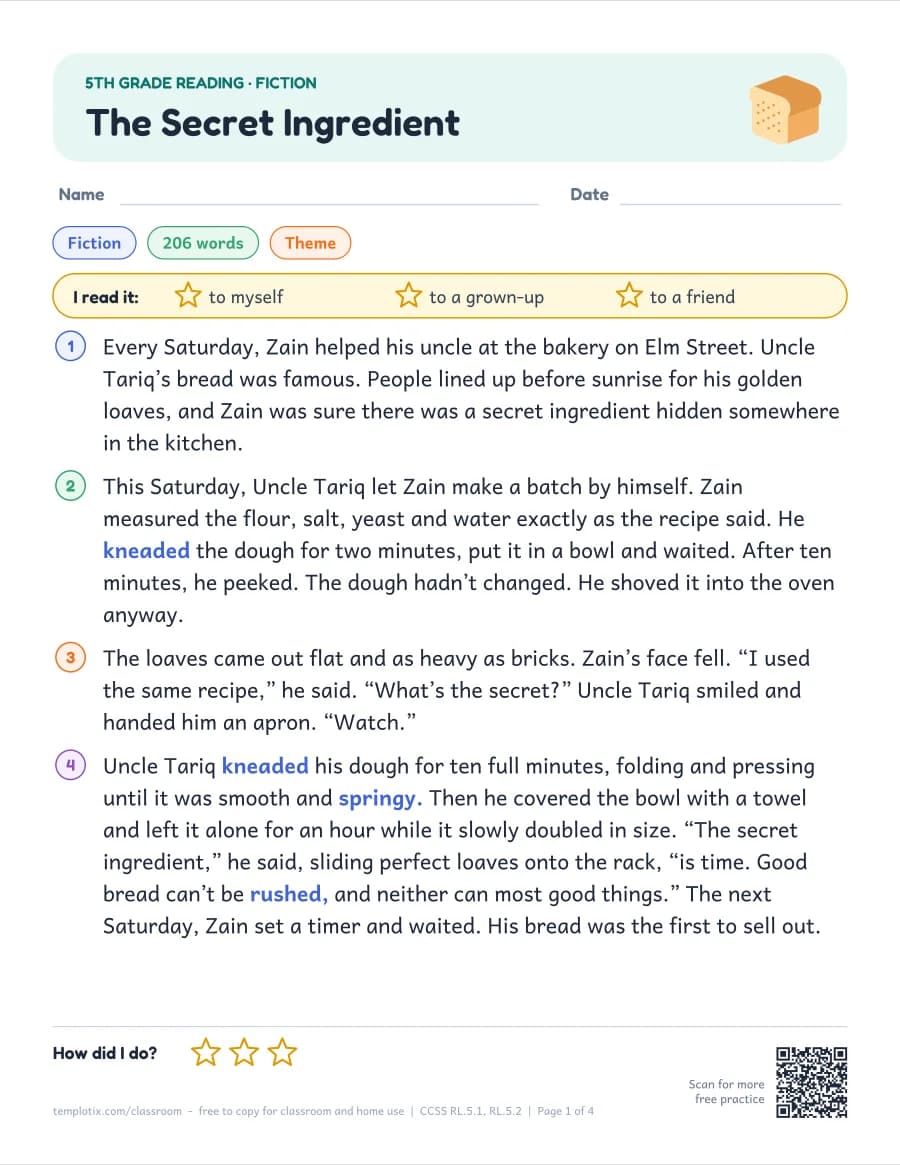
5. The Secret Ingredient
Fiction206 wordsThemeCCSS RL.5.1, RL.5.2
Every Saturday, Zain helped his uncle at the bakery on Elm Street. Uncle Tariq’s bread was famous. People lined up before sunrise for his golden loaves, and Zain was sure there was a secret ingredient hidden somewhere in the kitchen.
Read the whole passage
This Saturday, Uncle Tariq let Zain make a batch by himself. Zain measured the flour, salt, yeast and water exactly as the recipe said. He kneaded the dough for two minutes, put it in a bowl and waited. After ten minutes, he peeked. The dough hadn’t changed. He shoved it into the oven anyway.
The loaves came out flat and as heavy as bricks. Zain’s face fell. “I used the same recipe,” he said. “What’s the secret?” Uncle Tariq smiled and handed him an apron. “Watch.”
Uncle Tariq kneaded his dough for ten full minutes, folding and pressing until it was smooth and springy. Then he covered the bowl with a towel and left it alone for an hour while it slowly doubled in size. “The secret ingredient,” he said, sliding perfect loaves onto the rack, “is time. Good bread can’t be rushed, and neither can most good things.” The next Saturday, Zain set a timer and waited. His bread was the first to sell out.
Words taught: kneaded, springy, rushed.
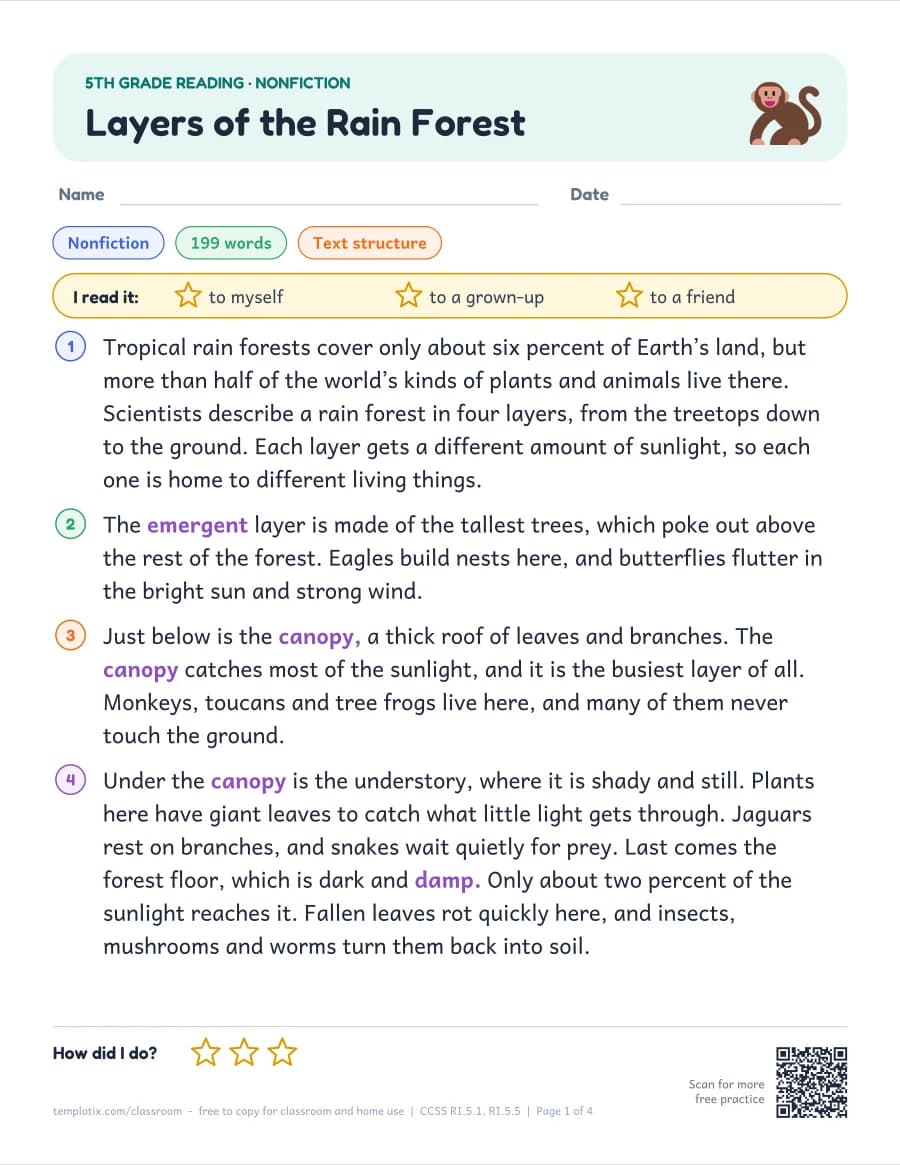
6. Layers of the Rain Forest
Nonfiction199 wordsText structureCCSS RI.5.1, RI.5.5
Tropical rain forests cover only about six percent of Earth’s land, but more than half of the world’s kinds of plants and animals live there. Scientists describe a rain forest in four layers, from the treetops down to the ground. Each layer gets a different amount of sunlight, so each one is home to different living things.
Read the whole passage
The emergent layer is made of the tallest trees, which poke out above the rest of the forest. Eagles build nests here, and butterflies flutter in the bright sun and strong wind.
Just below is the canopy, a thick roof of leaves and branches. The canopy catches most of the sunlight, and it is the busiest layer of all. Monkeys, toucans and tree frogs live here, and many of them never touch the ground.
Under the canopy is the understory, where it is shady and still. Plants here have giant leaves to catch what little light gets through. Jaguars rest on branches, and snakes wait quietly for prey. Last comes the forest floor, which is dark and damp. Only about two percent of the sunlight reaches it. Fallen leaves rot quickly here, and insects, mushrooms and worms turn them back into soil.
Words taught: emergent, canopy, damp.
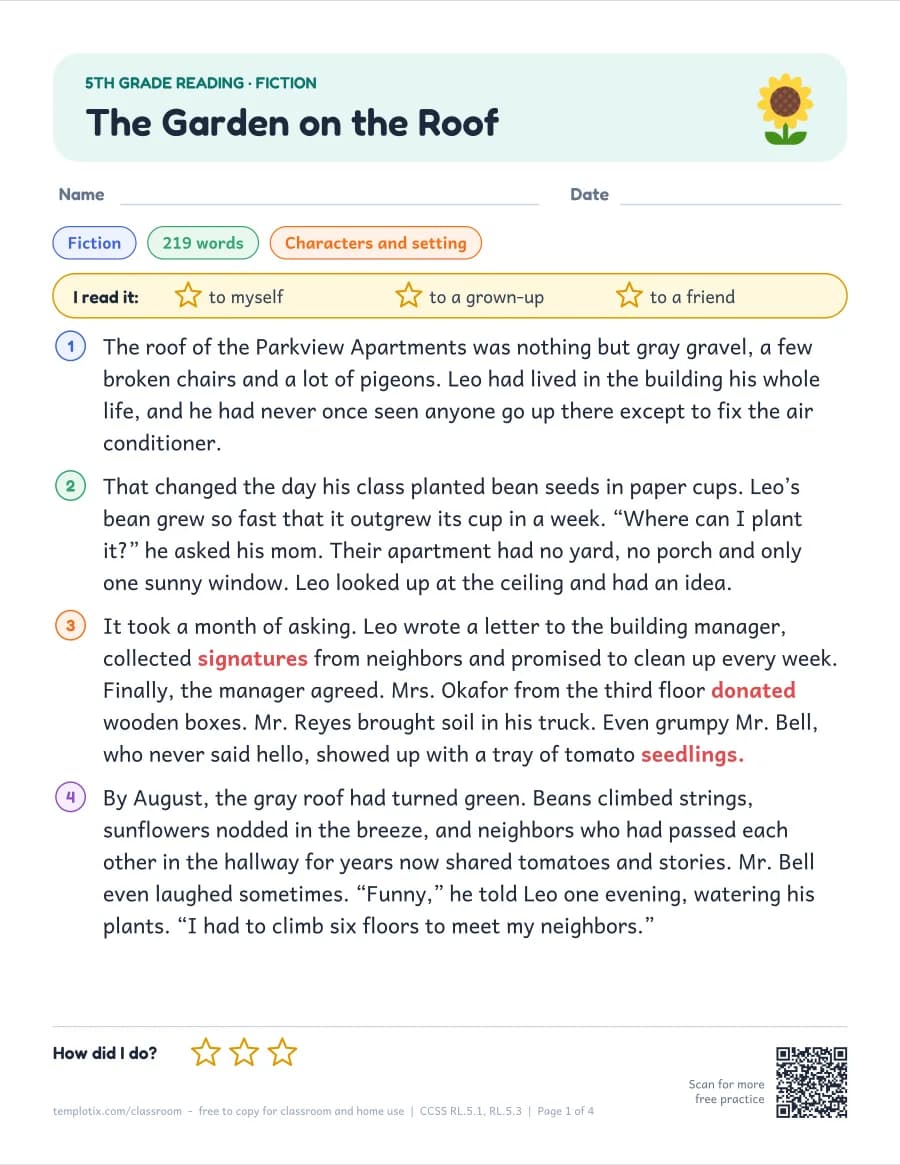
7. The Garden on the Roof
Fiction219 wordsCharacters and settingCCSS RL.5.1, RL.5.3
The roof of the Parkview Apartments was nothing but gray gravel, a few broken chairs and a lot of pigeons. Leo had lived in the building his whole life, and he had never once seen anyone go up there except to fix the air conditioner.
Read the whole passage
That changed the day his class planted bean seeds in paper cups. Leo’s bean grew so fast that it outgrew its cup in a week. “Where can I plant it?” he asked his mom. Their apartment had no yard, no porch and only one sunny window. Leo looked up at the ceiling and had an idea.
It took a month of asking. Leo wrote a letter to the building manager, collected signatures from neighbors and promised to clean up every week. Finally, the manager agreed. Mrs. Okafor from the third floor donated wooden boxes. Mr. Reyes brought soil in his truck. Even grumpy Mr. Bell, who never said hello, showed up with a tray of tomato seedlings.
By August, the gray roof had turned green. Beans climbed strings, sunflowers nodded in the breeze, and neighbors who had passed each other in the hallway for years now shared tomatoes and stories. Mr. Bell even laughed sometimes. “Funny,” he told Leo one evening, watering his plants. “I had to climb six floors to meet my neighbors.”
Words taught: signatures, donated, seedlings.
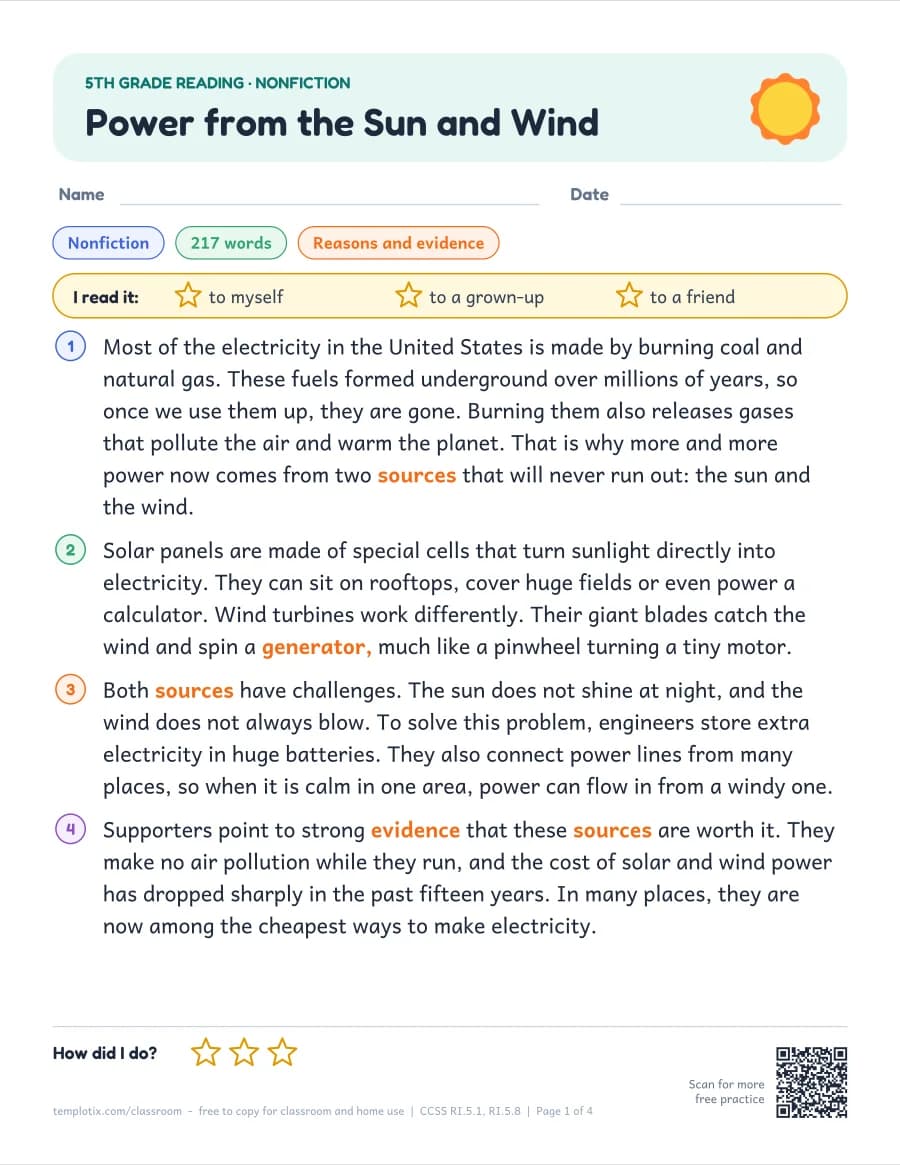
8. Power from the Sun and Wind
Nonfiction217 wordsReasons and evidenceCCSS RI.5.1, RI.5.8
Most of the electricity in the United States is made by burning coal and natural gas. These fuels formed underground over millions of years, so once we use them up, they are gone. Burning them also releases gases that pollute the air and warm the planet. That is why more and more power now comes from two sources that will never run out: the sun and the wind.
Read the whole passage
Solar panels are made of special cells that turn sunlight directly into electricity. They can sit on rooftops, cover huge fields or even power a calculator. Wind turbines work differently. Their giant blades catch the wind and spin a generator, much like a pinwheel turning a tiny motor.
Both sources have challenges. The sun does not shine at night, and the wind does not always blow. To solve this problem, engineers store extra electricity in huge batteries. They also connect power lines from many places, so when it is calm in one area, power can flow in from a windy one.
Supporters point to strong evidence that these sources are worth it. They make no air pollution while they run, and the cost of solar and wind power has dropped sharply in the past fifteen years. In many places, they are now among the cheapest ways to make electricity.
Words taught: sources, generator, evidence.
 1. The Robot Contest
 2. Coral Reefs
 3. The Night of the Storm
 4. The Moon Landing
 5. The Secret Ingredient
 6. Layers of the Rain Forest
 7. The Garden on the Roof
 8. Power from the Sun and Wind
Inside a worksheet
Common questions
What reading level are these 5th grade passages?
They are written for 5th grade: 193 to 219 words, with short sentences and everyday vocabulary, plus three new words in each passage that are taught on the worksheet. Use them for children reading at or near a 5th grade level.
What is in each worksheet?
Four pages: the passage with a "read it three times" tracker, multiple-choice questions with either an order-of-events or a true-or-false task, a word-meaning match with a written answer and a drawing box, and an answer key with a sample written answer.
How should I use a passage?
Read it together first, then let the child read it alone and to someone else (the stars on page 1 track this). Do the questions the next day, and ask the child to point to the sentence in the text that proves each answer.
Can I copy these worksheets for my class?
Yes. The PDFs are free to print and photocopy for classroom and home use, in color or in the black-and-white ink saver. Please link to this page rather than re-uploading the files.