Shop
 Grade workbooks


Classroom · Math · CCSS K.OA.A.1-5, 1.OA.C.6, 1.NBT.C.4, 2.OA.B.2, 2.NBT.B.5
and subtraction worksheets for K-2
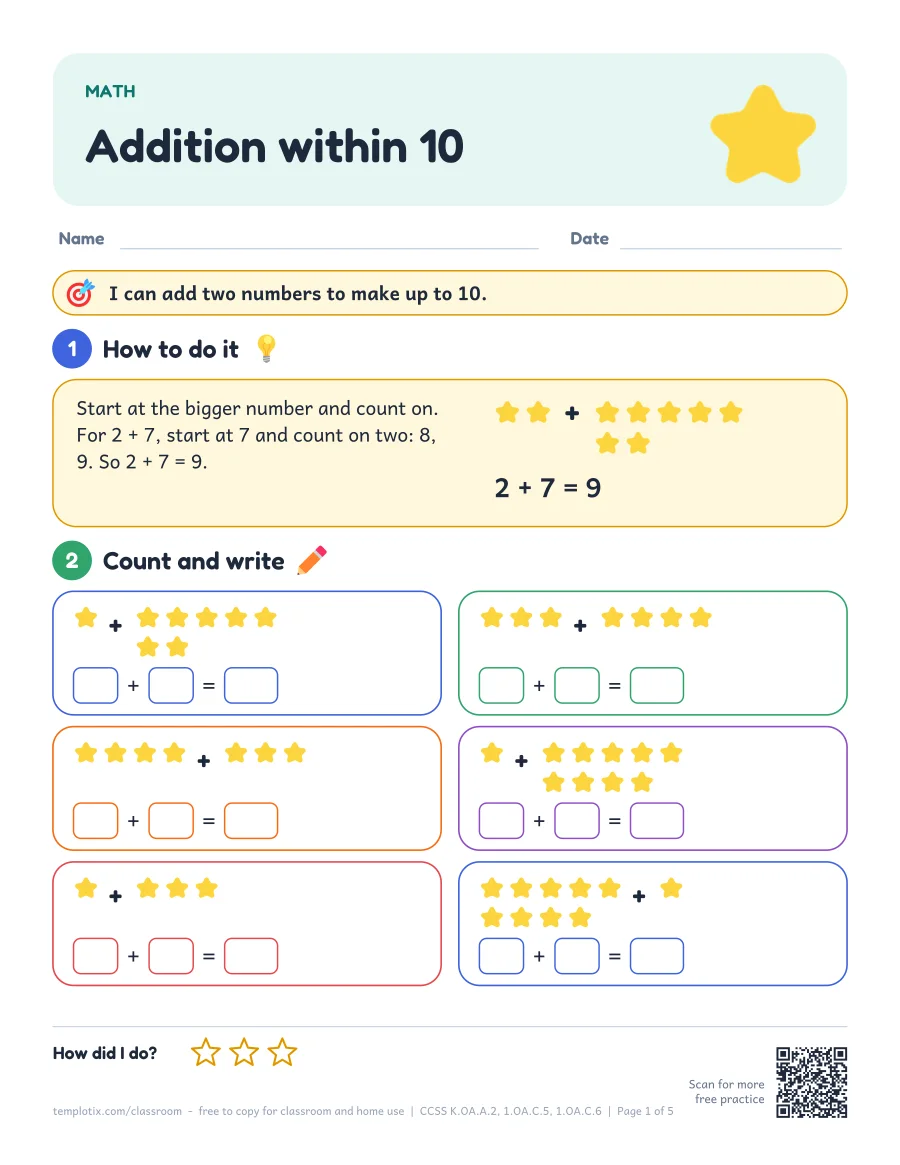
12 five-page packs, from adding pictures within 5 to two-digit subtraction with regrouping. Each one teaches a single strategy, then practices it in every format children meet at school, with an answer key. Print in color or ink-saving black and white.
Addition chart 1 to 10
 Addition chart 1 to 10
Every sum from 1 + 1 to 10 + 10, with the doubles highlighted, plus a blank chart to fill in.
Worksheet maker
 Worksheet maker
Choose addition, subtraction or both, within 5, 10, 20 or two-digit, and get a fresh sheet with an answer key every time.
Make a worksheetChoose a skill
- +Addition within 5Kindergarten
- –Subtraction within 5Kindergarten
- +Addition within 10Kindergarten and 1st grade
- –Subtraction within 10Kindergarten and 1st grade
- +Making 101st grade
- +Doubles and near doubles1st grade
- +Addition within 201st and 2nd grade
- –Subtraction within 201st and 2nd grade
- +Two-digit addition without regrouping1st and 2nd grade
- +Two-digit addition with regrouping2nd grade
- –Two-digit subtraction without regrouping2nd grade
- –Two-digit subtraction with regrouping2nd grade


What is in each pack
- 1. Learn itOne clear strategy with a worked example, then six problems to count and write, using pictures or ten frames.
- 2. PracticeTwenty facts to solve, then number lines to hop along.
- 3. Columns and missing numbersTwelve problems in columns, eight missing numbers like 3 + __ = 7, and a fact family triangle.
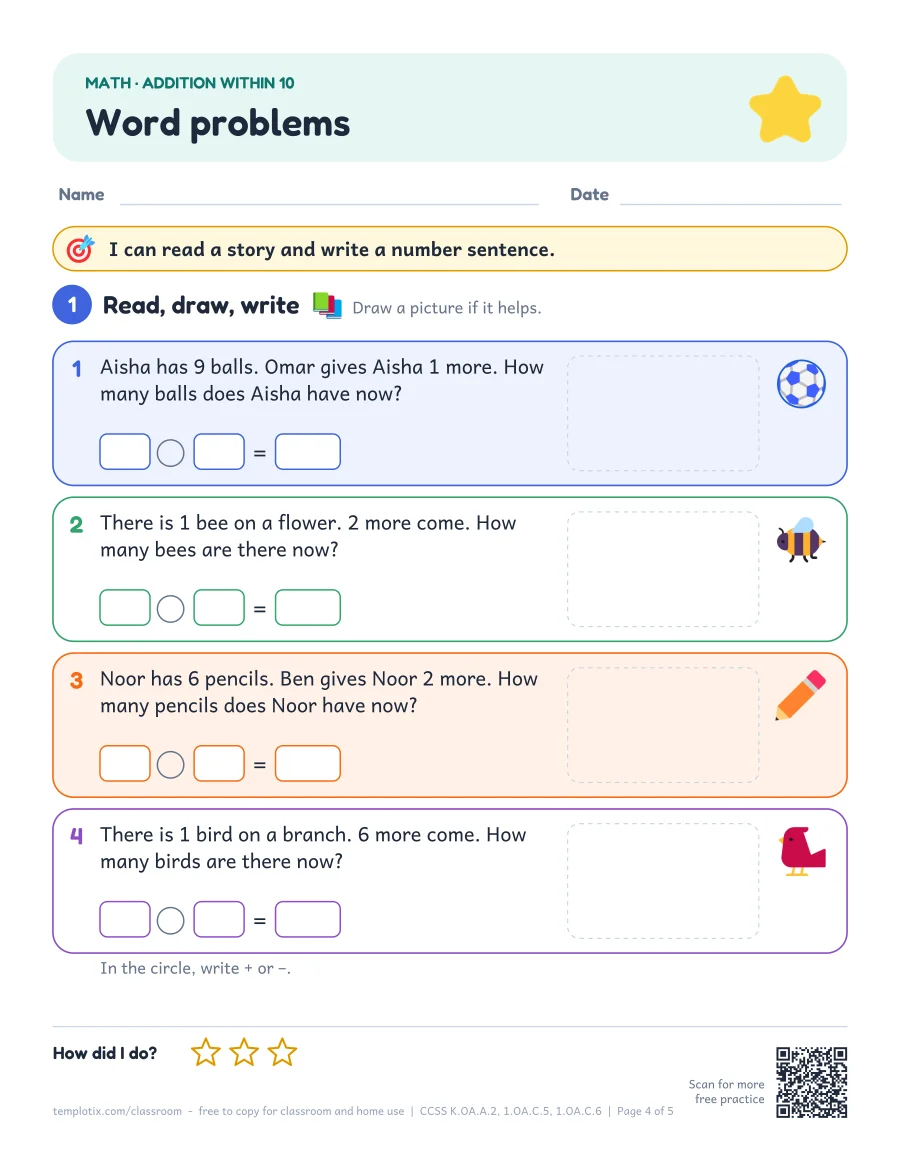
- 4. Word problemsFour short stories with a box to draw in. Children choose + or – themselves.
- 5. Answer key and tipEvery answer on one page, plus a teaching tip for grown-ups.


How to teach adding and subtracting
- Real things first. Blocks, buttons or fingers before pictures, and pictures before numbers alone.
- Count on, not count all. For 2 + 7, start at 7 and count two more. It is faster and builds number sense.
- Make 10 a friend. Knowing 3 and 7, 4 and 6 by heart is the key to adding within 20.
- Link the two. Every subtraction has a matching addition. Use the fact family to show it.
- Talk through stories. Word problems are where children decide whether to add or subtract, so let them explain why.
Common questions
In what order should children learn addition and subtraction?
Start with addition and subtraction within 5 in kindergarten, using real objects and pictures. Move to within 10, then learn the pairs that make 10 and the doubles. These two strategies make adding and subtracting within 20 much easier in 1st grade.
What are the addition and subtraction standards for K-2?
In the Common Core, kindergarten children add and subtract within 10 and are fluent within 5. In 1st grade they add and subtract within 20, are fluent within 10, and add within 100 using tens and ones. In 2nd grade they are fluent within 20 and add and subtract within 100, including regrouping.
What is a ten frame?
A ten frame is a box of two rows of five squares. Children put one counter in each square, so they can see at a glance how many there are and how many more make 10. It is the main picture used on the within-20, making-10 and doubles worksheets.
Why teach addition and subtraction together?
Because they undo each other. If 4 + 5 = 9, then 9 – 5 = 4. The fact family on every pack shows the four facts that go with three numbers, and many children find subtraction easier when they think of it as a missing number in an addition.
What does regrouping mean?
Regrouping (also called carrying and borrowing) is trading 10 ones for 1 ten, or 1 ten for 10 ones. In 47 + 25 the ones make 12, so 10 of them become a ten. In 52 – 17 there are not enough ones, so a ten is broken into 10 ones. Start with the "without regrouping" packs, then move on.
Can I copy these worksheets for my class?
Yes. The PDFs are free to print and photocopy for classroom and home use, in color or in the black-and-white ink saver. Please link to this page rather than re-uploading the files.