 Shop
 Grade workbooks


Classroom · Math · CCSS 3.NBT.A.3, 4.NBT.B.5, 5.NBT.B.5
worksheets for 3rd to 5th grade
Beyond the times tables: multiplying by 10, 100 and 1,000, then 2-digit and 3-digit numbers by 1 digit, and 2-digit by 2-digit, with area models, column practice and estimating to check. Every pack ends with an answer key.
- Multiplying by 10 and 1003rd and 4th grade
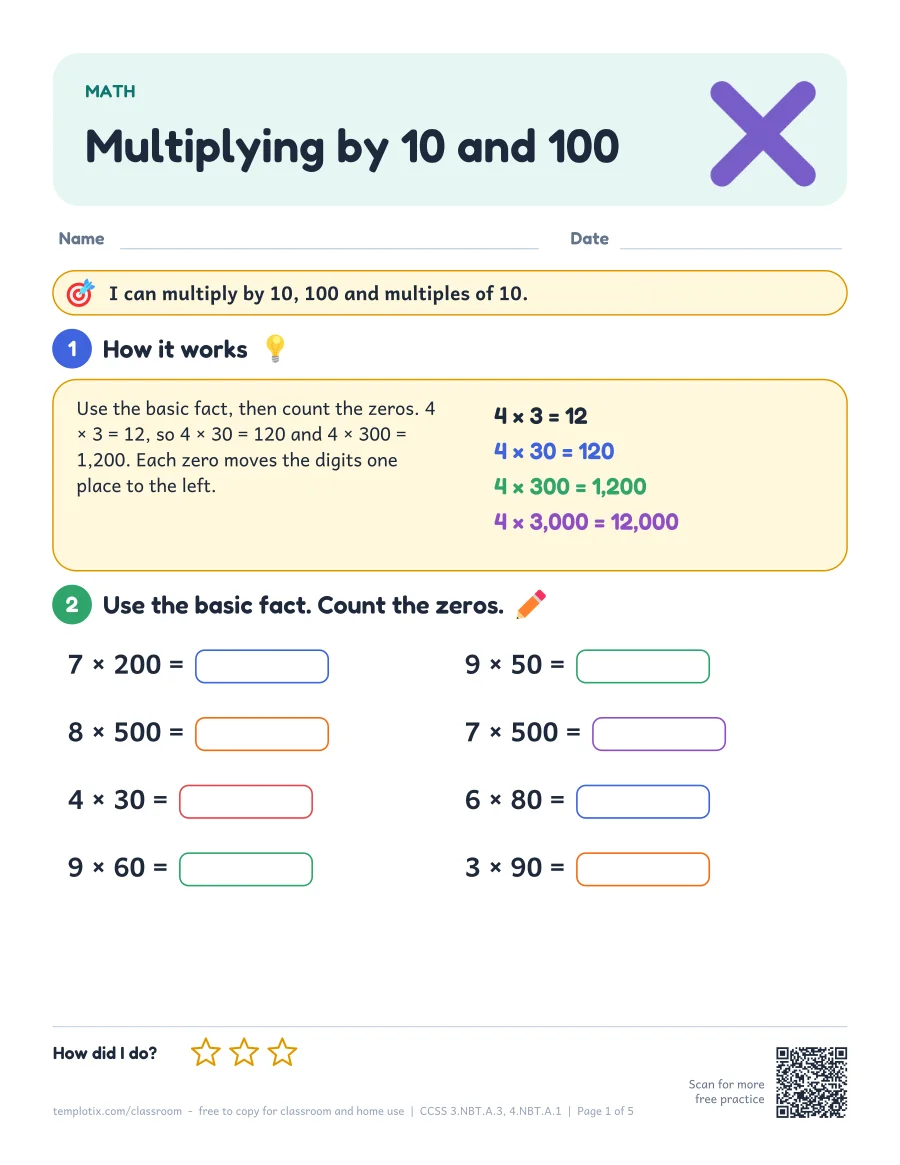
Use the basic fact, then count the zeros. 4 × 3 = 12, so 4 × 30 = 120 and 4 × 300 = 1,200. Each zero moves the digits one place to the left.
- 2-digit by 1-digit multiplication4th grade
Split the 2-digit number into tens and ones. For 23 × 4: 20 × 4 = 80 and 3 × 4 = 12, so 23 × 4 = 80 + 12 = 92.
- 3-digit by 1-digit multiplication4th grade
Multiply the ones, then the tens, then the hundreds, carrying when a product is 10 or more. For 214 × 3: 4 × 3 = 12, write 2 and carry 1, and so on.
- 2-digit by 2-digit multiplication4th and 5th grade
Split both numbers by place value and multiply every part: 23 × 14 = 20 × 10 + 20 × 4 + 3 × 10 + 3 × 4 = 200 + 80 + 30 + 12 = 322.

Area model template
 Area model template
Blank area models to split any multiplication into easy parts.
What is in each pack
- 1. Learn itHow it works with a worked area model, then three to fill in.
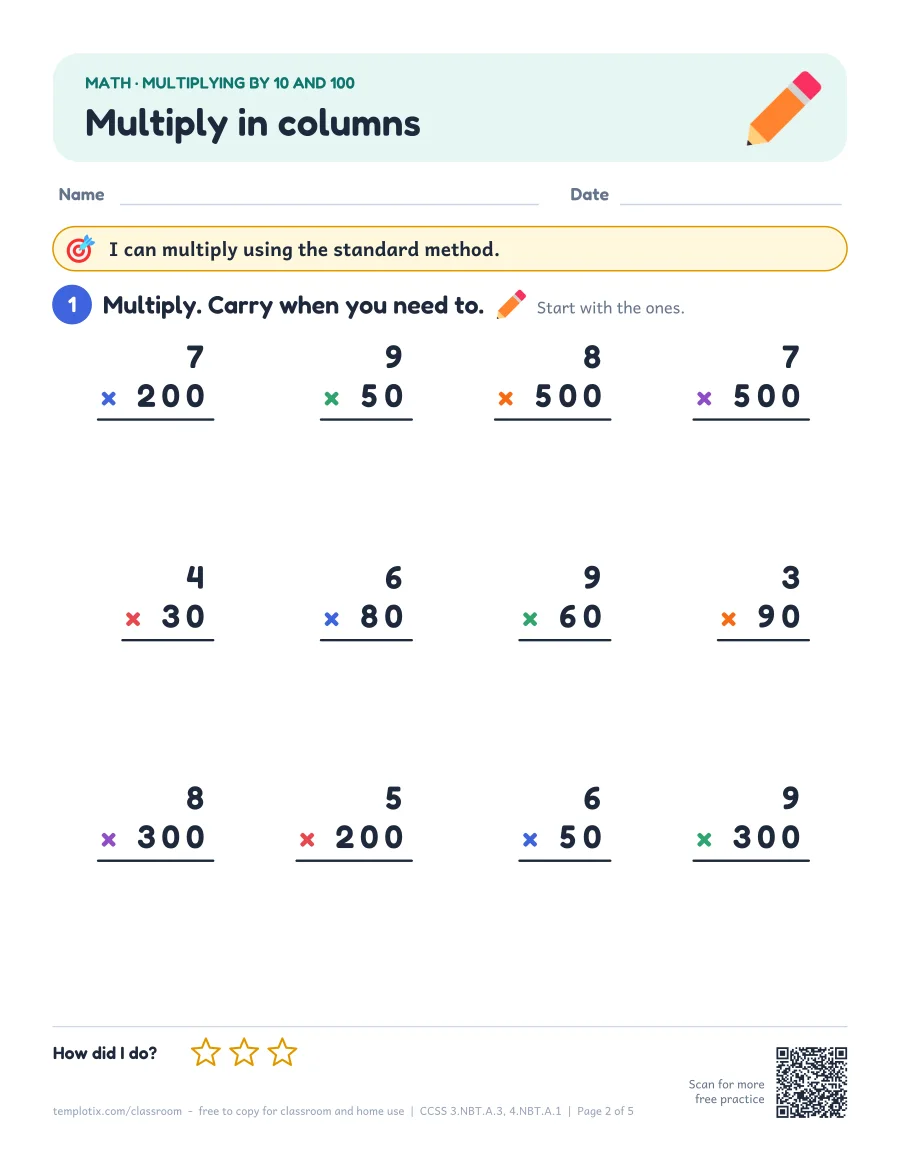
- 2. ColumnsTwelve problems in columns (six for 2-digit by 2-digit, with room for partial products).
- 3. Skill pagePatterns with zeros, or estimate first and then find the exact answer.
- 4. Word problemsFour stories about shelves, buses, flights and bakeries.
- 5. Answer key and tipEvery answer on one page, plus a teaching tip for grown-ups.


How to teach multi-digit multiplication
- Know the facts. Multi-digit multiplication is built on the times tables. Quick facts make every step easier.
- Think in place value. 23 is 20 and 3. Multiply each part, then add the parts together.
- Draw the area model. It shows every partial product, so children see why the steps work.
- Line up the columns. Use squared paper so ones sit under ones and tens under tens.
- Estimate and check. Round first, solve, then compare. If the answer is far from the estimate, look again.
Common questions
When do children learn multi-digit multiplication?
In the Common Core, 3rd graders multiply 1-digit numbers by multiples of 10. In 4th grade they multiply up to 4-digit numbers by 1-digit numbers and two 2-digit numbers, using place value and area models. In 5th grade they use the standard method fluently.
What is an area model?
A rectangle split into parts by place value. For 23 × 4, split 23 into 20 and 3, multiply each part by 4 (80 and 12), then add: 92. It shows why the standard method works.
Why estimate first?
An estimate tells you roughly what the answer should be. If 48 × 6 is about 50 × 6 = 300, an answer of 2,880 is clearly wrong.
Can I copy these worksheets for my class?
Yes. The PDFs are free to print and photocopy for classroom and home use, in color or in the black-and-white ink saver. Please link to this page rather than re-uploading the files.