Shop
 Grade workbooks


Classroom · Reading comprehension · 1st grade
reading comprehension worksheets
8 original passages, half stories and half nonfiction, each 82 to 94 words long. Every passage comes with four pages: the text, comprehension questions, word work and writing, and an answer key.
All 8 passages in one PDF
With a reading log and a Super Reader certificate.
The passages
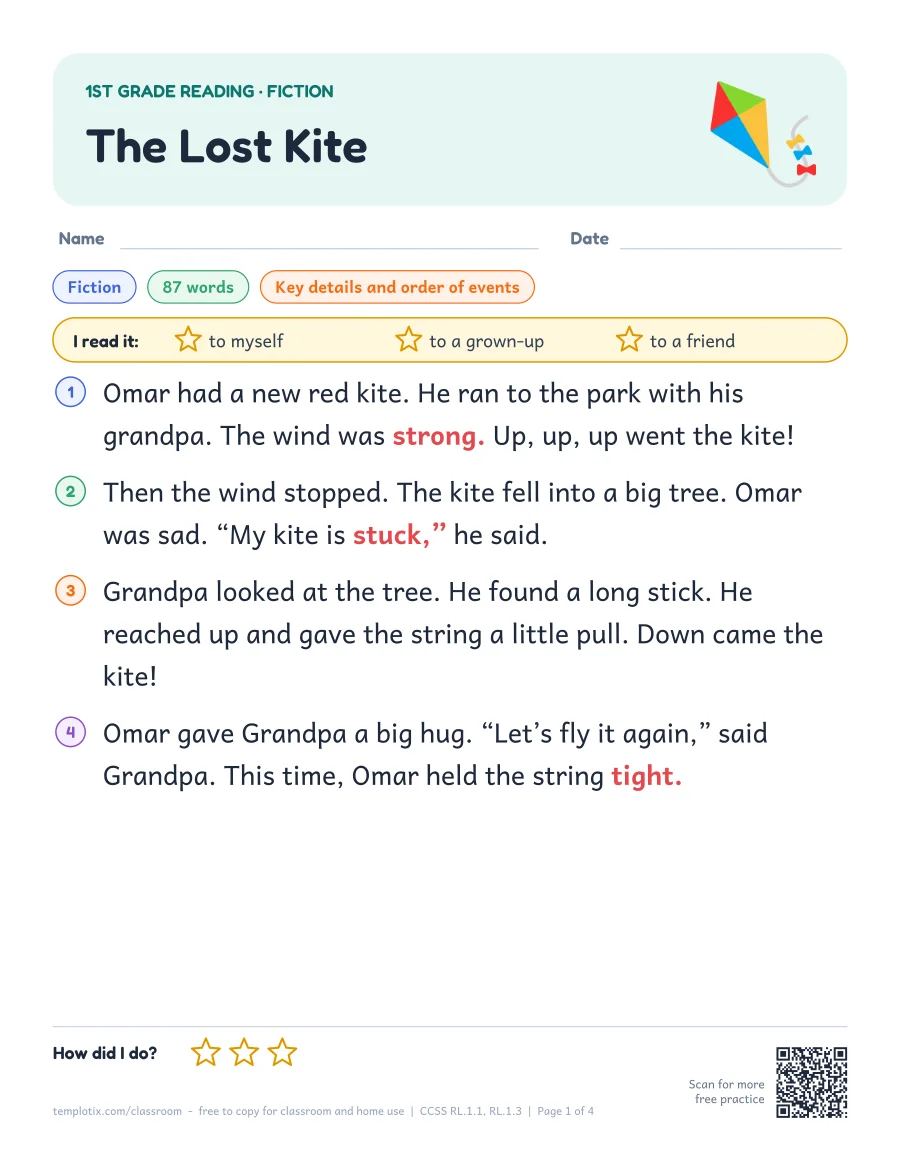
1. The Lost Kite
Fiction87 wordsKey details and order of eventsCCSS RL.1.1, RL.1.3
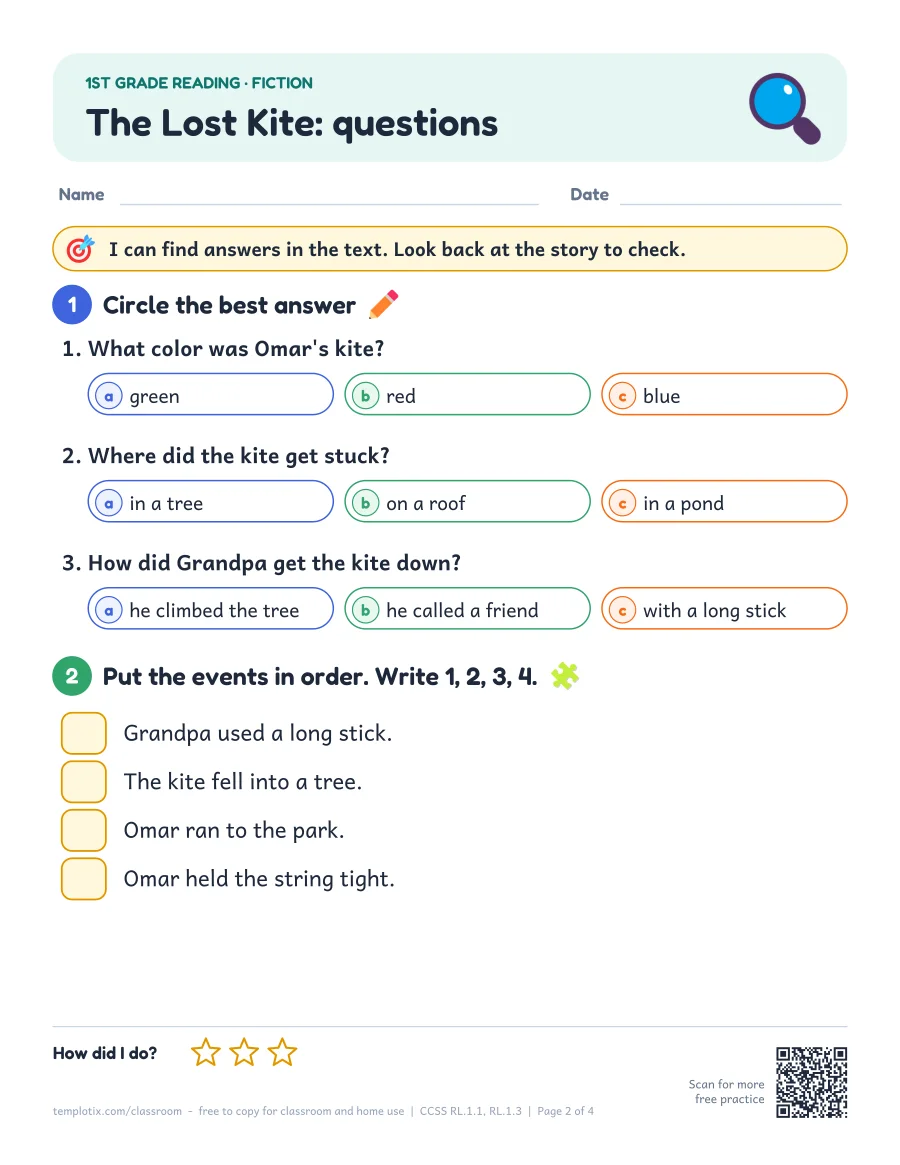
Omar had a new red kite. He ran to the park with his grandpa. The wind was strong. Up, up, up went the kite!
Read the whole passage
Then the wind stopped. The kite fell into a big tree. Omar was sad. “My kite is stuck,” he said.
Grandpa looked at the tree. He found a long stick. He reached up and gave the string a little pull. Down came the kite!
Omar gave Grandpa a big hug. “Let’s fly it again,” said Grandpa. This time, Omar held the string tight.
Words taught: strong, stuck, tight.
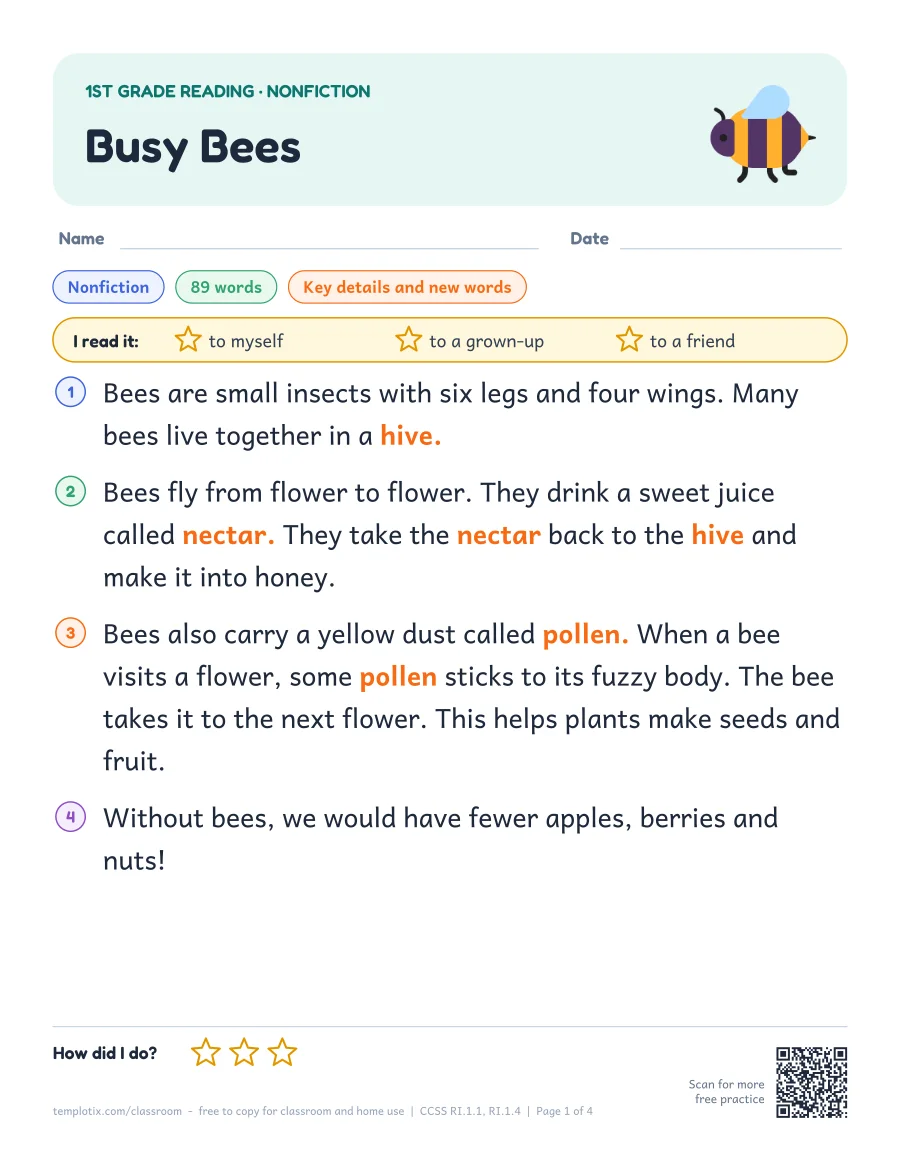
2. Busy Bees
Nonfiction89 wordsKey details and new wordsCCSS RI.1.1, RI.1.4
Bees are small insects with six legs and four wings. Many bees live together in a hive.
Read the whole passage
Bees fly from flower to flower. They drink a sweet juice called nectar. They take the nectar back to the hive and make it into honey.
Bees also carry a yellow dust called pollen. When a bee visits a flower, some pollen sticks to its fuzzy body. The bee takes it to the next flower. This helps plants make seeds and fruit.
Without bees, we would have fewer apples, berries and nuts!
Words taught: hive, nectar, pollen.
3. Puddle Day
Fiction83 wordsCharacters and eventsCCSS RL.1.1, RL.1.3
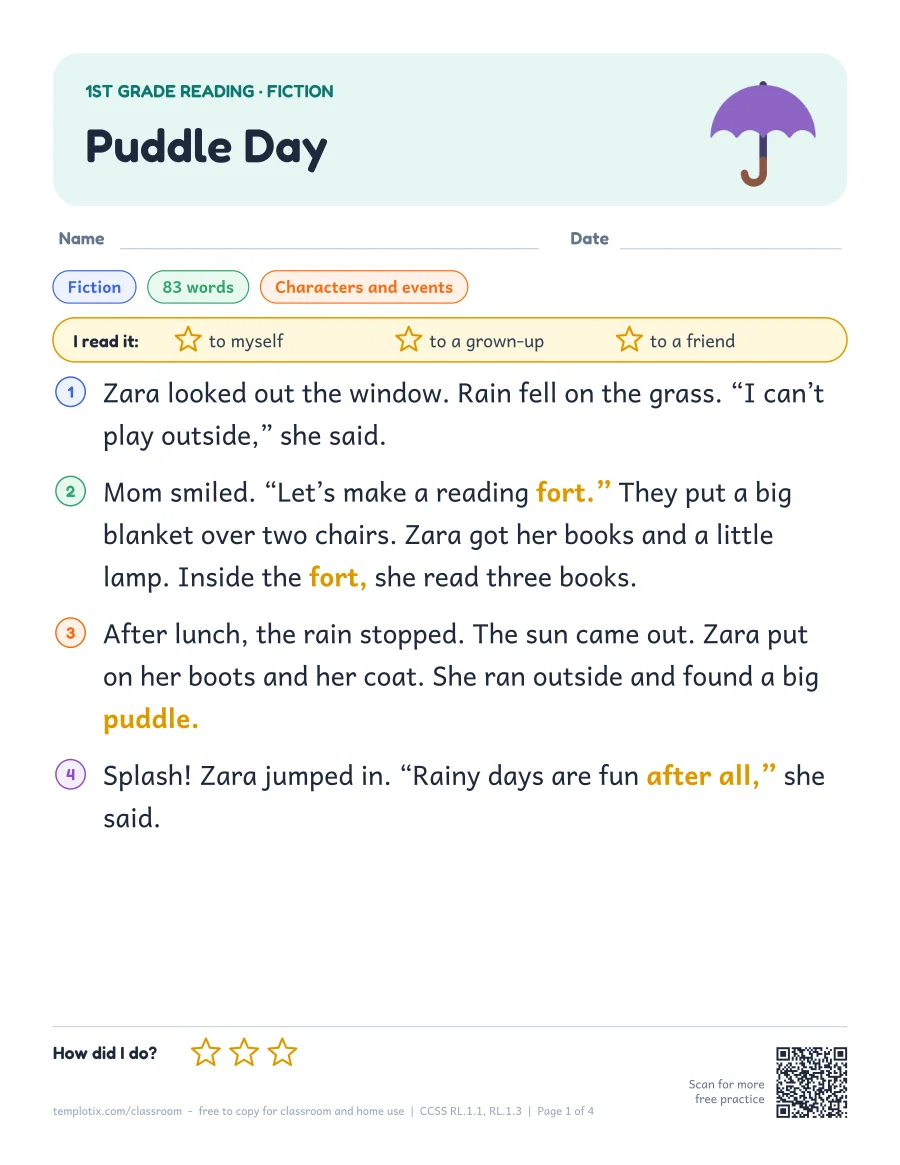
Zara looked out the window. Rain fell on the grass. “I can’t play outside,” she said.
Read the whole passage
Mom smiled. “Let’s make a reading fort.” They put a big blanket over two chairs. Zara got her books and a little lamp. Inside the fort, she read three books.
After lunch, the rain stopped. The sun came out. Zara put on her boots and her coat. She ran outside and found a big puddle.
Splash! Zara jumped in. “Rainy days are fun after all,” she said.
Words taught: fort, puddle, after all.
4. Turtles
Nonfiction94 wordsKey details and new wordsCCSS RI.1.1, RI.1.4
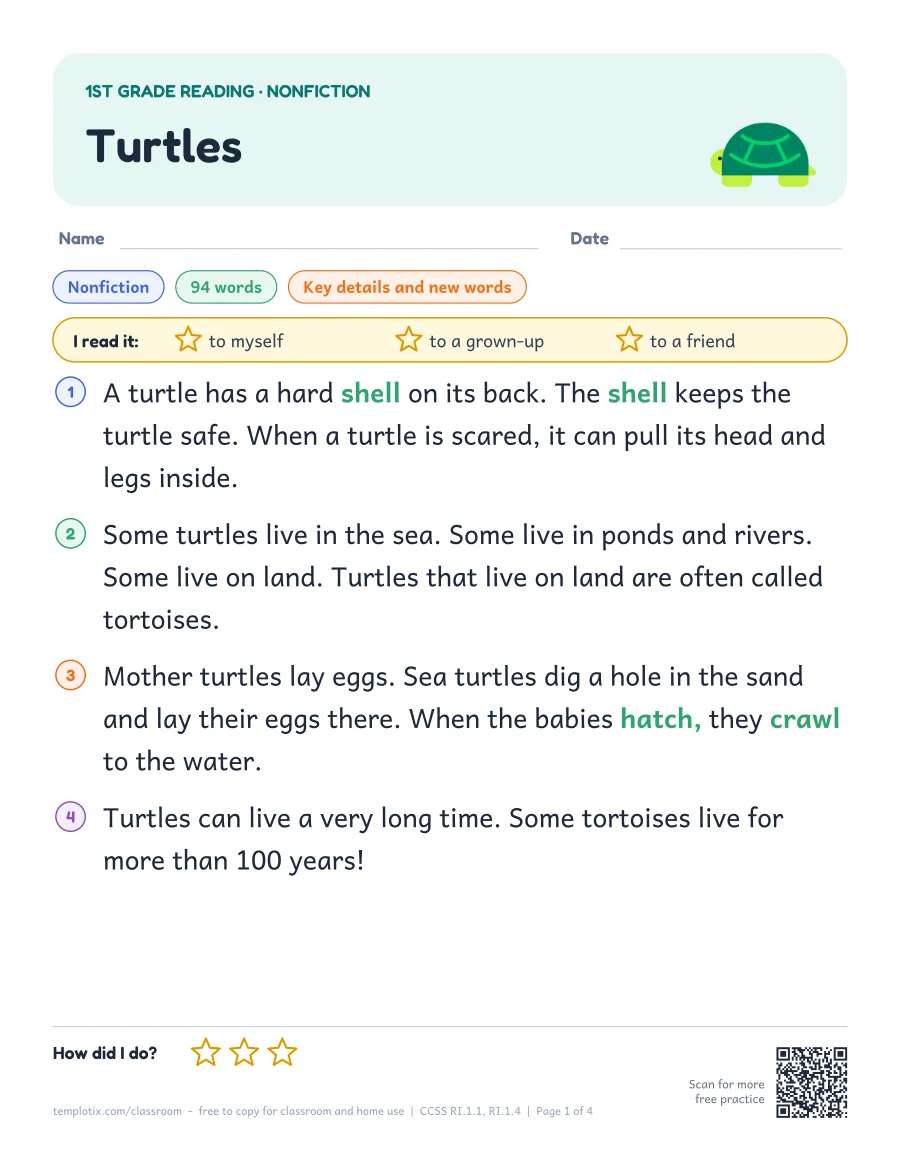
A turtle has a hard shell on its back. The shell keeps the turtle safe. When a turtle is scared, it can pull its head and legs inside.
Read the whole passage
Some turtles live in the sea. Some live in ponds and rivers. Some live on land. Turtles that live on land are often called tortoises.
Mother turtles lay eggs. Sea turtles dig a hole in the sand and lay their eggs there. When the babies hatch, they crawl to the water.
Turtles can live a very long time. Some tortoises live for more than 100 years!
Words taught: shell, hatch, crawl.
5. Ben’s First Bus Ride
Fiction91 wordsCharacters’ feelingsCCSS RL.1.1, RL.1.3
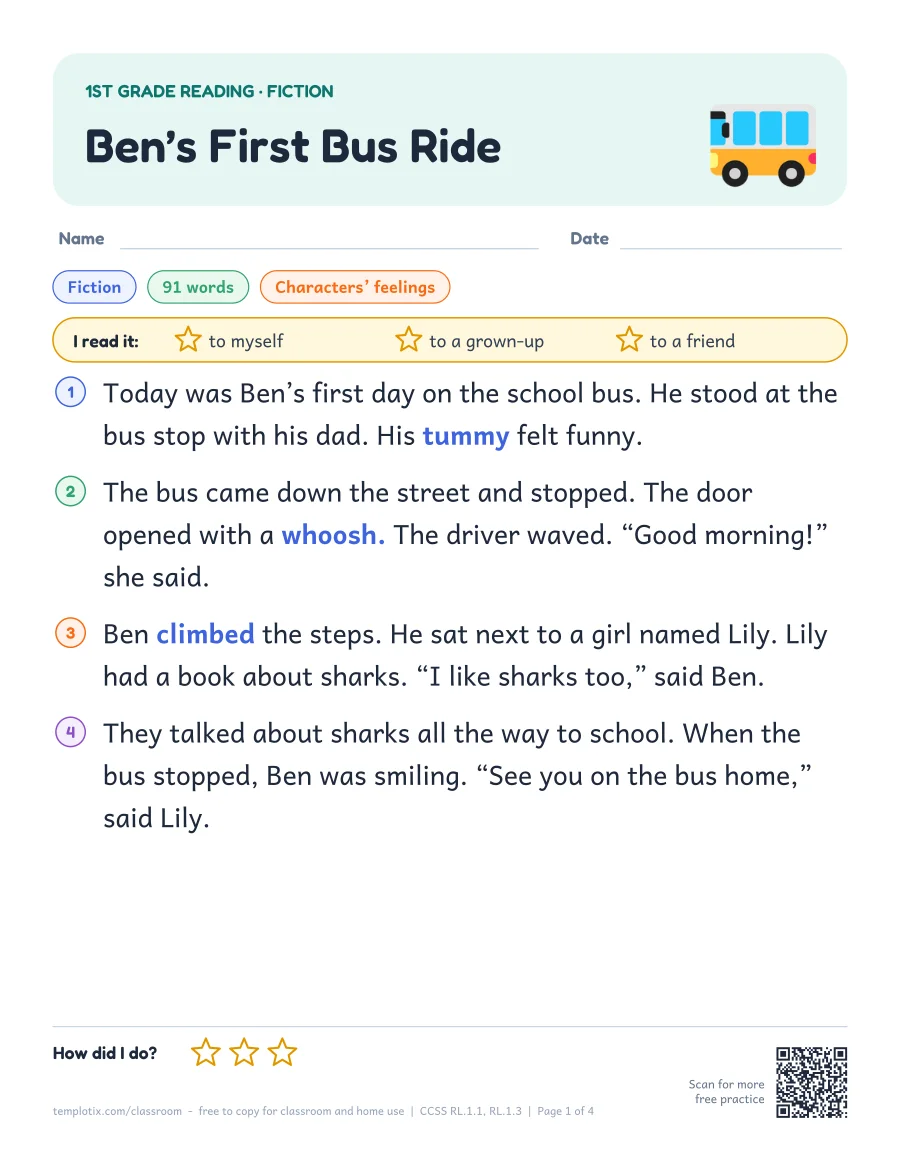
Today was Ben’s first day on the school bus. He stood at the bus stop with his dad. His tummy felt funny.
Read the whole passage
The bus came down the street and stopped. The door opened with a whoosh. The driver waved. “Good morning!” she said.
Ben climbed the steps. He sat next to a girl named Lily. Lily had a book about sharks. “I like sharks too,” said Ben.
They talked about sharks all the way to school. When the bus stopped, Ben was smiling. “See you on the bus home,” said Lily.
Words taught: tummy, climbed, whoosh.
6. Penguins
Nonfiction82 wordsKey details and new wordsCCSS RI.1.1, RI.1.4
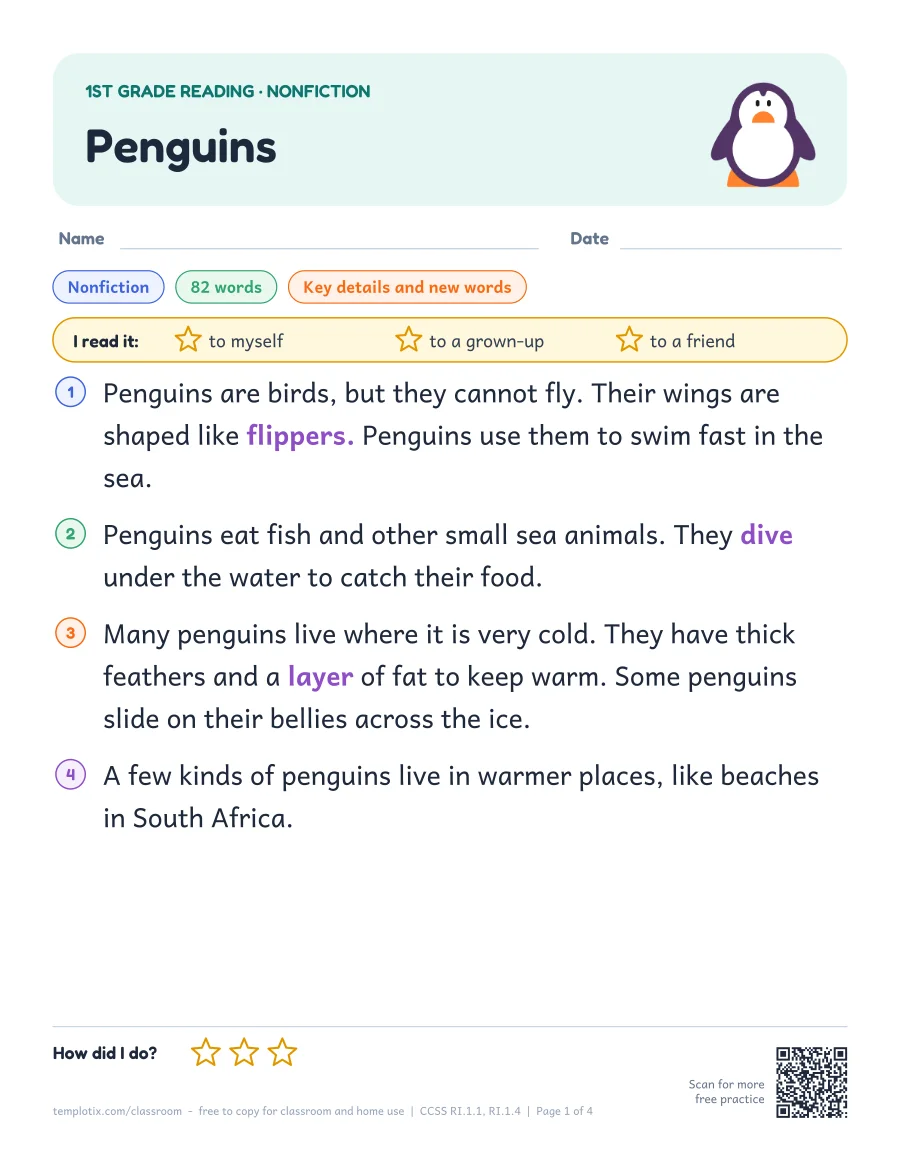
Penguins are birds, but they cannot fly. Their wings are shaped like flippers. Penguins use them to swim fast in the sea.
Read the whole passage
Penguins eat fish and other small sea animals. They dive under the water to catch their food.
Many penguins live where it is very cold. They have thick feathers and a layer of fat to keep warm. Some penguins slide on their bellies across the ice.
A few kinds of penguins live in warmer places, like beaches in South Africa.
Words taught: flippers, dive, layer.
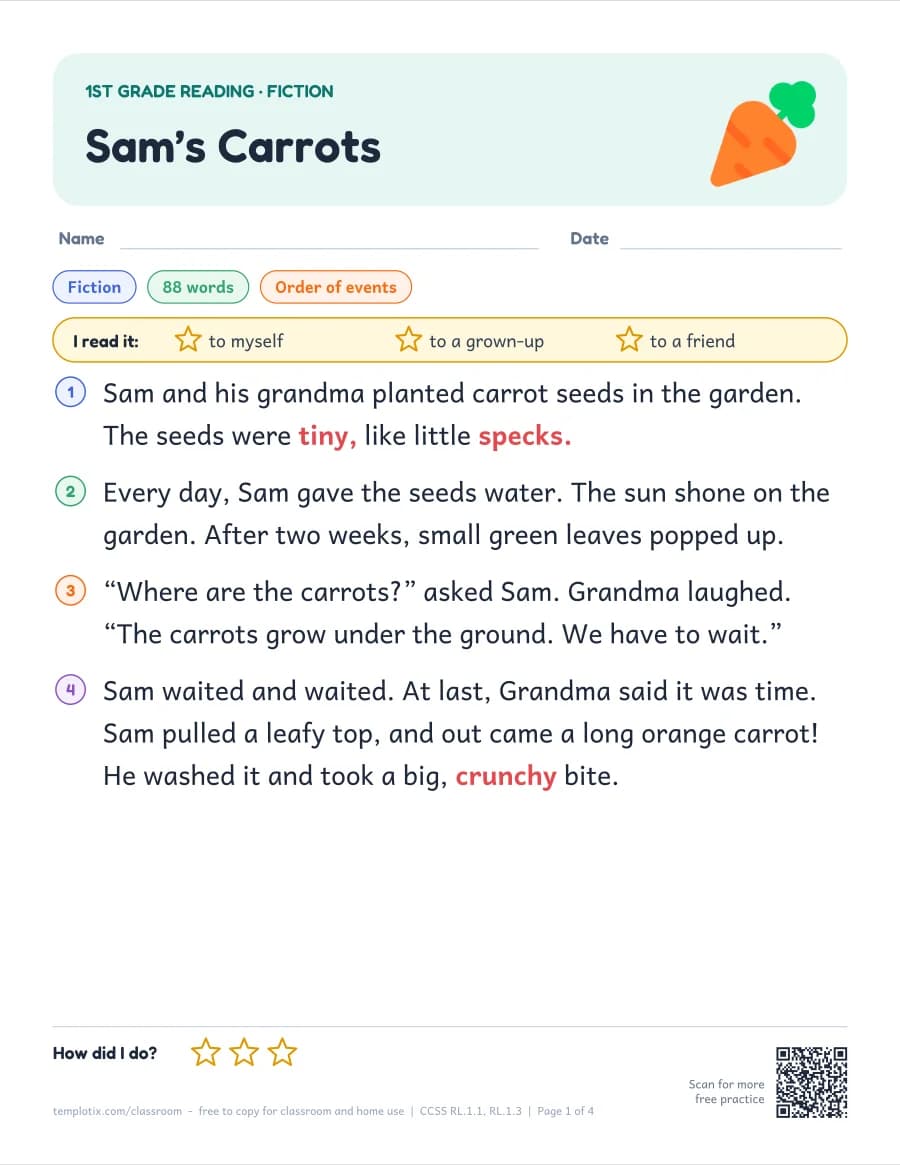
7. Sam’s Carrots
Fiction88 wordsOrder of eventsCCSS RL.1.1, RL.1.3
Sam and his grandma planted carrot seeds in the garden. The seeds were tiny, like little specks.
Read the whole passage
Every day, Sam gave the seeds water. The sun shone on the garden. After two weeks, small green leaves popped up.
“Where are the carrots?” asked Sam. Grandma laughed. “The carrots grow under the ground. We have to wait.”
Sam waited and waited. At last, Grandma said it was time. Sam pulled a leafy top, and out came a long orange carrot! He washed it and took a big, crunchy bite.
Words taught: tiny, specks, crunchy.
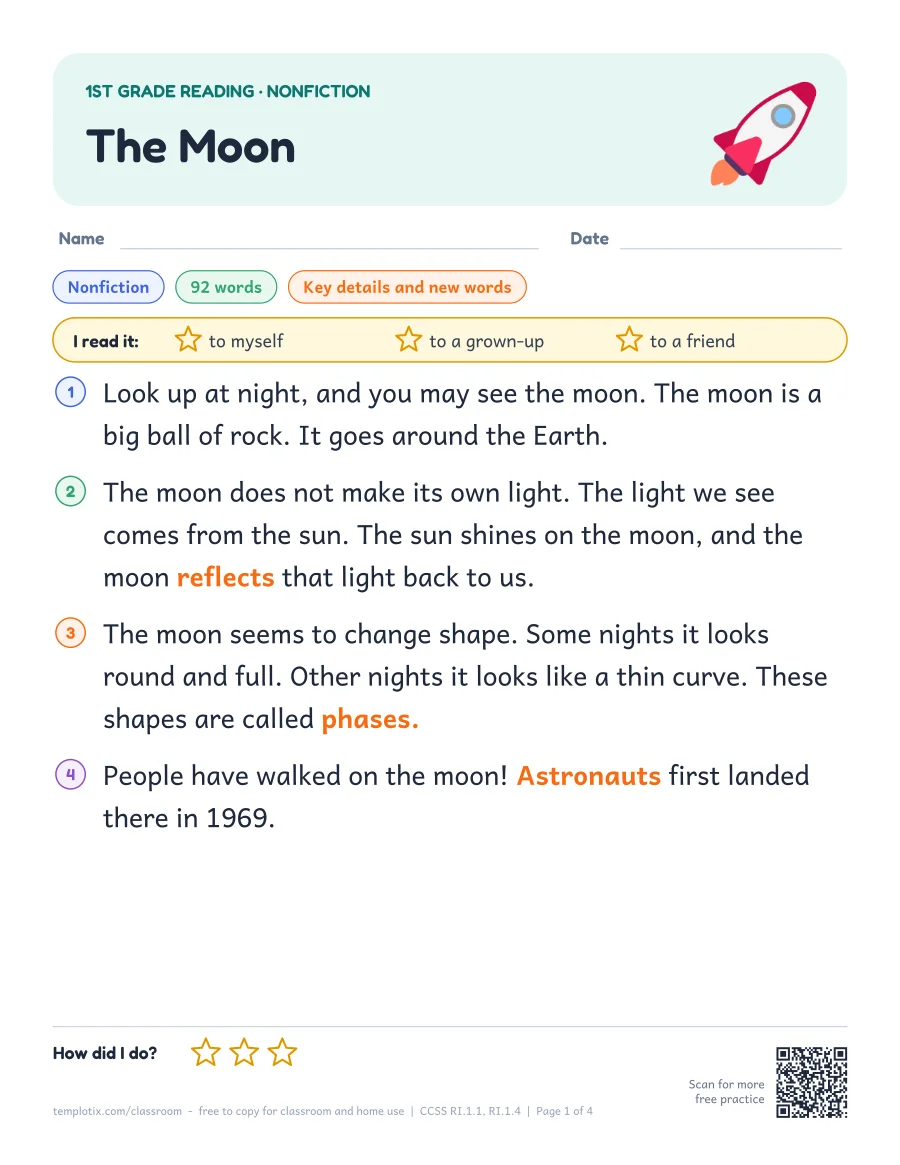
8. The Moon
Nonfiction92 wordsKey details and new wordsCCSS RI.1.1, RI.1.4
Look up at night, and you may see the moon. The moon is a big ball of rock. It goes around the Earth.
Read the whole passage
The moon does not make its own light. The light we see comes from the sun. The sun shines on the moon, and the moon reflects that light back to us.
The moon seems to change shape. Some nights it looks round and full. Other nights it looks like a thin curve. These shapes are called phases.
People have walked on the moon! Astronauts first landed there in 1969.
Words taught: reflects, phases, astronauts.
 1. The Lost Kite
 2. Busy Bees
 3. Puddle Day
 4. Turtles
 5. Ben’s First Bus Ride
 6. Penguins
 7. Sam’s Carrots
 8. The Moon
Inside a worksheet
Common questions
What reading level are these 1st grade passages?
They are written for 1st grade: 82 to 94 words, with short sentences and everyday vocabulary, plus three new words in each passage that are taught on the worksheet. Use them for children reading at or near a 1st grade level.
What is in each worksheet?
Four pages: the passage with a "read it three times" tracker, multiple-choice questions with either an order-of-events or a true-or-false task, a word-meaning match with a written answer and a drawing box, and an answer key with a sample written answer.
How should I use a passage?
Read it together first, then let the child read it alone and to someone else (the stars on page 1 track this). Do the questions the next day, and ask the child to point to the sentence in the text that proves each answer.
Can I copy these worksheets for my class?
Yes. The PDFs are free to print and photocopy for classroom and home use, in color or in the black-and-white ink saver. Please link to this page rather than re-uploading the files.