Shop
 Grade workbooks


Classroom · Science · Forces and motion · 2nd and 3rd grade
Friction worksheets
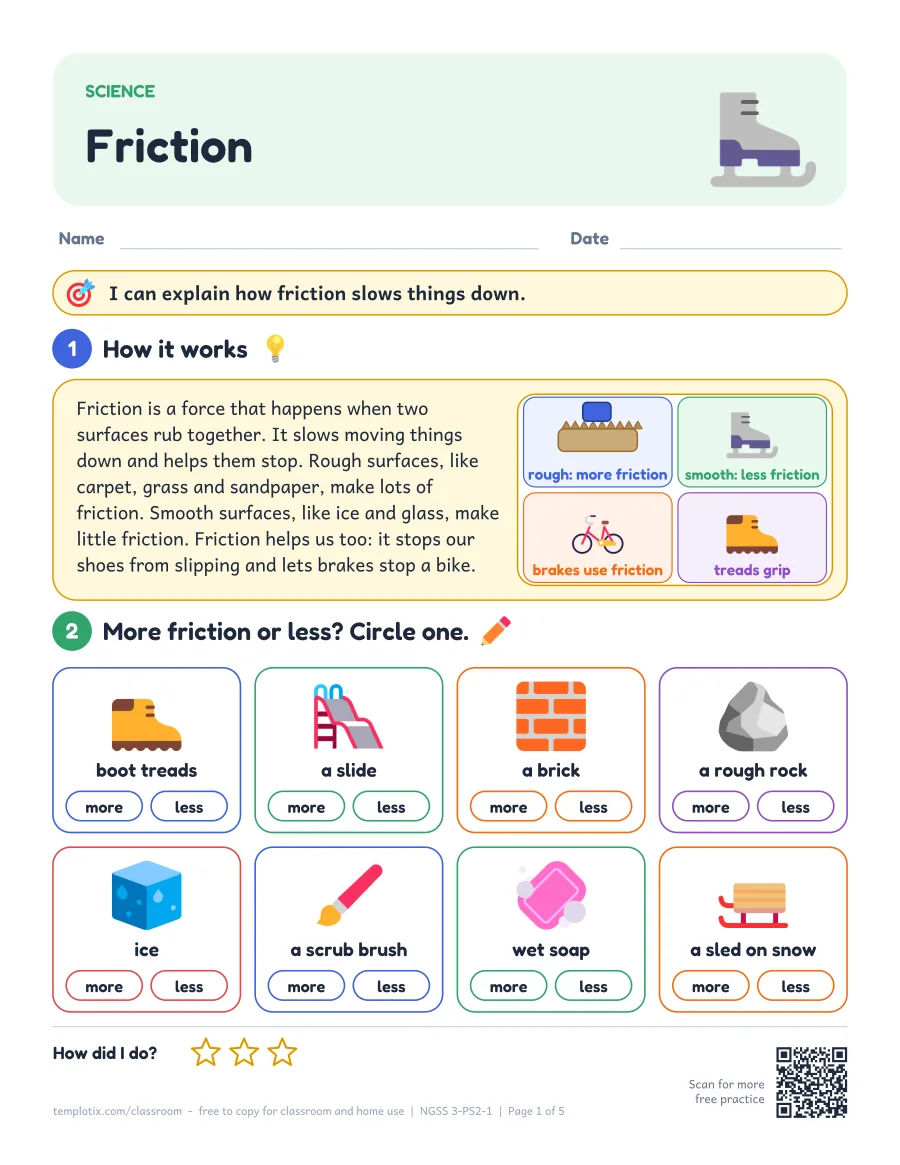
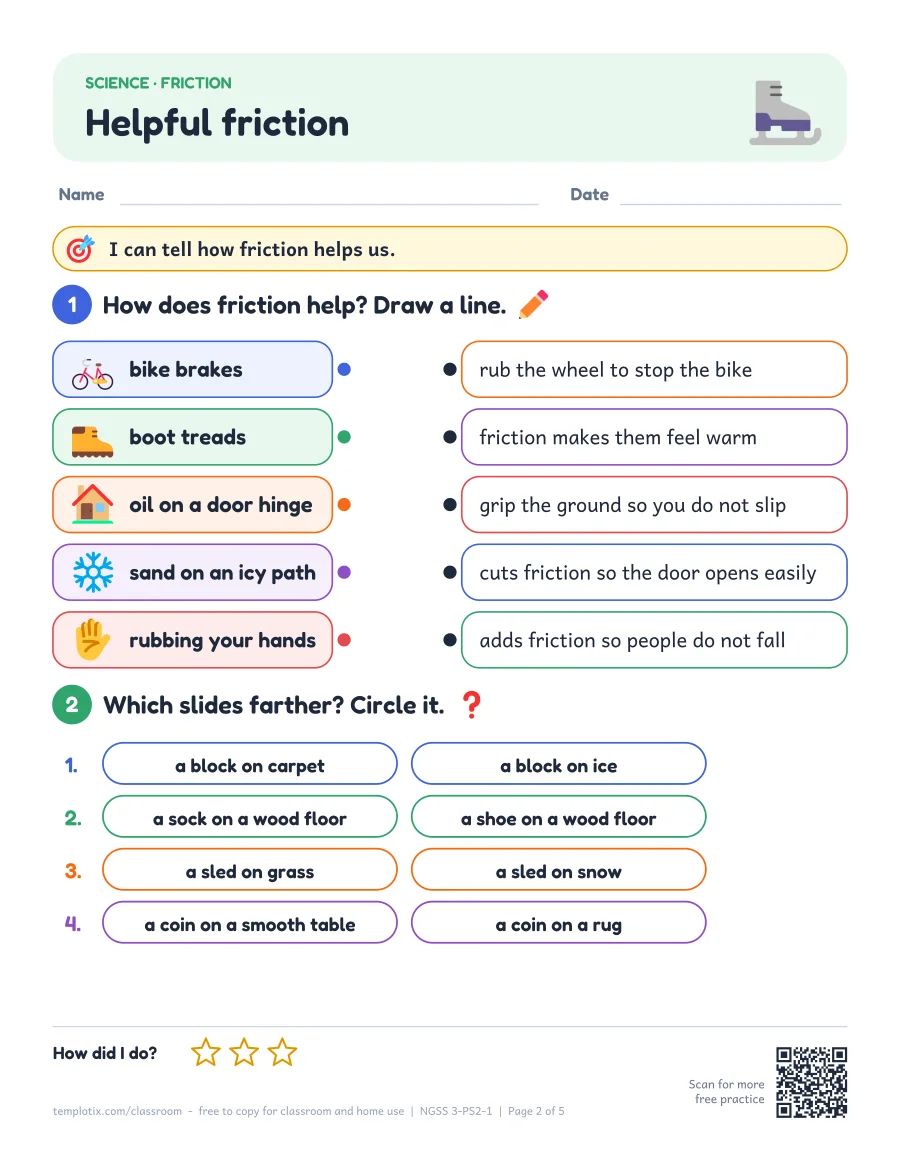
A free five-page science pack for 2nd and 3rd grade: learn to explain how friction slows things down, with a labeled picture, practice pages, a hands-on experiment and an answer key.
The big idea
 The big idea
Friction is a force that happens when two surfaces rub together. It slows moving things down and helps them stop. Rough surfaces, like carpet, grass and sandpaper, make lots of friction. Smooth surfaces, like ice and glass, make little friction. Friction helps us too: it stops our shoes from slipping and lets brakes stop a bike.
Teaching tip
 Teaching tip
Let children rub their hands together fast for ten seconds and feel the warmth. Friction makes heat, which is a fun way to start the topic.
Try it: the slide test
 Try it: the slide test
I can test how surfaces change friction.
You need
- A board for a ramp
- A small block or an eraser
- A towel
- Wax paper
- Sandpaper or a rug
What to do
- 1Make a ramp with the board and a few books.
- 2Let the block slide down the bare board. Mark where it stops.
- 3Cover the ramp with wax paper and try again. Then try the towel and the sandpaper.
- 4Compare how far the block slid each time.
Predict first: Which surface will let the block slide farthest?What happens?
The block slides farthest on the wax paper, because it is the smoothest surface and makes the least friction. It slides less on the bare board, and least of all on the towel and the sandpaper, which are rough and make the most friction. More friction means the block slows down and stops sooner.
Safety: keep the ramp low and steady. Handle sandpaper gently.
Quick check
What is friction?Tap to checkA force when two surfaces rub together
What does friction do to moving things?Tap to checkIt slows them down
Which has more friction, ice or carpet?Tap to checkCarpet
How do bike brakes work?Tap to checkThey rub the wheel and use friction
Why do shoes have treads?Tap to checkTo add friction so we do not slip
What do your hands feel when you rub them?Tap to checkWarmth from friction
What the worksheets look like
Forces all around poster
 Forces all around poster
One colorful page with push, pull, gravity, friction, simple machines and balanced forces, each with a picture and a one-line meaning. Made for a science wall.
Common questions
What are examples of friction in everyday life?
Brakes stopping a bike, shoes gripping the floor, rubbing your hands to warm them and an eraser rubbing out pencil marks. Without friction we could not walk or hold things.
Is friction good or bad?
Both. Friction helps us walk, grip and stop. It also wears out shoes and tires and makes machines work harder, so people use oil, wheels and smooth surfaces to reduce it.
What grade learns friction?
Usually 2nd and 3rd grade. In the Next Generation Science Standards (NGSS) it supports 3-PS2-1.
Is there a hands-on experiment?
Yes. Page 4 is a Try it! experiment, the slide test, with a materials list, a prediction and an observation chart. Safety: keep the ramp low and steady. Handle sandpaper gently.
Is there an answer key?
Yes. Page 5 has every answer from the pack, what to expect from the experiment and a short teaching tip.