Shop
 Grade workbooks


Classroom · Science · Human body · Kindergarten and 1st grade

Five senses worksheets
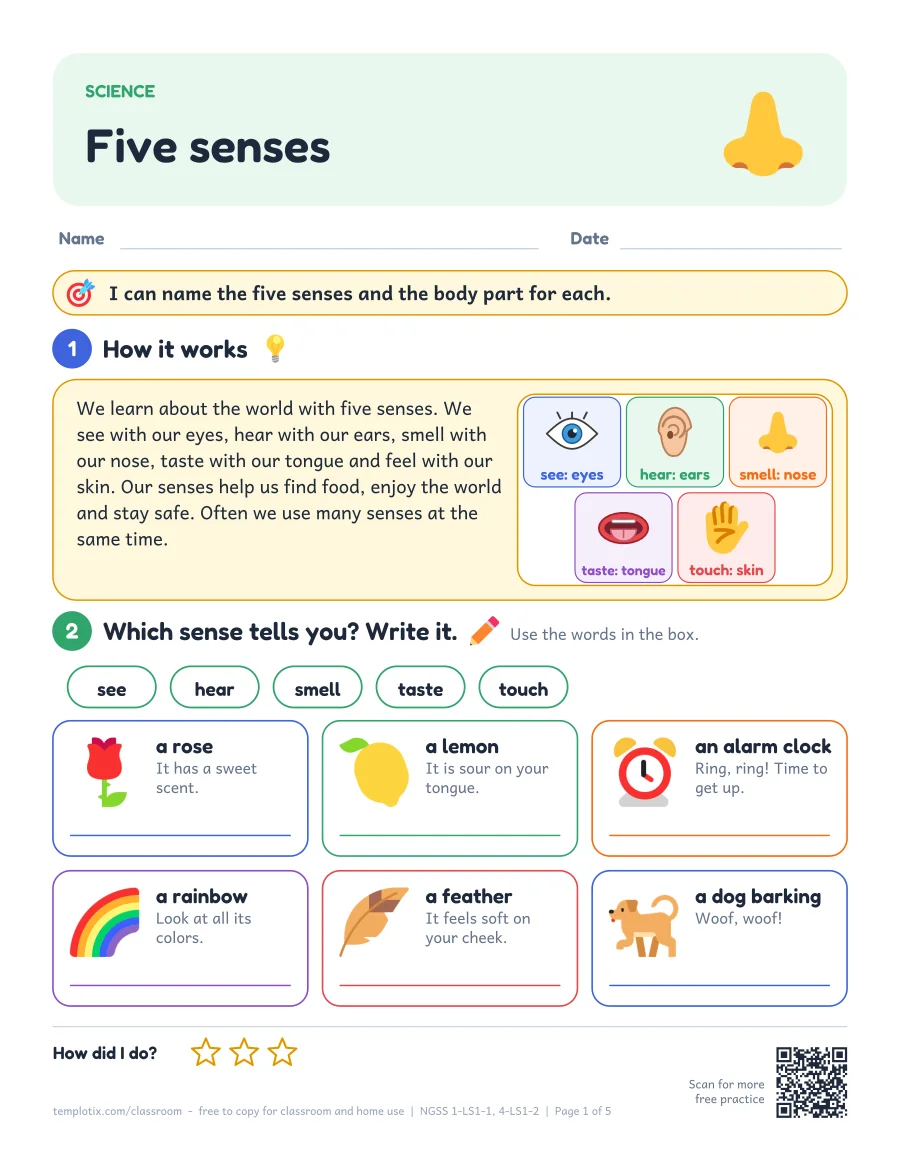
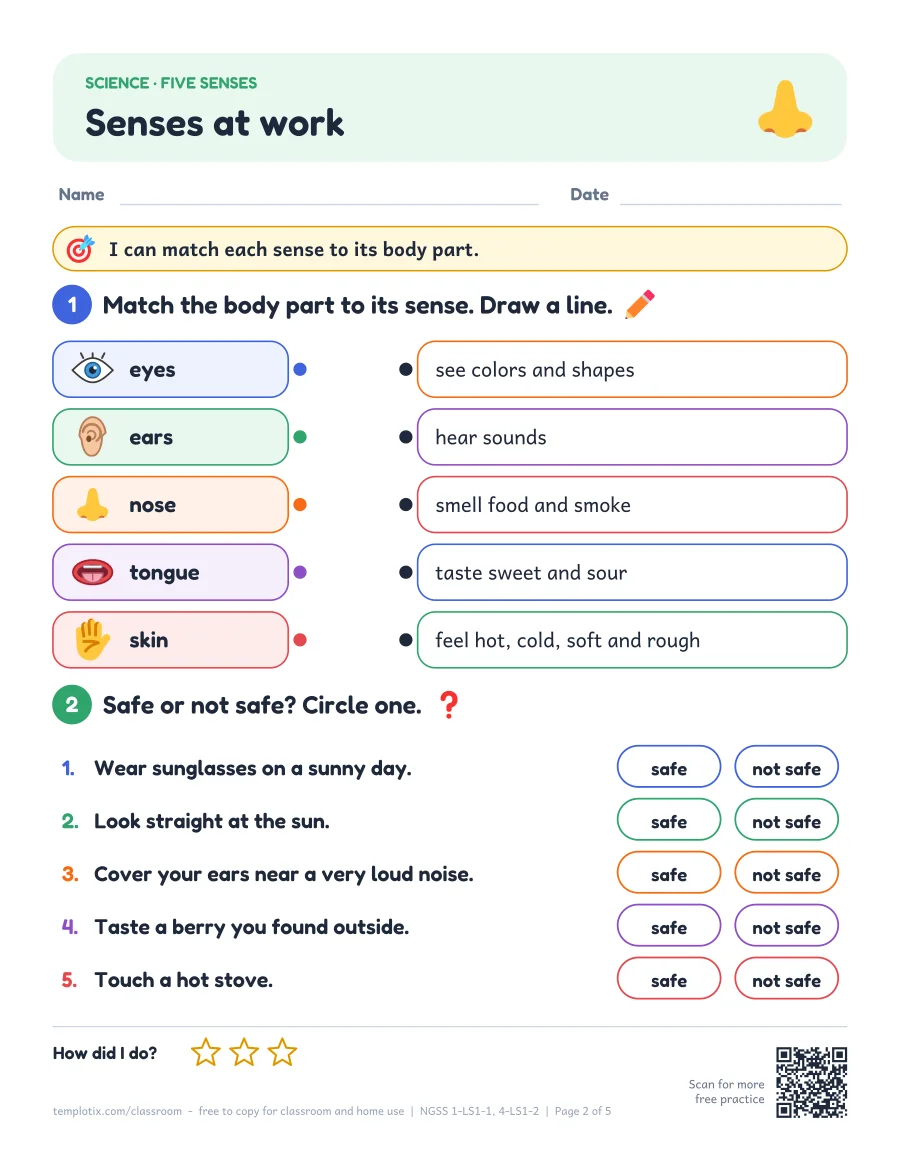
A free five-page science pack for Kindergarten and 1st grade: learn to name the five senses and the body part for each, with a labeled picture, practice pages, a hands-on experiment and an answer key.
The big idea
 The big idea
We learn about the world with five senses. We see with our eyes, hear with our ears, smell with our nose, taste with our tongue and feel with our skin. Our senses help us find food, enjoy the world and stay safe. Often we use many senses at the same time.
Teaching tip
 Teaching tip
Hand out one orange slice each and ask children to describe it with every sense, one at a time, before anyone takes a bite.
Try it: the mystery bag
 Try it: the mystery bag
I can name an object using only touch.
You need
- A paper bag or box
- 5 small, safe objects
- A partner
- A pencil
What to do
- 1Your partner hides one object in the bag. Do not peek.
- 2Put your hand in the bag and feel the object.
- 3Say what you feel: soft or hard, smooth or bumpy, big or small.
- 4Guess what it is, then take it out and check. Swap jobs.
Predict first: Can you name an object by touch alone?What happens?
Answers will vary. Children usually name objects with a clear shape or texture, like a ball or a spoon, and find look-alike objects harder. Touch gives a lot of information, but using more senses together helps us know things better.
Safety: use only clean objects with no sharp edges, and never put them in your mouth.
Quick check
What are the five senses?Tap to checkSight, hearing, smell, taste and touch
What do we smell with?Tap to checkOur nose
What do we taste with?Tap to checkOur tongue
Which sense feels hot and cold?Tap to checkTouch, with our skin
Which body part helps us hear?Tap to checkOur ears
How do senses keep us safe?Tap to checkThey warn us about danger, like heat or smoke
What the worksheets look like
Five senses poster
 Five senses poster
One colorful page with the five senses (sight, hearing, smell, taste and touch), the body part for each and how the brain puts the messages together. Made for a science wall.
Common questions
How do the five senses keep us safe?
Smell warns us of smoke or spoiled food, hearing catches a car horn or a fire alarm, sight spots danger in the road, and touch tells us a stove is hot. Every sense has a safety job.
Why does food taste bland when you have a cold?
Much of what we call flavor comes from smell. A blocked nose cannot smell the food, so it tastes flat. Children can test it by holding their nose while they eat an apple slice.
What grade learns five senses?
Usually Kindergarten and 1st grade. In the Next Generation Science Standards (NGSS) it supports 1-LS1-1 and 4-LS1-2.
Is there a hands-on experiment?
Yes. Page 4 is a Try it! experiment, the mystery bag, with a materials list, a prediction and an observation chart. Safety: use only clean objects with no sharp edges, and never put them in your mouth.
Is there an answer key?
Yes. Page 5 has every answer from the pack, what to expect from the experiment and a short teaching tip.