Shop
 Grade workbooks


Classroom · Science · NGSS 1-LS1, 1-PS4, 4-LS1, 4-PS4
worksheets for kindergarten to 4th grade
The human body is the one science topic every child carries everywhere. Each free pack teaches one big idea, from the five senses to bones, the heart and the brain, with a clear picture, practice pages, a Think like a scientist page and a hands-on experiment, then ends with an answer key.
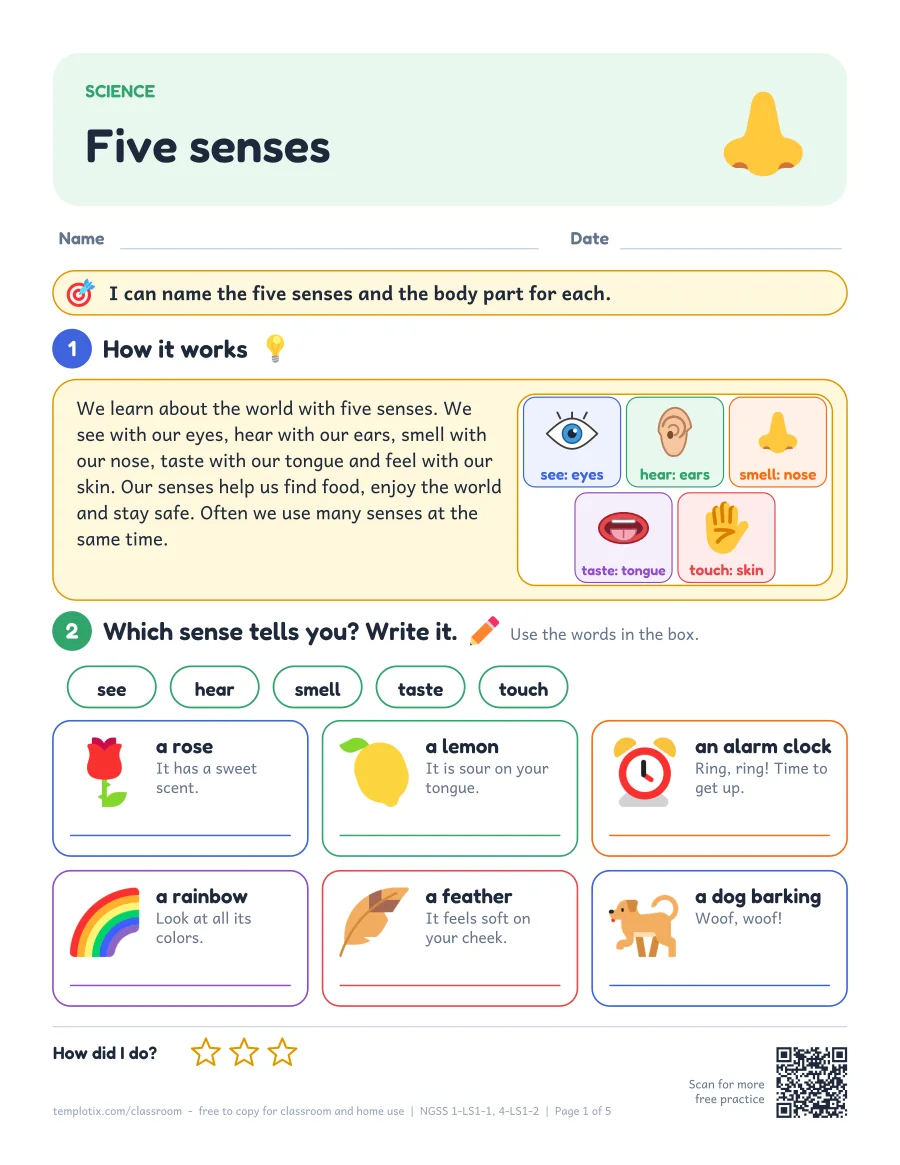
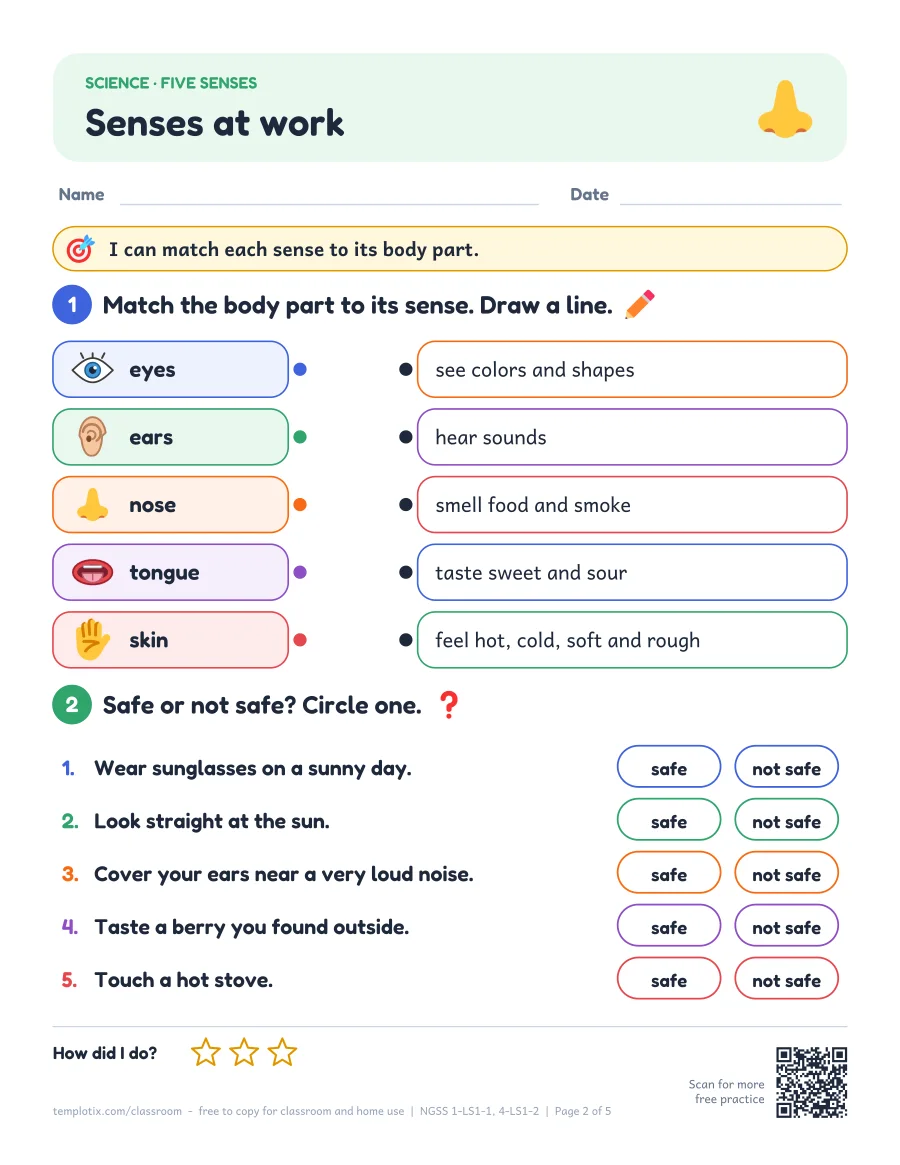
- Five sensesKindergarten and 1st grade · NGSS 1-LS1-1, 4-LS1-2
We learn about the world with five senses. We see with our eyes, hear with our ears, smell with our nose, taste with our tongue and feel with our skin. Our senses help us find food, enjoy the world and stay safe. Often we use many senses at the same time.
- How we see1st to 4th grade · NGSS 1-PS4-2, 4-PS4-2
We see things when light bounces off them and goes into our eyes. Light comes from the sun, lamps and screens. In a room with no light at all, we cannot see anything. The black circle in the eye, the pupil, lets light in. It gets smaller in bright light and bigger in dim light.
- How we hear1st grade · NGSS 1-PS4-1
Sounds are made when something vibrates, or moves back and forth very fast. The vibrations travel through the air to our ears. The outer ear catches the sound, and the eardrum inside vibrates too. Big vibrations make loud sounds and small vibrations make soft sounds.
- Bones and muscles3rd and 4th grade · NGSS 4-LS1-1
Your skeleton is made of more than 200 bones. Bones hold you up, give your body its shape and protect soft parts: the skull protects the brain and the ribs protect the heart and lungs. Muscles pull on bones to move them, and joints, like elbows and knees, are where bones meet and bend.
- Heart and lungs3rd and 4th grade · NGSS 4-LS1-1
Your heart is a strong muscle about the size of your fist. It pumps blood all around your body, day and night. Your lungs breathe in air with oxygen. Blood picks up oxygen in the lungs, and the heart pumps it to every part of you. When you run, your heart beats faster to bring more oxygen to your muscles.
- Brain and nerves4th grade · NGSS 4-LS1-2
Your brain is the control center of your body. Your senses send messages along nerves to your brain. The brain works out what the messages mean and sends messages back along nerves to tell your muscles what to do. Some messages are very fast: you pull your hand away from something hot before you even think.





Five senses poster
 Five senses poster
One colorful page with the five senses (sight, hearing, smell, taste and touch), the body part for each and how the brain puts the messages together. Made for a science wall.
What is in each pack
- 1. Learn itA short explanation with a clear, labeled picture, then a first activity.
- 2. PracticeLabeling, matching, sorting and fill in the blanks.
- 3. Think like a scientistWhy questions, true or false and a drawing that explains an idea.
- 4. Try it!A hands-on experiment with a materials list, a prediction and an observation chart.
- 5. Answer keyEvery answer, what to expect from the experiment, a teaching tip and a safety note.


How to teach human body
- Start with their own body. Children can feel their pulse, watch their pupils and bend their joints. Let them check every idea on themselves first.
- Use all five senses. A snack, a mystery bag or a sound walk turns each sense into something children notice on purpose.
- Name the part and its job. Pair every body part with what it does: the skull protects, the heart pumps, nerves carry messages.
- Keep it kind. Bodies differ. Some children wear glasses or hearing aids, or use a wheelchair, so talk about how every body works in its own way.
- Link it to healthy habits. Sleep, exercise, healthy food and helmets come up naturally when children learn what each part does.
More science
Common questions
Are these human body worksheets free?
Yes. Every human body pack and the poster are free to download, print and copy for your class or home, in color or in a black-and-white ink saver.
What grade are these human body worksheets for?
Kindergarten to 4th grade. The five senses start in kindergarten, seeing and hearing are 1st grade topics, and bones and muscles, the heart and lungs and the brain and nerves match 4th grade body structures in the Next Generation Science Standards (NGSS).
Do I need special supplies for the experiments?
No. The Try it! pages use everyday things, such as a paper bag, a small mirror, a bowl with plastic wrap and rice, tape, a ruler and a clock with a second hand.
Do the worksheets follow the NGSS?
Yes. Each pack names the NGSS performance expectation it supports, for example 1-PS4-1 for sound and vibration and 4-LS1-1 for body structures.