Shop
 Grade workbooks


Classroom · Science · NGSS K-LS1, 1-LS1, 2-LS2, 3-LS1, 3-LS4
worksheets for kindergarten to 3rd grade
Plants are a perfect first science unit: children can touch them, grow them and even eat them. Each free pack teaches one big idea with a clear picture, practice pages, a Think like a scientist page and a hands-on experiment you can do with things from the kitchen, then ends with an answer key.
- Parts of a plantKindergarten and 1st grade · NGSS K-LS1-1, 1-LS1-1
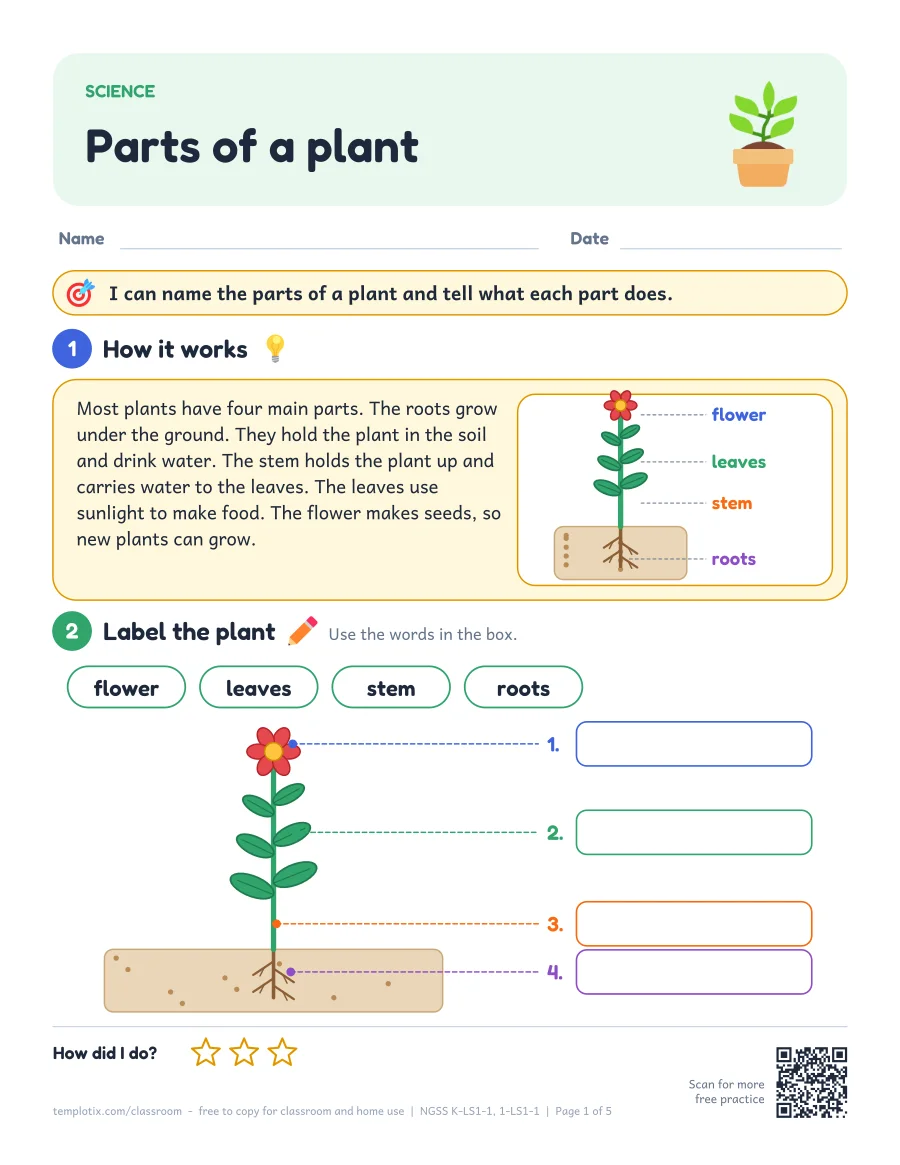
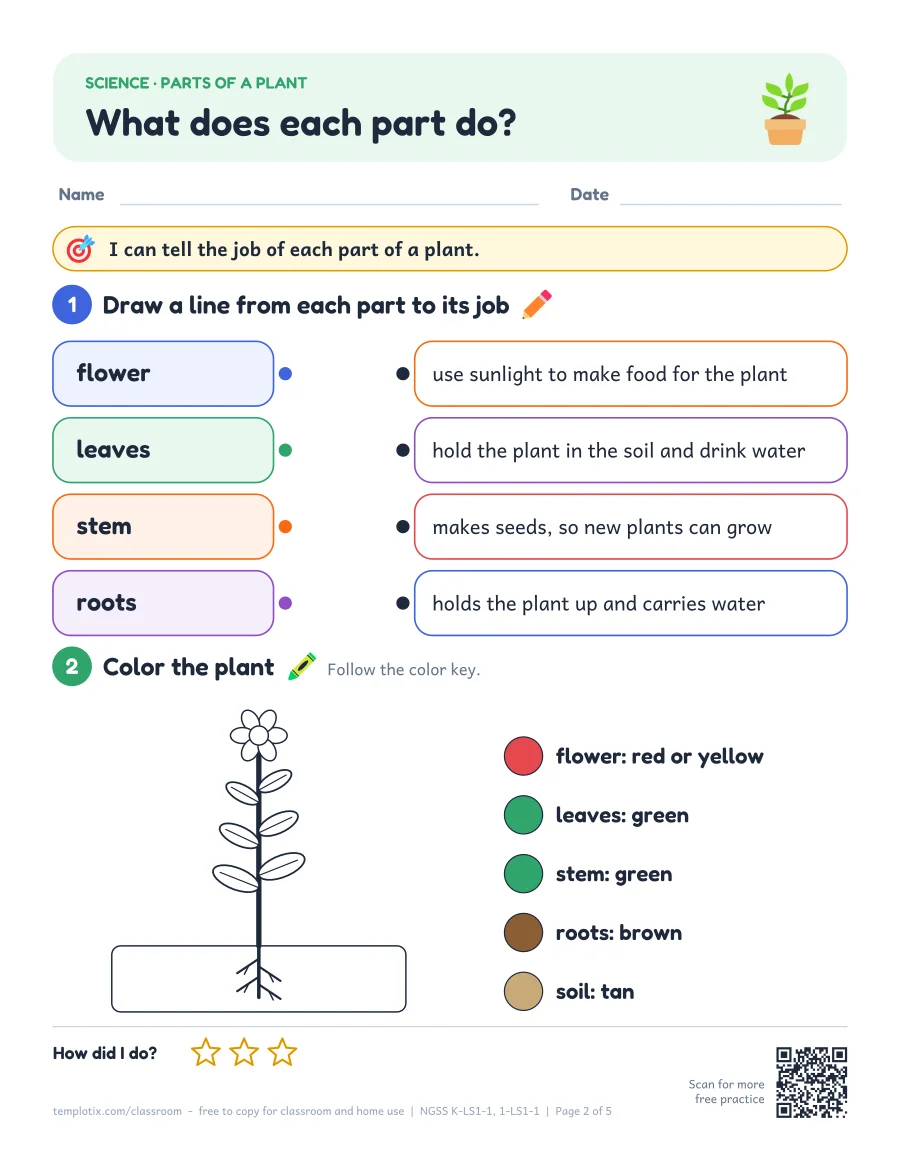
Most plants have four main parts. The roots grow under the ground. They hold the plant in the soil and drink water. The stem holds the plant up and carries water to the leaves. The leaves use sunlight to make food. The flower makes seeds, so new plants can grow.
- What plants needKindergarten to 2nd grade · NGSS K-LS1-1
Plants are living things, so they have needs, just like you. A plant needs sunlight, water, air and soil. Its leaves use sunlight and air to make food. Its roots drink water and hold on to the soil. A plant also needs space to grow. If a plant does not get what it needs, it droops, turns pale or dies.
- Plant life cycle1st to 3rd grade · NGSS 3-LS1-1
A plant's life is a cycle. A seed gets water and warmth and sprouts. The sprout grows into a seedling, then into an adult plant. The adult plant grows flowers. The flowers turn into fruit with new seeds inside. When those seeds are planted, the cycle starts again.
- How seeds travel2nd grade · NGSS 2-LS2-2
A plant cannot walk, but its seeds can travel. Some seeds fly in the wind, like dandelion fluff and maple wings. Some float on water, like coconuts. Some ride on animals: burrs hook onto fur, and birds eat berries and drop the seeds. Some pods dry out and pop! Seeds travel so each new plant gets space, light and water.
- Plant parts we eat1st to 3rd grade · NGSS K-LS1-1, 4-LS1-1
We eat every part of a plant! A carrot is a root. Celery is a stem. Lettuce and spinach are leaves. Broccoli is a bunch of tiny flowers. Apples and tomatoes are fruits, because they grow from a flower and hold seeds. Corn, rice, peas and peanuts are seeds. Next time you eat, ask: which part of the plant is this?
- Plant adaptations3rd grade · NGSS 3-LS4-3
An adaptation is a part that helps a plant survive in its home. A cactus has a thick stem that stores water and spines that keep animals away. A water lily has big, flat leaves that float in the sun. A pine tree has thin, waxy needles that save water in winter. Rainforest leaves have pointed tips, so heavy rain drips off.






Parts of a plant poster
One colorful page with the four parts of a plant, what each part does and the plant life cycle. Made for a science wall.
What is in each pack
- 1. Learn itA short explanation with a clear, labeled picture, then a first activity.
- 2. PracticeLabeling, matching, sorting and fill in the blanks.
- 3. Think like a scientistWhy questions, true or false and a drawing that explains an idea.
- 4. Try it!A hands-on experiment with a materials list, a prediction and an observation chart.
- 5. Answer keyEvery answer, what to expect from the experiment, a teaching tip and a safety note.


How to teach plants
- Start with a real plant. Pull up a weed or buy a small seedling, so children can touch the roots, stem and leaves before they draw them.
- Set up the experiment first. Seeds and plants take days to change, so start the Try it! page early and do the other pages while you wait.
- Ask how they know. Scientists use evidence. When a child gives an answer, ask what they saw that tells them so.
- Draw what you see. Observation drawings slow children down and help them notice details, like tiny root hairs or the star of seeds in an apple.
- Connect it to lunch. Point out roots, stems, leaves, flowers, fruits and seeds on the lunch plate. It makes the plant parts stick.
More science
Common questions
Are these plant worksheets free?
Yes. Every plant pack and the poster are free to download, print and copy for your class or home, in color or in a black-and-white ink saver.
What grade are these plant worksheets for?
Kindergarten to 3rd grade. Parts of a plant and what plants need start in kindergarten, seeds on the move is a 2nd grade topic, and the life cycle and plant adaptations are 3rd grade topics in the Next Generation Science Standards (NGSS).
Do I need special supplies for the experiments?
No. Every Try it! page uses things most homes and classrooms already have, such as a cup, water, paper towels, a dry bean, a celery stalk or a piece of fruit. A grown-up does any cutting.
Do the worksheets follow the NGSS?
Yes. Each pack names the NGSS performance expectation it supports, for example K-LS1-1 for what plants need to live and grow and 3-LS1-1 for plant life cycles.