Shop
 Grade workbooks


Classroom · Science · Matter · Kindergarten to 2nd grade

Sink or float worksheets
A free five-page science pack for Kindergarten to 2nd grade: learn to predict and test if objects sink or float, with a labeled picture, practice pages, a hands-on experiment and an answer key.
The big idea
 The big idea
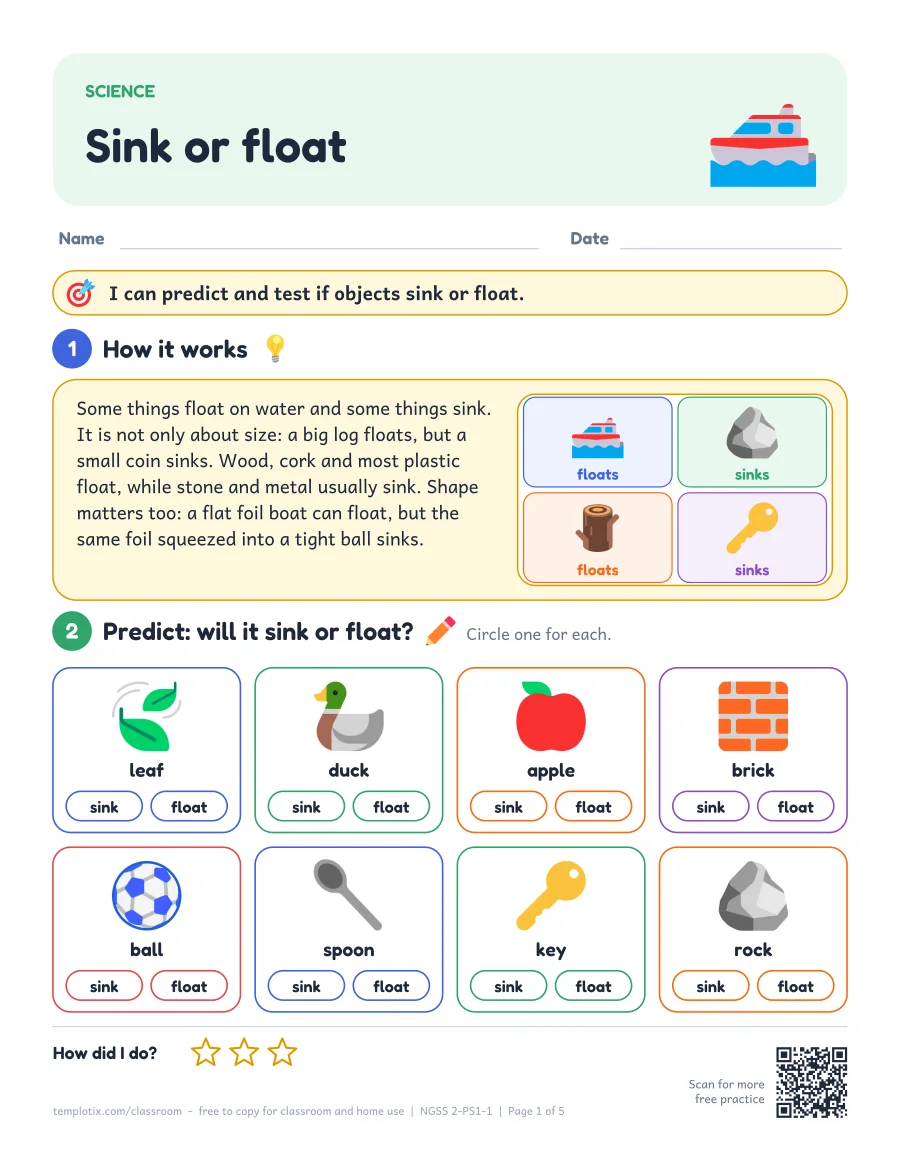
Some things float on water and some things sink. It is not only about size: a big log floats, but a small coin sinks. Wood, cork and most plastic float, while stone and metal usually sink. Shape matters too: a flat foil boat can float, but the same foil squeezed into a tight ball sinks.
Teaching tip
 Teaching tip
Before each test, let children put the object on a sink mat or a float mat to show their prediction. Count how many predictions were right and talk about the surprises.
Try it: the foil boat challenge
 Try it: the foil boat challenge
I can test how shape helps a boat float.
You need
- A square of aluminum foil
- A tub of water
- Coins or marbles
- A pencil
- A grown-up nearby
What to do
- 1Fold the foil into a boat with sides.
- 2Float your boat in the tub of water.
- 3Add coins one at a time, gently, until the boat sinks. Count them.
- 4Squeeze the same foil into a tight ball. Does it float or sink?
Predict first: How many coins can your boat hold?What happens?
Answers will vary. A wide, flat boat with tall sides usually holds the most coins, because it pushes away more water. The tight foil ball weighs the same, but it pushes away much less water, so it sinks. Shape, not only weight, decides if something floats.
Safety: a grown-up watches whenever there is a tub of water. Wipe up spills.
Quick check
Does a wooden block sink or float?Tap to checkIt floats
Does a metal key sink or float?Tap to checkIt sinks
Can a big log float?Tap to checkYes
Does a small coin float?Tap to checkNo, it sinks
How can you make foil float?Tap to checkShape it into a boat
Which floats better, a full or an empty bottle?Tap to checkAn empty bottle
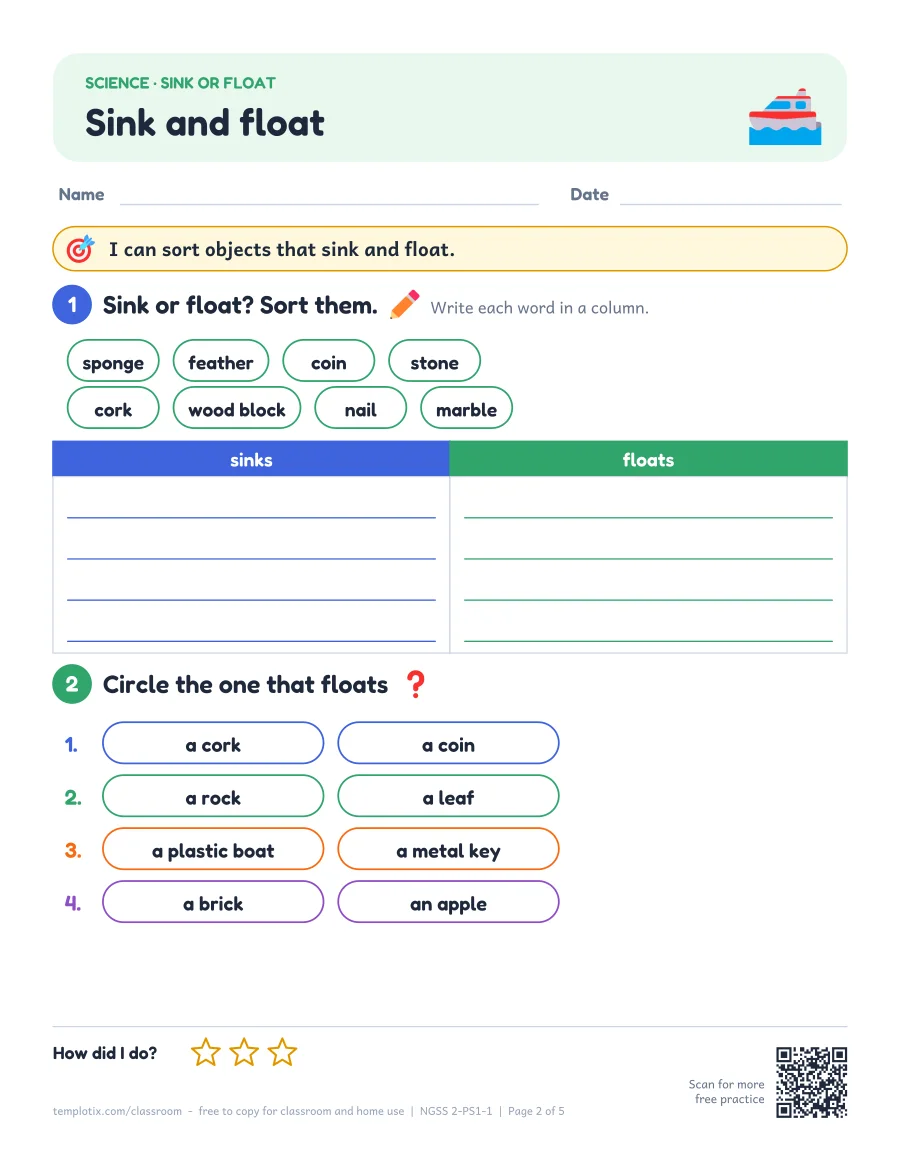
What the worksheets look like
States of matter poster
 States of matter poster
One colorful page showing solids, liquids and gases, how their tiny particles are packed, and everyday examples of each. Made for a science wall.
Common questions
Why do some things float and others sink?
It depends on how heavy an object is for its size. Things that are light for their size, like wood and cork, float. Things that are heavy for their size, like a coin or a rock, sink.
How can you make something that sinks float?
Change its shape. A ball of clay sinks, but the same clay shaped into a wide boat floats because it pushes aside more water. That is how heavy steel ships float.
What grade learns sink or float?
Usually Kindergarten to 2nd grade. In the Next Generation Science Standards (NGSS) it supports 2-PS1-1.
Is there a hands-on experiment?
Yes. Page 4 is a Try it! experiment, the foil boat challenge, with a materials list, a prediction and an observation chart. Safety: a grown-up watches whenever there is a tub of water. Wipe up spills.
Is there an answer key?
Yes. Page 5 has every answer from the pack, what to expect from the experiment and a short teaching tip.