Shop
 Grade workbooks


Classroom · Science · Matter · 2nd and 3rd grade

Magnets worksheets
A free five-page science pack for 2nd and 3rd grade: learn to tell what magnets attract and how they push and pull, with a labeled picture, practice pages, a hands-on experiment and an answer key.
The big idea
 The big idea
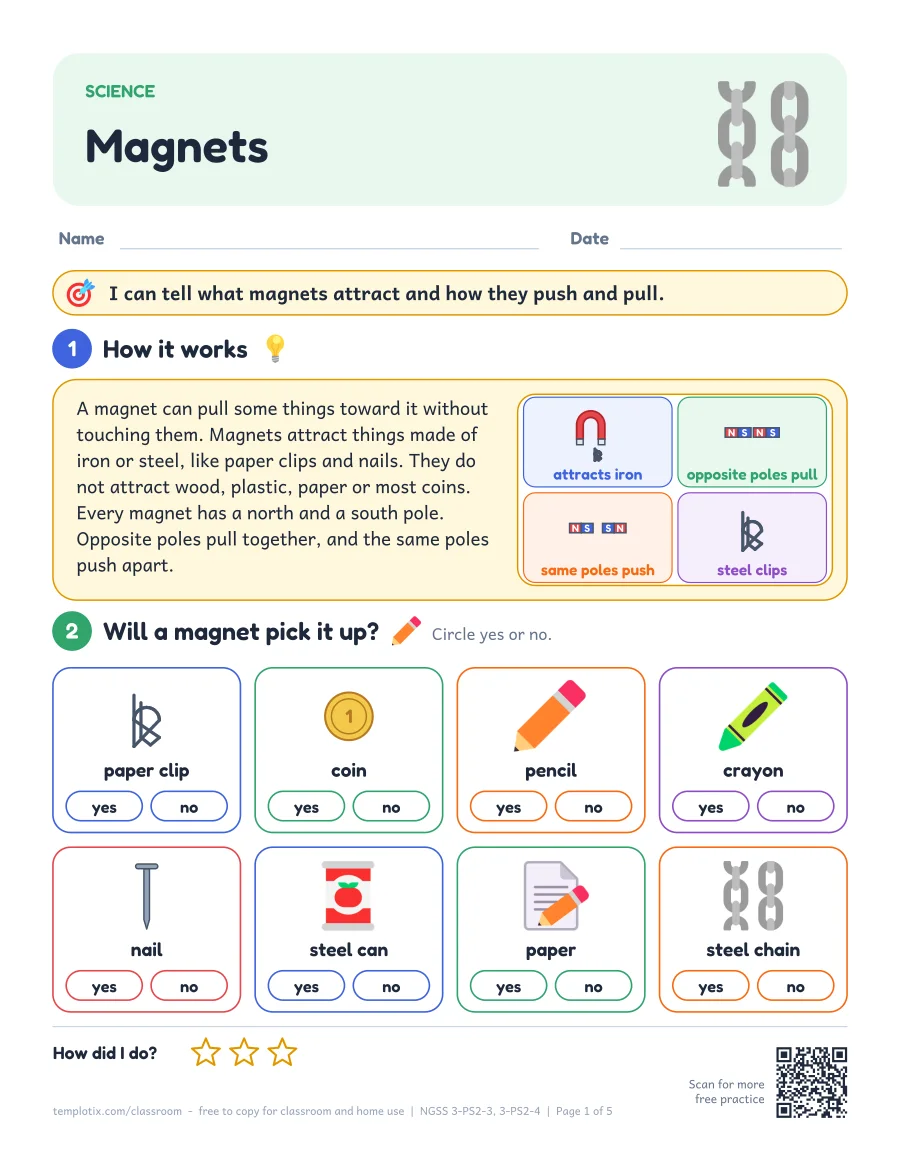
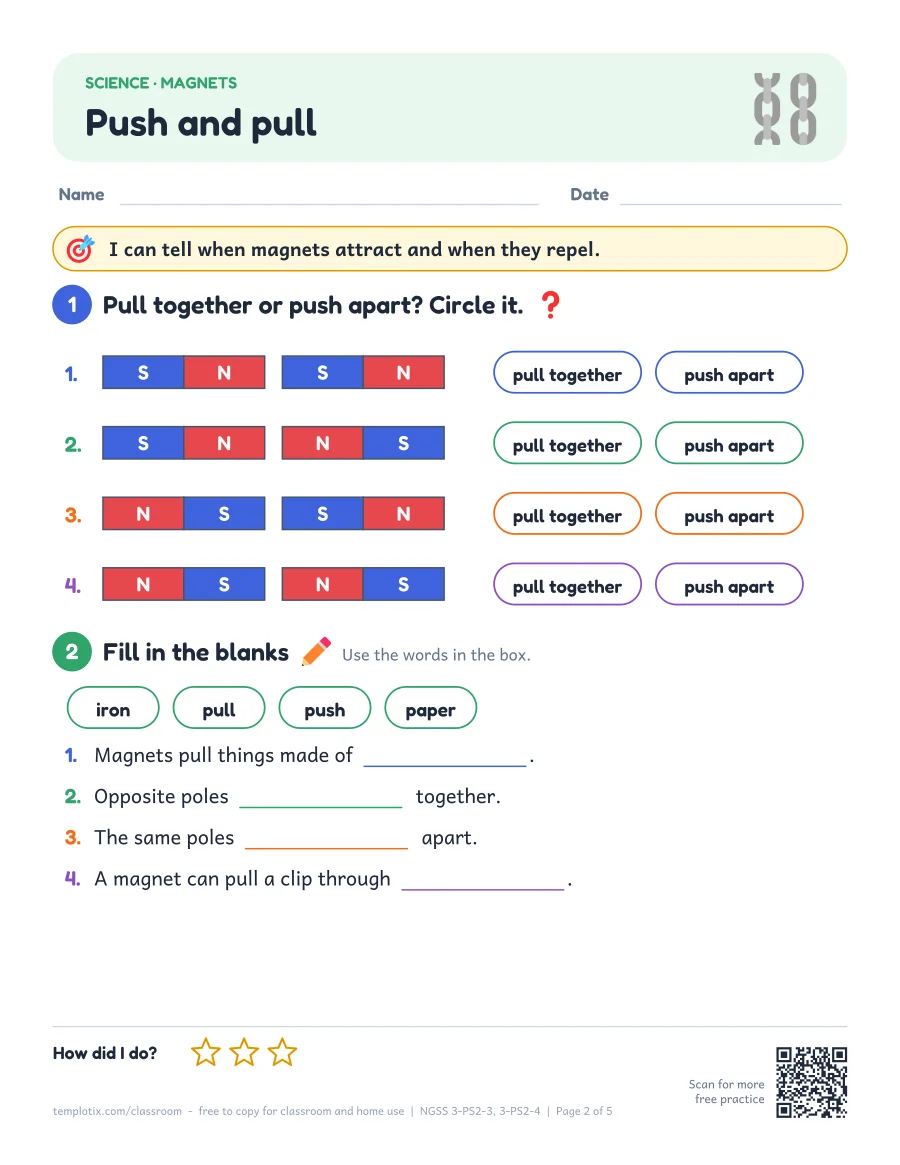
A magnet can pull some things toward it without touching them. Magnets attract things made of iron or steel, like paper clips and nails. They do not attract wood, plastic, paper or most coins. Every magnet has a north and a south pole. Opposite poles pull together, and the same poles push apart.
Teaching tip
 Teaching tip
Let children test the classroom with a magnet and sort what they find on a yes tray and a no tray. The surprise that foil and coins do not stick always starts a good talk.
Try it: the magnet hunt
 Try it: the magnet hunt
I can find out which objects a magnet attracts.
You need
- A magnet
- A notebook
- A pencil
- Things around the room
- A paper clip
What to do
- 1Choose 4 objects around the room. Predict: will the magnet stick?
- 2Touch the magnet to each object.
- 3Write which ones the magnet pulled.
- 4Look for a pattern: what are the yes objects made of?
Predict first: Which objects will stick to the magnet?What happens?
Answers will vary. The magnet sticks to things made of iron or steel, such as a fridge door, a paper clip, a steel can or scissors. It does not stick to wood, plastic, glass, paper, aluminum foil or most coins. Not every metal is magnetic.
Safety: keep magnets away from phones and screens, and never put small magnets in your mouth.
Quick check
What do magnets attract?Tap to checkThings made of iron or steel
Does a magnet pick up a pencil?Tap to checkNo
What happens when north meets south?Tap to checkThey pull together
What happens when north meets north?Tap to checkThey push apart
Can a magnet work through paper?Tap to checkYes
Do all metals stick to magnets?Tap to checkNo, only some, like iron and steel
What the worksheets look like
States of matter poster
 States of matter poster
One colorful page showing solids, liquids and gases, how their tiny particles are packed, and everyday examples of each. Made for a science wall.
Common questions
What things are attracted to magnets?
Things made of iron or steel, like paper clips, nails and many spoons. Plastic, wood, paper, glass, aluminum foil and most coins are not attracted.
What are the poles of a magnet?
Every magnet has a north pole and a south pole. Opposite poles attract and pull together, and the same poles repel and push apart. Children can feel the push by holding two magnets the same way round.
What grade learns magnets?
Usually 2nd and 3rd grade. In the Next Generation Science Standards (NGSS) it supports 3-PS2-3 and 3-PS2-4.
Is there a hands-on experiment?
Yes. Page 4 is a Try it! experiment, the magnet hunt, with a materials list, a prediction and an observation chart. Safety: keep magnets away from phones and screens, and never put small magnets in your mouth.
Is there an answer key?
Yes. Page 5 has every answer from the pack, what to expect from the experiment and a short teaching tip.