Shop
 Grade workbooks


Classroom · Math · CCSS K.MD.A.2, 1.MD.A.1, 1.MD.A.2, 2.MD.A.1, 2.MD.A.4, 3.MD.A.2
worksheets for Kindergarten to 3rd grade
Compare and measure. Children find what is longer, shorter and taller, measure with cubes and paper clips, use an inch and a centimeter ruler, then read scales and jugs in grams, kilograms, milliliters and liters.
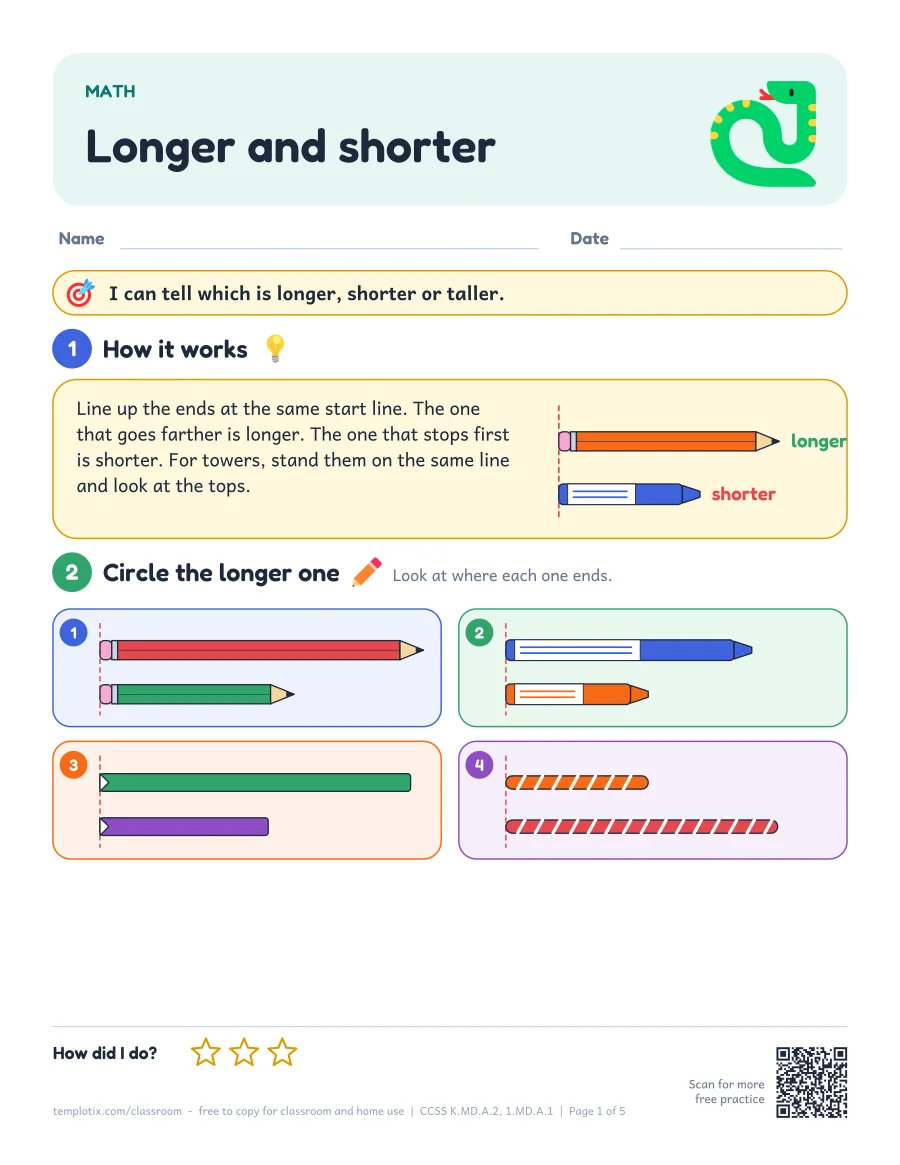
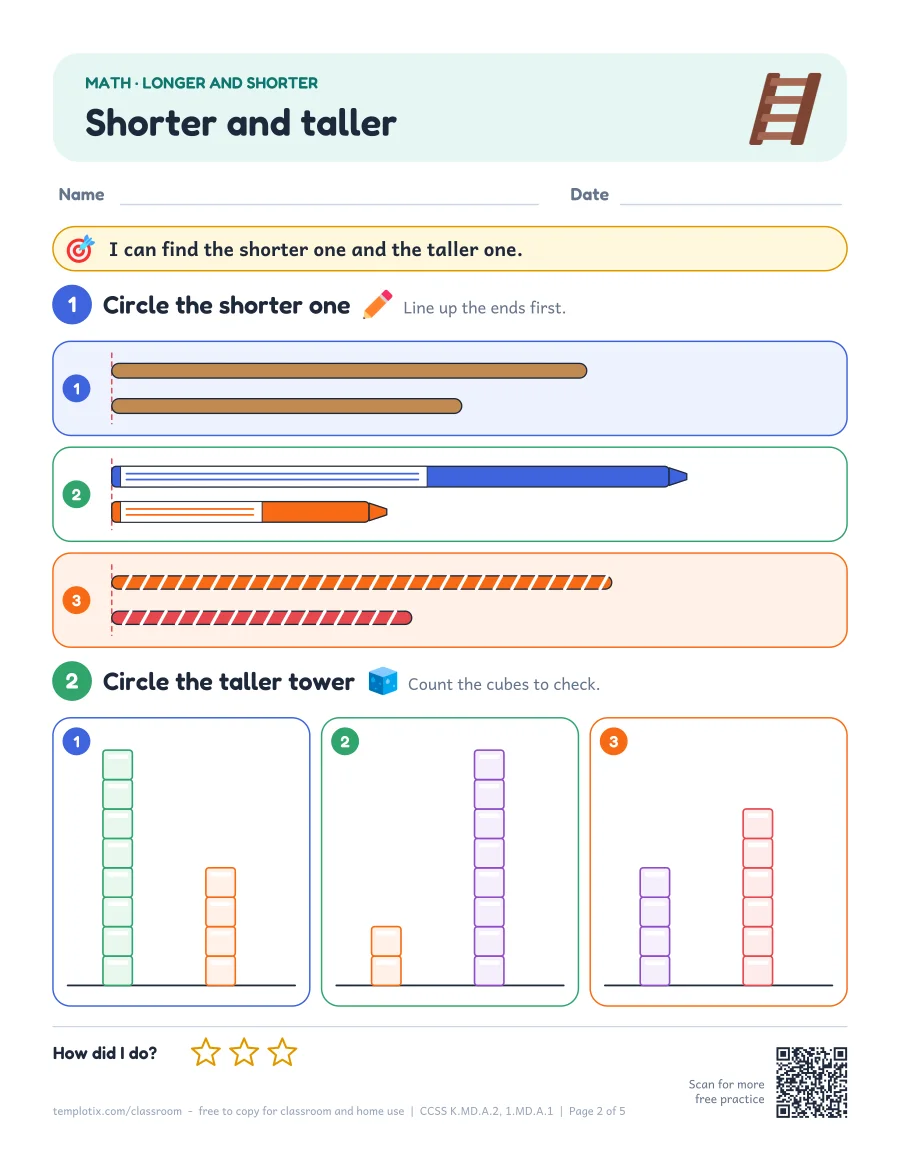
- Longer and shorterKindergarten and 1st grade
Line up the ends at the same start line. The one that goes farther is longer. The one that stops first is shorter. For towers, stand them on the same line and look at the tops.
- Measure with cubes and paper clips1st grade
Lay same-size units end to end, starting at one end. Leave no gaps and no overlaps. Count the units to find the length, such as 5 cubes long.
- Inches and centimeters2nd grade
Line up one end with the 0 on the ruler, not with the edge. Read the number at the other end. An inch is longer than a centimeter, so the same thing takes fewer inches.
- Mass and liquid volume3rd grade
Light things are measured in grams (g) and heavy things in kilograms (kg). Small amounts of liquid are milliliters (mL) and big amounts are liters (L). On a scale or a jug, read the numbers, then count the small marks between them.




Paper rulers
 Paper rulers
Inch rulers, centimeter rulers and unit cubes to cut out, at actual size.
Whole unit in one PDF Plus
 Whole unit in one PDF
All measurement packs, the unit chart and a contents page: 22 pages, ready to print. For Templotix Plus members.
What is in each pack
- 1. Learn itA picture that shows how to compare or measure, then first practice.
- 2. MeasureCompare, count units, read a ruler, a scale or a jug.
- 3. Use itOrder lengths, spot the right way to measure, draw lines or sort units.
- 4. Word problemsFour short stories about lengths, masses and amounts of water.
- 5. Answer key and tipEvery answer on one page, plus a teaching tip for grown-ups.


How to teach measurement
- Start with real things. Compare pencils, shoes and books on the table before using the pages. Line up the ends on the edge of the table.
- Use same-size units. Lay cubes or paper clips end to end with no gaps and no overlaps, then count them.
- Move to a ruler. Show where the 0 is. Line up one end with 0 and read the number at the other end.
- Talk about it. Ask which is longer, how much longer, and whether you would use grams or kilograms.
More math
- Telling time
- Money
- Fractions
- Division
- Multi-digit multiplication
- Decimals
- Greater than and less than
- Skip counting
- Shapes
- Number bonds
- Graphs and data
- Area and Perimeter
- Rounding and Estimating
- 3-Digit Addition and Subtraction
- Factors and Multiples
- Fraction Operations
- Decimal Operations
- Math Word Problems
- Geometry
- Order of Operations
- Measurement Conversions
- Counting
- Patterns
- Multiplication Strategies
- Multi-Digit Place Value
Common questions
What measurement do children learn in kindergarten to 3rd grade?
In kindergarten, children compare two objects to see which is longer, shorter or taller. In 1st grade they order three objects by length and measure with same-size units such as cubes. In 2nd grade they measure in inches and centimeters with a ruler and find how much longer one thing is. In 3rd grade they measure mass in grams and kilograms and liquid volume in liters and milliliters.
How do you teach a child to use a ruler?
Line up one end of the object with the 0 mark, not with the edge of the ruler. Look straight down at the other end and read the number it reaches. Practice with things that are a whole number of inches or centimeters first.
Will the rulers on these worksheets measure correctly?
Yes, when you print at actual size (100%). Turn off "fit to page" in the print settings. The paper rulers page has a 1-inch line you can check with a real ruler.
Can I copy these worksheets for my class?
Yes. The PDFs are free to print and photocopy for classroom and home use, in color or in the black-and-white ink saver. Please link to this page rather than re-uploading the files.