Shop
 Grade workbooks


Classroom · Science · Plants · 3rd grade

Plant adaptations worksheets
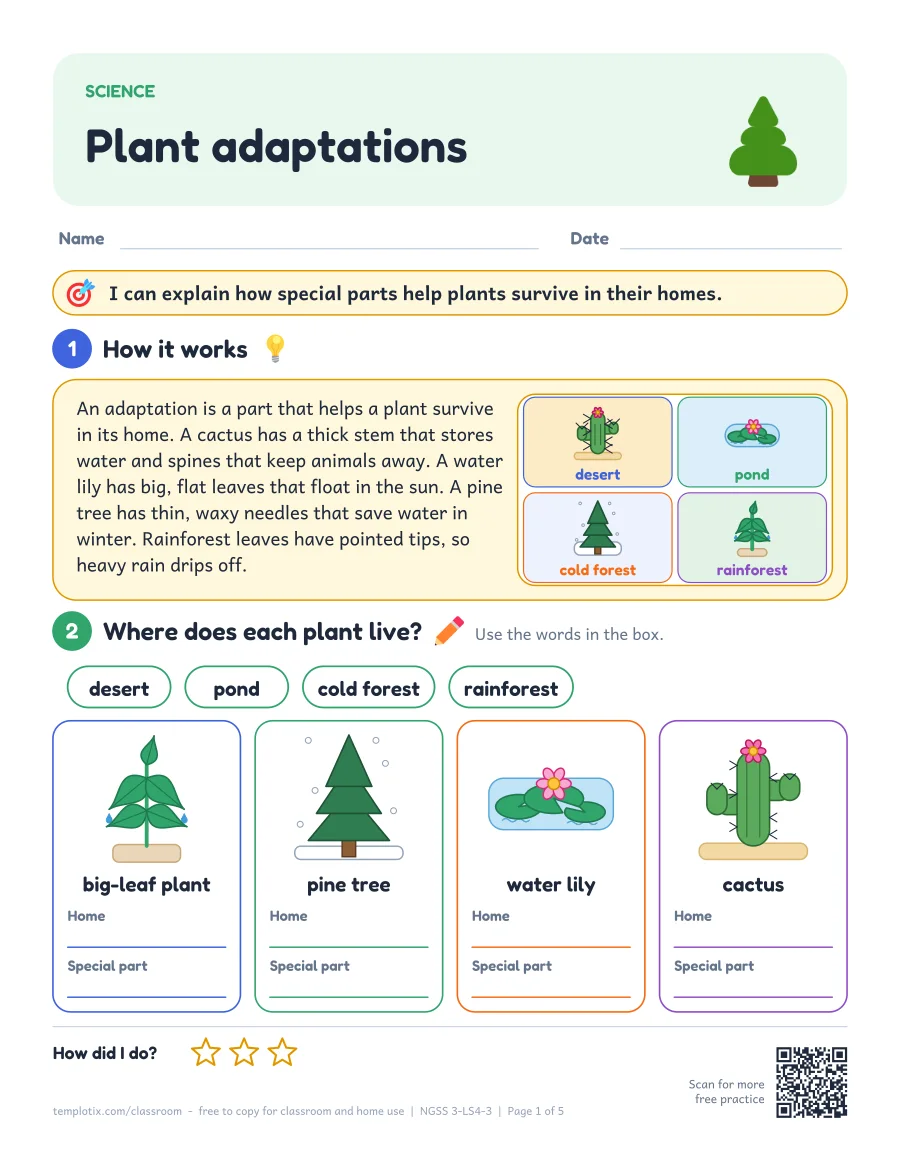
A free five-page science pack for 3rd grade: learn to explain how special parts help plants survive in their homes, with a labeled picture, practice pages, a hands-on experiment and an answer key.
The big idea
 The big idea
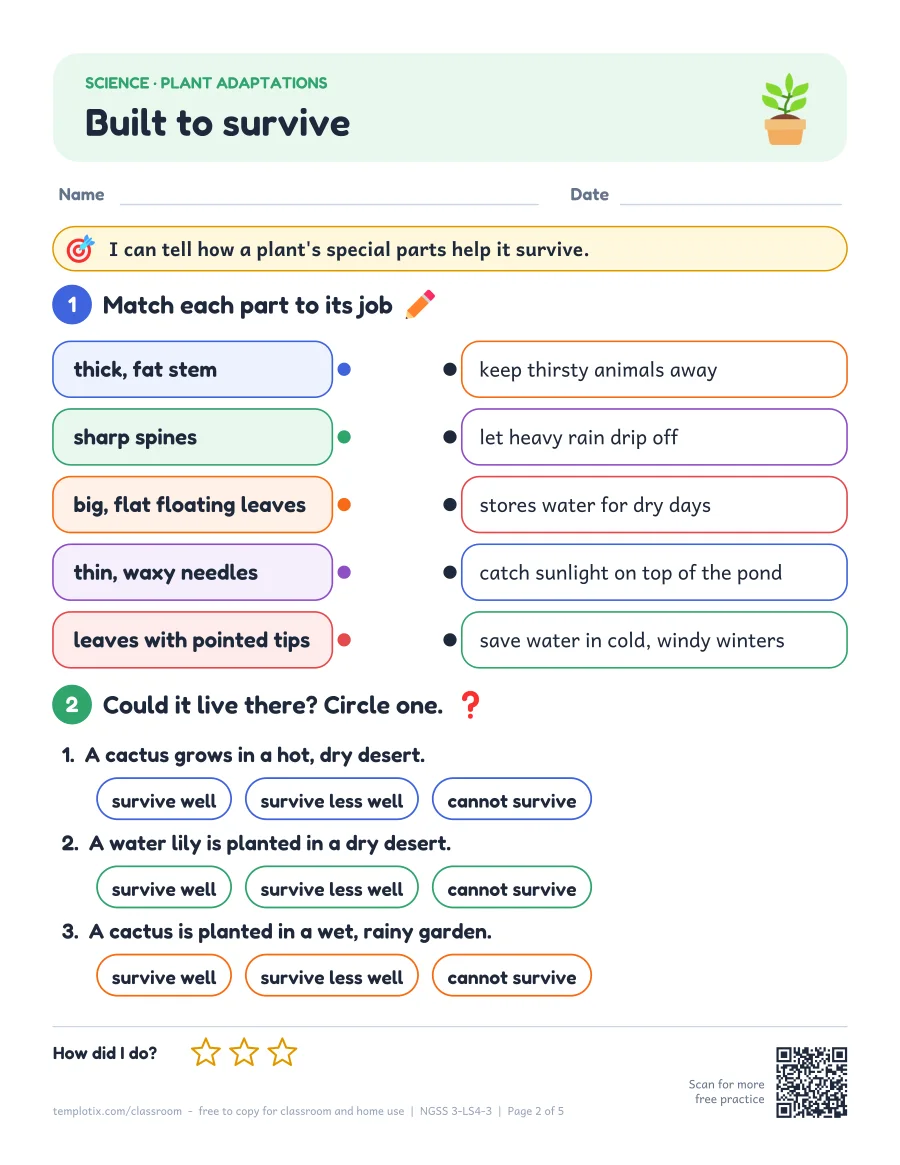
An adaptation is a part that helps a plant survive in its home. A cactus has a thick stem that stores water and spines that keep animals away. A water lily has big, flat leaves that float in the sun. A pine tree has thin, waxy needles that save water in winter. Rainforest leaves have pointed tips, so heavy rain drips off.
Teaching tip
 Teaching tip
Show real examples if you can: a small cactus, a pine branch and a houseplant leaf. Let children feel the waxy skin, then use the words survive well, survive less well and cannot survive when they argue where each plant belongs.
Try it: the waxy leaf test
 Try it: the waxy leaf test
I can show how a waxy skin saves water.
You need
- 2 paper towels
- Wax paper
- Water
- A plate
- Tape
What to do
- 1Wet both paper towels. Squeeze out the extra water.
- 2Roll each towel up like a leaf. Wrap one in wax paper and tape it. Leave the other bare.
- 3Put both on a plate in a sunny spot.
- 4Feel both towels after 1 hour, 3 hours and 1 day.
Predict first: Which towel will stay wet longer?What happens?
The bare towel dries out first. The towel wrapped in wax paper stays damp much longer, because the wax keeps the water from escaping into the air. A cactus and a pine needle have a waxy coat that works the same way, so they save water where it is hot, dry or freezing.
Safety: no cutting or heat is needed. Wipe up spills so no one slips.
Quick check
Where does a cactus store water?Tap to checkIn its thick stem
Why does a cactus have spines?Tap to checkTo keep animals away and save water
How does a water lily get sunlight?Tap to checkIts flat leaves float on top of the water
Why are pine needles thin and waxy?Tap to checkTo save water in cold winters
Why do rainforest leaves have pointed tips?Tap to checkSo heavy rain drips off
What is an adaptation?Tap to checkA body part or way of living that helps a living thing survive
What the worksheets look like
Parts of a plant poster
One colorful page with the four parts of a plant, what each part does and the plant life cycle. Made for a science wall.
Common questions
How do desert plants survive with so little water?
They store water and save it. A cactus stem swells after rain and holds water for months, a waxy skin keeps it in, and long, shallow roots soak up rain quickly before it dries up.
Why do some trees lose their leaves in fall?
Broad leaves lose a lot of water and can be damaged by freezing. In winter the water in the ground is frozen, so trees like maples and oaks drop their leaves and rest until spring. It is an adaptation to cold winters.
What grade learns plant adaptations?
Usually 3rd grade. In the Next Generation Science Standards (NGSS) it supports 3-LS4-3.
Is there a hands-on experiment?
Yes. Page 4 is a Try it! experiment, the waxy leaf test, with a materials list, a prediction and an observation chart. Safety: no cutting or heat is needed. Wipe up spills so no one slips.
Is there an answer key?
Yes. Page 5 has every answer from the pack, what to expect from the experiment and a short teaching tip.