Shop
 Grade workbooks


Classroom · Science · Animals · 2nd and 3rd grade

Animal habitats worksheets
A free five-page science pack for 2nd and 3rd grade: learn to match animals to the habitats where they live, with a labeled picture, practice pages, a hands-on experiment and an answer key.
The big idea
 The big idea
A habitat is the place where an animal lives. It gives the animal food, water and shelter. Camels and snakes live in the hot, dry desert. Penguins and seals live in icy polar lands. Whales and sharks live in the ocean. Monkeys live in the rainforest, frogs live in ponds, and owls live in forests.
Teaching tip
 Teaching tip
Make a class habitat wall with six parts (ocean, desert, polar, rainforest, pond and forest) and let children add animal drawings to each part through the week. Ask why each animal belongs there.
Try it: the minibeast hunt
 Try it: the minibeast hunt
I can compare the small animals in two habitats.
You need
- A magnifier
- A notebook
- A pencil
- Outdoor shoes
- A grown-up
What to do
- 1With a grown-up, choose two places: a sunny, dry spot and a shady, damp spot.
- 2Gently lift a rock or a log in each place. Look closely with the magnifier.
- 3Count the small animals you see: ants, worms, beetles, snails or spiders.
- 4Put the rock or log back just the way it was.
Predict first: Which place will have more small animals?What happens?
Most children find more small animals in the shady, damp place, such as worms, snails and beetles, because it gives them water, food and shelter. The sunny, dry place is hotter and drier, so fewer animals live there. Different places are habitats for different animals.
Safety: a grown-up lifts heavy rocks or logs. Do not touch spiders or stinging insects. Put everything back and wash hands.
Quick check
What is a habitat?Tap to checkThe place where an animal lives
Where do penguins live?Tap to checkIn icy polar lands
Where do camels live?Tap to checkIn the desert
Where do whales live?Tap to checkIn the ocean
Where do monkeys live?Tap to checkIn the rainforest
What does a habitat give an animal?Tap to checkFood, water and shelter
What the worksheets look like
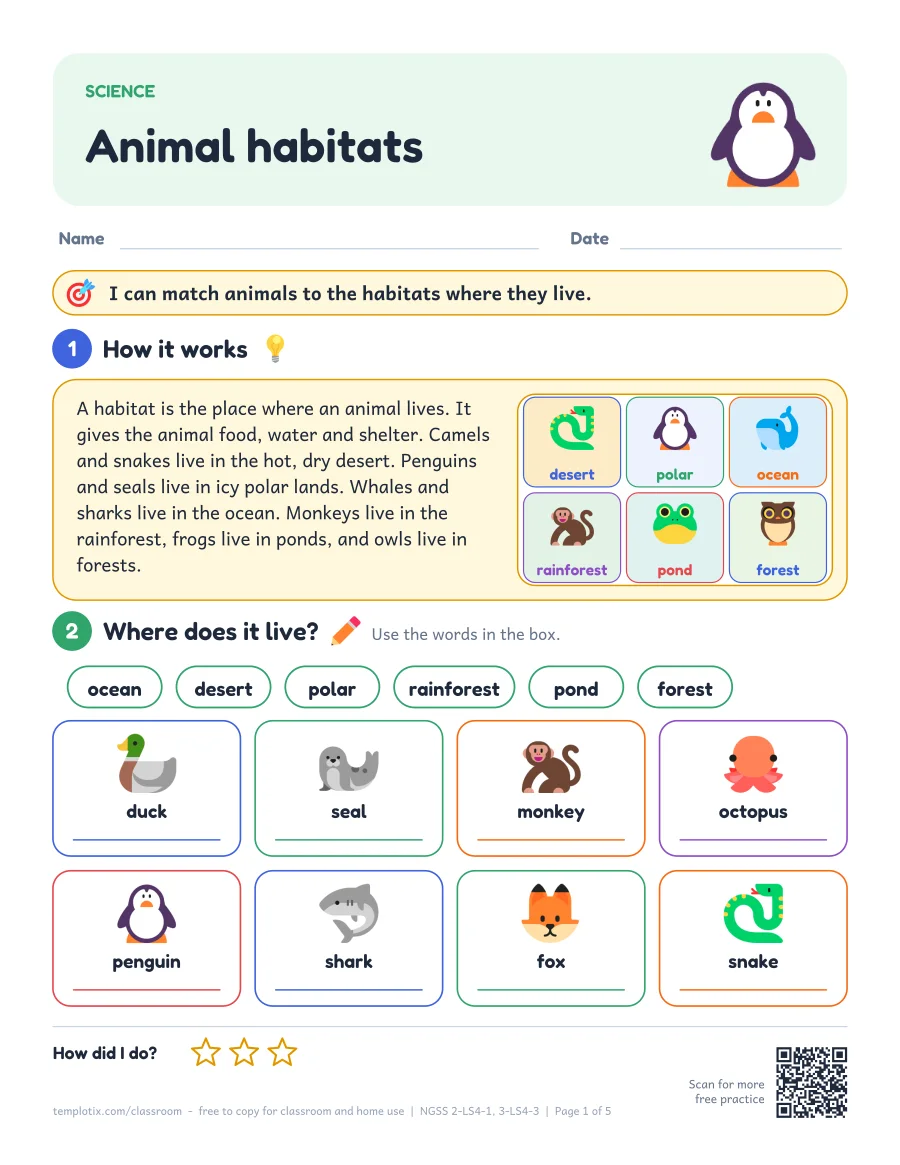
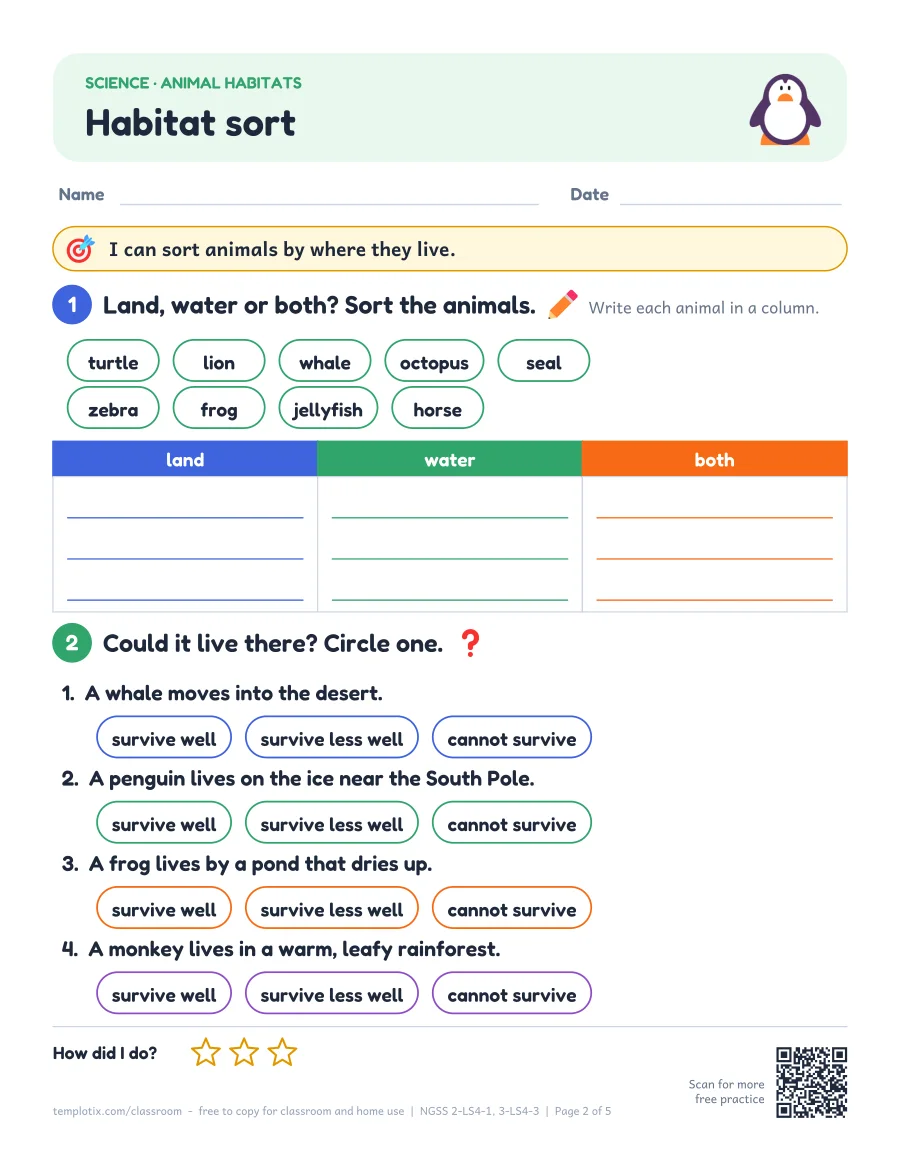
Animal habitats poster
 Animal habitats poster
One colorful page with six habitats (ocean, desert, polar lands, rainforest, pond and forest) and three animals that live in each. Made for a science wall.
Common questions
What are the main animal habitats?
The habitats taught in 2nd and 3rd grade are usually ocean, desert, rainforest, polar lands, forest, grassland and fresh water such as ponds. Each one has its own food, water, shelter and weather.
What happens when an animal's habitat changes?
Some animals adapt or move to a new place, and some cannot survive. When a pond dries up, frogs must find new water. When forests are cut down, animals that need trees lose their homes and food.
What grade learns animal habitats?
Usually 2nd and 3rd grade. In the Next Generation Science Standards (NGSS) it supports 2-LS4-1 and 3-LS4-3.
Is there a hands-on experiment?
Yes. Page 4 is a Try it! experiment, the minibeast hunt, with a materials list, a prediction and an observation chart. Safety: a grown-up lifts heavy rocks or logs. Do not touch spiders or stinging insects. Put everything back and wash hands.
Is there an answer key?
Yes. Page 5 has every answer from the pack, what to expect from the experiment and a short teaching tip.