Shop
 Grade workbooks


Classroom · Math · CCSS 4.OA.B.4, 6.NS.B.4
worksheets for 4th and 5th grade
Find factor pairs, list multiples, sort prime and composite numbers, and work out the greatest common factor and least common multiple. Each pack teaches the idea with a worked example, then builds up to riddles and word problems.
- Factors and factor pairs4th grade
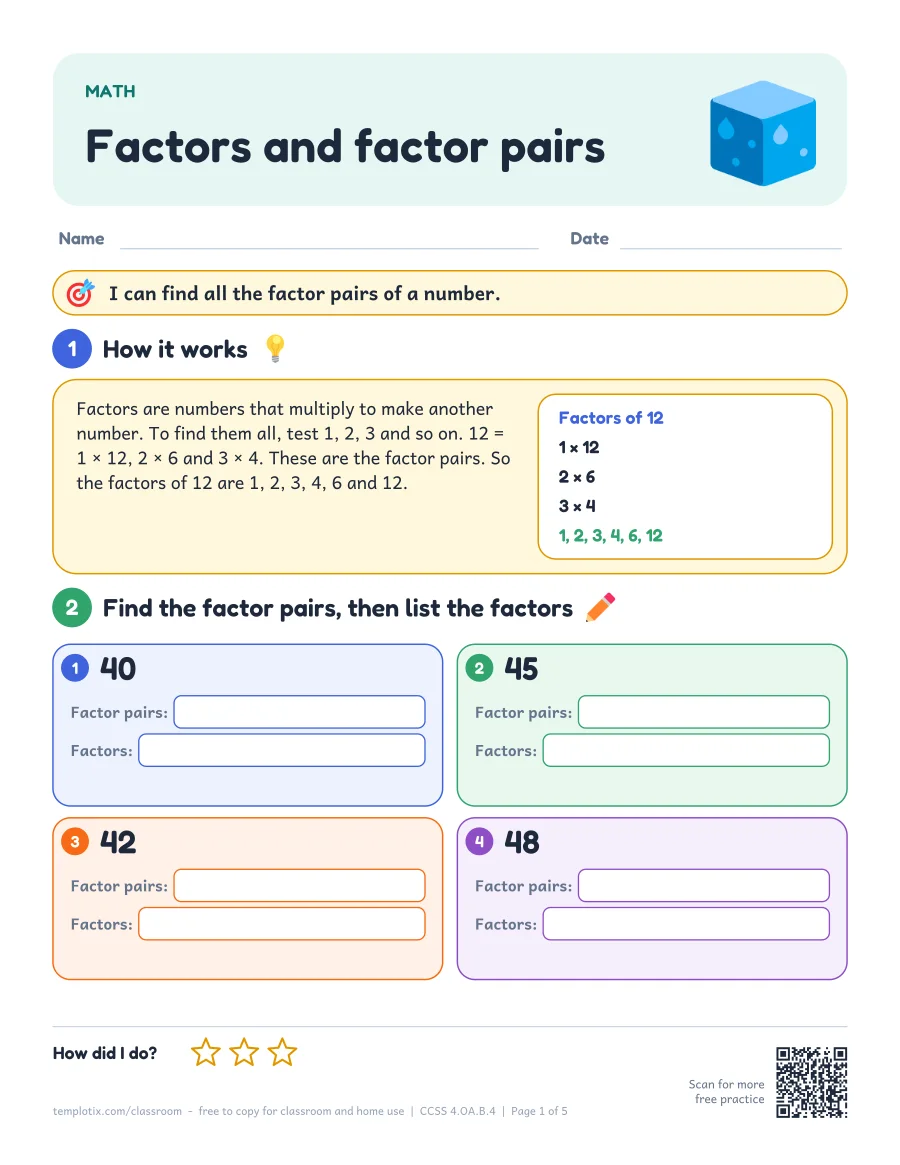
Factors are numbers that multiply to make another number. To find them all, test 1, 2, 3 and so on. 12 = 1 × 12, 2 × 6 and 3 × 4. These are the factor pairs. So the factors of 12 are 1, 2, 3, 4, 6 and 12.
- Multiples4th grade
A multiple is what you get when you multiply a number by 1, 2, 3 and so on. The multiples of 4 are 4, 8, 12, 16, 20 ... It is the same as skip counting by 4. Multiples go on forever.
- Prime and composite numbers4th grade
A prime number has exactly two factors: 1 and itself. 7 is prime. A composite number has more than two factors. 9 is composite because 3 × 3 = 9. The number 1 is neither prime nor composite.
- Greatest common factor and least common multiple5th grade
The greatest common factor (GCF) is the biggest factor two numbers share. List the factors of each and pick the biggest one in both lists. The least common multiple (LCM) is the smallest multiple they share. List multiples until one appears in both lists.




Prime numbers chart
 Prime numbers chart
A hundred chart with the 25 prime numbers from 1 to 100 circled.
Whole unit in one PDF Plus
 Whole unit in one PDF
All factors and multiples packs, the unit chart and a contents page: 22 pages, ready to print. For Templotix Plus members.
What is in each pack
- 1. Learn itA short explanation and a worked example, then first practice.
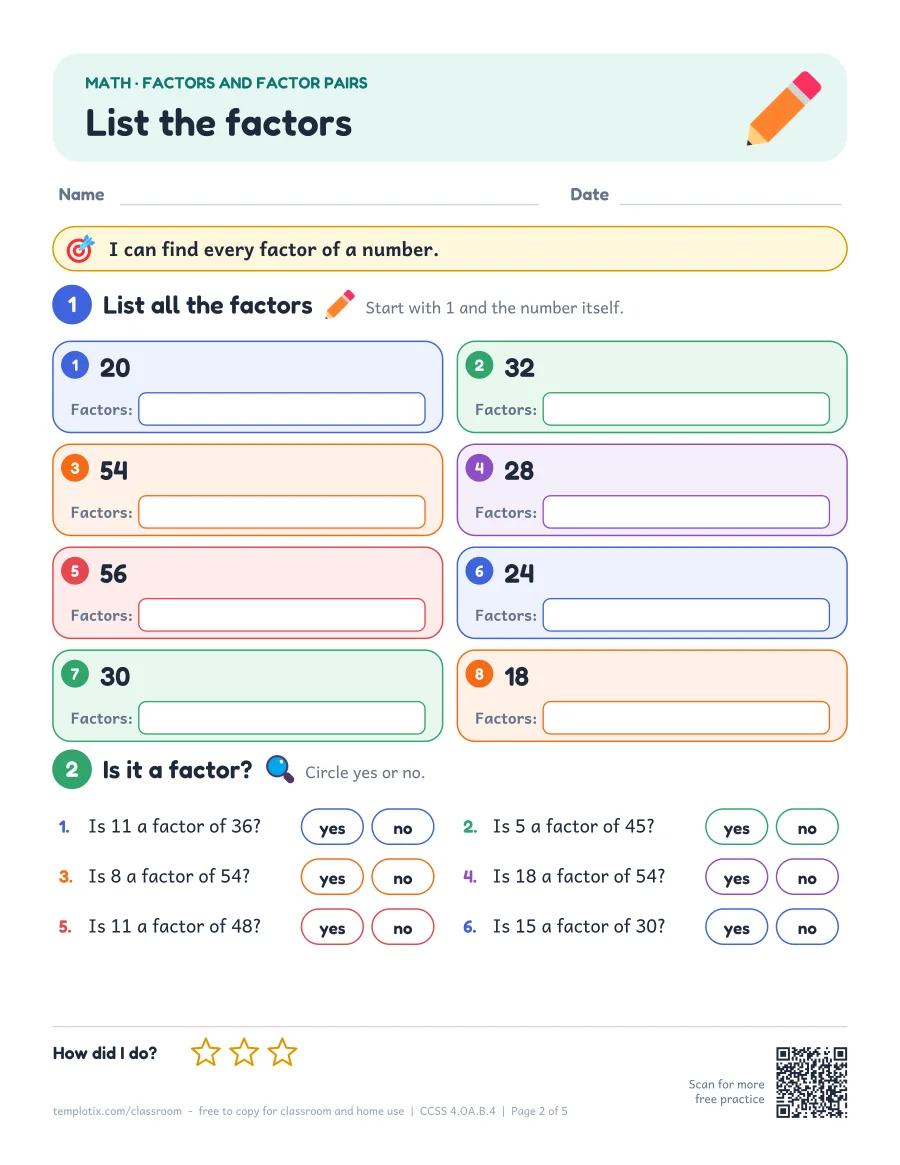
- 2. PracticeMore to solve, with yes or no checks and numbers to circle.
- 3. Think deeperCommon factors, patterns, sorting and number riddles.
- 4. Word problemsFour short stories about cookies, buses, stickers and fruit.
- 5. Answer key and tipEvery answer on one page, plus a teaching tip for grown-ups.


How to teach factors and multiples
- Start with arrays. Arrange 12 counters in equal rows. Every rectangle you can make is a factor pair.
- Link to times tables. Multiples are the answers in a times table. Factors are the numbers you multiply.
- Work in order. Test 1, 2, 3, 4 ... in turn so no factor is missed. Stop when the pairs repeat.
- Use the chart. Keep the prime numbers chart nearby until the primes to 50 feel familiar.
More math
- Telling time
- Money
- Fractions
- Division
- Multi-digit multiplication
- Decimals
- Greater than and less than
- Skip counting
- Shapes
- Number bonds
- Graphs and data
- Measurement
- Area and Perimeter
- Rounding and Estimating
- 3-Digit Addition and Subtraction
- Fraction Operations
- Decimal Operations
- Math Word Problems
- Geometry
- Order of Operations
- Measurement Conversions
- Counting
- Patterns
- Multiplication Strategies
- Multi-Digit Place Value
Common questions
What is the difference between a factor and a multiple?
A factor divides a number exactly. A multiple is what you get when you multiply a number by 1, 2, 3 and so on. 3 is a factor of 12, and 12 is a multiple of 3. Factors are the same size as the number or smaller; multiples are the same size or bigger.
What grade learns factors and multiples?
Factor pairs, multiples and prime and composite numbers up to 100 are a 4th grade standard (CCSS 4.OA.B.4). Greatest common factor and least common multiple are usually taught in 5th or 6th grade (CCSS 6.NS.B.4).
Is 1 a prime number?
No. A prime number has exactly two different factors, 1 and itself. The number 1 has only one factor, so it is neither prime nor composite. The smallest prime number is 2, which is also the only even prime.
Can I copy these worksheets for my class?
Yes. The PDFs are free to print and photocopy for classroom and home use, in color or in the black-and-white ink saver. Please link to this page rather than re-uploading the files.