Shop
 Grade workbooks


Classroom · Science · Forces and motion · 3rd grade

Balanced and unbalanced forces worksheets
A free five-page science pack for 3rd grade: learn to tell if forces are balanced or unbalanced, with a labeled picture, practice pages, a hands-on experiment and an answer key.
The big idea
 The big idea
Often more than one force acts on an object. In a tug of war, both teams pull the rope. If they pull with equal strength, the forces are balanced and the rope does not move. If one team pulls harder, the forces are unbalanced and the rope moves toward the stronger team. Unbalanced forces change motion.
Teaching tip
 Teaching tip
Run a gentle classroom tug of war with a soft rope, first with equal teams and then with uneven ones. Ask children to describe the forces before they say who won.
Try it: push the box
 Try it: push the box
I can test balanced and unbalanced pushes.
You need
- An empty box
- A smooth floor
- A partner
- A string
- Tape
What to do
- 1Put the box between you and your partner. Both push gently with the same force.
- 2Now one partner pushes harder. What happens?
- 3Both stop pushing. Does the box move?
- 4Tie the string to the box and try a gentle tug of war.
Predict first: What will the box do when you both push the same?What happens?
When both partners push equally, the box stays still: the forces are balanced. When one partner pushes harder, the box slides toward the weaker side: the forces are unbalanced. With no pushes the box stays still. Only unbalanced forces change motion.
Safety: push gently, keep fingers clear and use an empty box.
Quick check
What are balanced forces?Tap to checkEqual forces that do not change motion
What are unbalanced forces?Tap to checkUnequal forces that change motion
In a tie, does the rope move?Tap to checkNo
Which way does the rope move?Tap to checkToward the stronger team
Is a soccer kick balanced or unbalanced?Tap to checkUnbalanced
Is a book resting on a table balanced or unbalanced?Tap to checkBalanced
What the worksheets look like
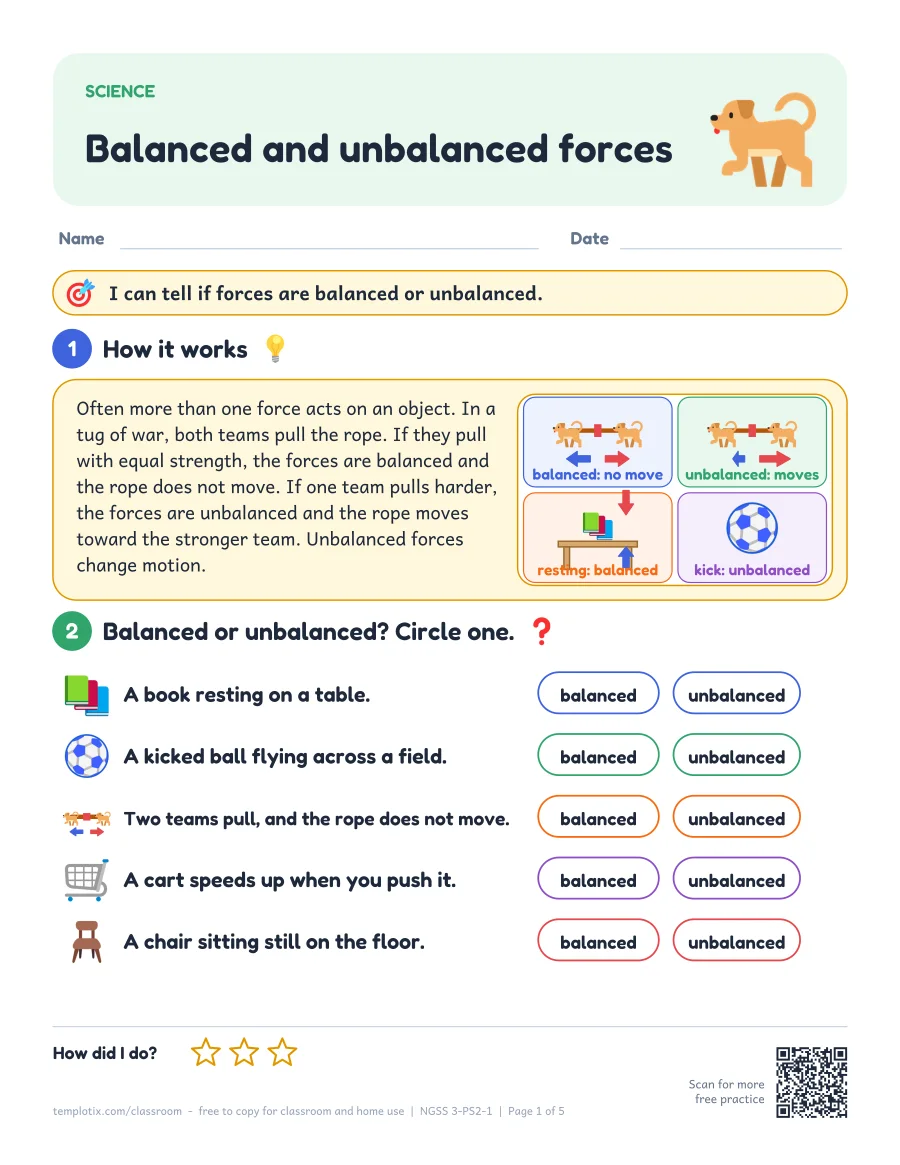
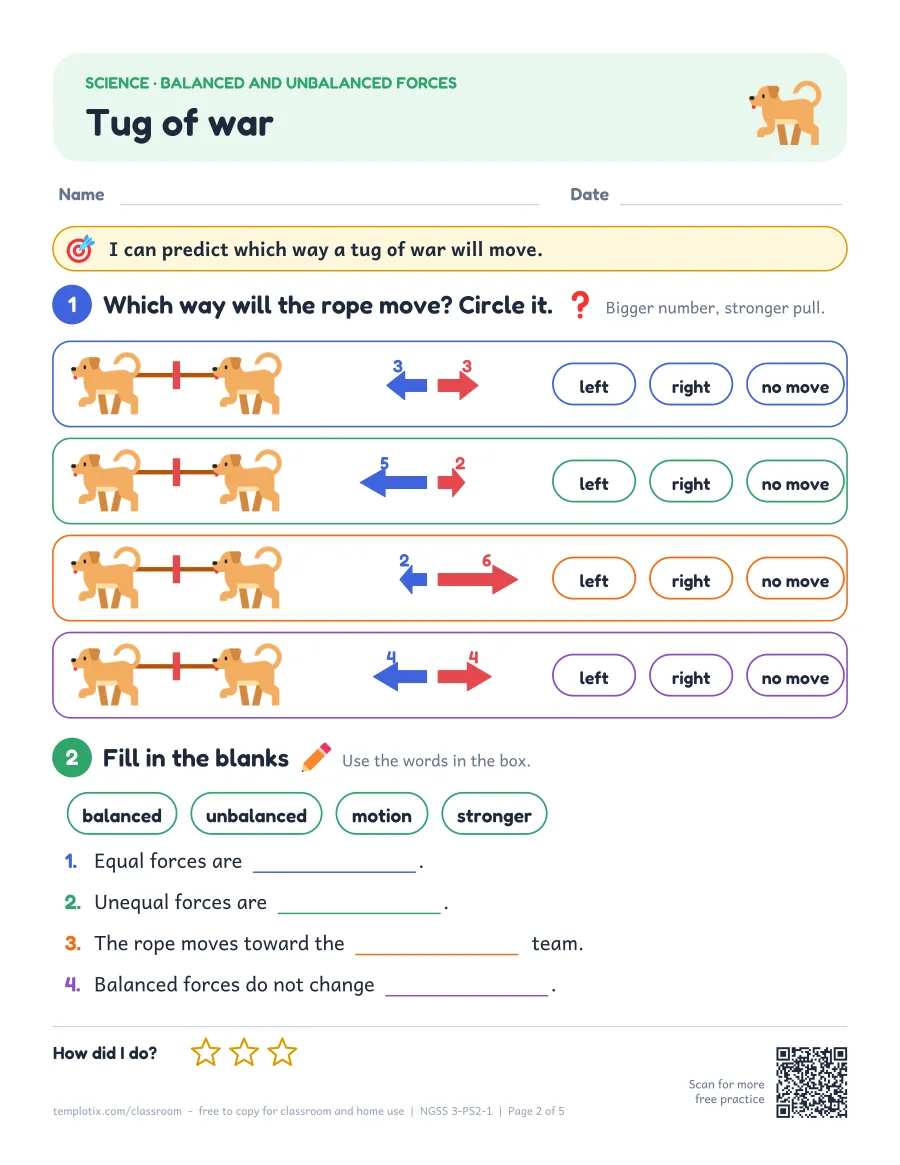
Forces all around poster
 Forces all around poster
One colorful page with push, pull, gravity, friction, simple machines and balanced forces, each with a picture and a one-line meaning. Made for a science wall.
Common questions
What are examples of balanced forces?
A book resting on a table, a tug of war where neither team moves, and a person standing still. The forces cancel each other out, so nothing changes.
How do unbalanced forces change motion?
They make something start moving, stop, speed up, slow down or change direction. Kicking a ball, braking a bike and wind pushing a sailboat are all unbalanced forces.
What grade learns balanced and unbalanced forces?
Usually 3rd grade. In the Next Generation Science Standards (NGSS) it supports 3-PS2-1.
Is there a hands-on experiment?
Yes. Page 4 is a Try it! experiment, push the box, with a materials list, a prediction and an observation chart. Safety: push gently, keep fingers clear and use an empty box.
Is there an answer key?
Yes. Page 5 has every answer from the pack, what to expect from the experiment and a short teaching tip.