Shop
 Grade workbooks


Classroom · Math · CCSS 4.G.A.1, 4.MD.C.5-7, 5.MD.C.3-5, 5.G.A.1-2, 5.OA.B.3
worksheets for 4th and 5th grade
Name and measure angles, find volume with unit cubes and the formula, and plot points on the coordinate plane. Every angle, cube and grid is drawn to size, so children can measure with a real protractor and count every cube.
- Types of angles4th grade
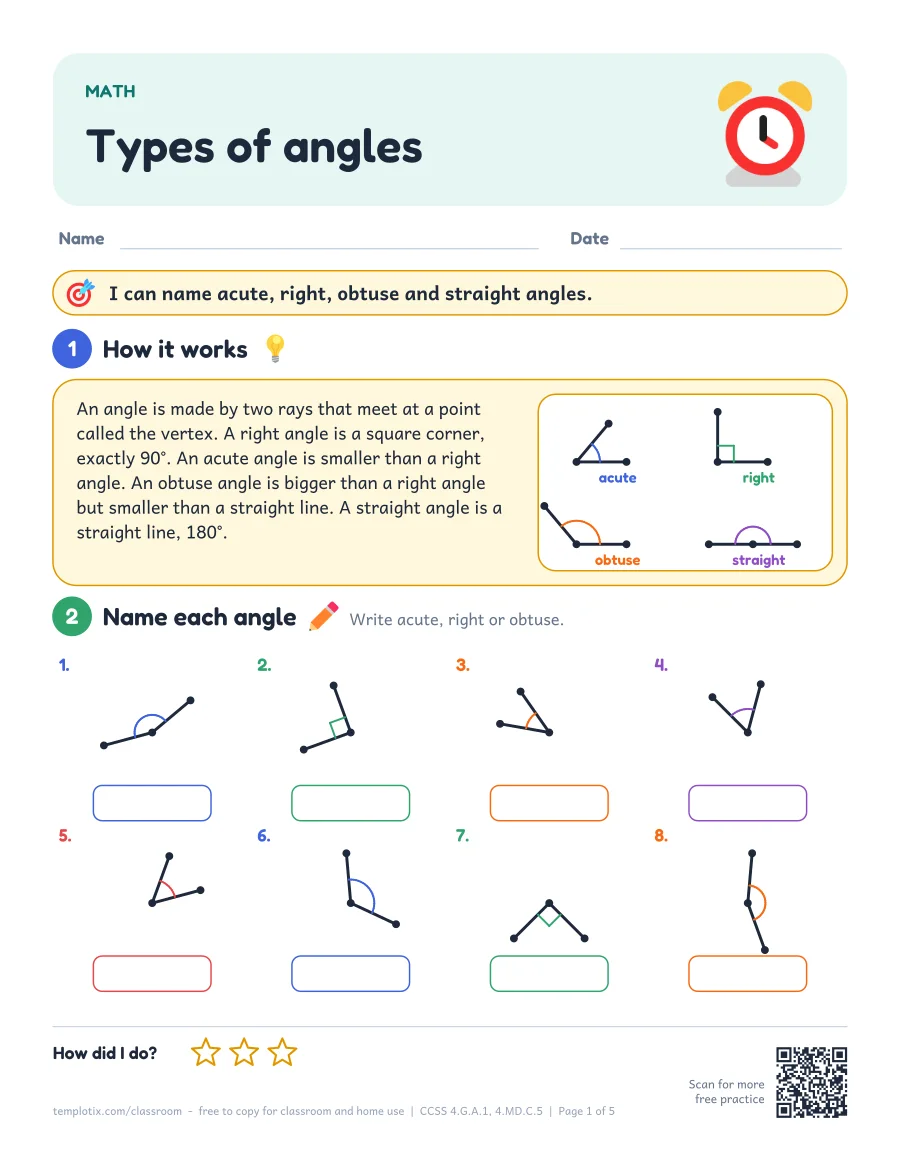
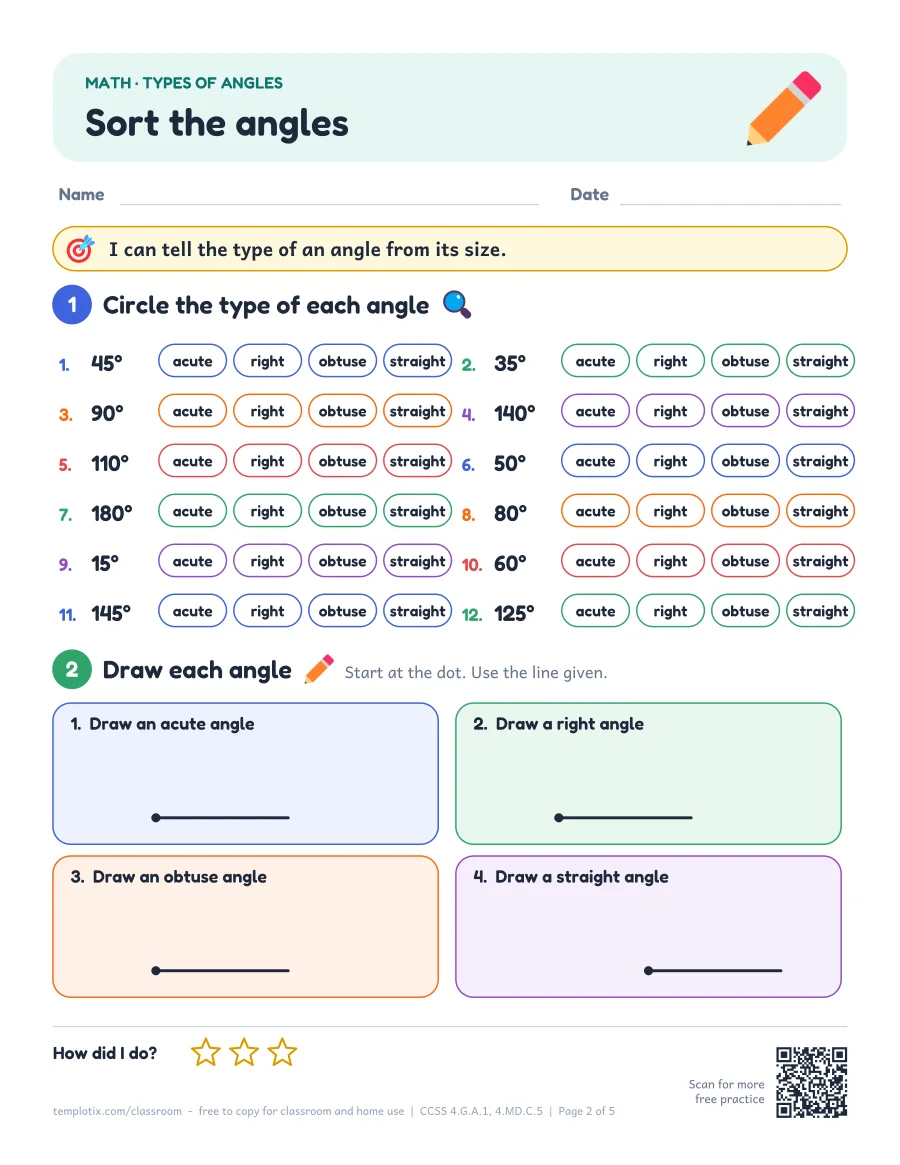
An angle is made by two rays that meet at a point called the vertex. A right angle is a square corner, exactly 90°. An acute angle is smaller than a right angle. An obtuse angle is bigger than a right angle but smaller than a straight line. A straight angle is a straight line, 180°.
- Measuring angles4th grade
Angles are measured in degrees (°). Put the center of the protractor on the vertex and line up the 0 line with one ray. Read the number where the other ray crosses the scale, using the scale that starts at 0 on your first ray. When an angle is split into parts, the parts add up to the whole angle.
- Volume with unit cubes5th grade
Volume is how much space a solid shape takes up. We measure it by counting unit cubes, cubes that are 1 unit long, wide and tall. Count the cubes in the bottom layer, then multiply by the number of layers. A box 3 cubes long, 2 wide and 2 tall holds 6 cubes in each layer, so 6 × 2 = 12 cubic units.
- Volume of rectangular prisms5th grade
The volume of a box is length × width × height. For a box 5 cm long, 3 cm wide and 4 cm tall: 5 × 3 × 4 = 60. The answer is in cubic units, here cm³. To find a missing side, divide the volume by the two sides you know. For a shape made of two boxes, find each volume and add.
- The coordinate plane5th grade
A coordinate grid has a line across (the x-axis) and a line up (the y-axis) that meet at the origin, (0, 0). An ordered pair like (4, 3) tells you where a point is: start at the origin, go 4 across, then 3 up. The first number is always across and the second is always up.
- Graphing ordered pairs5th grade
A rule like "add 2" turns each x number into a y number: 0 becomes 2, 1 becomes 3, and so on. Write the pairs in a table, then plot each (x, y) on the grid. Points from a rule like this line up. Graphs of real stories, like money saved each week, help you answer questions by reading the points.






Geometry cheat sheet
 Geometry cheat sheet
Angle types, the protractor, volume and the coordinate plane on one page.
Whole unit in one PDF Plus
 Whole unit in one PDF
All geometry packs, the unit chart and a contents page: 32 pages, ready to print. For Templotix Plus members.
What is in each pack
- 1. Learn itThe idea with a picture drawn to size, then first practice.
- 2. PracticeMeasuring, drawing, counting cubes and plotting points.
- 3. Think deeperClocks, missing angles, two-box shapes and patterns on a grid.
- 4. Word problemsFour short stories about pizzas, ladders, boxes and maps.
- 5. Answer key and tipEvery answer on one page, plus a teaching tip for grown-ups.


How to teach geometry
- Print at 100%. Turn off "fit to page" so the angles measure true with a real protractor.
- Build before drawing. Let children build boxes with cubes or sugar cubes before they count cubes in pictures.
- Across, then up. For ordered pairs, say "walk along the hall, then up the stairs" so x always comes first.
- Keep the cheat sheet out. Let children check the rules on the cheat sheet until they no longer need it.
More math
- Telling time
- Money
- Fractions
- Division
- Multi-digit multiplication
- Decimals
- Greater than and less than
- Skip counting
- Shapes
- Number bonds
- Graphs and data
- Measurement
- Area and Perimeter
- Rounding and Estimating
- 3-Digit Addition and Subtraction
- Factors and Multiples
- Fraction Operations
- Decimal Operations
- Math Word Problems
- Order of Operations
- Measurement Conversions
- Counting
- Patterns
- Multiplication Strategies
- Multi-Digit Place Value
Common questions
What grade learns angles, volume and the coordinate plane?
Angles and measuring with a protractor are 4th grade standards (CCSS 4.G.A.1 and 4.MD.C.5-7). Volume of rectangular prisms and graphing points on the coordinate plane are 5th grade (CCSS 5.MD.C.3-5 and 5.G.A.1-2).
How do you teach children to use a protractor?
Put the small hole on the vertex and line up the 0 line with one ray. Then follow the scale that starts at 0 on that ray, not the other one. Estimate first: if the angle is smaller than a square corner, the answer must be less than 90°.
What is the formula for volume?
The volume of a rectangular prism is length × width × height. It counts how many unit cubes fill the box, so the answer is in cubic units such as cm³ or in³.
Can I copy these worksheets for my class?
Yes. The PDFs are free to print and photocopy for classroom and home use, in color or in the black-and-white ink saver. Please link to this page rather than re-uploading the files.