Shop
 Grade workbooks


Classroom · Science · NGSS K-ESS2, K-ESS3, 1-ESS1, 2-ESS2, 3-ESS2, 3-ESS3
worksheets for kindergarten to 3rd grade
Weather is science children can see from the window every day. Each free pack teaches one big idea, from types of weather to the water cycle and storm safety, with a clear picture, practice pages, a Think like a scientist page and a hands-on experiment, then ends with an answer key.
- Types of weatherKindergarten and 1st grade · NGSS K-ESS2-1
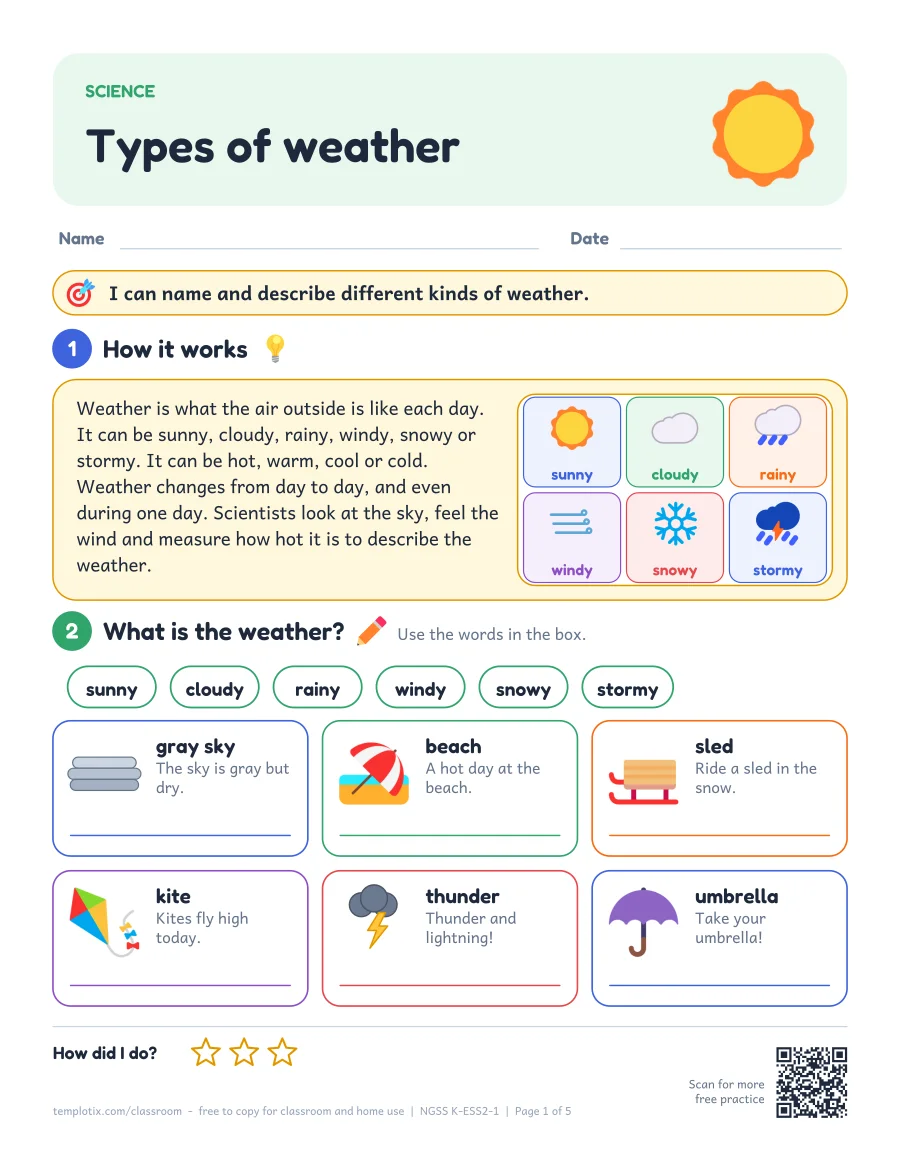
Weather is what the air outside is like each day. It can be sunny, cloudy, rainy, windy, snowy or stormy. It can be hot, warm, cool or cold. Weather changes from day to day, and even during one day. Scientists look at the sky, feel the wind and measure how hot it is to describe the weather.
- The four seasonsKindergarten and 1st grade · NGSS K-ESS2-1, 1-ESS1-2
A year has four seasons: spring, summer, fall and winter. In spring the air gets warmer, rain helps plants grow and flowers bloom. Summer is the hottest season, with long, sunny days. In fall the air cools and many leaves change color and drop. Winter is the coldest season, and in many places it snows.
- Weather tools2nd and 3rd grade · NGSS 3-ESS2-1
Scientists use tools to measure the weather. A thermometer measures temperature, how hot or cold the air is. A rain gauge measures how much rain falls. A wind vane shows which way the wind blows, and an anemometer measures how fast it blows. Measuring every day helps scientists find patterns and make forecasts.
- The water cycle2nd and 3rd grade · NGSS 2-ESS2-3, 2-PS1-4
Water on Earth moves round and round in the water cycle. The sun warms water in oceans and lakes, and it rises into the air as water vapor: evaporation. High up, the vapor cools and forms clouds: condensation. When the drops get heavy, they fall as rain or snow: precipitation. Then the water collects again.
- Types of clouds2nd and 3rd grade · NGSS 3-ESS2-1
Clouds are made of tiny drops of water or bits of ice floating in the air. Cumulus clouds are puffy and white, like cotton, and mean fair weather. Stratus clouds are flat and gray, like a blanket, and can bring drizzle. Cirrus clouds are thin and wispy, high in the sky. Cumulonimbus clouds are tall and dark and bring storms.
- Severe weather safety1st to 3rd grade · NGSS K-ESS3-2, 3-ESS3-1
Sometimes weather is dangerous. A thunderstorm brings lightning, so go inside. A tornado is a spinning funnel of wind: go to a low room with no windows. A hurricane is a huge storm that forms over the warm ocean. A blizzard is a snowstorm with strong wind. Forecasters warn us, so we can get ready in time.



Water cycle poster
 Water cycle poster
One colorful page with a labeled water cycle picture and the four steps: evaporation, condensation, precipitation and collection. Made for a science wall.
What is in each pack
- 1. Learn itA short explanation with a clear, labeled picture, then a first activity.
- 2. PracticeLabeling, matching, sorting and fill in the blanks.
- 3. Think like a scientistWhy questions, true or false and a drawing that explains an idea.
- 4. Try it!A hands-on experiment with a materials list, a prediction and an observation chart.
- 5. Answer keyEvery answer, what to expect from the experiment, a teaching tip and a safety note.


How to teach weather
- Look out the window every day. A one-minute weather check each morning builds the habit of observing, the heart of science.
- Measure, do not guess. A cheap thermometer and a homemade rain gauge turn the weather into numbers children can compare.
- Keep a class chart. Weather symbols on a calendar show patterns over weeks, and patterns are what forecasters use.
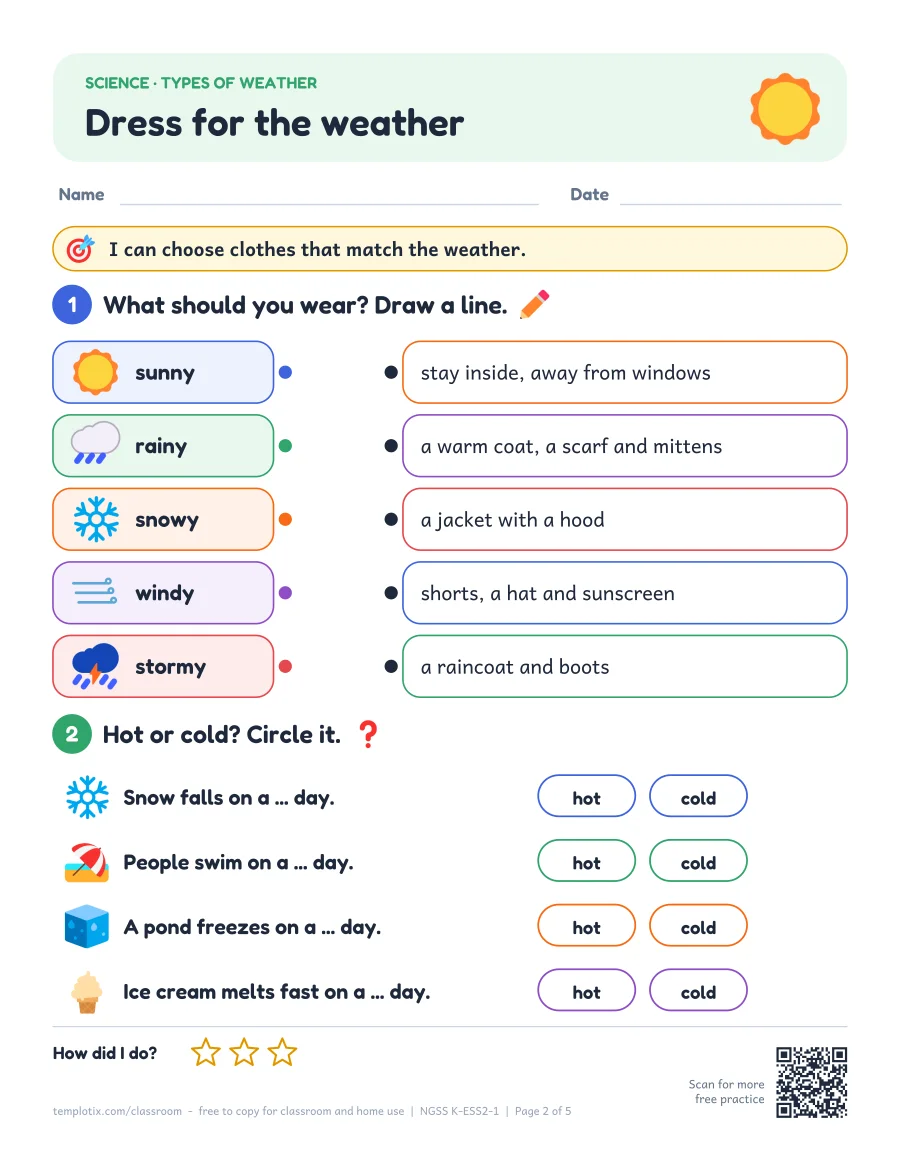
- Link it to clothes and plans. Ask what to wear and whether recess will be outside. Weather matters most when it changes what we do.
- Talk about safety calmly. Storm drills and safety plans help children feel prepared instead of scared.
More science
Common questions
Are these weather worksheets free?
Yes. Every weather pack and the poster are free to download, print and copy for your class or home, in color or in a black-and-white ink saver.
What grade are these weather worksheets for?
Kindergarten to 3rd grade. Types of weather and the four seasons start in kindergarten, storm safety suits 1st to 3rd grade, and weather tools, clouds and the water cycle are 2nd and 3rd grade topics.
Do I need special supplies for the experiments?
No. The Try it! pages use everyday things, such as ice cubes, a zip bag, a plastic bottle and a notebook. A grown-up does any cutting.
Do the worksheets follow the NGSS?
Yes. Each pack names the NGSS performance expectation it supports, for example K-ESS2-1 for daily weather patterns and 3-ESS2-1 for weather data and tools.