Shop
 Grade workbooks


Classroom · Writing · 3rd to 5th grade

Informative writing worksheets
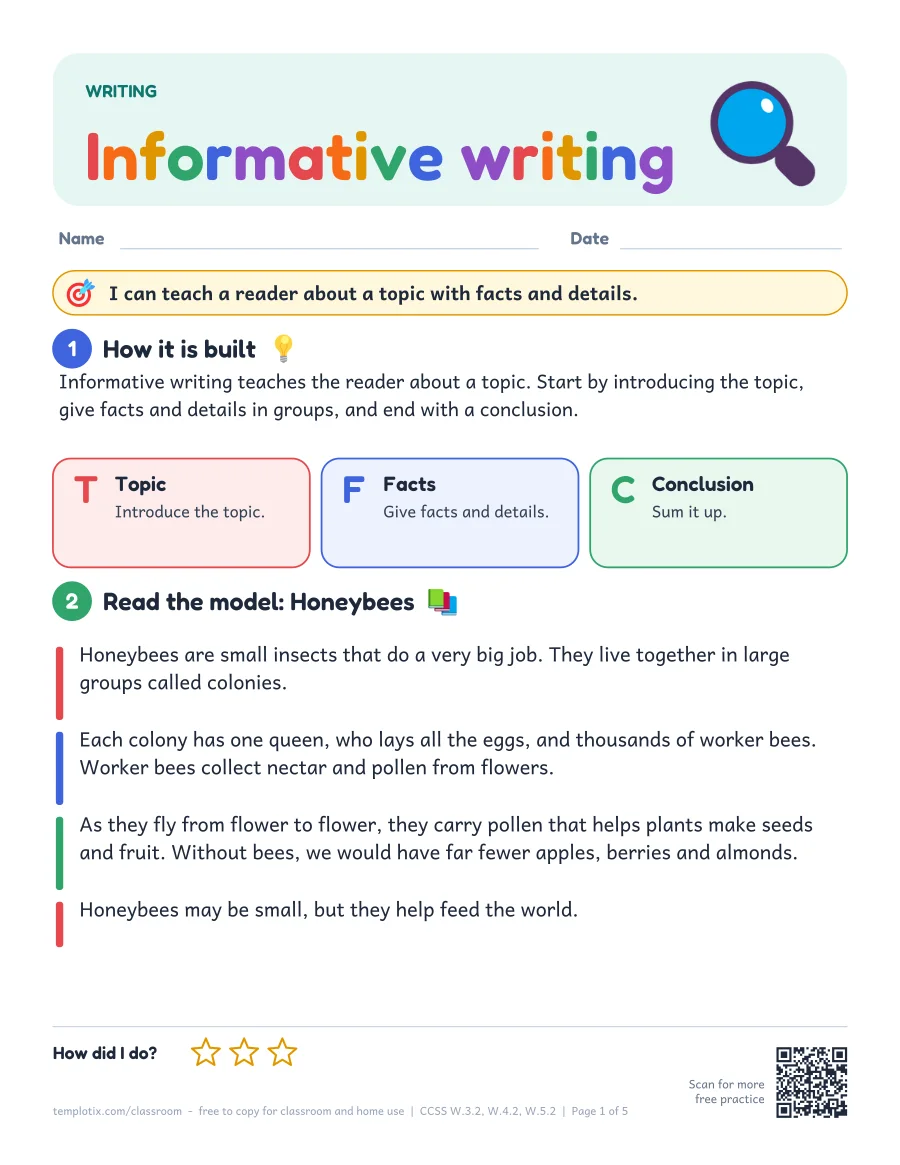
Informative writing teaches the reader about a topic. Start by introducing the topic, give facts and details in groups, and end with a conclusion.
Watch it solved
47 sec · with voice and captionsA pencil works one example of each activity, so you can see how the worksheet goes before you print it. Tap a step to jump to it. The rest of the sheet is left for your child to finish.
Read what the video says
- 0:00 Let's practice informative writing, step by step.
- 0:04 Informative writing teaches the reader about a topic. Introduce the topic, give facts and details, and end with a conclusion.
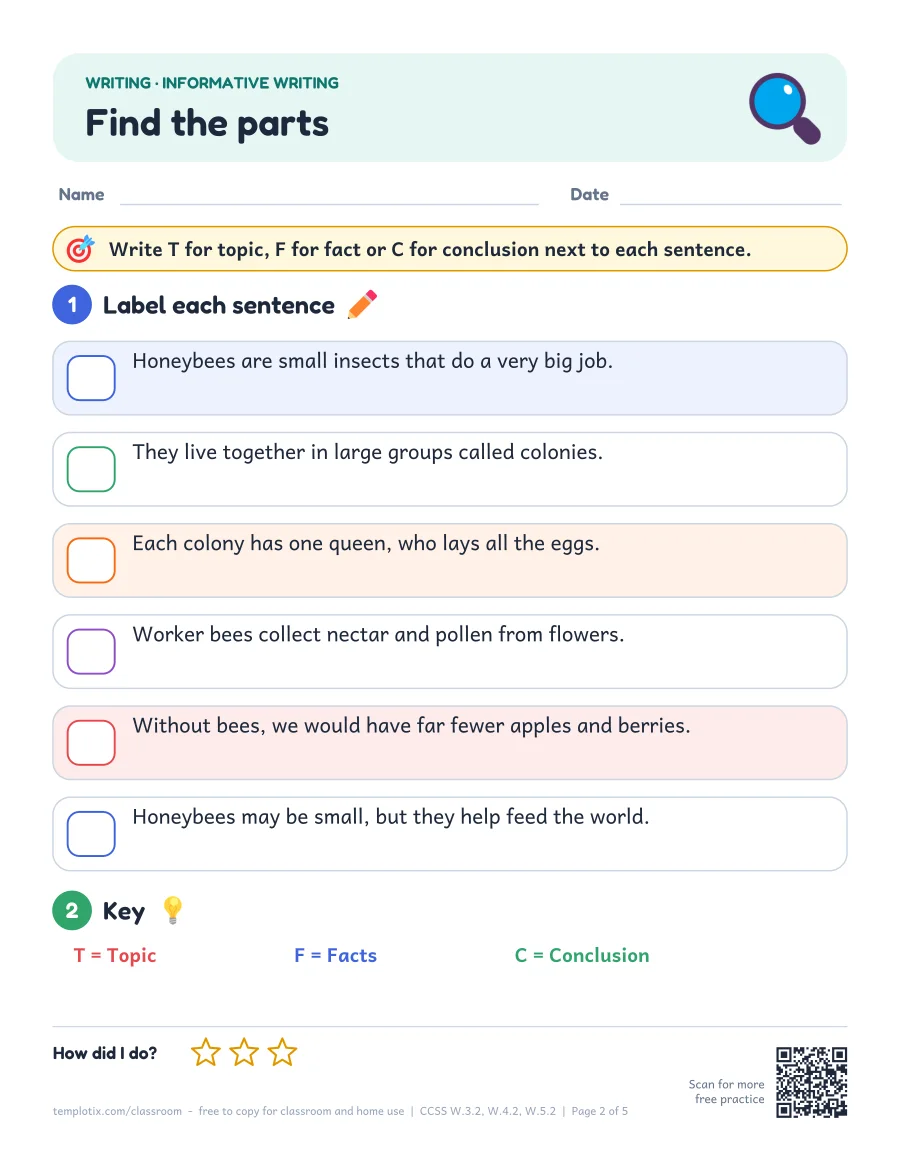
- 0:13 Label each sentence. Honeybees are small insects that do a very big job. That's the topic, so write T. They live together in large groups called colonies. That's a fact, so write F. Each colony has one queen, who lays all the eggs. That's a fact, so write F.
- 0:31 Choose a prompt, and circle it: An animal you know a lot about. Then use the boxes to plan your ideas before you write.
- 0:40 Great job! Now print the free worksheet, and finish the rest on your own.
How it is built
- TTopicIntroduce the topic.
- FFactsGive facts and details.
- CConclusionSum it up.
Model: Honeybees
Honeybees are small insects that do a very big job. They live together in large groups called colonies.
Each colony has one queen, who lays all the eggs, and thousands of worker bees. Worker bees collect nectar and pollen from flowers.
As they fly from flower to flower, they carry pollen that helps plants make seeds and fruit. Without bees, we would have far fewer apples, berries and almonds.
Honeybees may be small, but they help feed the world.
Signal words
- For example
- Also
- Another
- In addition
- In fact
- In conclusion
Prompts to try
- An animal you know a lot about
- How to take care of a pet
- A place in your town
Check my writing
 Check my writing
- My first sentence introduces the topic.
- I gave at least three facts.
- I added details or examples.
- I used linking words such as also and for example.
- My conclusion sums up the topic.
- I checked capitals, spelling and periods.
Teaching tip
 Teaching tip
Let children write about something they already know well, such as a sport, a pet or a game. Knowing the facts lets them focus on organizing them.
Watch for
 Watch for
Opinions sneaking in ("Bees are the best"). Ask, "Is that a fact you could check, or what you think?"
What the worksheets look like
Writing paper
Primary lines for K-2 and lined paper for 3rd to 5th grade.
Common questions
How do you teach informative writing?
Informative writing teaches the reader about a topic. Start by introducing the topic, give facts and details in groups, and end with a conclusion. Let children write about something they already know well, such as a sport, a pet or a game. Knowing the facts lets them focus on organizing them.
What grade learns informative writing?
Usually 3rd to 5th grade. In the Common Core it is part of W.3.2, W.4.2, W.5.2.
What is the most common mistake?
Opinions sneaking in ("Bees are the best"). Ask, "Is that a fact you could check, or what you think?"