Shop
 Grade workbooks


Classroom · Science · NGSS 2-PS1, 3-PS2
worksheets for kindergarten to 3rd grade
Matter is everything around us, so it is easy to explore with real things from the kitchen and the classroom. Each free pack teaches one big idea, from solids, liquids and gases to magnets and dissolving, with a clear picture, practice pages, a Think like a scientist page and a hands-on experiment, then ends with an answer key.
- Solids, liquids and gases1st to 3rd grade · NGSS 2-PS1-1
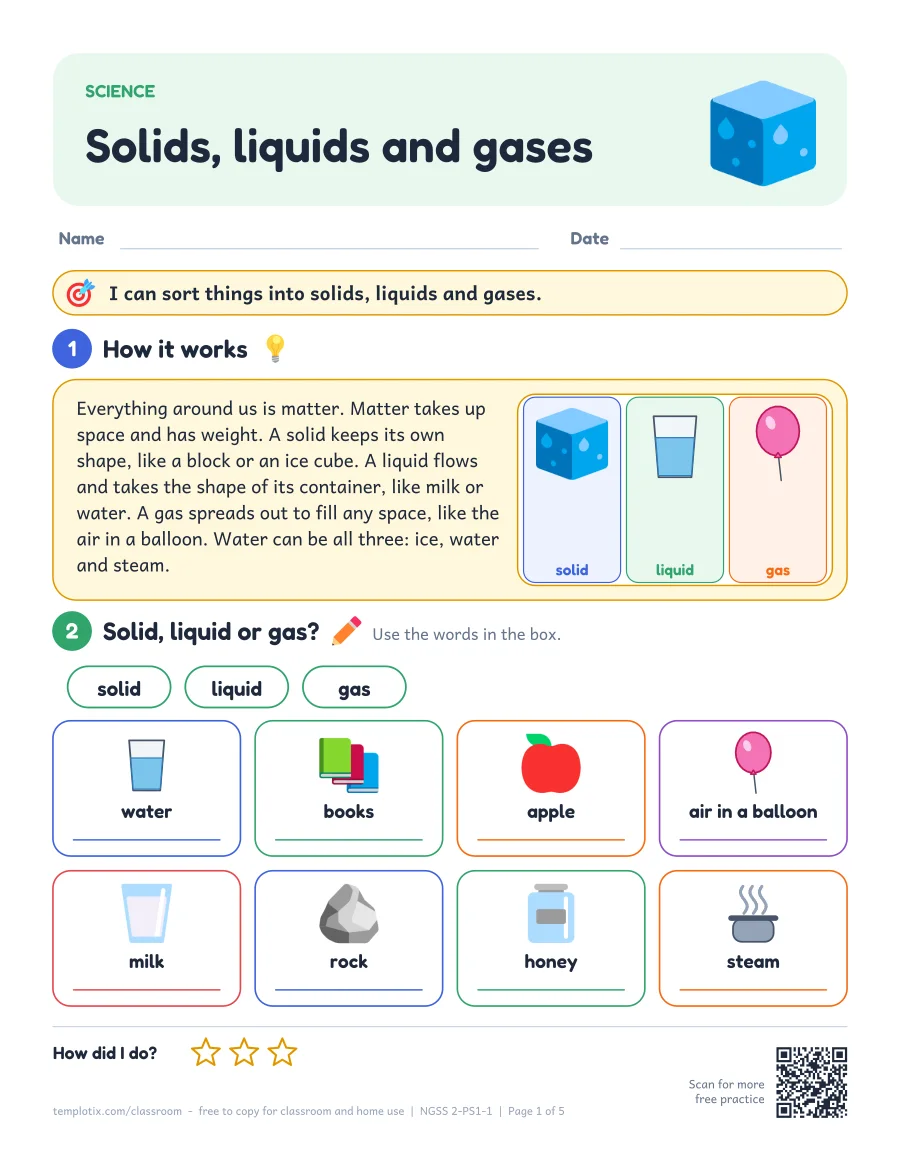
Everything around us is matter. Matter takes up space and has weight. A solid keeps its own shape, like a block or an ice cube. A liquid flows and takes the shape of its container, like milk or water. A gas spreads out to fill any space, like the air in a balloon. Water can be all three: ice, water and steam.
- Properties of matter1st and 2nd grade · NGSS 2-PS1-1, 2-PS1-2
A property is something you can observe about an object. You can describe its color, shape and size. You can feel if it is hard or soft, rough or smooth, heavy or light. You can test if it bends or if it floats. Scientists use properties to sort things and to choose the best material for a job.
- Sink or floatKindergarten to 2nd grade · NGSS 2-PS1-1
Some things float on water and some things sink. It is not only about size: a big log floats, but a small coin sinks. Wood, cork and most plastic float, while stone and metal usually sink. Shape matters too: a flat foil boat can float, but the same foil squeezed into a tight ball sinks.
- Heating and cooling2nd grade · NGSS 2-PS1-4
Heating and cooling can change matter. Heat melts ice into water and melts chocolate and butter. Cooling freezes water into ice. Some changes can be undone: melted chocolate hardens again when it cools. Some changes cannot be undone: once bread is toasted or an egg is cooked, it cannot change back.
- Magnets2nd and 3rd grade · NGSS 3-PS2-3, 3-PS2-4
A magnet can pull some things toward it without touching them. Magnets attract things made of iron or steel, like paper clips and nails. They do not attract wood, plastic, paper or most coins. Every magnet has a north and a south pole. Opposite poles pull together, and the same poles push apart.
- Mixing and dissolving2nd and 3rd grade · NGSS 2-PS1-1, 5-PS1-4
When you mix two things, you make a mixture. In some mixtures you can still see each part, like sand in water or trail mix. Some solids dissolve in water: sugar and salt seem to disappear, but they are still there, and you can taste them. Other solids, like sand and rice, do not dissolve.






States of matter poster
 States of matter poster
One colorful page showing solids, liquids and gases, how their tiny particles are packed, and everyday examples of each. Made for a science wall.
What is in each pack
- 1. Learn itA short explanation with a clear, labeled picture, then a first activity.
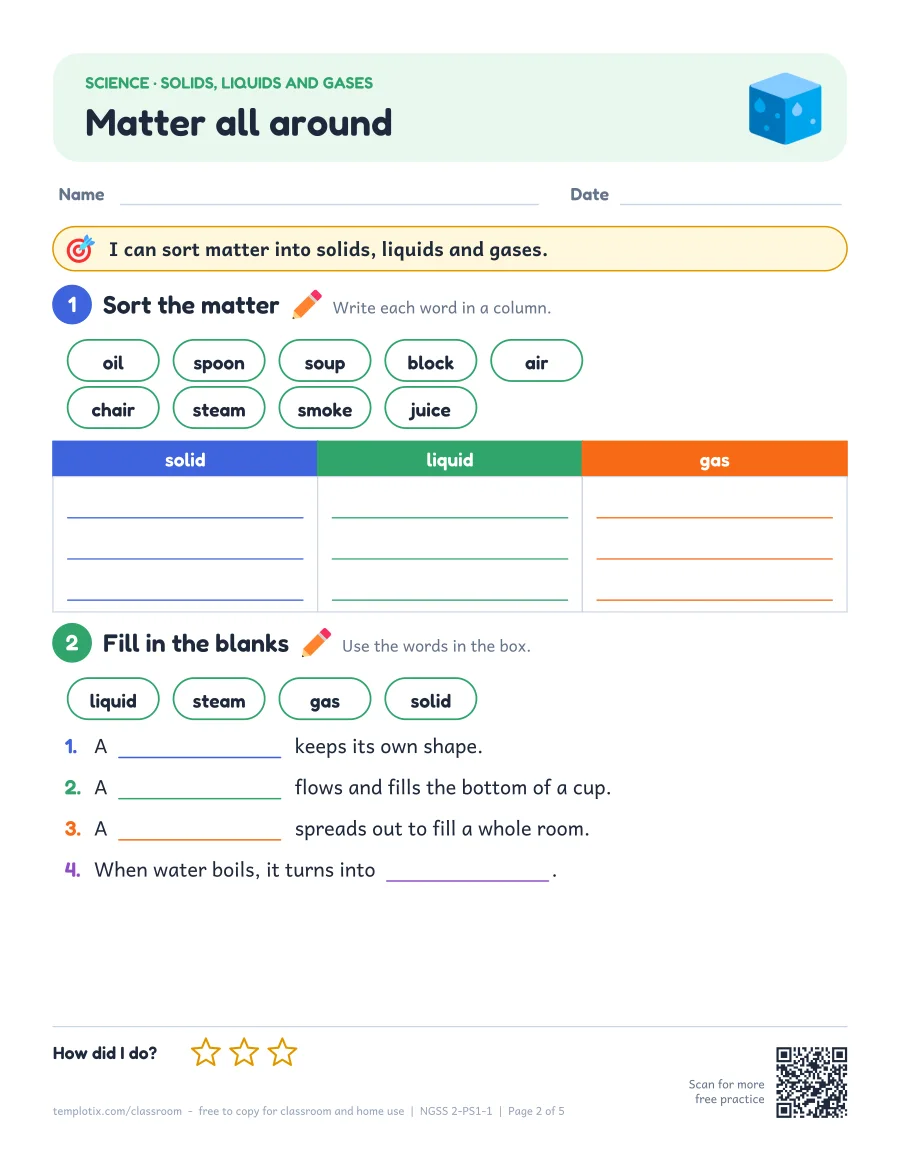
- 2. PracticeLabeling, matching, sorting and fill in the blanks.
- 3. Think like a scientistWhy questions, true or false and a drawing that explains an idea.
- 4. Try it!A hands-on experiment with a materials list, a prediction and an observation chart.
- 5. Answer keyEvery answer, what to expect from the experiment, a teaching tip and a safety note.


How to teach matter
- Use real objects. A tray of a block, a cup of water and a balloon teaches more about matter than any picture.
- Predict before you test. Ask children to guess first. A wrong prediction that they test themselves is the best lesson of all.
- Talk in properties. Push for describing words like hard, smooth, bendy and heavy, and ask how they know.
- Sort, then sort again. Sort the same objects by state, then by material, then by sink or float. Each sort shows a new property.
- Keep a class word wall. Add words like solid, dissolve, attract and reversible as they come up, with a small drawing for each.
More science
Common questions
Are these matter worksheets free?
Yes. Every matter pack and the poster are free to download, print and copy for your class or home, in color or in a black-and-white ink saver.
What grade are these matter worksheets for?
Kindergarten to 3rd grade. Sink or float starts in kindergarten, properties of matter suit 1st and 2nd grade, and solids, liquids and gases, heating and cooling, dissolving and magnets are 2nd and 3rd grade topics.
Do I need special supplies for the experiments?
No. The Try it! pages use everyday things, such as ice cubes, aluminum foil, a magnet, sugar, salt and a bag of small objects. A grown-up watches any water play.
Do the worksheets follow the NGSS?
Yes. Each pack names the NGSS performance expectation it supports, for example 2-PS1-1 for properties of matter and 3-PS2-3 for magnets.