Shop
 Grade workbooks


Classroom · Science · Space · 1st to 3rd grade

Phases of the moon worksheets
A free five-page science pack for 1st to 3rd grade: learn to name the phases of the moon and put them in order, with a labeled picture, practice pages, a hands-on experiment and an answer key.
The big idea
 The big idea
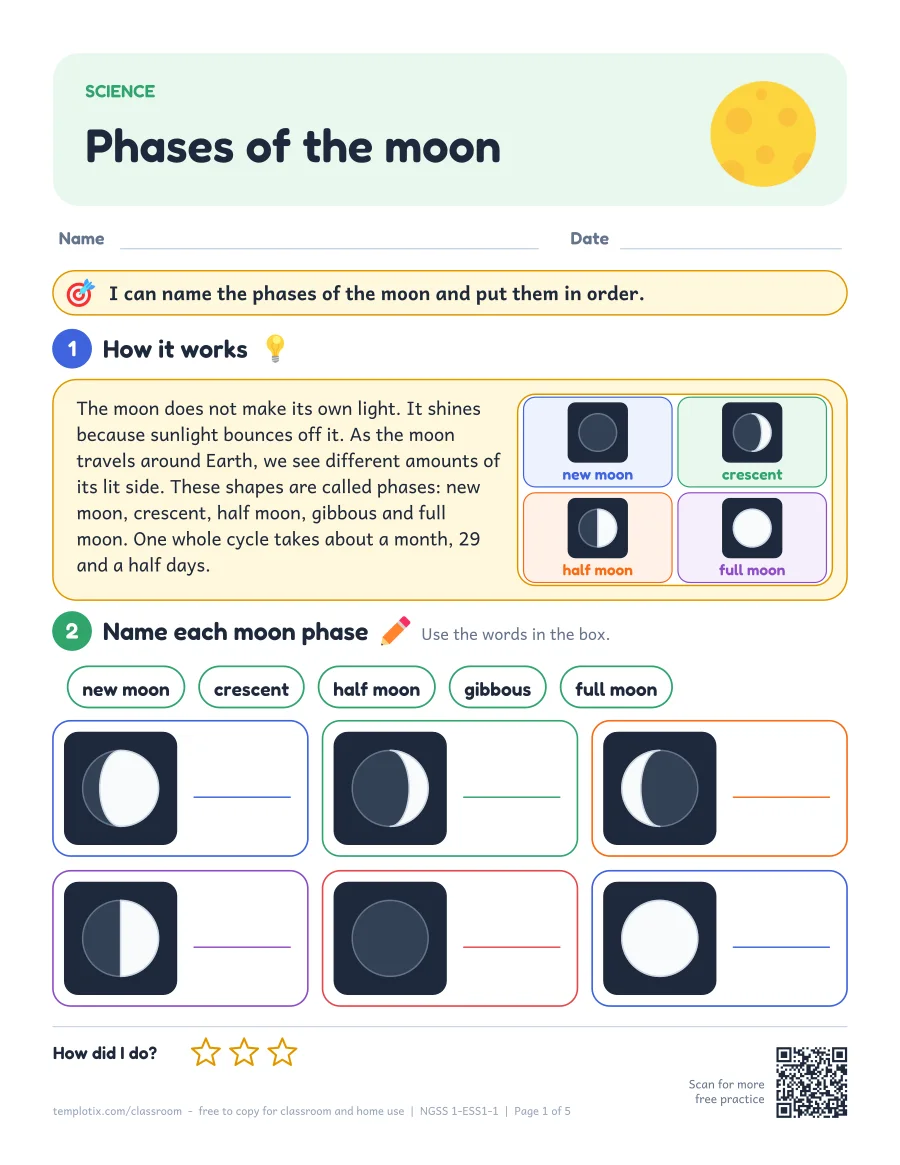
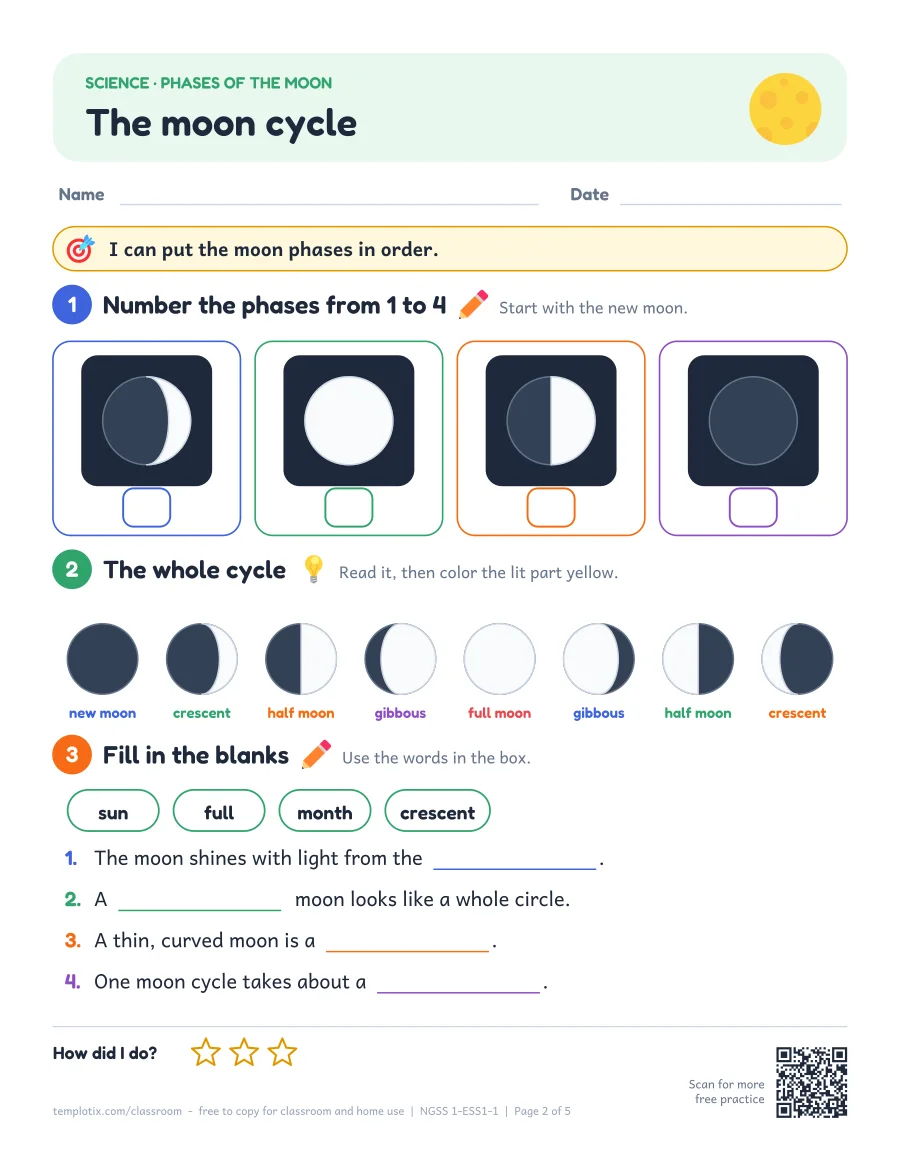
The moon does not make its own light. It shines because sunlight bounces off it. As the moon travels around Earth, we see different amounts of its lit side. These shapes are called phases: new moon, crescent, half moon, gibbous and full moon. One whole cycle takes about a month, 29 and a half days.
Teaching tip
 Teaching tip
Model the phases with a lamp as the sun and a ball on a stick as the moon. A child holds the ball out and turns slowly in place: everyone sees the crescent, half and full shapes appear.
Try it: moon watch
 Try it: moon watch
I can observe the moon and record its phases.
You need
- A notebook
- A pencil
- A window
- A calendar
- A grown-up
What to do
- 1With a grown-up, look at the moon at the same time each night or early morning.
- 2Draw its shape in the chart and write the date.
- 3Look again every 3 days for 2 weeks.
- 4Is the lit part growing or shrinking?
Predict first: Will the lit part grow or shrink this week?What happens?
Answers will vary with the date. If the lit part grows each night, the moon is waxing toward a full moon; if it shrinks, it is waning toward a new moon. Over about 29 and a half days the moon shows every phase, then the cycle starts again.
Safety: look at the night sky with a grown-up, from a safe place.
Quick check
Does the moon make its own light?Tap to checkNo, it reflects sunlight
What does a full moon look like?Tap to checkA whole bright circle
What does a crescent moon look like?Tap to checkA thin, curved shape
Can we see a new moon?Tap to checkNo
How long does one moon cycle take?Tap to checkAbout a month
What are the moon shapes called?Tap to checkPhases
What the worksheets look like
Solar system poster
 Solar system poster
One colorful page with the sun and the eight planets in order, a fact for each, which are rocky and which are gas giants, and a sentence to remember the order.
Common questions
What are the 8 phases of the moon?
New moon, waxing crescent, first quarter, waxing gibbous, full moon, waning gibbous, last quarter and waning crescent. Then the cycle starts again.
How long does it take the moon to go through its phases?
About 29 and a half days, roughly one month. Children can draw the moon each night for a month to see the whole cycle.
What grade learns phases of the moon?
Usually 1st to 3rd grade. In the Next Generation Science Standards (NGSS) it supports 1-ESS1-1.
Is there a hands-on experiment?
Yes. Page 4 is a Try it! experiment, moon watch, with a materials list, a prediction and an observation chart. Safety: look at the night sky with a grown-up, from a safe place.
Is there an answer key?
Yes. Page 5 has every answer from the pack, what to expect from the experiment and a short teaching tip.