Shop
 Grade workbooks


Classroom · Math · CCSS 5.NBT.A.2, 5.NBT.A.4, 5.NBT.B.7
worksheets for 5th grade
Multiply and divide by 10, 100 and 1,000, round decimals, then multiply and divide with decimals. Each pack teaches the rule with a picture and a worked example, then builds up to estimating, placing the decimal point and word problems.
- Multiplying and dividing by 10, 100 and 1,0005th grade
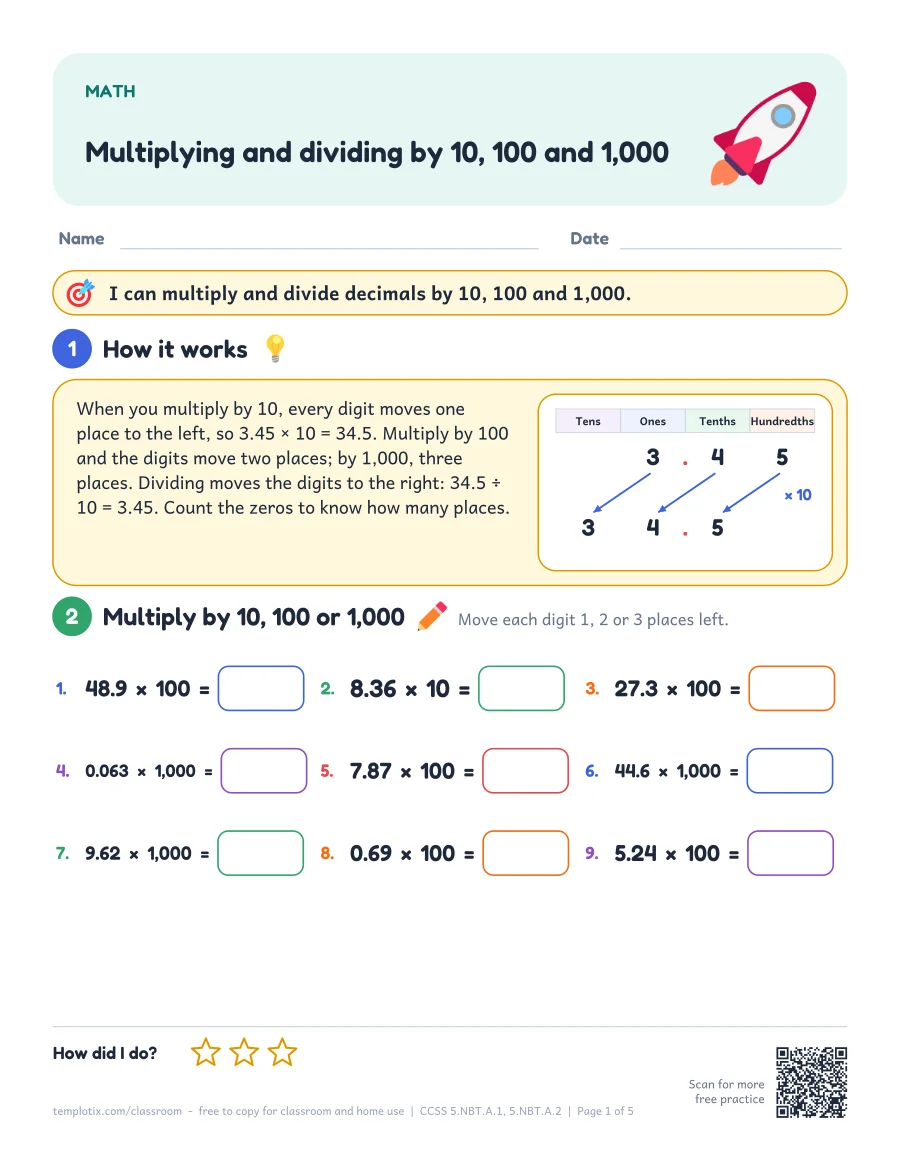
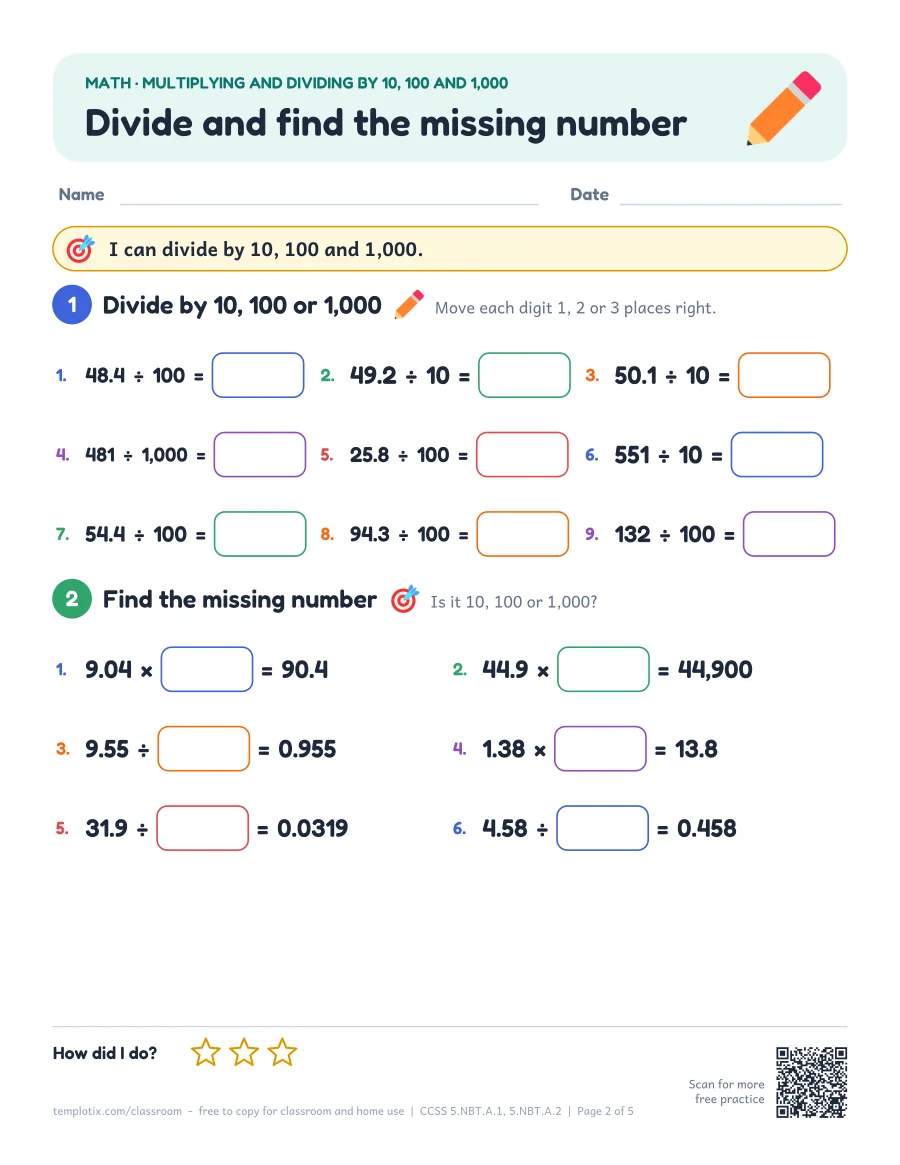
When you multiply by 10, every digit moves one place to the left, so 3.45 × 10 = 34.5. Multiply by 100 and the digits move two places; by 1,000, three places. Dividing moves the digits to the right: 34.5 ÷ 10 = 3.45. Count the zeros to know how many places.
- Rounding decimals5th grade
Find the place you are rounding to, then look at the digit just to its right. If it is 5 or more, round up. If it is less than 5, keep the digit. 2.7 rounds to 3 because 7 is 5 or more. 4.63 rounds to 4.6 to the nearest tenth because 3 is less than 5.
- Multiplying decimals by whole numbers5th grade
Multiply as if there were no decimal point. Then put the point back so the answer has as many decimal places as the decimal you started with. For 2.35 × 3, work out 235 × 3 = 705. 2.35 has 2 decimal places, so the answer is 7.05.
- Multiplying decimals5th grade
Multiply as whole numbers, then count the decimal places in both numbers together. The answer gets that many places. 0.3 × 0.4: 3 × 4 = 12, and there are 2 decimal places in all, so the answer is 0.12. The grid shows 12 of the 100 squares shaded twice.
- Dividing decimals by whole numbers5th grade
Divide as you would with whole numbers. Put the decimal point in the answer straight above the decimal point in the number you are dividing, before you start. 7.5 ÷ 3: 3 goes into 7 twice, then into 15 five times, so the answer is 2.5.
- Dividing by decimals5th grade
Dividing asks how many fit. 1.2 ÷ 0.3 asks how many 0.3s are in 1.2. Make the divisor a whole number: multiply both numbers by 10 to get 12 ÷ 3 = 4. The answer does not change, because both numbers grew by the same amount.






Decimal rules cheat sheet
 Decimal rules cheat sheet
The six decimal rules on one page, each with a worked example.
Whole unit in one PDF Plus
 Whole unit in one PDF
All decimal operations packs, the unit chart and a contents page: 32 pages, ready to print. For Templotix Plus members.
What is in each pack
- 1. Learn itThe rule in plain words, a picture and a worked example, then first practice.
- 2. PracticeMore to solve, in rows and in columns, with room to show the work.
- 3. Think deeperEstimating, placing the decimal point, missing numbers and number lines.
- 4. Word problemsFour short stories about shopping, running, ribbons and recipes.
- 5. Answer key and tipEvery answer on one page, plus a teaching tip for grown-ups.


How to teach decimal operations
- Go in order. Powers of 10 and rounding come first. Every later pack uses them.
- Estimate every time. Round to whole numbers first. A child who expects about 15 will notice that 1.5 or 150 is wrong.
- Use money. Dollars and cents are decimals children already know. $2.50 × 3 makes sense before 2.5 × 3.
- Keep the cheat sheet out. Let children check the rule on the cheat sheet until they no longer need it.
More math
- Telling time
- Money
- Fractions
- Division
- Multi-digit multiplication
- Decimals
- Greater than and less than
- Skip counting
- Shapes
- Number bonds
- Graphs and data
- Measurement
- Area and Perimeter
- Rounding and Estimating
- 3-Digit Addition and Subtraction
- Factors and Multiples
- Fraction Operations
- Math Word Problems
- Geometry
- Order of Operations
- Measurement Conversions
- Counting
- Patterns
- Multiplication Strategies
- Multi-Digit Place Value
Common questions
How do you multiply decimals?
Multiply as if there were no decimal points. Then count the decimal places in both numbers and give the answer that many places. For 1.2 × 0.3, work out 12 × 3 = 36. There are 2 decimal places in all, so the answer is 0.36.
What grade learns decimal operations?
Multiplying and dividing by powers of 10, rounding decimals, and adding, subtracting, multiplying and dividing decimals to hundredths are all 5th grade standards (CCSS 5.NBT.A.2, 5.NBT.A.4 and 5.NBT.B.7). Fluent decimal division with any numbers comes in 6th grade.
How do you divide by a decimal?
Multiply both numbers by 10 or 100 until the divisor is a whole number, then divide as usual. 1.2 ÷ 0.3 becomes 12 ÷ 3 = 4. The answer stays the same because both numbers grew by the same amount.
Can I copy these worksheets for my class?
Yes. The PDFs are free to print and photocopy for classroom and home use, in color or in the black-and-white ink saver. Please link to this page rather than re-uploading the files.