Shop
 Grade workbooks


Classroom · Science · Ecosystems and food chains · 3rd to 5th grade

Producers, consumers and decomposers worksheets
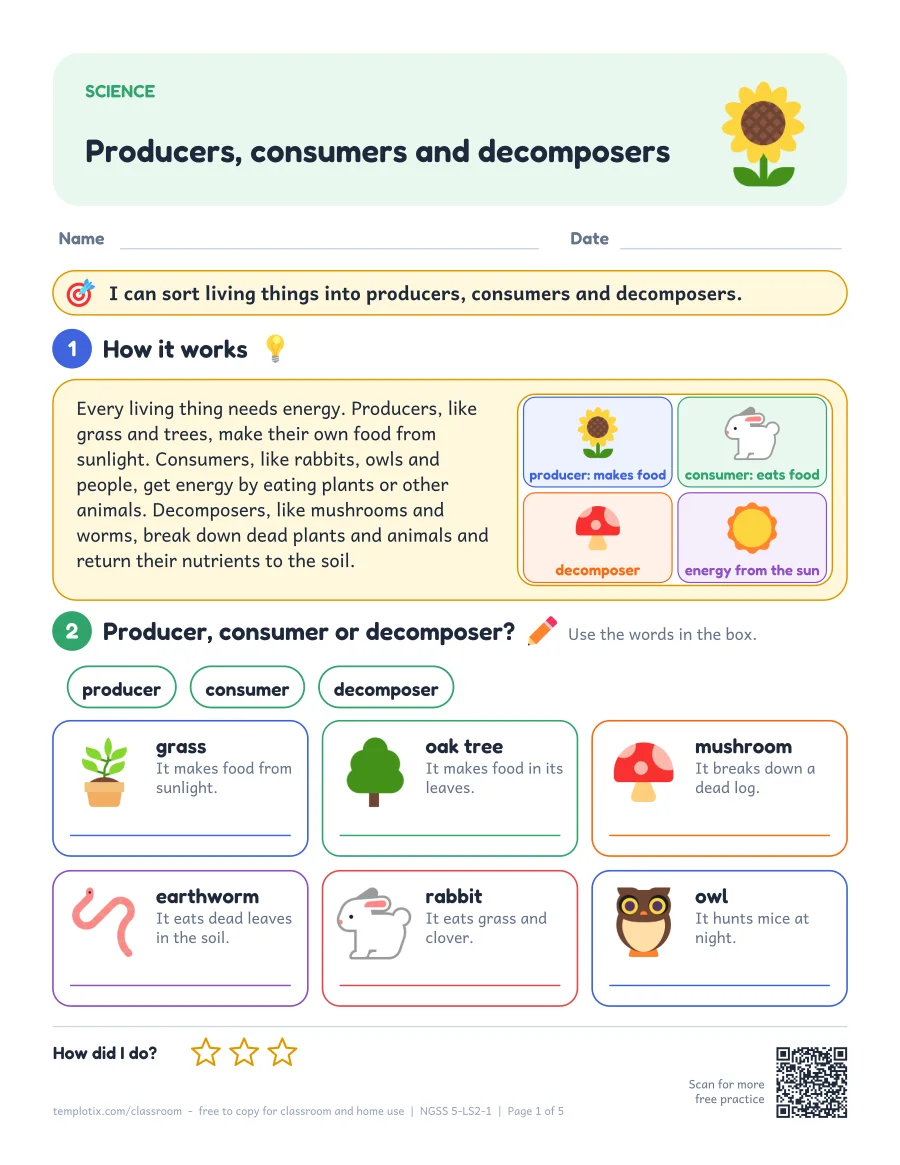
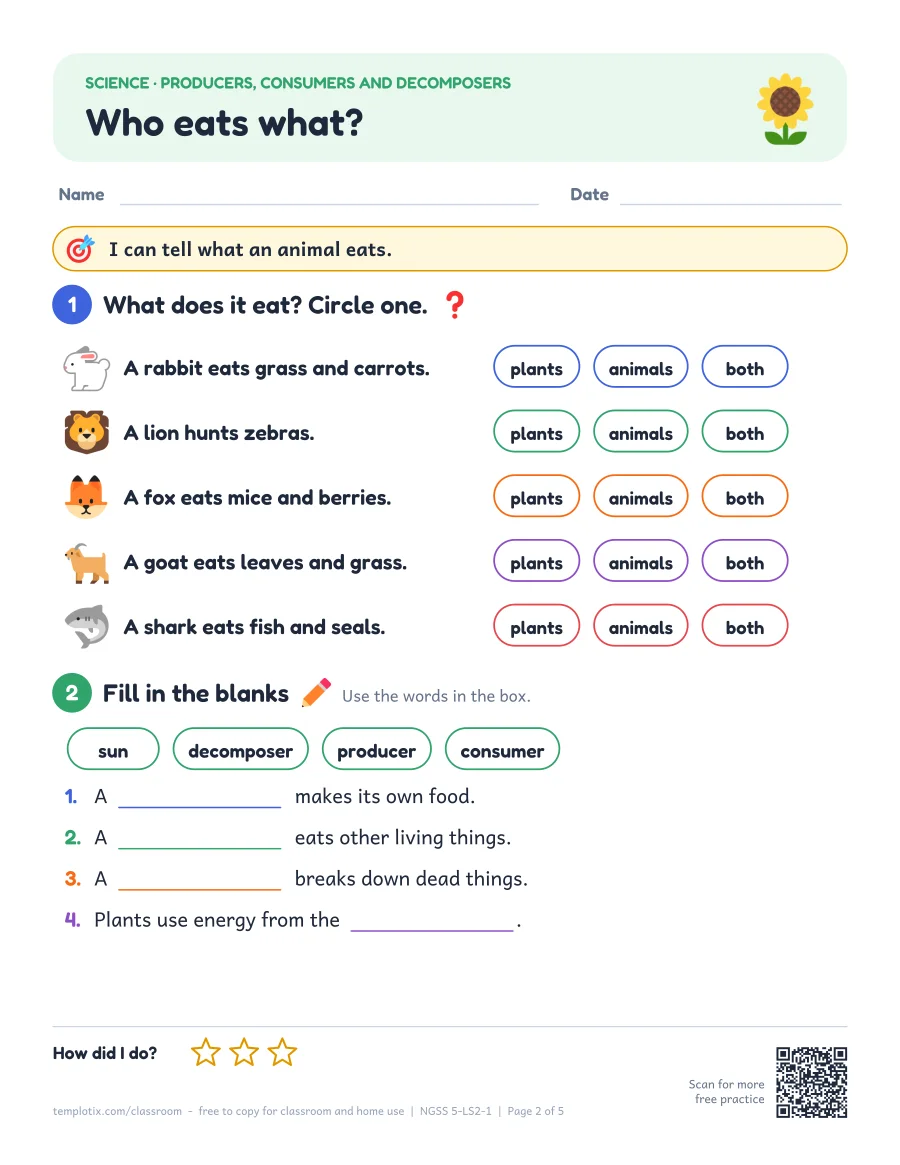
A free five-page science pack for 3rd to 5th grade: learn to sort living things into producers, consumers and decomposers, with a labeled picture, practice pages, a hands-on experiment and an answer key.
The big idea
 The big idea
Every living thing needs energy. Producers, like grass and trees, make their own food from sunlight. Consumers, like rabbits, owls and people, get energy by eating plants or other animals. Decomposers, like mushrooms and worms, break down dead plants and animals and return their nutrients to the soil.
Teaching tip
 Teaching tip
Start with lunch. Ask children where each food came from until they reach a plant: cheese comes from a cow, and the cow ate grass. Every chain leads back to a producer.
Try it: the schoolyard survey
 Try it: the schoolyard survey
I can find and sort the living things in one small patch of ground.
You need
- A hoop or a loop of string
- A magnifying glass
- A clipboard and a pencil
- A grassy spot
- A partner
What to do
- 1Lay the hoop on the grass. Your survey is only what is inside it.
- 2Look closely with the magnifying glass. List every living thing you see.
- 3Sort each one: producer, consumer or decomposer.
- 4Count how many of each kind you found.
Predict first: Will you find more producers or more consumers?What happens?
Most children find far more producers (grass, clover and weeds) than consumers (ants, beetles, spiders and worms). That is true in every ecosystem: there must be many more plants than animals, because the animals depend on the plants for food. A worm or a patch of mold counts as a decomposer.
Safety: look but do not touch bugs or mushrooms, and wash your hands afterward.
Quick check
What is a producer?Tap to checkA living thing that makes its own food, like a plant
What is a consumer?Tap to checkA living thing that eats other living things
What is a decomposer?Tap to checkA living thing that breaks down dead plants and animals
Is a mushroom a producer or a decomposer?Tap to checkA decomposer
Where do producers get their energy?Tap to checkFrom sunlight
Name a consumer that eats only plants.Tap to checkA rabbit, a deer or a goat
What the worksheets look like
Who eats what? poster
 Who eats what? poster
One colorful page with a food chain, producers, consumers, decomposers, predators, prey and food webs, each with a picture and a one-line meaning. Made for a science wall.
Common questions
What is the difference between a producer and a consumer?
A producer makes its own food, the way plants use sunlight to make sugar in their leaves. A consumer cannot make food, so it eats plants or other animals.
Why are decomposers important?
Without decomposers, dead leaves and animals would pile up and the nutrients in them would be locked away. Decomposers break them down and return those nutrients to the soil for new plants.
What grade learns producers, consumers and decomposers?
Usually 3rd to 5th grade. In the Next Generation Science Standards (NGSS) it supports 5-LS2-1.
Is there a hands-on experiment?
Yes. Page 4 is a Try it! experiment, the schoolyard survey, with a materials list, a prediction and an observation chart. Safety: look but do not touch bugs or mushrooms, and wash your hands afterward.
Is there an answer key?
Yes. Page 5 has every answer from the pack, what to expect from the experiment and a short teaching tip.