Shop
 Grade workbooks


Classroom · Math · CCSS 4.NF.A.1, 4.NF.B.3, 5.NF.A.1, 5.NF.B.4, 5.NF.B.7, 6.NS.A.1
worksheets for 4th and 5th grade
Simplify fractions, change between mixed numbers and improper fractions, then add, subtract, multiply and divide fractions. Each pack teaches the rule with a picture and a worked example, then builds up to estimating, missing fractions and word problems.
- Simplifying fractions4th and 5th grade
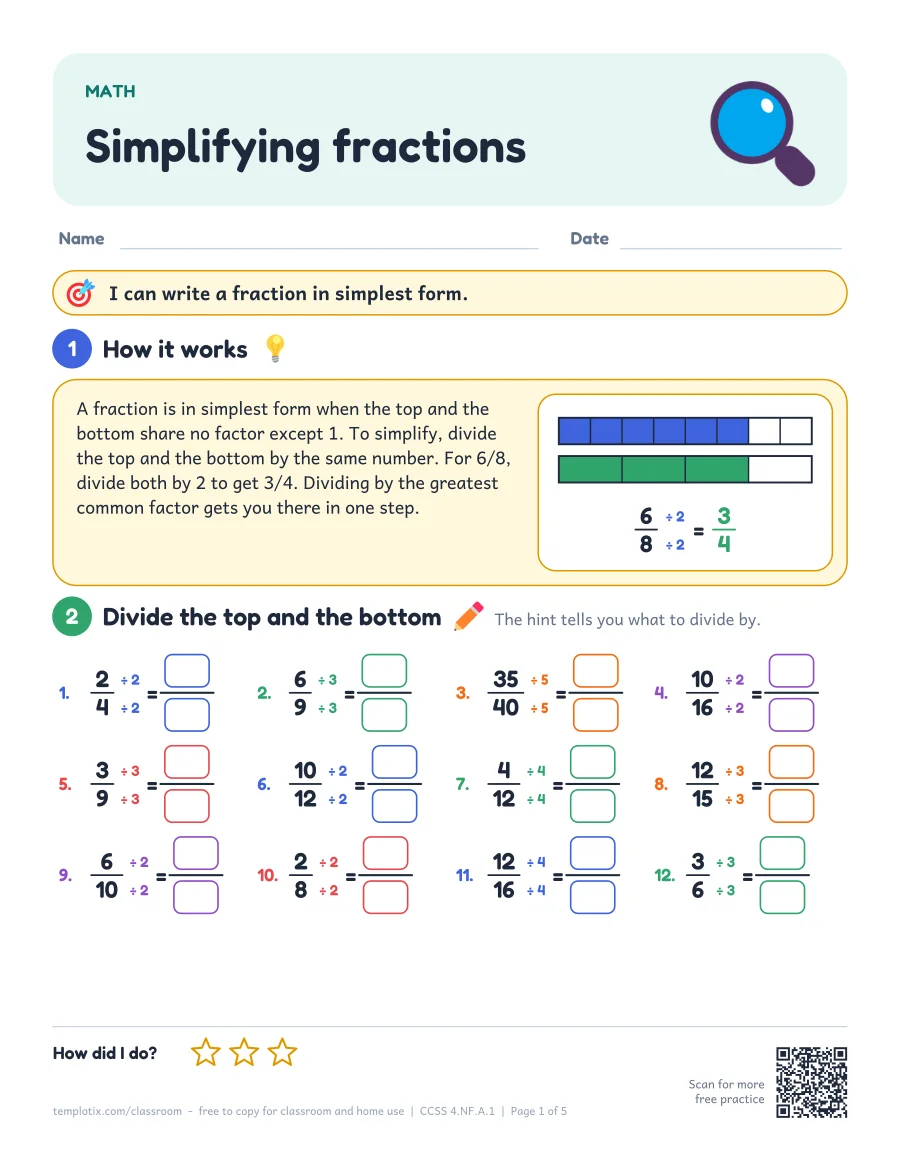
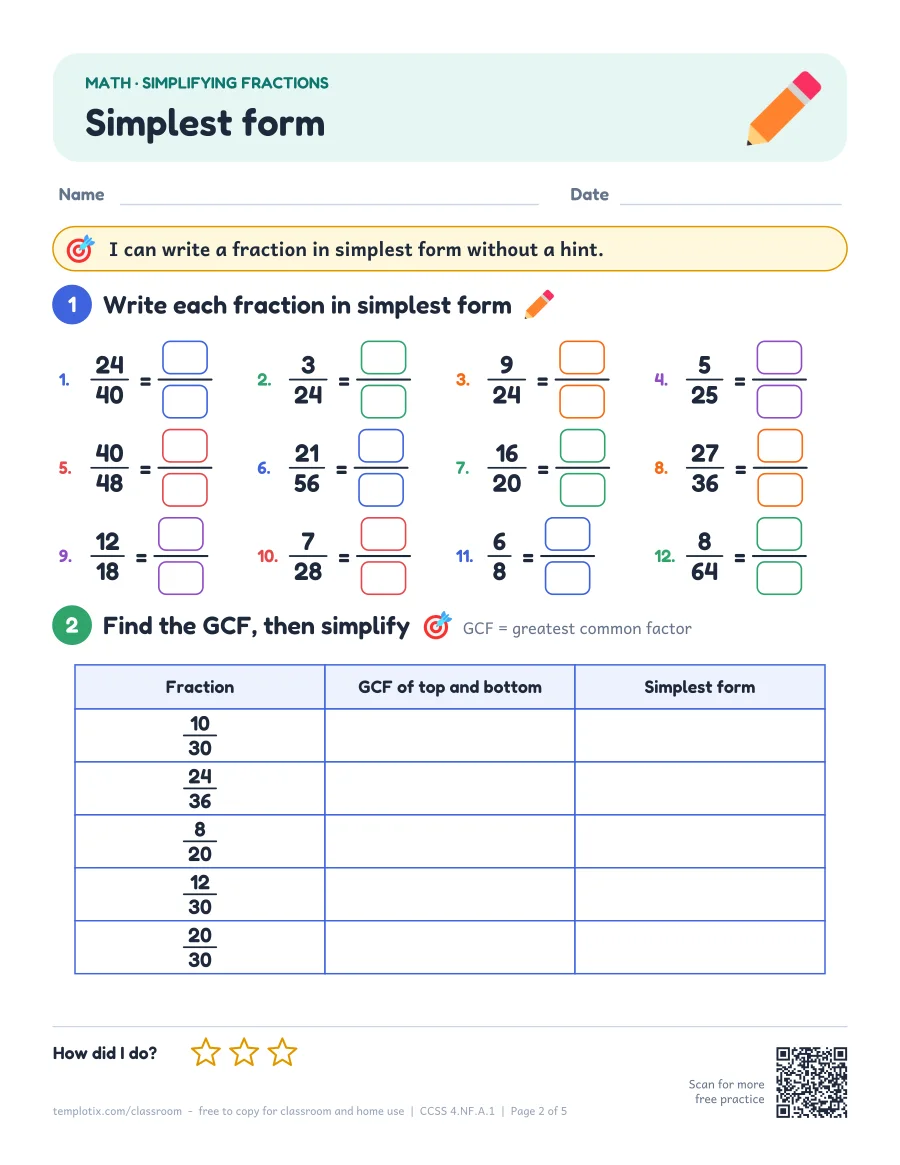
A fraction is in simplest form when the top and the bottom share no factor except 1. To simplify, divide the top and the bottom by the same number. For 6/8, divide both by 2 to get 3/4. Dividing by the greatest common factor gets you there in one step.
- Mixed numbers and improper fractions4th and 5th grade
An improper fraction has a top that is bigger than its bottom, like 7/4. A mixed number has a whole number and a fraction, like 1 3/4. To change 7/4, divide: 7 ÷ 4 = 1 remainder 3, so 7/4 = 1 3/4. To go back, multiply and add: 1 × 4 + 3 = 7, so 7/4.
- Adding fractions with unlike denominators5th grade
You can only add fractions when the bottoms match. Find a common denominator, a number both bottoms divide into. For 1/2 + 1/3, use 6. Rewrite each fraction: 1/2 = 3/6 and 1/3 = 2/6. Now add the tops and keep the bottom: 3/6 + 2/6 = 5/6.
- Subtracting fractions with unlike denominators5th grade
You can only subtract fractions when the bottoms match. Find a common denominator, a number both bottoms divide into. For 1/2 – 1/3, use 6. Rewrite each fraction: 1/2 = 3/6 and 1/3 = 2/6. Now subtract the tops and keep the bottom: 3/6 – 2/6 = 1/6.
- Multiplying fractions5th grade
To multiply fractions, multiply the tops, then multiply the bottoms. 3/4 × 2/3 = 6/12, which simplifies to 1/2. The picture shows why: 3/4 of the columns and 2/3 of the rows overlap in 6 of the 12 parts. You do not need a common denominator.
- Dividing fractions5th grade
Dividing asks how many fit. 2 ÷ 1/4 asks how many fourths are in 2. There are 8. The shortcut: keep the first number, change ÷ to ×, and flip the second fraction. So 2 ÷ 1/4 = 2 × 4 = 8. A flipped fraction is called a reciprocal.






Fraction rules cheat sheet
 Fraction rules cheat sheet
The six fraction rules on one page, each with a worked example.
Whole unit in one PDF Plus
 Whole unit in one PDF
All fraction operations packs, the unit chart and a contents page: 32 pages, ready to print. For Templotix Plus members.
What is in each pack
- 1. Learn itThe rule in plain words, a picture and a worked example, then first practice.
- 2. PracticeMore to solve, with answers in simplest form and mixed numbers.
- 3. Think deeperMissing fractions, estimating, area models and find-the-mistake questions.
- 4. Word problemsFour short stories about recipes, ribbons, running and sharing.
- 5. Answer key and tipEvery answer on one page, plus a teaching tip for grown-ups.


How to teach fraction operations
- Go in order. Simplifying and mixed numbers come first. Every later pack uses them in its answers.
- Draw it first. Fraction bars and area models show why the rule works before children use the shortcut.
- Estimate, then solve. Ask if the answer will be more or less than 1. It catches most mistakes.
- Keep the cheat sheet out. Let children check the rule on the cheat sheet until they no longer need it.
More math
- Telling time
- Money
- Fractions
- Division
- Multi-digit multiplication
- Decimals
- Greater than and less than
- Skip counting
- Shapes
- Number bonds
- Graphs and data
- Measurement
- Area and Perimeter
- Rounding and Estimating
- 3-Digit Addition and Subtraction
- Factors and Multiples
- Decimal Operations
- Math Word Problems
- Geometry
- Order of Operations
- Measurement Conversions
- Counting
- Patterns
- Multiplication Strategies
- Multi-Digit Place Value
Common questions
How do you add fractions with different denominators?
Find a common denominator, a number both bottoms divide into. Rewrite each fraction with that denominator, then add the tops and keep the bottom. For 1/2 + 1/3, use 6: 3/6 + 2/6 = 5/6. Subtraction works the same way.
What grade learns fraction operations?
Adding and subtracting fractions with unlike denominators and multiplying fractions are 5th grade standards (CCSS 5.NF.A.1 and 5.NF.B.4). Dividing with unit fractions is also 5th grade (5.NF.B.7), and dividing any two fractions is 6th grade (6.NS.A.1). Simplifying and mixed numbers usually start in 4th grade.
What does keep, change, flip mean?
It is the shortcut for dividing fractions. Keep the first fraction, change the division sign to multiplication, and flip the second fraction to its reciprocal. So 1/2 ÷ 3/4 becomes 1/2 × 4/3 = 4/6, which simplifies to 2/3.
Can I copy these worksheets for my class?
Yes. The PDFs are free to print and photocopy for classroom and home use, in color or in the black-and-white ink saver. Please link to this page rather than re-uploading the files.