Shop
 Grade workbooks


Classroom · Science · Human body · 1st to 4th grade

How we see worksheets
A free five-page science pack for 1st to 4th grade: learn to explain that we see when light goes into our eyes, with a labeled picture, practice pages, a hands-on experiment and an answer key.
The big idea
 The big idea
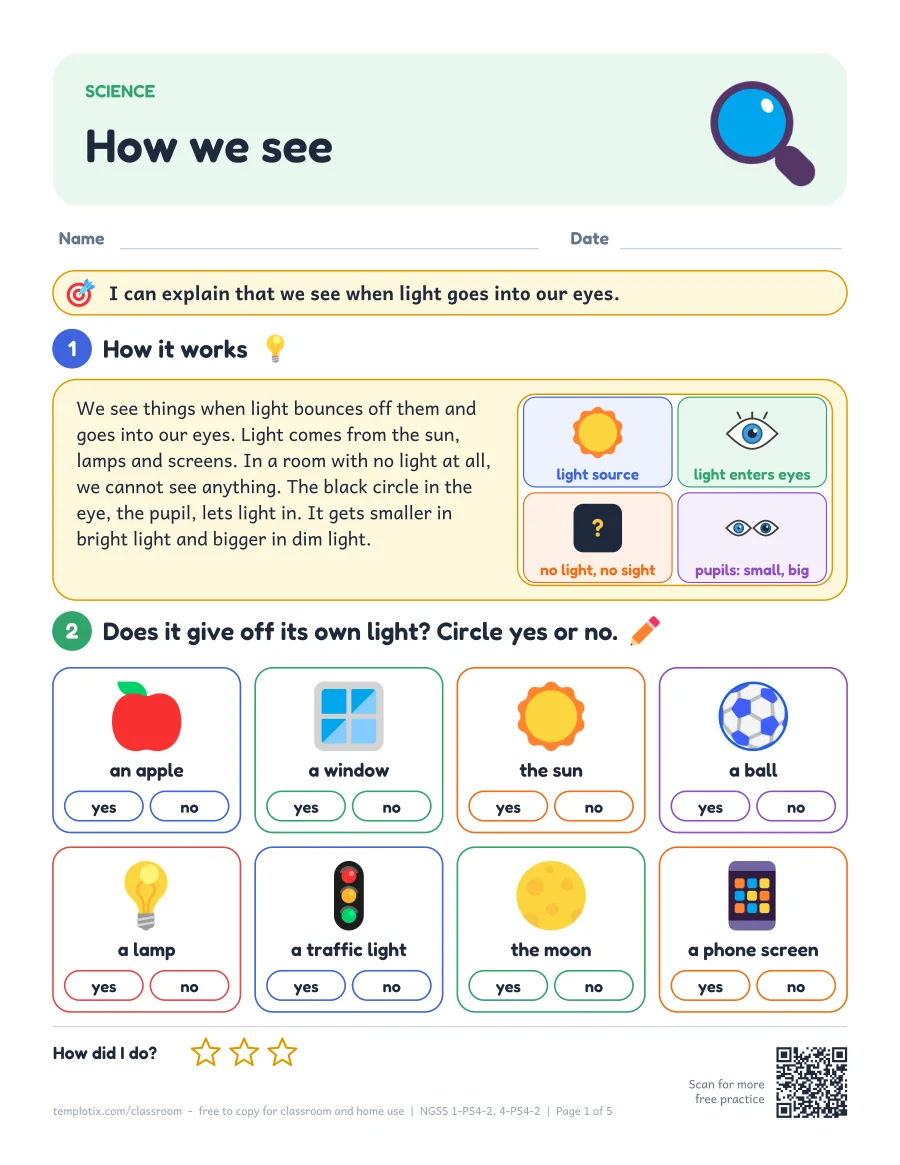
We see things when light bounces off them and goes into our eyes. Light comes from the sun, lamps and screens. In a room with no light at all, we cannot see anything. The black circle in the eye, the pupil, lets light in. It gets smaller in bright light and bigger in dim light.
Teaching tip
 Teaching tip
Make a shoebox viewer with a small peephole and a flap on the lid. Children look in with the flap shut, then open it and see the object inside appear.
Try it: pupil watch
 Try it: pupil watch
I can see my pupils change in bright and dim light.
You need
- A small mirror
- A lamp
- A dim room
- A pencil
What to do
- 1Sit in a dim room for one minute. Look at your pupils in the mirror. Draw them.
- 2Turn on the lamp. Do not look at the bulb.
- 3Look at your pupils right away. Draw them.
- 4Turn the lamp off. Watch your pupils for 30 seconds.
Predict first: What will your pupils do in bright light?What happens?
In dim light the pupils are big, to let in as much light as they can. In bright light they quickly get smaller, which protects the eye from too much light. When the lamp goes off, they slowly get bigger again.
Safety: never look straight at the sun, a lamp bulb or a flashlight.
Quick check
What do we need to see?Tap to checkLight
Where does light come from?Tap to checkThe sun, lamps and screens
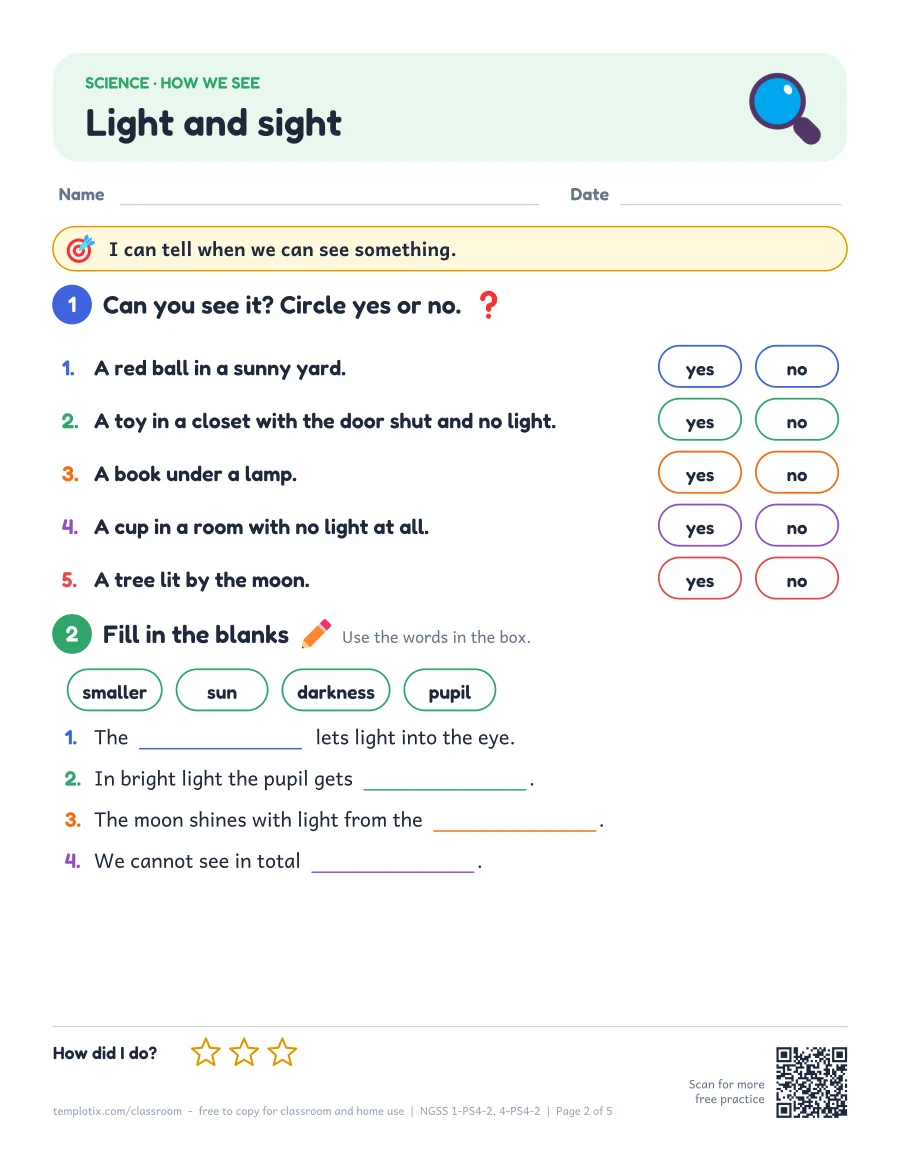
Does the moon make its own light?Tap to checkNo, it reflects sunlight
What lets light into the eye?Tap to checkThe pupil
What does the pupil do in bright light?Tap to checkIt gets smaller
Can we see in total darkness?Tap to checkNo
What the worksheets look like
Five senses poster
 Five senses poster
One colorful page with the five senses (sight, hearing, smell, taste and touch), the body part for each and how the brain puts the messages together. Made for a science wall.
Common questions
What do the parts of the eye do?
The pupil is the hole that lets light in, the iris is the colored ring that makes the pupil bigger or smaller, the lens focuses the light, and the retina at the back sends the picture to the brain through the optic nerve.
Can cats see in the dark?
Cats see much better than people in dim light. They have very large pupils and a shiny layer at the back of the eye that sends light through the eye a second time. In total darkness, though, a cat cannot see either.
What grade learns how we see?
Usually 1st to 4th grade. In the Next Generation Science Standards (NGSS) it supports 1-PS4-2 and 4-PS4-2.
Is there a hands-on experiment?
Yes. Page 4 is a Try it! experiment, pupil watch, with a materials list, a prediction and an observation chart. Safety: never look straight at the sun, a lamp bulb or a flashlight.
Is there an answer key?
Yes. Page 5 has every answer from the pack, what to expect from the experiment and a short teaching tip.