Shop
 Grade workbooks


Classroom · Science · Weather · Kindergarten and 1st grade

The four seasons worksheets
A free five-page science pack for Kindergarten and 1st grade: learn to describe the weather in each season, with a labeled picture, practice pages, a hands-on experiment and an answer key.
The big idea
 The big idea
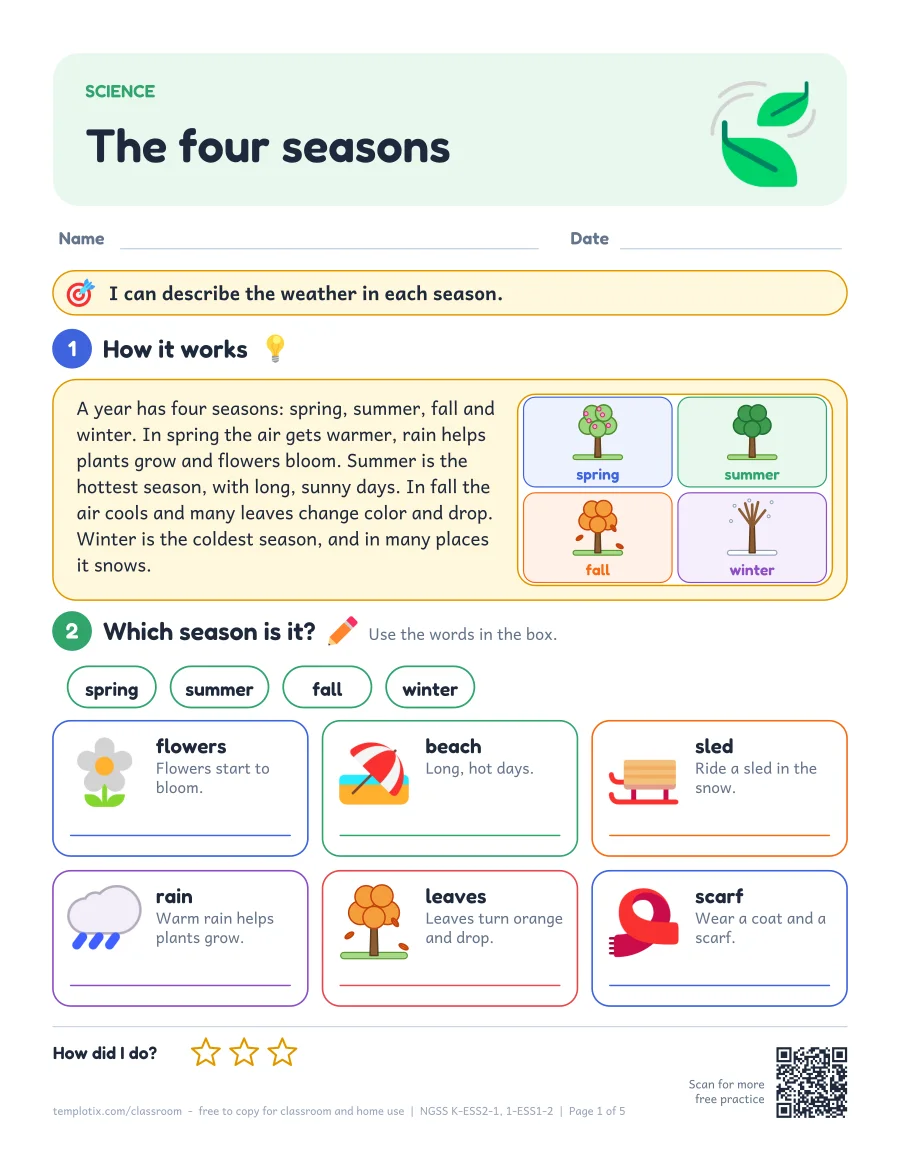
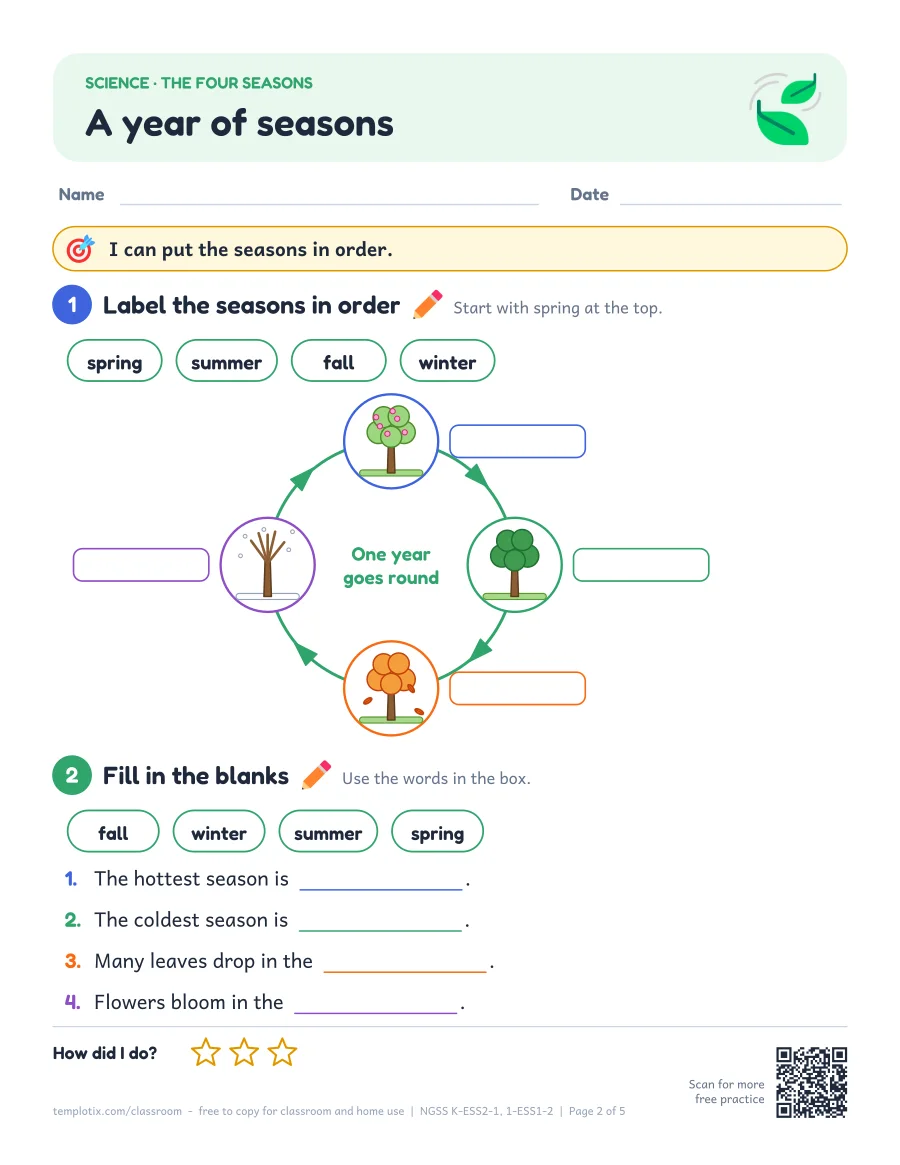
A year has four seasons: spring, summer, fall and winter. In spring the air gets warmer, rain helps plants grow and flowers bloom. Summer is the hottest season, with long, sunny days. In fall the air cools and many leaves change color and drop. Winter is the coldest season, and in many places it snows.
Teaching tip
 Teaching tip
Choose one tree near your school and take its photo every month. By the end of the year, children have their own four seasons poster and can see the pattern for themselves.
Try it: the ice cube race
 Try it: the ice cube race
I can test where ice melts fastest.
You need
- 3 ice cubes
- 3 small plates
- A sunny spot
- A shady spot
- A freezer
What to do
- 1Put one ice cube on each plate.
- 2Put one plate in the sun, one in the shade and one in the freezer.
- 3Check every 10 minutes. Which cube melts first?
- 4Write the time when each cube has all turned to water.
Predict first: Which ice cube will melt first?What happens?
The ice cube in the sun melts first, then the one in the shade. The one in the freezer does not melt at all. Warm places melt ice faster. This is why snow and ice melt in spring and summer, when the days are longer and warmer.
Safety: wipe up the water so no one slips.
Quick check
What are the four seasons?Tap to checkSpring, summer, fall and winter
Which season is the hottest?Tap to checkSummer
Which season is the coldest?Tap to checkWinter
In which season do many leaves drop?Tap to checkFall
In which season do many flowers bloom?Tap to checkSpring
Which season comes after summer?Tap to checkFall
What the worksheets look like
Water cycle poster
 Water cycle poster
One colorful page with a labeled water cycle picture and the four steps: evaporation, condensation, precipitation and collection. Made for a science wall.
Common questions
Why do we have seasons?
Earth is tilted. As Earth travels around the sun during the year, our part of the world leans toward the sun in summer, giving longer, warmer days, and away from the sun in winter, giving shorter, colder days.
Do all places have four seasons?
No. Places near the equator stay warm all year and often have a rainy season and a dry season instead. Places near the poles have long, cold winters and short, cool summers.
What grade learns the four seasons?
Usually Kindergarten and 1st grade. In the Next Generation Science Standards (NGSS) it supports K-ESS2-1 and 1-ESS1-2.
Is there a hands-on experiment?
Yes. Page 4 is a Try it! experiment, the ice cube race, with a materials list, a prediction and an observation chart. Safety: wipe up the water so no one slips.
Is there an answer key?
Yes. Page 5 has every answer from the pack, what to expect from the experiment and a short teaching tip.