Shop
 Grade workbooks


Classroom · Science · Energy · 4th grade

Sound and waves worksheets
A free five-page science pack for 4th grade: learn to explain how waves make sounds loud, soft, high and low, with a labeled picture, practice pages, a hands-on experiment and an answer key.
The big idea
 The big idea
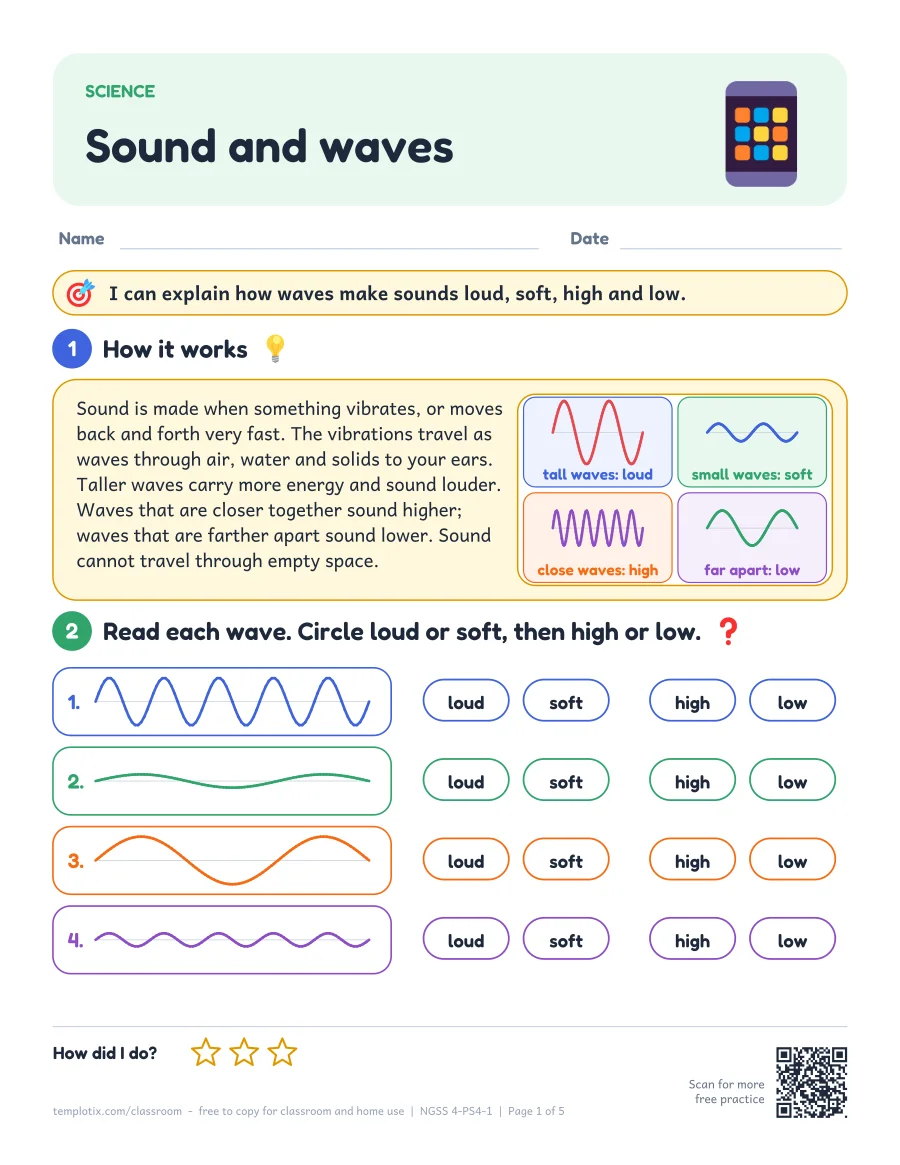
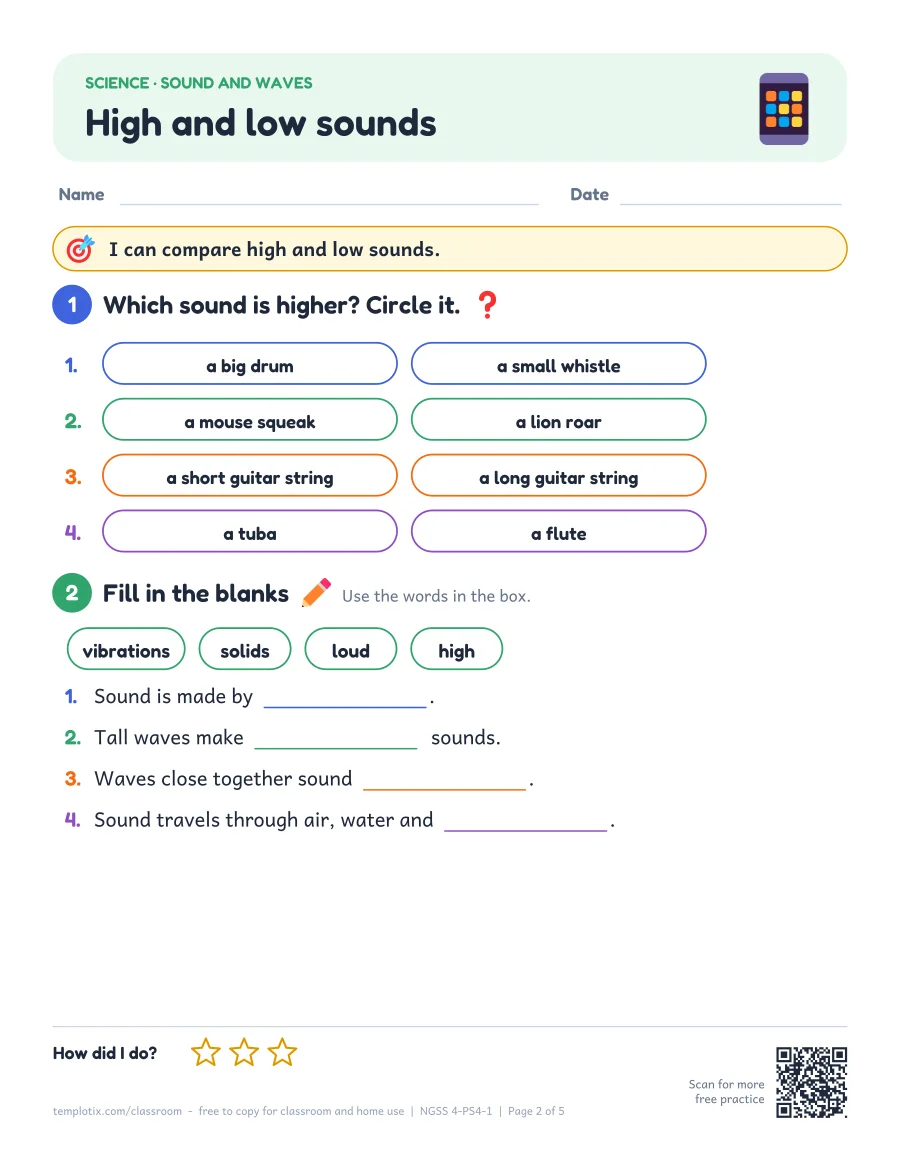
Sound is made when something vibrates, or moves back and forth very fast. The vibrations travel as waves through air, water and solids to your ears. Taller waves carry more energy and sound louder. Waves that are closer together sound higher; waves that are farther apart sound lower. Sound cannot travel through empty space.
Teaching tip
 Teaching tip
Have children put a hand on their throat and hum high, then low, then loud. They feel the vibration change, which makes the wave pictures make sense.
Try it: the rubber band guitar
 Try it: the rubber band guitar
I can test how a string changes pitch.
You need
- An empty shoebox
- 3 rubber bands, thin to thick
- A pencil
- Your fingers to pluck
- A partner to listen
What to do
- 1Stretch the 3 rubber bands around the open box.
- 2Pluck each band. Listen: high or low?
- 3Slide a pencil under the bands to make them shorter, and pluck again.
- 4Pluck gently, then harder. Listen: loud or soft?
Predict first: Which rubber band will make the highest sound?What happens?
The thin band makes the highest sound and the thick band the lowest, because thin bands vibrate faster. Making a band shorter with the pencil also raises the pitch. Plucking harder makes bigger vibrations, so the sound is louder but not higher.
Safety: stretch the bands gently and keep them away from faces and eyes.
Quick check
What makes sound?Tap to checkVibrations
What kind of waves make a loud sound?Tap to checkTall waves
What kind of waves make a high sound?Tap to checkWaves with peaks close together
Does a short string sound higher or lower?Tap to checkHigher
Can sound travel through water?Tap to checkYes
Why is there no sound in space?Tap to checkThere is no air to carry the waves
What the worksheets look like
Energy all around poster
One colorful page with light, heat, sound, motion, electricity and renewable energy, each with a picture and a one-line meaning. Made for a science wall.
Common questions
What makes a sound loud or soft?
The size of the vibration. Big vibrations make tall waves and loud sounds; small vibrations make small waves and soft sounds.
What makes a sound high or low?
How fast something vibrates. Fast vibrations make waves close together and a high sound; slow vibrations make waves far apart and a low sound.
What grade learns sound and waves?
Usually 4th grade. In the Next Generation Science Standards (NGSS) it supports 4-PS4-1.
Is there a hands-on experiment?
Yes. Page 4 is a Try it! experiment, the rubber band guitar, with a materials list, a prediction and an observation chart. Safety: stretch the bands gently and keep them away from faces and eyes.
Is there an answer key?
Yes. Page 5 has every answer from the pack, what to expect from the experiment and a short teaching tip.