Shop
 Grade workbooks


Classroom · Math · CCSS 3.OA.D.8, 5.OA.A.1, 5.OA.A.2
worksheets for 4th and 5th grade
Solve expressions in the right order, use parentheses, brackets and braces, and turn words into expressions and back. Every expression is solved step by step in the answer key, so children can check each line of their working, not just the final answer.
- Order of operations without parentheses4th grade
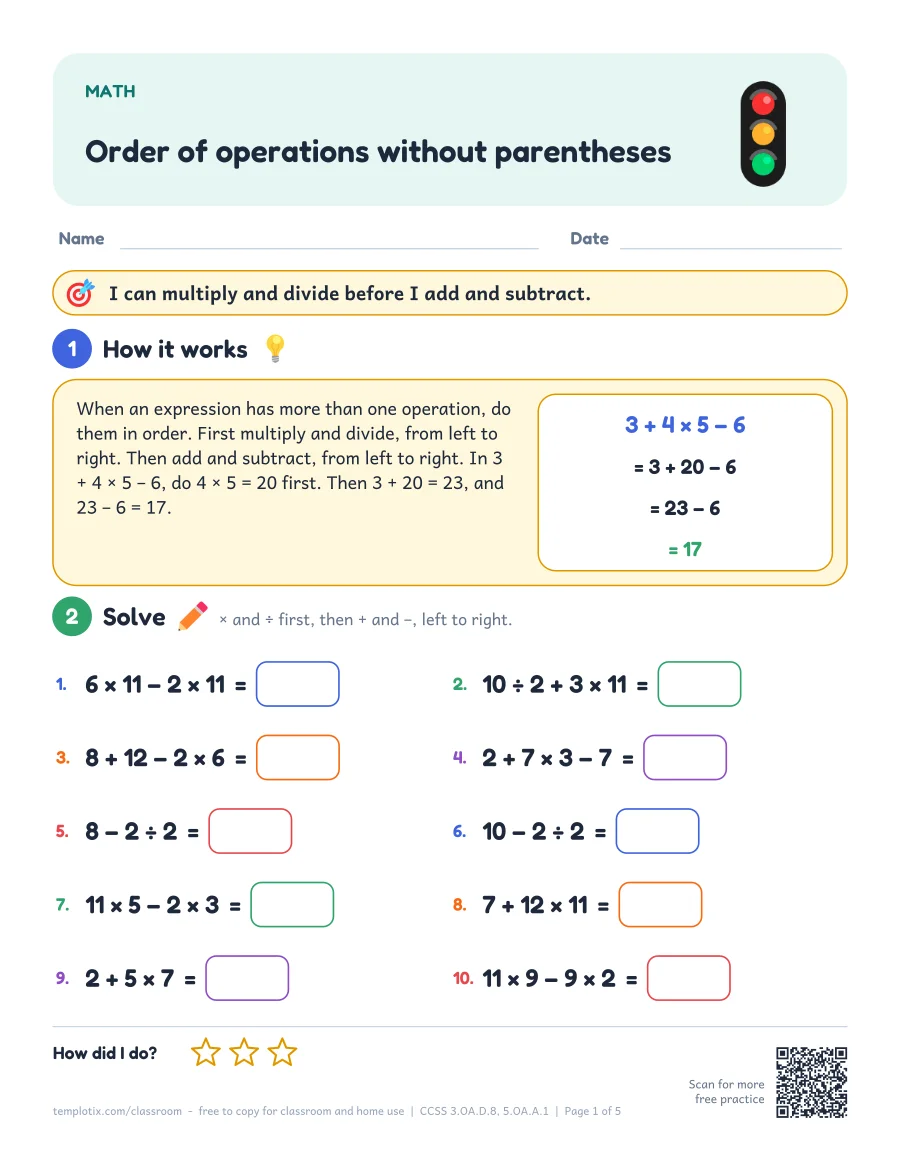
When an expression has more than one operation, do them in order. First multiply and divide, from left to right. Then add and subtract, from left to right. In 3 + 4 × 5 – 6, do 4 × 5 = 20 first. Then 3 + 20 = 23, and 23 – 6 = 17.
- Order of operations with parentheses5th grade
Parentheses ( ) mean "do this part first". Solve inside the parentheses, then multiply and divide from left to right, then add and subtract from left to right. In (6 + 4) × 3 – 5, the parentheses give 10, then 10 × 3 = 30, and 30 – 5 = 25.
- Parentheses, brackets and braces5th grade
Brackets [ ] and braces { } are bigger grouping symbols. They hold parentheses inside them, like boxes inside boxes. Always start with the innermost group and work outward. In 2 × [3 + (8 – 2)], do 8 – 2 = 6, then 3 + 6 = 9, then 2 × 9 = 18.
- Placing parentheses5th grade
Parentheses can change the answer. 2 + 3 × 4 = 14, because you multiply first. But (2 + 3) × 4 = 20, because the parentheses say add first. To make an expression equal a target, try the parentheses in different places and solve each one until it matches.
- Writing expressions5th grade
An expression is numbers and operation signs with no equal sign, like (8 + 7) × 2. To write one from words, find the numbers and the operations. Words like sum and total mean +, difference means –, product and times mean ×, and divided by means ÷. If something must be done first, put it in parentheses.
- Interpreting expressions5th grade
You can often compare expressions just by looking. 3 × (25 + 13) is three groups of 25 + 13, so it is 3 times as large as 25 + 13. (36 + 12) ÷ 2 is half as large as 36 + 12. Look at what is being multiplied or divided before you calculate anything.






Order of operations poster
 Order of operations poster
The three steps, a worked example and the PEMDAS warning on one page.
Whole unit in one PDF Plus
 Whole unit in one PDF
All order of operations packs, the unit chart and a contents page: 32 pages, ready to print. For Templotix Plus members.
What is in each pack
- 1. Learn itThe rule with a worked example, then first practice.
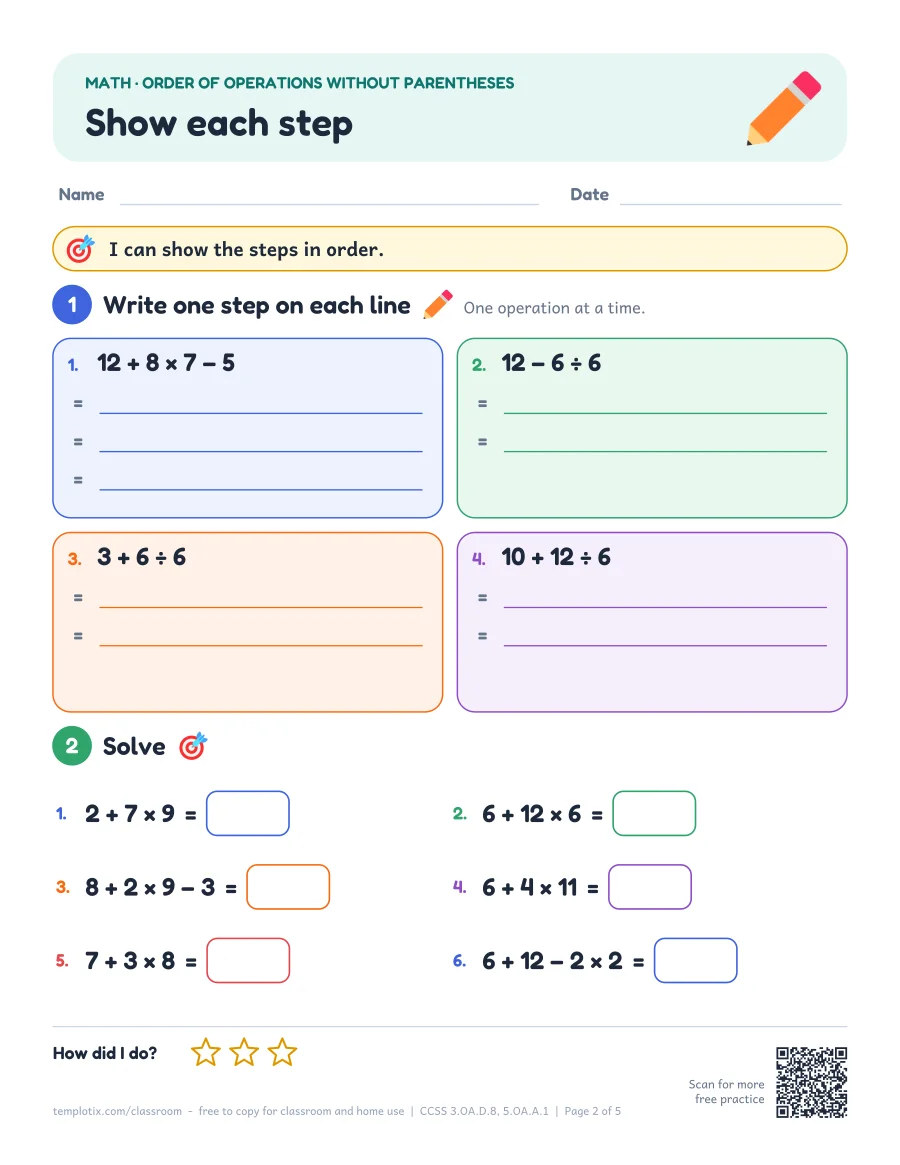
- 2. PracticeShow every step, one operation on each line.
- 3. Think deeperTrue or false, find the mistake and make a number.
- 4. Word problemsFour short stories to turn into one expression each.
- 5. Answer key and tipEvery step of the working on one page, plus a teaching tip.


How to teach order of operations
- One step per line. Ask children to rewrite the whole expression after each operation. It is slower at first, but it stops most mistakes.
- Circle the first step. Before solving, children circle the operation they will do first. Check the circles before they calculate.
- Teams, not letters. Teach × and ÷ as one team and + and – as another, always left to right, so PEMDAS does not mislead.
- Keep the poster out. Let children check the three steps on the poster until they no longer need it.
More math
- Telling time
- Money
- Fractions
- Division
- Multi-digit multiplication
- Decimals
- Greater than and less than
- Skip counting
- Shapes
- Number bonds
- Graphs and data
- Measurement
- Area and Perimeter
- Rounding and Estimating
- 3-Digit Addition and Subtraction
- Factors and Multiples
- Fraction Operations
- Decimal Operations
- Math Word Problems
- Geometry
- Measurement Conversions
- Counting
- Patterns
- Multiplication Strategies
- Multi-Digit Place Value
Common questions
What is the order of operations?
First work out anything inside grouping symbols: parentheses ( ), then brackets [ ], then braces { }. Next multiply and divide from left to right. Last, add and subtract from left to right. So 3 + 4 × 2 = 3 + 8 = 11, not 14.
What grade learns the order of operations?
Children meet the idea in 3rd grade, when they solve two-step problems (CCSS 3.OA.D.8). Using parentheses, brackets and braces and writing simple expressions are 5th grade standards (CCSS 5.OA.A.1 and 5.OA.A.2). Many 4th grade classes practice it too.
Is PEMDAS wrong?
PEMDAS is fine as a memory aid if children know one thing: multiplication and division are a team, and so are addition and subtraction. Inside each team, you go from left to right. Without that, children add before they subtract in 10 – 4 + 2 and get 4 instead of 8.
Can I copy these worksheets for my class?
Yes. The PDFs are free to print and photocopy for classroom and home use, in color or in the black-and-white ink saver. Please link to this page rather than re-uploading the files.