Shop
 Grade workbooks


Classroom · Order of Operations · 5th grade

Interpreting expressions worksheets
A free five-page pack for 5th grade: learn to compare expressions without working them out, with a worked example, practice pages, word problems and an answer key.
How to do it
 How to do it
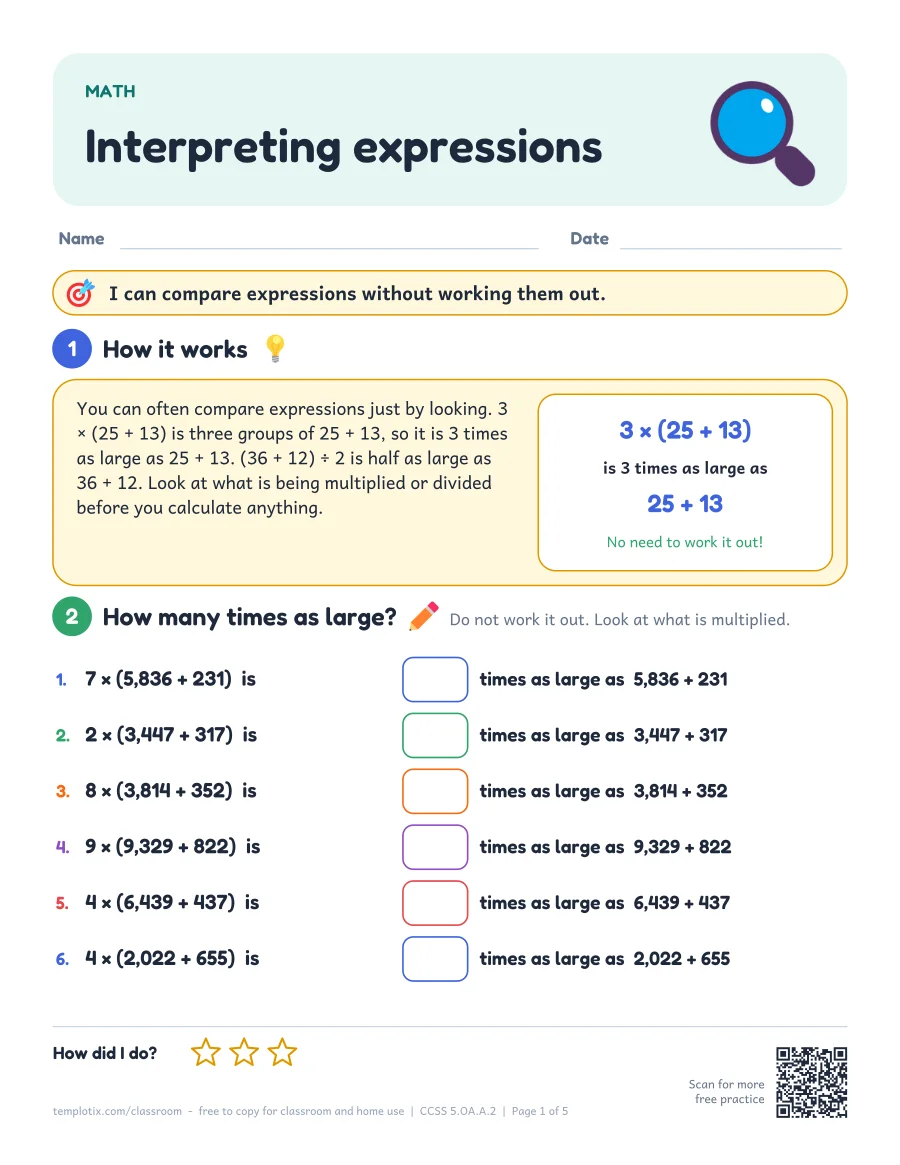
You can often compare expressions just by looking. 3 × (25 + 13) is three groups of 25 + 13, so it is 3 times as large as 25 + 13. (36 + 12) ÷ 2 is half as large as 36 + 12. Look at what is being multiplied or divided before you calculate anything.
Teaching tip
 Teaching tip
Use big, awkward numbers on purpose so children cannot easily calculate. That pushes them to reason about the structure, which is exactly what this standard asks for.
Try some
How does 7 × (5836 + 231) compare to 5836 + 231?Tap to check7 times as large
How does 2 × (3447 + 317) compare to 3447 + 317?Tap to check2 times as large
How does 8 × (3814 + 352) compare to 3814 + 352?Tap to check8 times as large
How does 9 × (9329 + 822) compare to 9329 + 822?Tap to check9 times as large
How does 4 × (6439 + 437) compare to 6439 + 437?Tap to check4 times as large
How does 4 × (2022 + 655) compare to 2022 + 655?Tap to check4 times as large
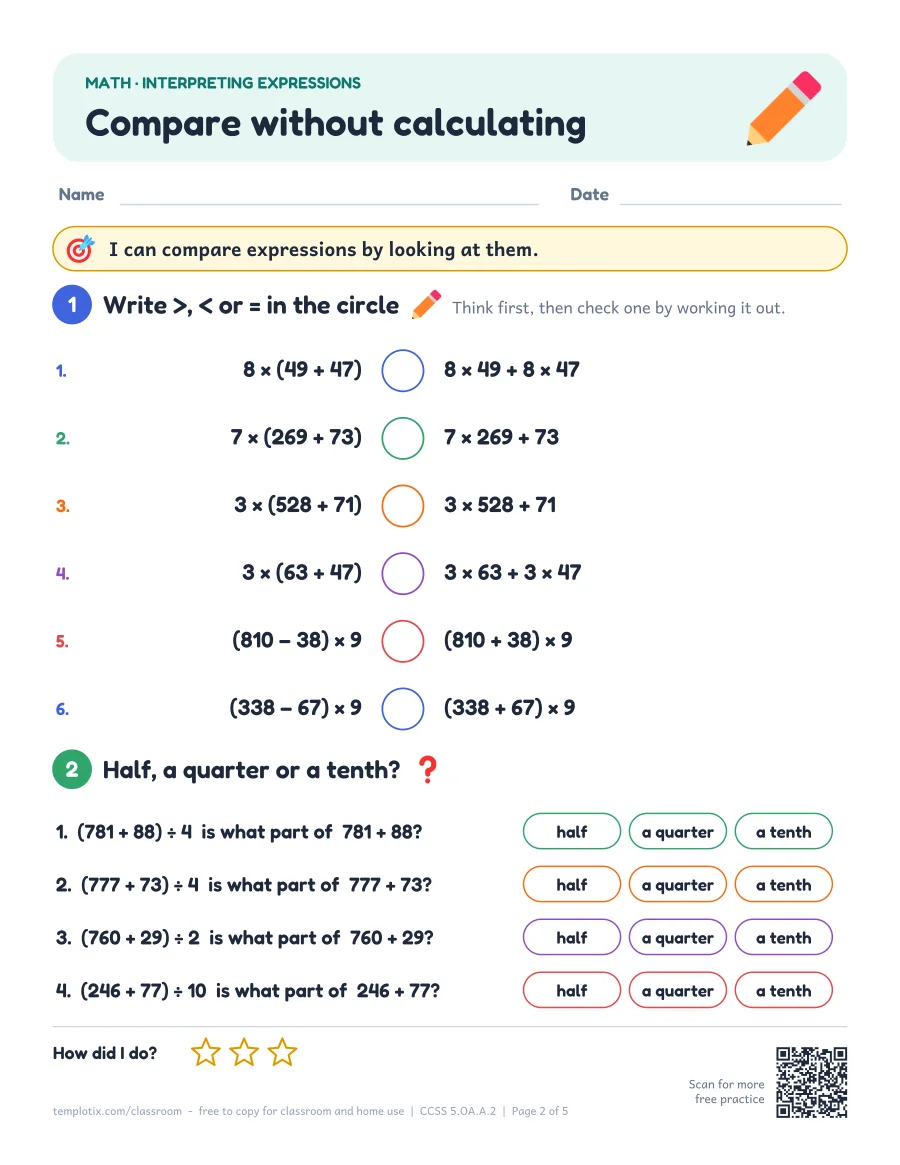
>, < or =? 8 × (49 + 47) ? 8 × 49 + 8 × 47Tap to check=
>, < or =? 7 × (269 + 73) ? 7 × 269 + 73Tap to check>
Word problems
Omar bakes 3 trays of 12 cookies and 8 more cookies. Write one expression for the total, then solve it.Show answer

3 × 12 + 8 = 44 cookies
Zara buys 4 gift packs. Each pack has a $6 book and a $3 pen. Write one expression for the total cost, then solve it.Show answer

4 × (6 + 3) = $36
Without calculating, how does 5 × (138 + 47) compare to 138 + 47?Show answer

It is 5 times as large.
Omar says 2 × 8 + 5 and 2 × (8 + 5) are the same. Is Omar right? Show why.Show answer
No. 2 × 8 + 5 = 21, but 2 × (8 + 5) = 26.
What the worksheets look like
Order of operations poster
 Order of operations poster
The three steps, a worked example and the PEMDAS warning on one page.
Common questions
How do you teach interpreting expressions?
You can often compare expressions just by looking. 3 × (25 + 13) is three groups of 25 + 13, so it is 3 times as large as 25 + 13. (36 + 12) ÷ 2 is half as large as 36 + 12. Look at what is being multiplied or divided before you calculate anything. Use big, awkward numbers on purpose so children cannot easily calculate. That pushes them to reason about the structure, which is exactly what this standard asks for.
What grade learns interpreting expressions?
Usually 5th grade. In the Common Core it is part of 5.OA.A.2.
Is there an answer key?
Yes. Page 5 has every answer from the pack and a short teaching tip.