Shop
 Grade workbooks


Classroom · Math · CCSS K.OA.A.3, K.OA.A.4, 1.OA.B.3, 1.OA.B.4, 1.OA.C.6, 1.OA.D.8
worksheets for kindergarten to 2nd grade
Split a number into two parts and put it back together. Number bonds to 5, 10 and 20 build fast adding and taking away, and fact families show how addition and subtraction fit together.
- Number bonds to 5Kindergarten
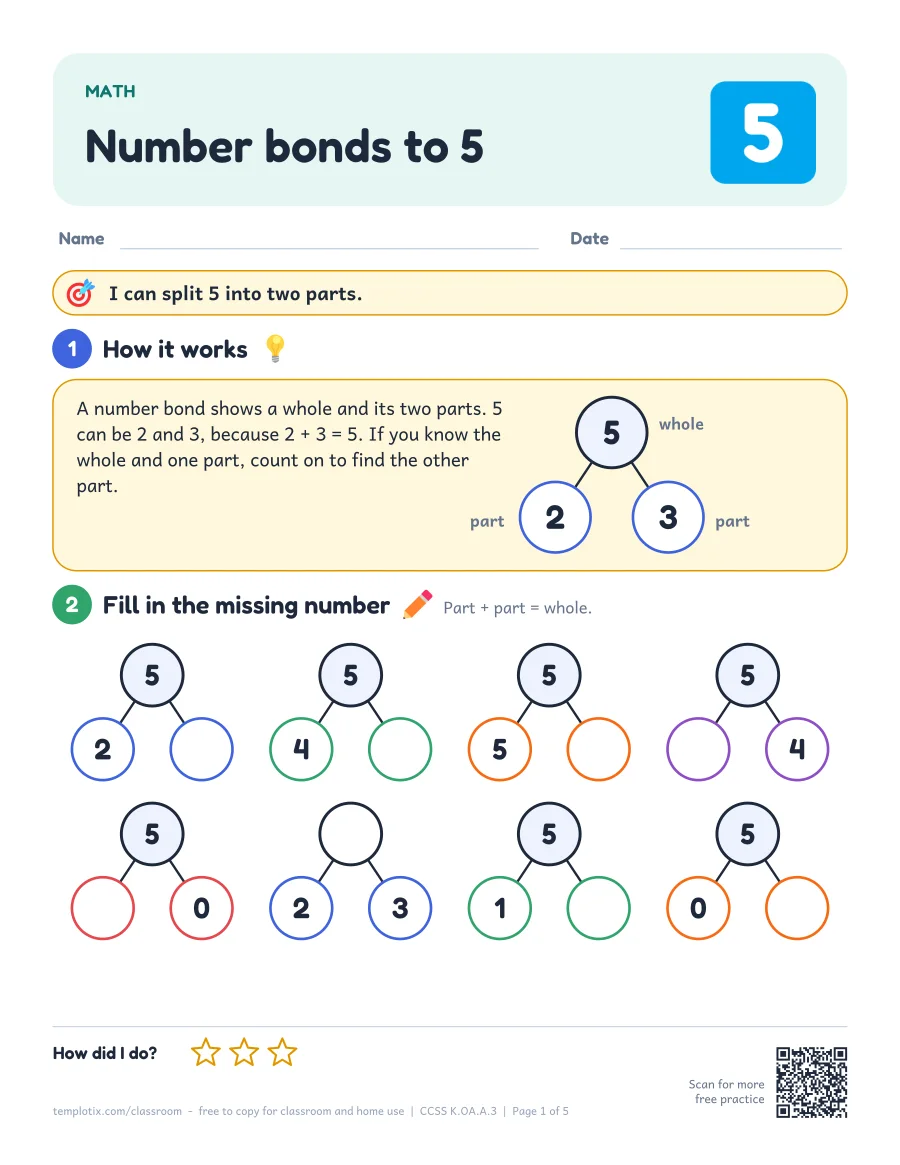
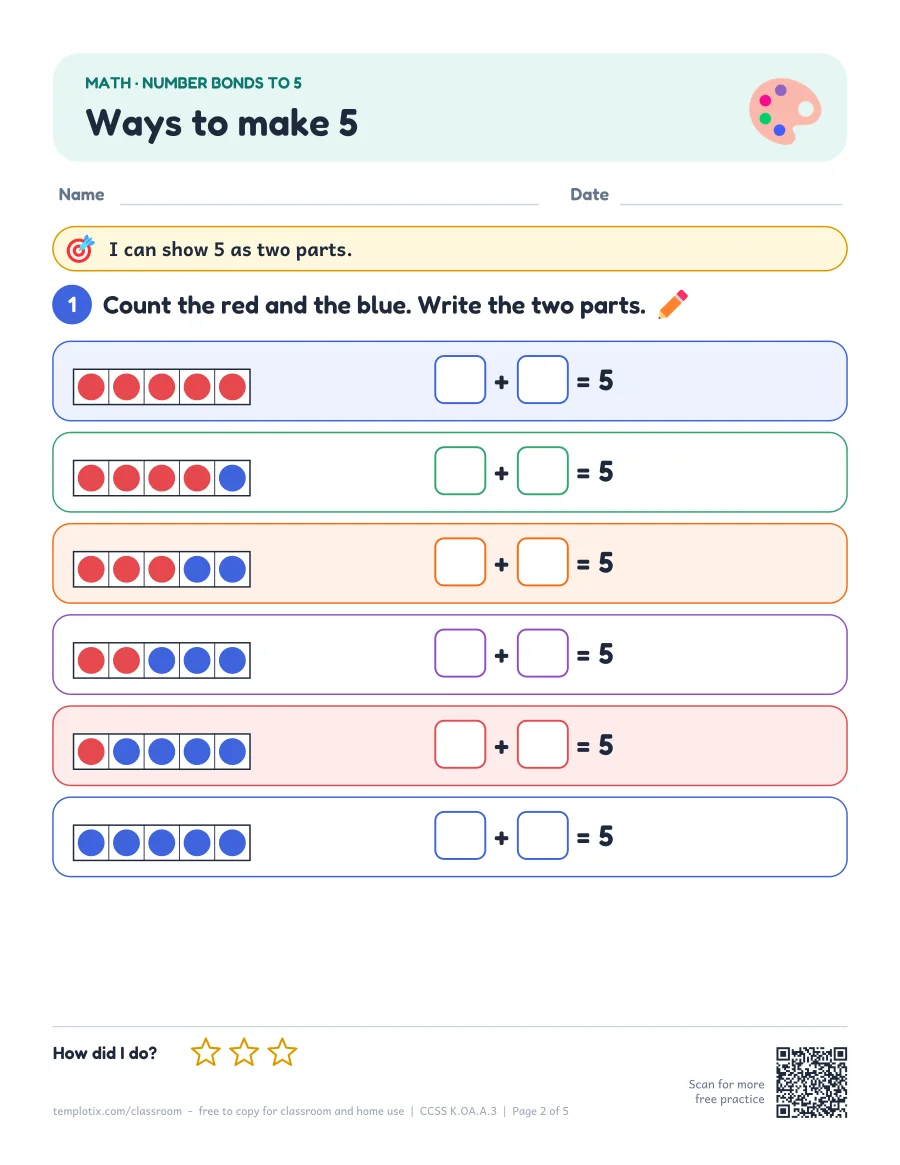
A number bond shows a whole and its two parts. 5 can be 2 and 3, because 2 + 3 = 5. If you know the whole and one part, count on to find the other part.
- Number bonds to 10Kindergarten and 1st grade
There are 11 ways to make 10, from 0 + 10 to 10 + 0. Learn the pairs: 1 and 9, 2 and 8, 3 and 7, 4 and 6, 5 and 5. A ten frame shows the missing part as the empty boxes.
- Number bonds to 201st grade
Use what you know about 10. If 3 and 7 make 10, then 13 and 7 make 20. Fill one ten frame, then look at what is missing in the second one.
- Fact families1st and 2nd grade
A fact family uses three numbers. The biggest number is the whole. Add the two parts in either order, then take each part away from the whole.




Number bond mats
 Number bond mats
Six blank bonds to use with counters, plus every bond to 10 on one page.
Whole unit in one PDF Plus
 Whole unit in one PDF
All number bonds packs, the unit chart and a contents page: 22 pages, ready to print. For Templotix Plus members.
What is in each pack
- 1. Learn itA worked number bond or fact family, then a first practice page.
- 2. Show the waysColor counters in ten frames to show the parts, or turn bonds into four facts.
- 3. Skill pageMissing numbers, pairs that make the number, and facts that do not belong.
- 4. Word problemsFour short stories with apples, ducks, stickers and cars.
- 5. Answer key and tipEvery answer on one page, plus a teaching tip for grown-ups.


How to teach number bonds
- Start with real things. Put 5 counters in a line and slide some to one side. Say it out loud: 5 is 2 and 3.
- Draw the bond. Write the whole in the top circle and the two parts below. Then cover one part and ask what is missing.
- Find every way. List all the ways to make 5 or 10 in order. Children see the pattern: one part goes up as the other goes down.
- Turn bonds into facts. Each bond gives two adding facts and two taking away facts. That is a fact family.
More math
- Telling time
- Money
- Fractions
- Division
- Multi-digit multiplication
- Decimals
- Greater than and less than
- Skip counting
- Shapes
- Graphs and data
- Measurement
- Area and Perimeter
- Rounding and Estimating
- 3-Digit Addition and Subtraction
- Factors and Multiples
- Fraction Operations
- Decimal Operations
- Math Word Problems
- Geometry
- Order of Operations
- Measurement Conversions
- Counting
- Patterns
- Multiplication Strategies
- Multi-Digit Place Value
Common questions
What is a number bond?
A number bond shows how a number (the whole) splits into two parts. For example, 10 can split into 6 and 4, because 6 + 4 = 10. It is drawn as a circle on top joined to two circles below.
When do children learn number bonds?
Kindergartners take numbers up to 10 apart in different ways and find the number that makes 10 with any number from 1 to 9. In 1st grade, children add and subtract within 20 and use fact families to find missing numbers.
What is a fact family?
A fact family is a set of facts that use the same three numbers. 3, 5 and 8 make 3 + 5 = 8, 5 + 3 = 8, 8 – 3 = 5 and 8 – 5 = 3. Knowing one fact gives you the other three.
Can I copy these worksheets for my class?
Yes. The PDFs are free to print and photocopy for classroom and home use, in color or in the black-and-white ink saver. Please link to this page rather than re-uploading the files.